Skip to content
ROR Labs — Return on Risk

ROR Labs

  • Accident TrendsExpand
    • United StatesExpand
      • FireExpand
        • Home fires
        • Building fires
        • Wildfires
      • Earthquakes
      • Transport accidentsExpand
        • Road
        • Maritime
        • Aviation
      • Financial fraud
      • DiseaseExpand
        • Infectious disease
        • Chronic disease
      • Injuries
    • CanadaExpand
      • FireExpand
        • Home fires
        • Building fires
        • Wildfires
      • Earthquakes
      • Transport accidentsExpand
        • Road
        • Maritime
        • Aviation
      • Financial fraud
      • DiseaseExpand
        • Infectious disease
        • Chronic disease
      • Injuries
    • United KingdomExpand
      • FireExpand
        • Home fires
        • Building fires
        • Wildfires
      • Earthquakes
      • Transport accidentsExpand
        • Road
        • Maritime
        • Aviation
      • Financial fraud
      • DiseaseExpand
        • Infectious disease
        • Chronic disease
      • Injuries
    • AustraliaExpand
      • FireExpand
        • Home fires
        • Building fires
        • Wildfires
      • Earthquakes
      • Transport accidentsExpand
        • Road
        • Maritime
        • Aviation
      • Financial fraud
      • DiseaseExpand
        • Infectious disease
        • Chronic disease
      • Injuries
    • JapanExpand
      • FireExpand
        • Home fires
        • Building fires
        • Wildfires
      • Earthquakes
      • Transport accidentsExpand
        • Road
        • Maritime
        • Aviation
      • Financial fraud
      • DiseaseExpand
        • Infectious disease
        • Chronic disease
      • Injuries
    • GermanyExpand
      • FireExpand
        • Home fires
        • Building fires
        • Wildfires
      • Earthquakes
      • Transport accidentsExpand
        • Road
        • Maritime
        • Aviation
      • Financial fraud
      • DiseaseExpand
        • Infectious disease
        • Chronic disease
      • Injuries
  • InterestsExpand
    • NutrientsExpand
      • Macronutrients
      • Vitamins
      • Minerals
      • Other
    • SportsExpand
      • Team SportsExpand
        • Baseball
        • Basketball
        • American Football
        • Soccer
        • Volleyball
        • Ice Hockey
        • Rugby
        • Cricket
      • Racket and ClubExpand
        • Tennis
        • Pickleball
        • Golf
        • Badminton
      • Individual and CombatExpand
        • Running
        • Cycling
        • Swimming
        • Wrestling
        • Boxing
      • Outdoor and AdventureExpand
        • Hiking
        • Climbing
        • Skiing
        • Horse Riding
        • Surfing
  • 16 Types
  • Big Five
  • Topics
  • ToolsExpand
    • All tools
    • Action guides
  • Guides
  • HealthExpand
    • Infectious Disease
    • Heart, Blood and Circulation
    • Brain and Ageing
    • Sleep and Overwork
    • Food and Allergy
    • Medical Care
  • AccidentsExpand
    • Fire and Burns
    • Home and Indoor Hazards
    • Falls and Impact
    • Road and Vehicles
    • Public Transport
    • Work and Machinery
    • Crowds and Public Space
  • CrimeExpand
    • Fraud and Scams
    • Accounts and Devices
    • Privacy and Data
    • Burglary and Personal Crime
  • ManipulationExpand
    • Interface and Persuasion
    • Relationship Manipulation
    • Social Engineering
    • Information and Belief
    • Groups and Influence
  • MoneyExpand
    • Investing and Markets
    • Retirement and Withdrawal
    • Insurance
    • Banking and Deposits
    • Debt and Credit
  • EnvironmentExpand
    • Air Quality
    • Water and Contaminants
    • Heat and Cold
    • Storms and Flooding
    • Earthquake and Wildfire
  • SocialExpand
    • Isolation and Belonging
    • Work and Livelihood
    • Family and Care
    • Bullying and Harassment
    • Youth and Digital Life
  • GeopoliticsExpand
    • Conflict and War
    • Civil Unrest and Policing
    • Travel and Borders
    • Sanctions and Economic Coercion
    • Law and Governance
  • InfrastructureExpand
    • Power and Energy
    • Water and Sanitation
    • Healthcare Systems
    • Telecom and Internet
    • Transport Networks
  • EN日本語
ROR Labs — Return on Risk
ROR Labs
Which type
are you? →
MBTI-style16 Types PersonalityBig Five
EN日本語
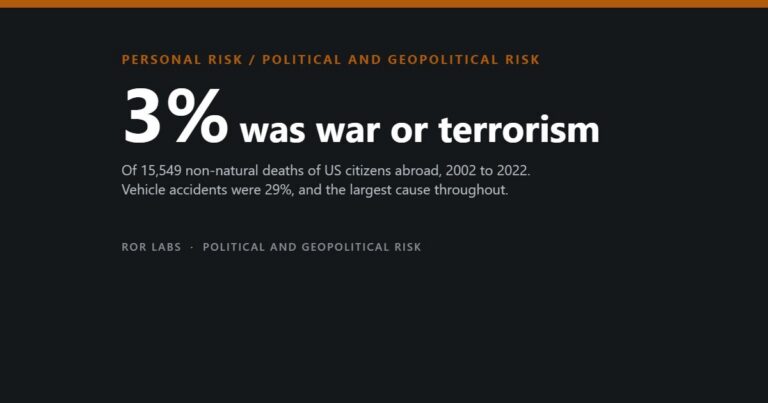
  • Dark card reading 3% was war or terrorism, with the subtitle: of 15,549 non-natural deaths of US citizens abroad, 2002 to 2022. Vehicle accidents were 29%, and the largest cause throughout.
    Political and Geopolitical Risk | Travel and Borders

    Three Per Cent of American Deaths Abroad Were War or Terrorism. And the Evacuation, If It Comes, Is a Loan.

    BySeung Hyoun Kim September 7, 2026October 2, 2026

    Two decades of consular records put war and terrorism at 3% of non-natural deaths of US citizens abroad and vehicles at 29%. What the advisory levels do not do, why the insurance excludes exactly this event, and why a government evacuation is a promissory note rather than a rescue.
    Read More Three Per Cent of American Deaths Abroad Were War or Terrorism. And the Evacuation, If It Comes, Is a Loan.Continue

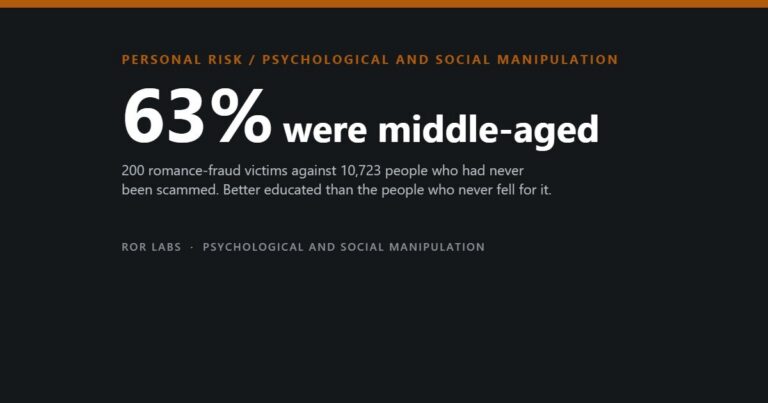
  • Dark card reading 63% were middle-aged, with the subtitle: 200 romance-fraud victims against 10,723 people who had never been scammed. Better educated than the people who never fell for it.
    Psychological and Social Manipulation | Social Engineering

    Romance Scam Victims Were Better Educated Than People Who Never Fell for One. The Newest Version Never Asks for Money.

    BySeung Hyoun Kim September 7, 2026October 4, 2026

    A comparison of 200 romance fraud victims with 10,723 people who were never scammed found victims middle-aged and better educated, with self-rated security knowledge predicting nothing. The current version of the fraud asks for an investment rather than a favour, stepping between the two standard warnings.

    Read More Romance Scam Victims Were Better Educated Than People Who Never Fell for One. The Newest Version Never Asks for Money.Continue

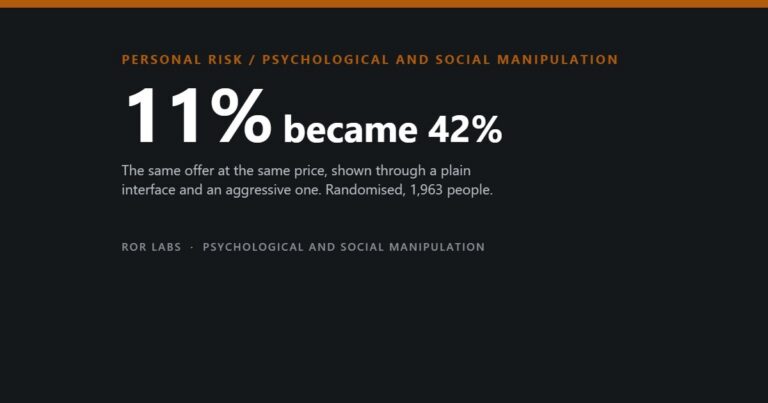
  • Dark card reading 11% became 42%, with the subtitle: the same offer at the same price, shown through a plain interface and an aggressive one. Randomised, 1,963 people.
    Interface and Persuasion | Psychological and Social Manipulation

    The Same Offer Went From 11% Acceptance to 42%. Only the Buttons Changed.

    BySeung Hyoun Kim September 7, 2026October 2, 2026

    Randomised experiments show manipulative interface design nearly quadrupling acceptance of an unchanged offer, while raising its price fourfold changed nothing. What works, what is overstated, and why enforcement rather than vigilance is what altered the interfaces.

    Read More The Same Offer Went From 11% Acceptance to 42%. Only the Buttons Changed.Continue

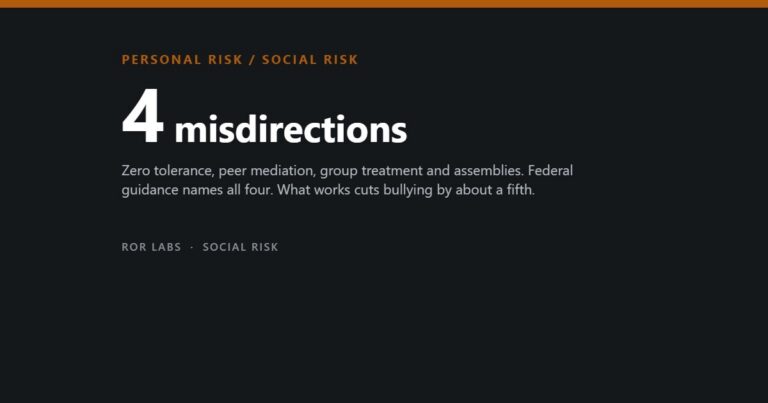
  • ROR Labs cover: four misdirections — zero tolerance, peer mediation, group treatment and assemblies.
    Bullying and Harassment | Social Risk

    The Four Things Schools Do About Bullying Are the Four the Guidance Says Not To.

    BySeung Hyoun Kim September 4, 2026October 4, 2026

    Zero tolerance, peer mediation, group treatment and assemblies are all identified as misdirections — and one of them can leave the bullied child worse. What works cuts bullying by about a fifth, and that figure needs a caveat.

    Read More The Four Things Schools Do About Bullying Are the Four the Guidance Says Not To.Continue

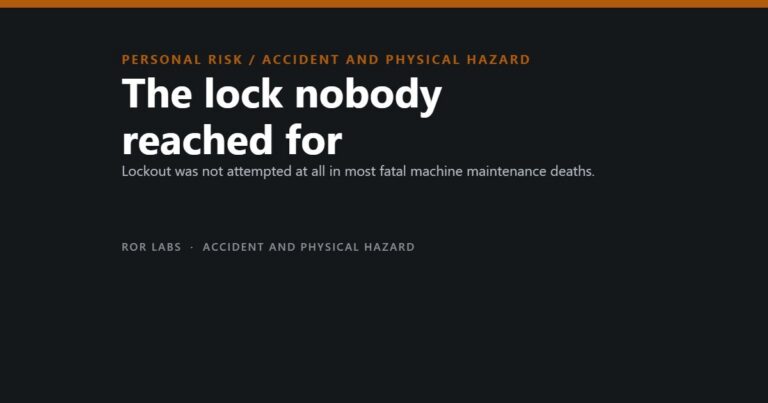
  • ROR Labs cover: The lock nobody reached for — lockout was not attempted in most fatal machine maintenance deaths.
    Accident and Physical Hazard | Work and Machinery

    Lockout Was Not Even Attempted in Most Fatal Machine Maintenance Accidents. Most of Them Were Cleaning Jobs.

    BySeung Hyoun Kim September 3, 2026October 4, 2026

    OSHA investigation records show lockout was not attempted at all in at least 59% of fatal machine maintenance incidents, and a national audit of 2,632 machines explains why: procedures were posted at 9% of them. What the evidence says about guards, locks, and the short jobs that kill.

    Read More Lockout Was Not Even Attempted in Most Fatal Machine Maintenance Accidents. Most of Them Were Cleaning Jobs.Continue

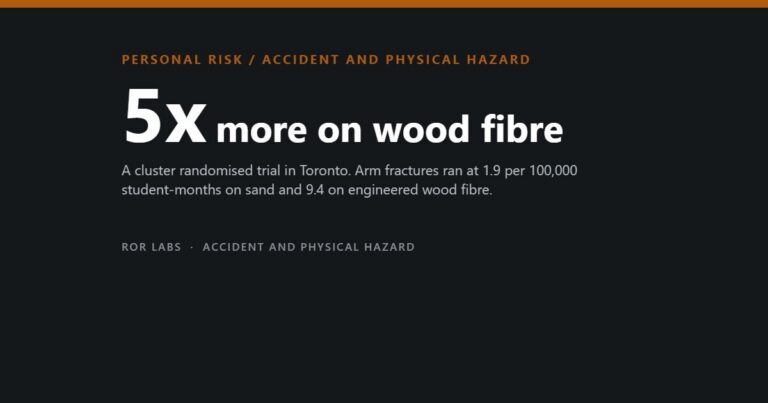
  • ROR Labs cover: 5x more on wood fibre. A cluster randomised trial in Toronto. Arm fractures ran at 1.9 per 100,000 student-months on sand and 9.4 on engineered wood fibre.
    Accident and Physical Hazard | Falls and Impact

    The Safety Surface Under the Climbing Frame Lost to Sand, Five to One, in a Randomised Trial.

    BySeung Hyoun Kim September 1, 2026October 4, 2026

    213,000 children a year, three quarters of them from falls, and mostly broken arms. The one randomised trial of playground surfacing found the certified material came off worse — and one piece of safety equipment has killed children on climbing frames.

    Read More The Safety Surface Under the Climbing Frame Lost to Sand, Five to One, in a Randomised Trial.Continue

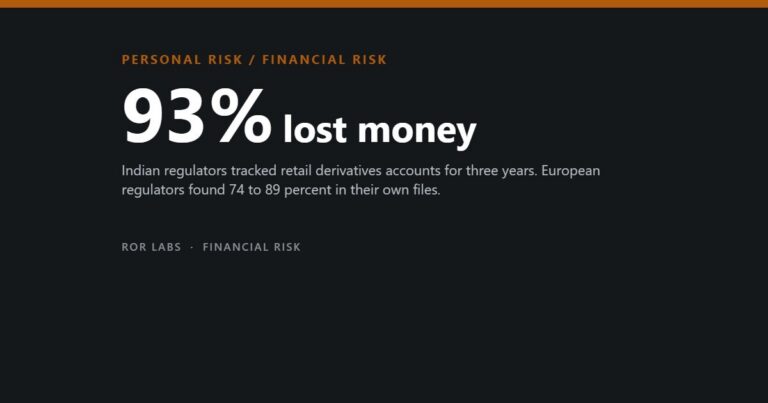
  • ROR Labs cover: 93% lost money. Indian regulators tracked retail derivatives accounts for three years. European regulators found 74 to 89 percent in their own files.
    Financial Risk | Investing and Markets

    Options and Futures: Where Retail Money Actually Goes

    BySeung Hyoun Kim August 30, 2026October 4, 2026

    European regulators found 74-89% of retail CFD accounts losing money; India found over 91% of derivatives traders losing. What the regulatory records and trade-level research show about how leverage, expiry and spreads take money from retail traders – including the study arguing the losses are overstated.

    Read More Options and Futures: Where Retail Money Actually GoesContinue

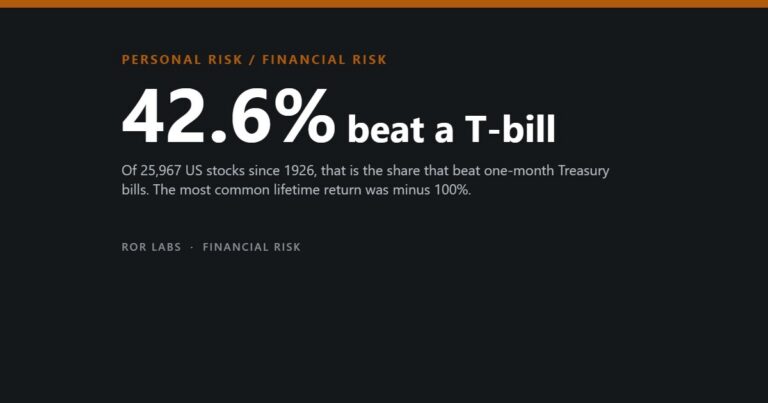
  • ROR Labs cover: 42.6% beat a T-bill. Of 25,967 US stocks since 1926, that is the share that beat one-month Treasury bills. The most common lifetime return was minus 100%.
    Financial Risk | Investing and Markets

    Why Most Stock Investors Lose Money: What the Evidence Actually Shows

    BySeung Hyoun Kim August 30, 2026October 4, 2026

    Only 42.6% of 25,967 US stocks beat Treasury bills over their lifetime, and the most common outcome was a total loss. What the research on individual investors, day traders and active funds shows about how money is actually lost in the stock market.

    Read More Why Most Stock Investors Lose Money: What the Evidence Actually ShowsContinue

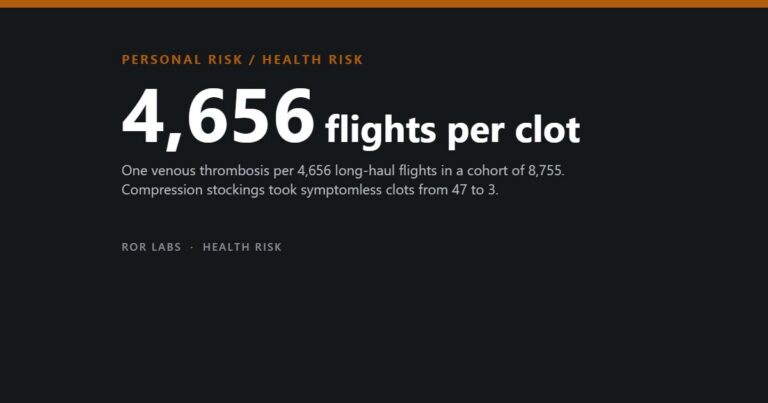
  • ROR Labs cover: 4,656 flights per clot. One venous thrombosis per 4,656 long-haul flights in a cohort of 8,755. Compression stockings took symptomless clots from 47 to 3.
    Health Risk | Heart, Blood and Circulation

    One Clot per 4,656 Long-Haul Flights. Stockings Took the Silent Ones from 47 Down to 3.

    BySeung Hyoun Kim August 29, 2026October 4, 2026

    Long flights roughly double clot risk from a small baseline, and the risk peaks two weeks after landing. Compression stockings have high-certainty Cochrane evidence behind them, with one caveat worth reading.

    Read More One Clot per 4,656 Long-Haul Flights. Stockings Took the Silent Ones from 47 Down to 3.Continue

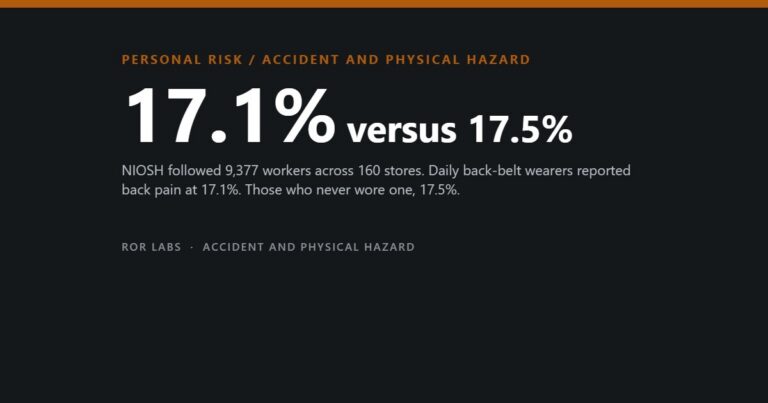
  • ROR Labs cover: 17.1% versus 17.5%. NIOSH followed 9,377 workers across 160 stores. Daily back-belt wearers reported back pain at 17.1%. Those who never wore one, 17.5%.
    Accident and Physical Hazard | Work and Machinery

    9,377 Workers, Two Years, and the Back Belt Made No Difference. Neither Did the Lifting Training.

    BySeung Hyoun Kim August 29, 2026October 4, 2026

    The largest prospective study of back belts found 17.1% back pain among daily wearers and 17.5% among those who never wore one. What the evidence supports instead is changing the task.

    Read More 9,377 Workers, Two Years, and the Back Belt Made No Difference. Neither Did the Lifting Training.Continue

Page navigation

Previous PagePrevious 1 … 16 17 18 19 20 … 22 Next PageNext
  • About
  • Contact
  • Affiliate Disclosure
  • Tools
  • Privacy Policy
  • RSS Feed
  • Terms of Service

© 2026 ROR Labs - WordPress Theme by Kadence WP

  • Topics
  • Tools
    • All tools
    • Action guides
  • Guides
  • Health
    • Infectious Disease
    • Heart, Blood and Circulation
    • Brain and Ageing
    • Sleep and Overwork
    • Food and Allergy
    • Medical Care
  • Accidents
    • Fire and Burns
    • Home and Indoor Hazards
    • Falls and Impact
    • Road and Vehicles
    • Public Transport
    • Work and Machinery
    • Crowds and Public Space
  • Crime
    • Fraud and Scams
    • Accounts and Devices
    • Privacy and Data
    • Burglary and Personal Crime
  • Manipulation
    • Interface and Persuasion
    • Relationship Manipulation
    • Social Engineering
    • Information and Belief
    • Groups and Influence
  • Money
    • Investing and Markets
    • Retirement and Withdrawal
    • Insurance
    • Banking and Deposits
    • Debt and Credit
  • Environment
    • Air Quality
    • Water and Contaminants
    • Heat and Cold
    • Storms and Flooding
    • Earthquake and Wildfire
  • Social
    • Isolation and Belonging
    • Work and Livelihood
    • Family and Care
    • Bullying and Harassment
    • Youth and Digital Life
  • Geopolitics
    • Conflict and War
    • Civil Unrest and Policing
    • Travel and Borders
    • Sanctions and Economic Coercion
    • Law and Governance
  • Infrastructure
    • Power and Energy
    • Water and Sanitation
    • Healthcare Systems
    • Telecom and Internet
    • Transport Networks
  • EN日本語
Accident trends
By countryAccident TrendsUnited States
FireEarthquakesTransportFraudDiseaseInjuries
Canada
FireEarthquakesTransportFraudDiseaseInjuries
United Kingdom
FireEarthquakesTransportFraudDiseaseInjuries
Australia
FireEarthquakesTransportFraudDiseaseInjuries
Japan
FireEarthquakesTransportFraudDiseaseInjuries
Germany
FireEarthquakesTransportFraudDiseaseInjuries
Beyond risk
Beyond riskInterestsNutrientsMacronutrientsVitaminsMineralsOtherSportsTeam Sports
BaseballBasketballAmerican FootballSoccerVolleyballIce HockeyRugbyCricket
Racket and Club
TennisPickleballGolfBadminton
Individual and Combat
RunningCyclingSwimmingWrestlingBoxing
Outdoor and Adventure
HikingClimbingSkiingHorse RidingSurfing