Open-water swimming and cold water shock, and the first minute that kills before hypothermia can
Key takeaways · 10 min read
- Cold water shock, a gasp and uncontrollable breathing that peaks within 30 seconds, and swim failure kill long before hypothermia can.
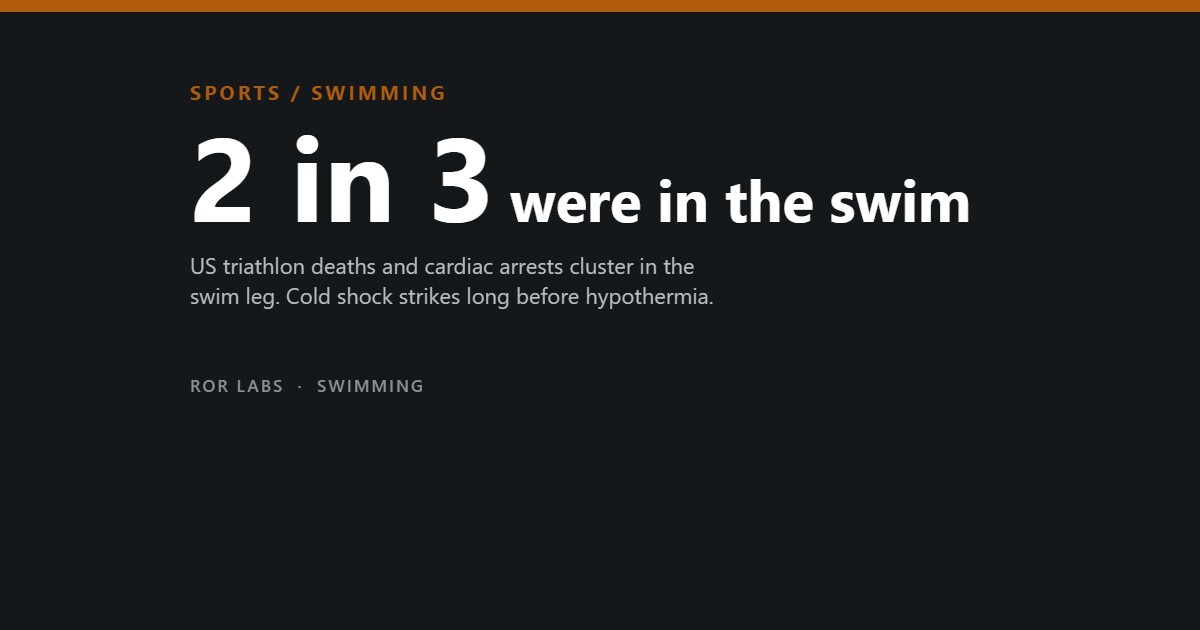
- In a US case series, 90 of 135 triathlon deaths and cardiac arrests happened in the swim; 44% of those autopsied had heart disease.
- About four repeated immersions shrink the cold shock response, but acclimatised swimmers can feel warmer than they are.
- Floating first is backed by physiology and small RNLI-funded studies; inexperienced adults floated better after seeing the advice.
On 7 April 2026 four 17-year-olds walked up to High Dam, a small tarn above Windermere. The air was about 21°C; the water was 11°C at most. They set off for an island roughly 150 metres out. One turned back, dizzy and cold. One, not a strong swimmer, was halfway across when he began splashing and calling for help, and he drowned. In August a coroner recorded misadventure and said the likely cause was cold-induced swim failure.
He was in the water for minutes, far too briefly for hypothermia. In a 1969 experiment, two thin men who called themselves good swimmers floundered after 1.5 and 7.6 minutes in water at 4.7°C, breathing 56 to 60 times a minute, before their core temperature had fallen. Organised swimming shows a related pattern: in a US case series, 90 of 135 triathlon deaths and cardiac arrests happened in the swim.
This article covers what cold water does to breathing and the heart, why swimmers fail before they freeze, where deaths concentrate, and what has been measured to help. The conclusion is not to stay out of the water. It is to swim carefully, and to respect the first minute.
What cold water does in the first minutes
Sudden immersion in cold water sets off the cold shock response. It begins with an involuntary gasp of about 2.5 litres, followed by hyperventilation that makes holding the breath almost impossible, while heart rate and blood pressure surge. In a 2014 review Mike Tipton and Carl Bradford wrote that the response peaks within the first 30 seconds and adapts over about two minutes. It is strongest between 10°C and 15°C.
Hyperventilation blows off carbon dioxide, which narrows the arteries to the brain. In one flume study, blood-flow velocity in a main brain artery fell by about 20% after sudden immersion at 10°C, and the response was just as severe in 15 skilled swimmers as in 17 less skilled ones. A gasp taken underwater can fill the lungs.
If the first minutes pass, the arms are next. Muscle loses force below about 27°C, and maximum power falls by roughly 3% for each degree of muscle cooling. Strokes shorten and the body sinks lower. This is swim failure, and it can arrive well before the core cools. A 2026 review co-authored by Tipton concluded that in most cold-water drowning deaths, hypothermia develops only after water has been inhaled.
Swimming for 90 minutes at three water temperatures
Ten volunteers swam breaststroke in a flume for up to 90 minutes at each temperature. Swim failure meant being unable to keep the feet off the bottom.
Source: Tipton et al., The Lancet (1999). Swimmers withdrawn at 10°C had a rectal temperature of 35°C, the threshold of mild hypothermia.
Where the risk concentrates
A US case series covering 1985 to 2016 found 135 sudden deaths, resuscitated cardiac arrests and trauma deaths in triathlons; 85% of the victims were men, with an average age of 46.7. Of the non-trauma cases, 90 happened during the swim, compared with 15 on the run and seven on the bike. Of the 61 people who had an autopsy, 27 had clinically relevant heart disease, most often coronary artery disease or cardiomyopathy.
When triathlon deaths and cardiac arrests happened
Cases in US triathlons from 1985 to 2016, by race segment. Counts; the bike figure excludes 15 deaths from crashes.
Source: Harris et al., Annals of Internal Medicine 167:529 (2017). Case identification may be incomplete, especially in the early years.
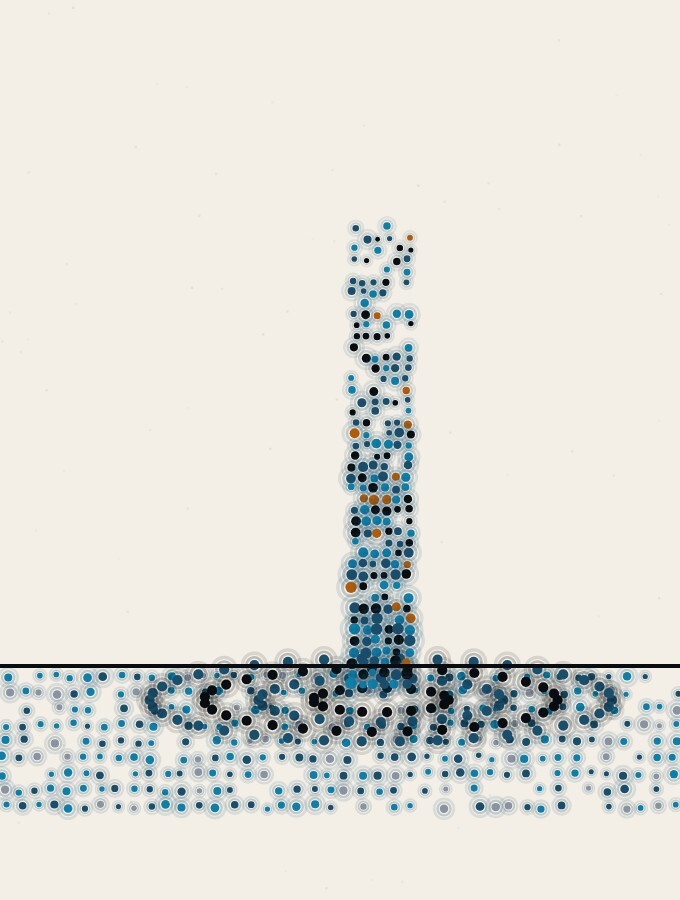
Tipton and the cardiac physiologist Michael Shattock proposed in 2012 why the swim is so dangerous. Cold on the skin drives the heart faster through the sympathetic nervous system, while cold water on the face and holding the breath slow it through the vagus nerve. When both fire at once, which they call autonomic conflict, the heart may be pushed into abnormal rhythms. In a 1994 experiment, 11 of 12 healthy men had ectopic beats after breath-hold submersions in cold water, in 29 of 36 trials, mostly in the seconds after they released the breath.
Mass starts add the other triggers: crowding, water in the nose, breath-holding, anxiety and anger. Tipton and Bradford noted that most general incidents in open-water events happen in the first 400 metres. Even in wetsuits the water still takes its toll: in a full-distance triathlon at about 15°C to 16°C, one of 51 swimmers who swallowed temperature capsules became hypothermic, a lean athlete with a long swim time.
Rate of death or cardiac arrest in US triathlons
Cases per 100,000 participants in races sanctioned by USA Triathlon, 2006 to 2016, among 4,776,443 participants.
Source: Harris et al., Annals of Internal Medicine (2017). Pre-race medical history was unknown in most cases.
The cardiac story is persuasive, but it is not proven. A systematic review of 17 studies on swimming-related death called the evidence inconsistent and of limited quality, although arrhythmia looked the likeliest cause. Fatal arrhythmias leave no trace at autopsy. In a healthy rabbit heart, stimulating both nervous inputs together did not trigger dangerous ventricular rhythms, which suggests autonomic conflict kills only when the heart is already vulnerable. The 44% autopsy figure points the same way.
Outside events, the official counts are broad. The UK recorded 193 accidental water-related deaths in 2024, 84% of them male and 61% inland, and 33 reports mentioned alcohol or drugs. Heather Massey and colleagues reported 22 deaths while outdoor swimming that year. Australia counted 357 drowning deaths in 2024–25, 27% above its ten-year average; swimming and recreating accounted for 24%. The US CDC says alcohol is involved in up to 70% of deaths during water recreation among adolescents and adults.
What has been measured to work
The cold shock response can be trained down. A 2023 meta-analysis of 17 groups found that repeated immersions reduced every part of it, usually after about four: the rise in heart rate fell by 14 beats a minute, breathing rate by eight breaths a minute and ventilation by 21.3 litres a minute. Laboratory protocols typically used five to seven head-out immersions of two to seven minutes in 10°C to 15°C water. In one study, six cold showers cut breathing rate during a later immersion by 21% in two of three shower regimes.
Habituation has a catch. Tipton and Bradford warned that acclimatised swimmers feel less cold than they are, so comfort is no guide to core temperature. So keep cold swims short and rewarm promptly. Clothing blunted the reflex in early laboratory tests, and a wetsuit also slows cooling and its buoyancy keeps the airway higher. Neither makes cold water safe, as the hypothermic triathlete in a wetsuit showed.
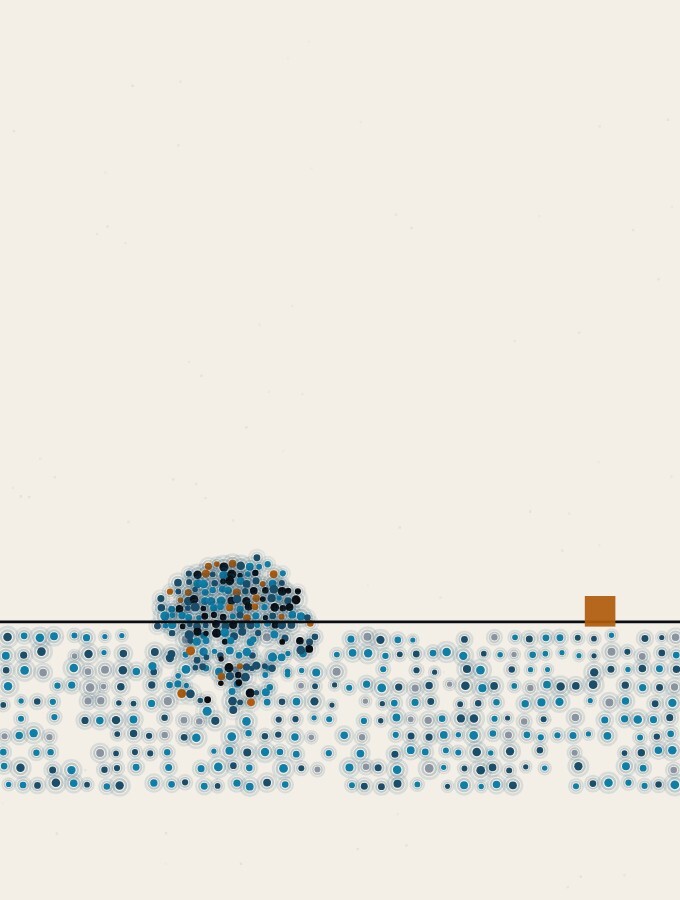
For people who fall in, the best-known advice is the RNLI’s Float to Live, promoted since 2017: tilt the head back, relax, scull gently and wait for the breathing to settle before trying to swim or shout. The charity says the advice has helped save more than 50 people, though it does not publish how that figure was counted. The case for floating first is physiological: swimming at the peak of cold shock raises the risk of inhaling water.
Its authors admit that the original research was done in indoor pools with confident swimmers. So in 2022 an RNLI-funded team asked 25 inexperienced adults to float in lakes and the sea; only 32% felt confident beforehand. After the campaign video, competence on a ten-point floating scale rose from 5.0 to 6.3, and 6.9 after coaching. The study had no control group outdoors, the water was relatively mild at about 23°C, and the researchers’ own laboratory work underpins the advice.
Float to Live with inexperienced adults
Share of participants in open fresh water (21 or 22 per float) reporting that their breathing did not interfere at all with floating, before and after the RNLI messaging and coaching.
Source: Eglin et al., BMC Public Health (2024), funded by the RNLI. No outdoor control group; water at about 23°C.
For events, Tipton and Bradford recommend smaller waves, wide starts, long straight first legs, gaps between waves, weaker swimmers starting at the back and extra safety cover over the first 400 metres. They say plainly that the evidence for these measures is weak and largely hypothetical. Harris and colleagues suggested screening middle-aged and older men for heart disease before racing; whether that prevents deaths has not been shown.
Why the answer is not to stop swimming

Outdoor swimming is booming. Massey, Clare Eglin and Tipton note a 138% rise since 2016 in people in the UK who swim in open water at least twice a month. A 2026 meta-analysis of 13 studies and 4,105 adults found results that generally favoured cold water for depressive symptoms, stress and mood, but with wide uncertainty that shrank when only controlled studies were counted. Immunity claims rest on thinner evidence.
The risks are manageable. Get in slowly, never dive or jump into cold water, and keep the face out until the breathing settles; the RNLI says the initial effects pass in less than a minute. Stay within easy reach of the shore, swim with a friend, wear a bright hat and a tow float, which makes you visible and gives you something to hold, and skip alcohol. Build up gradually through the autumn and get out early.
The “1-10-1” rule taught by the Canadian physiologist Gordon Giesbrecht is a useful memory aid: one minute to control the breathing, about ten minutes of useful movement, and around an hour before hypothermia brings unconsciousness. It came from his Cold Water Boot Camp demonstrations rather than a trial, and the numbers are rounded. The first one is the one to learn. As our article on swimming injuries and lessons shows, the skills that keep people safe in water can be taught.
Cold-water thresholds used by swimming bodies
Water temperatures in °C at which guidance changes. Most rules date from concern about hypothermia and rest on limited evidence.
Sources: RNLI, Float to Live; British Triathlon guidance as quoted in Tipton and Bradford, Extreme Physiology & Medicine (2014); USA Triathlon thresholds as summarised by US Masters Swimming (2023).
See a doctor before cold-water swimming if you have heart disease, high blood pressure, a family history of sudden death or an inherited rhythm disorder, or if you have ever fainted during exercise, and stop if you feel chest pain or palpitations in the water. Older men new to triathlon should check their heart first and practise open-water starts.
What to do
Steps sorted by when they matter. Each one says how strong the evidence is: Measured Official advice Untested
Before
- See a doctor first if you have heart disease, high blood pressure, a family history of sudden death or have fainted during exercise. 27 of 61 autopsied triathlon victims had heart disease. Measured see Sources
- Build up gradually with short, repeated dips. About four immersions shrank the cold shock response in pooled laboratory studies. Measured see Sources
- Swim with a friend, stay within easy reach of the shore, and wear a bright hat and a tow float. Official advice see Sources
If it happens
- Get in slowly and keep your face out until your breathing settles. Cold shock peaks within about 30 seconds. Measured see Sources
- Keep cold swims short and get out early. Acclimatised swimmers can feel warmer than they are. Official advice see Sources
- Stop if you feel chest pain or palpitations in the water. Official advice see Sources
Afterwards
- Rewarm promptly after a cold swim. Official advice see Sources
What not to do
- Do not dive or jump into cold water. The gasp reflex can draw water into the lungs. Official advice see Sources
- Do not drink before swimming. The CDC says alcohol is involved in up to 70% of deaths during water recreation among adolescents and adults. Measured see Sources
Not medical advice. If someone collapses in or after cold water, call emergency services at once: CPR with rescue breaths and an AED save lives.
Questions people ask
What is cold water shock?
A reflex to sudden immersion: a gasp, rapid uncontrollable breathing and a surge in heart rate and blood pressure. It peaks within about 30 seconds and settles over a minute or two.
Is hypothermia the main danger in cold water?
Not in the first minutes. Cold shock and swim failure are thought to cause most early deaths, through inhaled water or heart rhythm problems. Hypothermia takes far longer; the 1-10-1 rule of thumb puts it at around an hour.
How many swims does it take to get used to cold water?
Laboratory studies found the cold shock response shrinking after about four to seven short immersions. Habituation reduces the gasp and rapid breathing but does not stop the body cooling, and feeling comfortable is not a reliable guide.
Why do most triathlon deaths happen in the swim?
The likeliest explanation is a heart rhythm problem, often in someone with undiagnosed heart disease, set off by cold water, crowding, breath-holding and stress at the start. It has not been proven.
Should I float or swim if I fall into cold water?
Float first, with your head back, until your breathing is under control, then swim to safety or call for help. The advice rests on physiology and small studies.
The short version
- Cold water shock, a gasp and uncontrollable breathing that peaks within 30 seconds, and swim failure kill long before hypothermia can.
- In a US case series, 90 of 135 triathlon deaths and cardiac arrests happened in the swim; 44% of those autopsied had heart disease.
- About four repeated immersions shrink the cold shock response, but acclimatised swimmers can feel warmer than they are.
- Floating first is backed by physiology and small RNLI-funded studies; inexperienced adults floated better after seeing the advice.
- Keep swimming: enter slowly, swim with others and a tow float, skip alcohol, and see a doctor first if your heart is in question.
This is a summary of published research and official data, not medical advice. If you have heart disease, high blood pressure, a history of fainting or palpitations, or a family history of sudden death, talk to your doctor before swimming in cold water. If someone collapses in or after cold water, call the emergency services; CPR and an AED save lives, and rescue breaths matter for drowning.
Further reading: Tipton and Bradford, Extreme Physiology & Medicine (2014), for the physiology of open-water swimming. Harris et al., Annals of Internal Medicine (2017), for deaths in US triathlons. Eglin et al., BMC Public Health (2024), for Float to Live tested in open water.
- Wintering, Katherine May (2020). A memoir about hard seasons of life, with winter sea swimming as one of its threads. For the why of cold water rather than the physiology.
- The Comfort Crisis, Michael Easter (2021). A journalist argues that modern life is too comfortable and tests discomfort, cold included. Lively, though some claims run ahead of the evidence.
- Exercised, Daniel E. Lieberman (2021). A Harvard evolutionary biologist tests common beliefs about exercise against evidence. Useful for weighing claims about any sport.
Sources
- BBC News (BBC Cumbria), Swim death teen suffered cold water shock, 19 August 2026, republished by AOL; ITV Border, Family of drowned teenager working with national park to promote water safety, 20 August 2026.
- Keatinge WR, Prys-Roberts C, Cooper KE, Honour AJ, Haight J. Sudden failure of swimming in cold water. British Medical Journal 1(5642):480 (1969).
- Harris KM, Creswell LL, Haas TS, et al. Death and cardiac arrest in U.S. triathlon participants, 1985 to 2016: a case series. Annals of Internal Medicine 167:529–535 (2017), doi:10.7326/M17-0847, PMID 28975231.
- Tipton M, Bradford C. Moving in extreme environments: open water swimming in cold and warm water. Extreme Physiology & Medicine (2014), doi:10.1186/2046-7648-3-12.
- Eglin C, Massey H, Long G, Mayhew A, Tipton M. Inexperienced water users can “Float to Live” in realistic open water conditions. BMC Public Health (2024), doi:10.1186/s12889-024-19409-6. Funded by the RNLI.
- Button C, Croft JL, Cotter JD, Graham MJ, Lucas SJE. Integrative physiological and behavioural responses to sudden cold-water immersion are similar in skilled and less-skilled swimmers. Physiology & Behavior (2014), doi:10.1016/j.physbeh.2014.10.024.
- Leuci L, Melau J, Messina A, Tipton M, Carenzo L. Beyond hypothermia: mechanisms of death, rescue, and prevention in cold water immersion – a narrative review. Journal of Applied Physiology (2026), doi:10.1152/japplphysiol.00578.2026.
- Tipton M, Eglin C, Gennser M, Golden F. Immersion deaths and deterioration in swimming performance in cold water. The Lancet (1999), doi:10.1016/S0140-6736(99)07273-6.
- Shattock MJ, Tipton MJ. ‘Autonomic conflict’: a different way to die during cold water immersion? Journal of Physiology (2012), doi:10.1113/jphysiol.2012.229864.
- Tipton MJ, Kelleher PC, Golden FS. Supraventricular arrhythmias following breath-hold submersions in cold water (1994), PMID 7950804.
- Høiseth LØ, Melau J, Bonnevie-Svendsen M, et al. Core temperature during cold-water triathlon swimming. Sports 9(6):87 (2021).
- Asplund CA, Creswell LL. Hypothesised mechanisms of swimming-related death: a systematic review. British Journal of Sports Medicine (2016), doi:10.1136/bjsports-2015-094722.
- Winter J, Tipton MJ, Shattock MJ. Concomitant vagal and adrenergic stimulation does not precipitate ventricular arrhythmias in a healthy rabbit heart model of autonomic conflict. Extreme Physiology & Medicine (2015), conference abstract, doi:10.1186/2046-7648-4-S1-A39.
- National Water Safety Forum. WAID UK 2024 summary (May 2025); RoSPA, Public urged to respect the water as 2024 accidental water-related fatality data released, 15 July 2025.
- Massey H, Eglin C, Tipton M. Making waves in cold-water immersion/swimming research: towards a balanced assessment of therapeutic efficacy and water safety. Lifestyle Medicine (2025), doi:10.1002/lim2.70046.
- Royal Life Saving Society – Australia. National Drowning Report 2025; press release, 26 August 2025.
- Centers for Disease Control and Prevention. Risk factors for drowning (accessed October 2026).
- Barwood MJ, Eglin C, Hills SP, Johnston N, Massey H, McMorris T, et al. Habituation of the cold shock response: a systematic review and meta-analysis. Journal of Thermal Biology (2023).
- Yurkevicius BR, Alba BK, Seeley AD, Castellani JW. Human cold habituation: physiology, timeline, and modifiers. Temperature (2021), doi:10.1080/23328940.2021.1903145.
- Keatinge WR, Evans M. The respiratory and cardiovascular response to immersion in cold and warm water. Quarterly Journal of Experimental Physiology (1961), doi:10.1113/expphysiol.1961.sp001519.
- Eglin CM, Tipton MJ. Repeated cold showers as a method of habituating humans to the initial responses to cold water immersion. European Journal of Applied Physiology (2004), doi:10.1007/s00421-004-1239-6.
- Royal National Lifeboat Institution. Float to Live, rnli.org/safety/float (accessed October 2026); RNLI in Wales launches Float to Live campaign, press release, 20 May 2025.
- Schepanski SN, Batta F, Schröter M, et al. Cold-water exposure and psychological outcomes in adults: a systematic review and meta-analysis. Frontiers in Physiology (2026), doi:10.3389/fphys.2026.1926423.
- Wang C. Professor Popsicle’s physiological proof. McGill University Office for Science and Society, 17 February 2023.
- Howley EK. At what water temperature do I need a wetsuit? US Masters Swimming, 2 May 2023.