Thiamin: Food Sources, Beriberi, and Why There Is No Upper Limit
In This Series: Nutrients
- Which Nutrients Are You Actually Short Of?
- How Nutrients Are Classified — and What the Reference Numbers Mean
- Vitamin A: Food Sources, Deficiency, and Safe Limits
- Vitamin C: Food Sources, Scurvy, and the Ceiling the Body Sets
- Vitamin D: Food Sources, Sunlight, and What the Trials Found
- Vitamin D2 vs D3: What the Head-to-Head Trials Found
- Riboflavin: Food Sources, Deficiency, and the Migraine Trials
- Calcium: Food Sources, Bone Density, and What the Trials Found
Key takeaways · 10 min read
- Thiamin diphosphate is a cofactor for five enzymes in energy metabolism. The body holds about 25 to 30 mg in total.
- Per tablespoon: yeast extract 3.51 mg, rice bran 0.41, wheat germ 0.28. The top of the list is what milling removes.
- Beriberi became a public health problem in the nineteenth century as steam-powered rice mills spread. The vitamin was found in the discarded polishings.
- Enrichment closed the gap: enriched white rice 0.163 mg per 100 g against brown at 0.178. About half of US dietary thiamin now comes from fortified foods.
Beriberi is the one deficiency disease with a clear industrial cause. It had been described sporadically for centuries, and then in the nineteenth century it became a public health emergency across East and Southeast Asia — following, closely, the spread of the steam-powered rice mill.
The mill did one thing well: it stripped the bran and germ off the grain, which made white rice cheap, storable and popular. Thiamin lives in the part that was stripped. The vitamin was eventually found in the discarded polishings, and its first name, aneurine, meant the anti-neuritic factor.
This is the fourth entry in this appendix: what the nutrient does, which foods carry it per measured spoonful, what running short does, and what the reference numbers are. Thiamin is the one where the food table and the history say the same thing.
What it does
An adult body holds roughly 25 to 30 milligrams of thiamin, and about 80 per cent of it is present as thiamin diphosphate — the metabolically active form, also called thiamin pyrophosphate. That coenzyme is an essential cofactor for five enzymes in glucose, amino acid and lipid metabolism.
The short version is that thiamin is how cells get energy out of carbohydrate. Which is why the tissues that complain first are the ones with the highest and least interruptible energy demand: nerve and heart muscle. It also explains why the body holds so little of it. Twenty-five to thirty milligrams is a working supply, not a reserve, and there is no fat-soluble store to draw down — which is why the interval between stopping the supply and showing symptoms is measured in weeks rather than the months or years that vitamin A or D allow.
The three foods that carry the most per spoonful
Ranked by what fits on a level tablespoon, using USDA composition values, the list reads like an inventory of milling waste.
Thiamin per level tablespoon
USDA SR Legacy values per 100 g, converted at 15 g. Share is of the 1.2 mg adult male RDA.
| Food (USDA FDC ID) | Per 100 g | Per tablespoon | Share of RDA |
|---|---|---|---|
| Yeast extract spread (167717) | 23.4 mg | 3.51 mg | 292% |
| Rice bran, crude (169713) | 2.75 mg | 0.41 mg | 34% |
| Wheat germ, crude (168892) | 1.88 mg | 0.28 mg | 24% |
| Sunflower seed kernels, dried (170562) | 1.48 mg | 0.22 mg | 19% |
| Wheat bran, crude (169722) | 0.523 mg | 0.078 mg | 7% |
| Pork loin chop, boneless (168251) | 0.693 mg | 0.104 mg | 9% |
| Black beans, boiled (173735) | 0.244 mg | 0.037 mg | 3% |
Source: USDA FoodData Central, SR Legacy. Tablespoon figures are conversions at 15 g.
Rice bran and wheat germ are second and third, and they are not foods in the ordinary sense. They are the fractions that milling removes. The first entry is a yeast spread that most of the world does not eat, and after that the list drops to ordinary portions of pork and beans that do the actual work by volume.
So the spoon points straight at the history. The nutrient sits in the part of the grain that industrial processing was designed to take off.
Where it actually comes from now
Per plate the picture is entirely different, and entirely modern. The most common sources of thiamin in the US diet are cereals and bread, with pork the other major contributor. About half of it comes from foods that contain thiamin naturally; the other half comes from foods it was added to.
Thiamin per serving, as people actually eat it
NIH Office of Dietary Supplements, milligrams per stated serving. Full bar = 1.2 mg, the adult male RDA.
Source: NIH Office of Dietary Supplements, selected food sources of thiamin.
The single largest entry on that list is not a food at all. It is a fortification decision, taken once, at industrial scale, that now supplies a day’s requirement in one bowl. Nothing else on the list comes close, and the slice of wholemeal bread — the option that sounds most like the unprocessed answer — is at the bottom.
The disease the mill made
Beriberi has been recognised sporadically for something like 1,300 years. It became a major public health problem in the Far East in the nineteenth century, with the introduction of the steam-powered rice mill and the wider consumption of highly milled rice that followed. The protective factor was then found in the polishings that had been thrown away.
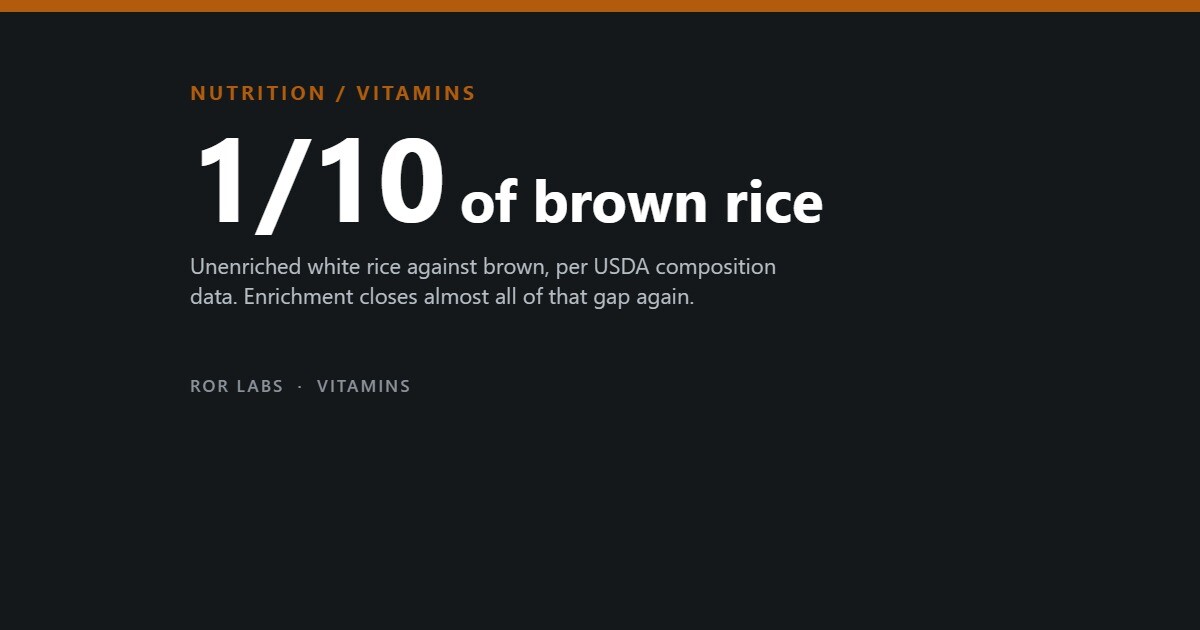
The scale of the loss is measurable today. Unless white rice is enriched, it holds about one-tenth the thiamin of unenriched brown rice.
What milling removes, and what enrichment puts back
USDA SR Legacy, thiamin per 100 g of cooked rice.
Source: USDA FoodData Central, SR Legacy. Milligrams per 100 g. Full bar = 0.212 mg.
That is the second half of the story and it rarely gets told. Enriched white rice carries 0.163 mg per 100 g against brown rice at 0.178 — effectively the same. Parboiled enriched rice carries more than brown does. The same industry that created the deficiency closed it again by putting the vitamin back after milling, and in the United States about half of dietary thiamin now comes from foods it was added to.
Bread does not fully escape either: heating costs thiamin, and bread holds 20 to 30 per cent less than its raw ingredients.
What running short does
The classic presentation is beriberi, characterised mainly by peripheral neuropathy and wasting, with impaired sensory, motor and reflex function. In severe cases it produces congestive heart failure, oedema of the lower limbs and, occasionally, death.
The more common presentation in the United States is Wernicke-Korsakoff syndrome, and its two phases are worth separating because their outlook differs sharply.
The two phases, and what treatment recovers
NIH Office of Dietary Supplements.
The people at risk are specific rather than general. Up to 80 per cent of people with chronic alcohol dependence develop thiamin deficiency, because ethanol reduces absorption, liver stores and phosphorylation all at once. Between 20 and 30 per cent of older adults show laboratory indicators suggesting some degree of deficiency. Bariatric surgery carries a real risk through malabsorption — one literature review counted 84 cases of Wernicke’s encephalopathy after bariatric surgery, mostly gastric bypass, between 1991 and 2008. People with HIV are at higher risk, and small studies have found plasma thiamin up to 76 per cent lower in type 1 diabetes and 50 to 75 per cent lower in type 2.
Why there is no upper limit
Thiamin is one of the few nutrients with no tolerable upper intake level, and the reasoning is unusually explicit. The Food and Nutrition Board did not set one because the body excretes excess thiamin in urine and there are no reports of adverse effects from high intakes — 50 mg a day or more — from food or supplements.
The mechanism they propose for that lack of toxicity is the interesting part. Thiamin is absorbed by active transport at nutritional doses and by passive diffusion at pharmacological ones, and the Board points to the rapid decline in absorption at intakes above 5 milligrams.
Where the numbers sit, in milligrams a day
Full bar = 100 mg, a common supplement dose.
Sources: NIH Office of Dietary Supplements; Food and Nutrition Board. No upper level has been set.
Read those two facts together and they say something slightly awkward about the tablet. It is safe because most of it is not absorbed. The absence of an upper limit is not evidence that a large dose does more; it is evidence that a large dose mostly leaves.
That does not make high-dose thiamin pointless everywhere. Where absorption is the problem rather than intake — alcohol dependence, bariatric surgery, suspected Wernicke’s — treatment is given in doses far above the RDA and often by injection, precisely because the oral route cannot deliver enough. That is a clinical decision, and a different question from whether a healthy person benefits from 100 mg on a shelf.
There is a quieter problem underneath all of this, and it is the cost of the fix having worked. Enrichment removed beriberi from the general population of countries that adopted it, which means the disease is now something clinicians rarely see and rarely expect. The remaining cases sit almost entirely inside the risk groups above, where the cause is absorption or intake collapse rather than the national food supply — and where the acute phase can kill a fifth of the people who reach it untreated. A deficiency that has become rare is not the same as a deficiency that has become harmless.
Questions people ask
How much thiamin is in a tablespoon?
Yeast extract spread about 3.51 mg, rice bran 0.41, wheat germ 0.28, sunflower seeds 0.22, pork chop 0.104, black beans 0.037. Only the first is more than a day’s requirement, and almost nobody eats it by the spoonful.
Is brown rice better than white rice for thiamin?
Only if the white rice is not enriched. Unenriched, white rice holds about a tenth of what brown rice does. Enriched, the USDA figures are 0.163 mg per 100 g against 0.178 for brown — and enriched parboiled rice, at 0.212, carries more than brown.
Does a 100 mg tablet do anything?
Absorption declines rapidly above about 5 mg, so most of a 100 mg dose is not taken up and is excreted. That is why no upper level exists. If a doctor has prescribed a high dose for a specific reason — alcohol dependence, after bariatric surgery, a suspected Wernicke’s presentation — that is a different situation and the dose is deliberately large.
Who actually runs short?
Not the general population in countries that enrich their flour and rice. The measured risk sits with chronic alcohol dependence (up to 80 per cent), older adults (20 to 30 per cent with laboratory indicators), people after bariatric surgery, and people with HIV.
Does cooking destroy it?
Heat costs some. Bread carries 20 to 30 per cent less thiamin than its raw ingredients, which is a real loss but a modest one next to what milling removes before the flour is ever baked.
What about the thiamin figures in diabetes?
Small studies have reported plasma thiamin up to 76 per cent lower in type 1 diabetes and 50 to 75 per cent lower in type 2. Those are measurements of a difference, not a demonstration that supplementing changes anything, and they come from small samples. Worth knowing; not yet a reason to do anything.
The short version
- Thiamin diphosphate is a cofactor for five enzymes in energy metabolism. The body holds about 25 to 30 mg in total.
- Per tablespoon: yeast extract 3.51 mg, rice bran 0.41, wheat germ 0.28. The top of the list is what milling removes.
- Beriberi became a public health problem in the nineteenth century as steam-powered rice mills spread. The vitamin was found in the discarded polishings.
- Enrichment closed the gap: enriched white rice 0.163 mg per 100 g against brown at 0.178. About half of US dietary thiamin now comes from fortified foods.
- Deficiency is beriberi, or Wernicke-Korsakoff. Untreated Wernicke’s kills up to 20 per cent; about a quarter of Korsakoff patients do not recover with treatment.
- RDA 1.2 mg men, 1.1 mg women. No upper level — because absorption falls away sharply above 5 mg and the excess is excreted.
This is a reference page, not clinical guidance. Suspected Wernicke’s encephalopathy is a medical emergency and is treated urgently with parenteral thiamin; nothing here is a substitute for that.
Further reading: The NIH fact sheet is unusually candid here — it states the reason no upper level exists, which is a more useful fact than the absence itself.
- Ultra-Processed People, Chris van Tulleken (2023). A physician’s self-experimenting look at ultra-processed food and the state of the evidence.
- Slow Cooked, Marion Nestle (2023). A career spent tracing industry funding effects on nutrition science, from the field’s leading scholar.
- How to Read Numbers, Tom Chivers & David Chivers (2021). Common statistical traps explained through news examples.
Sources
- NIH Office of Dietary Supplements, “Thiamin”, fact sheet for health professionals. (RDA 1.2/1.1 mg; no UL, with the stated reasoning and the decline in absorption above 5 mg; 25–30 mg body content, 80% as TDP, cofactor for five enzymes; beriberi and Wernicke-Korsakoff including the 20% and one-quarter figures; risk groups including the 80%, 20–30%, 84 bariatric cases, and the diabetes plasma figures; white rice at one-tenth of unenriched brown; bread 20–30% loss; about half of US thiamin from fortified foods.)
- USDA FoodData Central, SR Legacy, thiamin per 100 g. (Yeast extract spread 167717, 23.4 mg; rice bran 169713, 2.75; wheat germ 168892, 1.88; sunflower seeds 170562, 1.48; pork loin chop 168251, 0.693; wheat bran 169722, 0.523; black beans boiled 173735, 0.244; brown rice cooked 169704, 0.178; enriched white rice cooked 168878, 0.163; enriched parboiled 169708, 0.212.)
- Bender, D.A. and Bender, A.E., on thiamin. (Beriberi recognised sporadically for some 1,300 years; a major public health problem in the Far East in the nineteenth century following the steam-powered rice mill and wider consumption of highly milled rice; the factor found in the discarded polishings and first named aneurine, the anti-neuritic vitamin.)