Skip to content
ROR Labs — Return on Risk

ROR Labs

  • Accident TrendsExpand
    • United StatesExpand
      • FireExpand
        • Home fires
        • Building fires
        • Wildfires
      • Earthquakes
      • Transport accidentsExpand
        • Road
        • Maritime
        • Aviation
      • Financial fraud
      • DiseaseExpand
        • Infectious disease
        • Chronic disease
      • Injuries
    • United KingdomExpand
      • FireExpand
        • Home fires
        • Building fires
        • Wildfires
      • Earthquakes
      • Transport accidentsExpand
        • Road
        • Maritime
        • Aviation
      • Financial fraud
      • DiseaseExpand
        • Infectious disease
        • Chronic disease
      • Injuries
    • AustraliaExpand
      • FireExpand
        • Home fires
        • Building fires
        • Wildfires
      • Earthquakes
      • Transport accidentsExpand
        • Road
        • Maritime
        • Aviation
      • Financial fraud
      • DiseaseExpand
        • Infectious disease
        • Chronic disease
      • Injuries
    • JapanExpand
      • FireExpand
        • Home fires
        • Building fires
        • Wildfires
      • Earthquakes
      • Transport accidentsExpand
        • Road
        • Maritime
        • Aviation
      • Financial fraud
      • DiseaseExpand
        • Infectious disease
        • Chronic disease
      • Injuries
  • InterestsExpand
    • NutrientsExpand
      • Macronutrients
      • Vitamins
      • Minerals
      • Other
    • SportsExpand
      • Team SportsExpand
        • Baseball
        • Basketball
        • American Football
        • Soccer
        • Volleyball
        • Ice Hockey
        • Rugby
        • Cricket
      • Racket and ClubExpand
        • Tennis
        • Pickleball
        • Golf
        • Badminton
      • Individual and CombatExpand
        • Running
        • Cycling
        • Swimming
        • Wrestling
        • Boxing
      • Outdoor and AdventureExpand
        • Hiking
        • Climbing
        • Skiing
        • Horse Riding
        • Surfing
  • Topics
  • Tools
  • HealthExpand
    • Infectious Disease
    • Heart, Blood and Circulation
    • Brain and Ageing
    • Sleep and Overwork
    • Food and Allergy
    • Medical Care
  • AccidentsExpand
    • Fire and Burns
    • Home and Indoor Hazards
    • Falls and Impact
    • Road and Vehicles
    • Public Transport
    • Work and Machinery
    • Crowds and Public Space
  • CrimeExpand
    • Fraud and Scams
    • Accounts and Devices
    • Privacy and Data
    • Burglary and Personal Crime
  • ManipulationExpand
    • Interface and Persuasion
    • Relationship Manipulation
    • Social Engineering
    • Information and Belief
    • Groups and Influence
  • MoneyExpand
    • Investing and Markets
    • Retirement and Withdrawal
    • Insurance
    • Banking and Deposits
    • Debt and Credit
  • EnvironmentExpand
    • Air Quality
    • Water and Contaminants
    • Heat and Cold
    • Storms and Flooding
    • Earthquake and Wildfire
  • SocialExpand
    • Isolation and Belonging
    • Work and Livelihood
    • Family and Care
    • Bullying and Harassment
    • Youth and Digital Life
  • GeopoliticsExpand
    • Conflict and War
    • Civil Unrest and Policing
    • Travel and Borders
    • Sanctions and Economic Coercion
    • Law and Governance
  • InfrastructureExpand
    • Power and Energy
    • Water and Sanitation
    • Healthcare Systems
    • Telecom and Internet
    • Transport Networks
  • EN日本語
ROR Labs — Return on Risk
ROR Labs
EN日本語
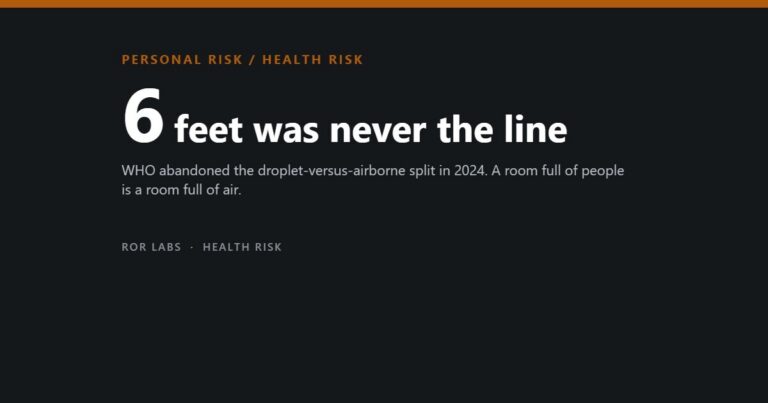
  • ROR Labs cover: 6 feet was never the line. WHO abandoned the droplet-versus-airborne split in 2024. A room full of people is a room full of air.
    Health Risk | Infectious Disease

    The Six-Foot Rule Was Wrong, and Handwashing Was Never the Main Defence

    BySeung Hyoun Kim August 29, 2026October 4, 2026

    In 2024 the WHO dropped the droplet-versus-airborne distinction that underpinned decades of advice. Exhaled particles behave like smoke, not falling cannonballs — which moves ventilation to the top of the list and surface cleaning near the bottom.
    Read More The Six-Foot Rule Was Wrong, and Handwashing Was Never the Main DefenceContinue

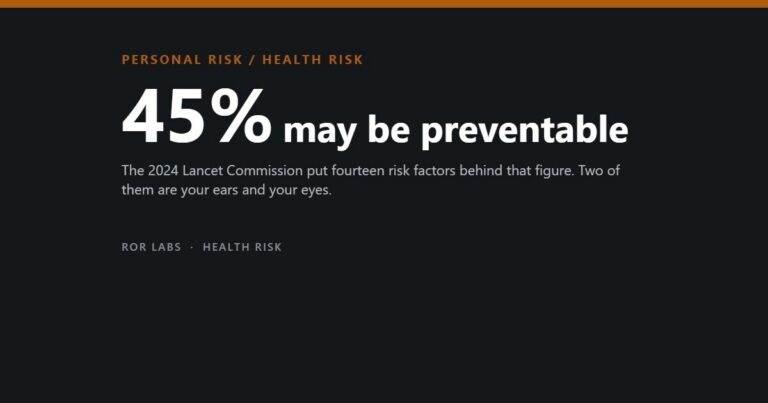
  • ROR Labs cover: 45% potentially preventable. The 2024 Lancet Commission put fourteen risk factors behind that figure. Two of them are your ears and your eyes.
    Brain and Ageing | Health Risk

    Two of the 14 Dementia Risk Factors Are Your Ears and Your Eyes

    BySeung Hyoun Kim August 29, 2026October 4, 2026

    The 2024 Lancet Commission put 45% of dementia cases down to 14 modifiable risk factors. Two were added that year — midlife cholesterol and untreated vision loss. Almost none of the list is something you buy, and no supplement appears on it at all.

    Read More Two of the 14 Dementia Risk Factors Are Your Ears and Your EyesContinue

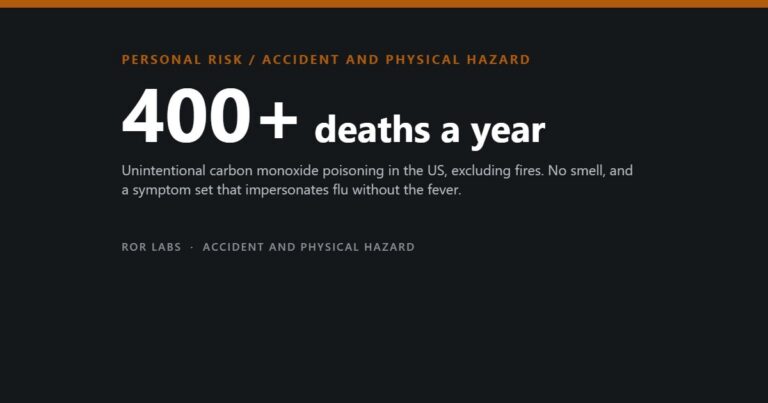
  • ROR Labs cover: 400+ deaths a year. Unintentional carbon monoxide poisoning in the US, excluding fires. No smell, and a symptom set that impersonates flu without the fever.
    Accident and Physical Hazard | Home and Indoor Hazards

    It Looks Exactly Like Flu, Except for the Fever

    BySeung Hyoun Kim August 29, 2026October 4, 2026

    Over 400 Americans a year die from carbon monoxide unrelated to fires. The symptoms impersonate flu — but CO causes no fever, affects everyone in the building at once, and eases when you leave the house. What actually distinguishes them.

    Read More It Looks Exactly Like Flu, Except for the FeverContinue

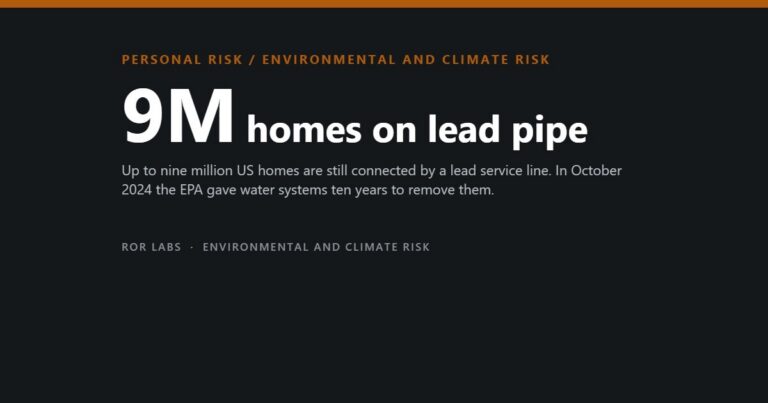
  • ROR Labs cover: 9M homes on lead pipe. Up to nine million US homes are still connected by a lead service line. In October 2024 the EPA gave water systems ten years to remove them.
    Environmental and Climate Risk | Water and Contaminants

    Nine Million Homes Still Drink Through a Lead Pipe

    BySeung Hyoun Kim August 29, 2026October 4, 2026

    The EPA gave water systems until 2034 to replace up to nine million lead service lines. How to find out in one minute whether yours is one of them, which filter specification actually matters, and why boiling makes lead worse rather than better.

    Read More Nine Million Homes Still Drink Through a Lead PipeContinue

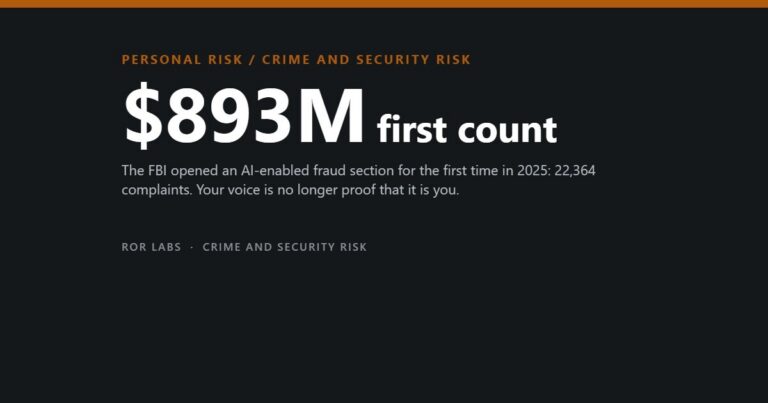
  • ROR Labs cover: $893M first count. The FBI opened an AI-enabled fraud section for the first time in 2025: 22,364 complaints. Your voice is no longer proof that it is you.
    Crime and Security Risk | Fraud and Scams

    Your Voice Is No Longer Proof That It Is You

    BySeung Hyoun Kim August 29, 2026October 4, 2026

    The FBI logged its first AI-fraud category in 2025: 22,364 complaints and $893 million. A few seconds of public audio is enough to clone a voice. The scam has one shape, one tell, and one free defence that defeats all of it.

    Read More Your Voice Is No Longer Proof That It Is YouContinue

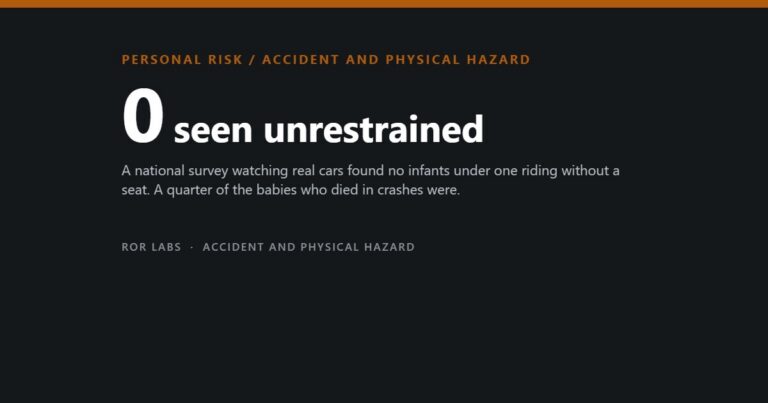
  • ROR Labs cover: 0 seen unrestrained. A national survey watching real cars found no infants under one riding without a seat. A quarter of the babies who died in crashes were.
    Accident and Physical Hazard | Road and Vehicles

    Nobody Skips the Car Seat. The Deaths Are in the Exceptions.

    BySeung Hyoun Kim August 29, 2026October 4, 2026

    Observation surveys found no unrestrained infants on the road — yet a quarter of infant crash deaths were unrestrained. Car seats cut fatal injury risk 71% for babies. The stages, and the five installation mistakes that keep showing up.

    Read More Nobody Skips the Car Seat. The Deaths Are in the Exceptions.Continue

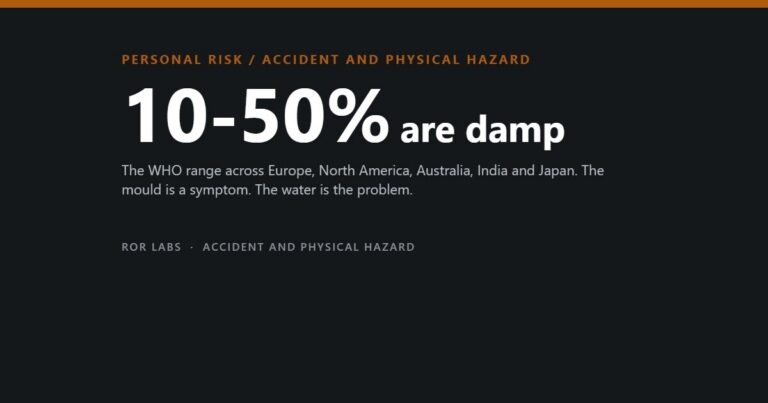
  • ROR Labs cover: 10-50% of homes are damp. The WHO range across Europe, North America, Australia, India and Japan. The mould is a symptom. The water is the problem.
    Accident and Physical Hazard | Home and Indoor Hazards

    The Mould Is Not the Problem. The Water Is.

    BySeung Hyoun Kim August 29, 2026October 4, 2026

    Dampness affects an estimated 10–50% of homes, and the evidence linking it to asthma and respiratory infection is solid. But the visible mould is a symptom — and the sprays, anti-mould paints and test kits sold to treat it leave the cause untouched.

    Read More The Mould Is Not the Problem. The Water Is.Continue

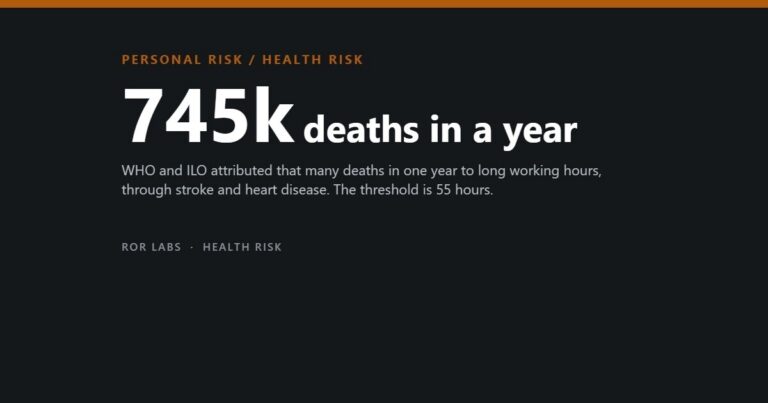
  • ROR Labs cover: 745,000 deaths in a year. WHO and ILO attributed that many deaths in one year to long working hours, through stroke and heart disease. The threshold is 55 hours.
    Health Risk | Sleep and Overwork

    Working 55 Hours a Week Has a Body Count

    BySeung Hyoun Kim August 29, 2026October 4, 2026

    The WHO and ILO attributed 745,000 deaths in a single year to long working hours — a 35% higher stroke risk at 55+ hours a week. And the WHO defines burnout as workplace stress that was not managed, which puts the failure somewhere other than your resilience.

    Read More Working 55 Hours a Week Has a Body CountContinue

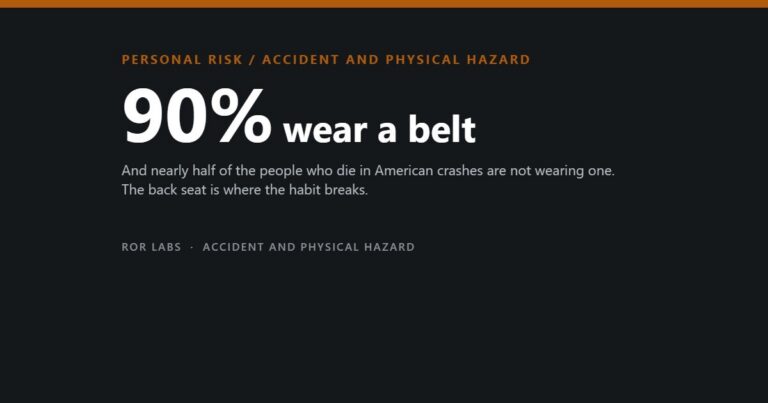
  • ROR Labs cover: 90% wear a belt. And nearly half of the people who die in American crashes are not wearing one. The back seat is where the habit breaks.
    Accident and Physical Hazard | Road and Vehicles

    Half of the People Who Die in Crashes Were Not Wearing a Belt

    BySeung Hyoun Kim August 28, 2026October 4, 2026

    US traffic deaths fell to 36,640 in 2025, the second-lowest rate on record. But among rear-seat occupants killed in crashes only 32% were belted, against 84% everyday use — and an unbelted passenger behind you is a danger to you.

    Read More Half of the People Who Die in Crashes Were Not Wearing a BeltContinue

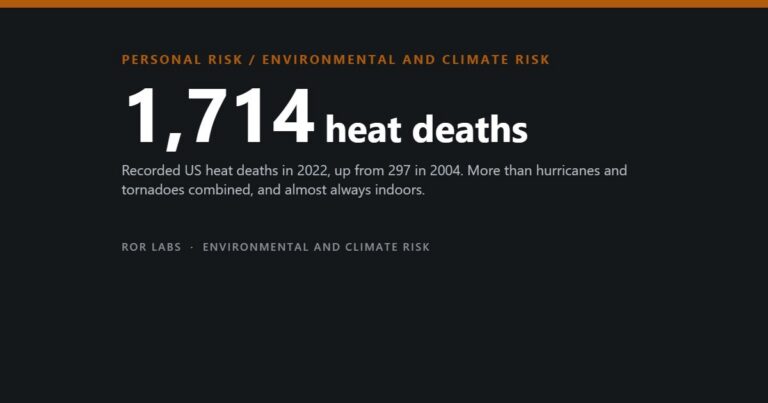
  • ROR Labs cover: 1,714 heat deaths. Recorded US heat deaths in 2022, up from 297 in 2004. More than hurricanes and tornadoes combined, and almost always indoors.
    Environmental and Climate Risk | Heat and Cold

    Heat Kills More Americans Than Hurricanes. Almost Always Indoors.

    BySeung Hyoun Kim August 28, 2026October 4, 2026

    Recorded US heat deaths rose from 297 in 2004 to 1,714 in 2022. In New York City records, none of the at-home heat-stress deaths had air conditioning in use — and a quarter had only a fan. Why a fan is not cooling, and what actually works.

    Read More Heat Kills More Americans Than Hurricanes. Almost Always Indoors.Continue

Page navigation

Previous PagePrevious 1 … 12 13 14 15 Next PageNext
  • About
  • Contact
  • Affiliate Disclosure
  • Tools
  • Privacy Policy
  • RSS Feed
  • Terms of Service

© 2026 ROR Labs - WordPress Theme by Kadence WP

  • Topics
  • Tools
  • Health
    • Infectious Disease
    • Heart, Blood and Circulation
    • Brain and Ageing
    • Sleep and Overwork
    • Food and Allergy
    • Medical Care
  • Accidents
    • Fire and Burns
    • Home and Indoor Hazards
    • Falls and Impact
    • Road and Vehicles
    • Public Transport
    • Work and Machinery
    • Crowds and Public Space
  • Crime
    • Fraud and Scams
    • Accounts and Devices
    • Privacy and Data
    • Burglary and Personal Crime
  • Manipulation
    • Interface and Persuasion
    • Relationship Manipulation
    • Social Engineering
    • Information and Belief
    • Groups and Influence
  • Money
    • Investing and Markets
    • Retirement and Withdrawal
    • Insurance
    • Banking and Deposits
    • Debt and Credit
  • Environment
    • Air Quality
    • Water and Contaminants
    • Heat and Cold
    • Storms and Flooding
    • Earthquake and Wildfire
  • Social
    • Isolation and Belonging
    • Work and Livelihood
    • Family and Care
    • Bullying and Harassment
    • Youth and Digital Life
  • Geopolitics
    • Conflict and War
    • Civil Unrest and Policing
    • Travel and Borders
    • Sanctions and Economic Coercion
    • Law and Governance
  • Infrastructure
    • Power and Energy
    • Water and Sanitation
    • Healthcare Systems
    • Telecom and Internet
    • Transport Networks
  • EN日本語
Accident trends
By countryAccident TrendsUnited States
FireEarthquakesTransportFraudDiseaseInjuries
United Kingdom
FireEarthquakesTransportFraudDiseaseInjuries
AustraliaJapan
Beyond risk
Beyond riskInterestsNutrientsMacronutrientsVitaminsMineralsOtherSportsTeam Sports
BaseballBasketballAmerican FootballSoccerVolleyballIce HockeyRugbyCricket
Racket and Club
TennisPickleballGolfBadminton
Individual and Combat
RunningCyclingSwimmingWrestlingBoxing
Outdoor and Adventure
HikingClimbingSkiingHorse RidingSurfing