Badminton and sudden cardiac arrest, and the minutes that decide survival
Key takeaways · 10 min read
- Most cardiac arrests during sport strike middle-aged men playing for fun, usually because of coronary disease they did not know about; young victims more often have inherited or inflammatory heart conditions.
- Vigorous exertion briefly multiplies the risk: about 12-fold in Swedish men who trained more than twice a week, but more than 100-fold in those who rarely exercised.
- Badminton accounted for 12% of 374 sports-related sudden deaths in one Chinese province, a share that reflects popularity as much as risk.
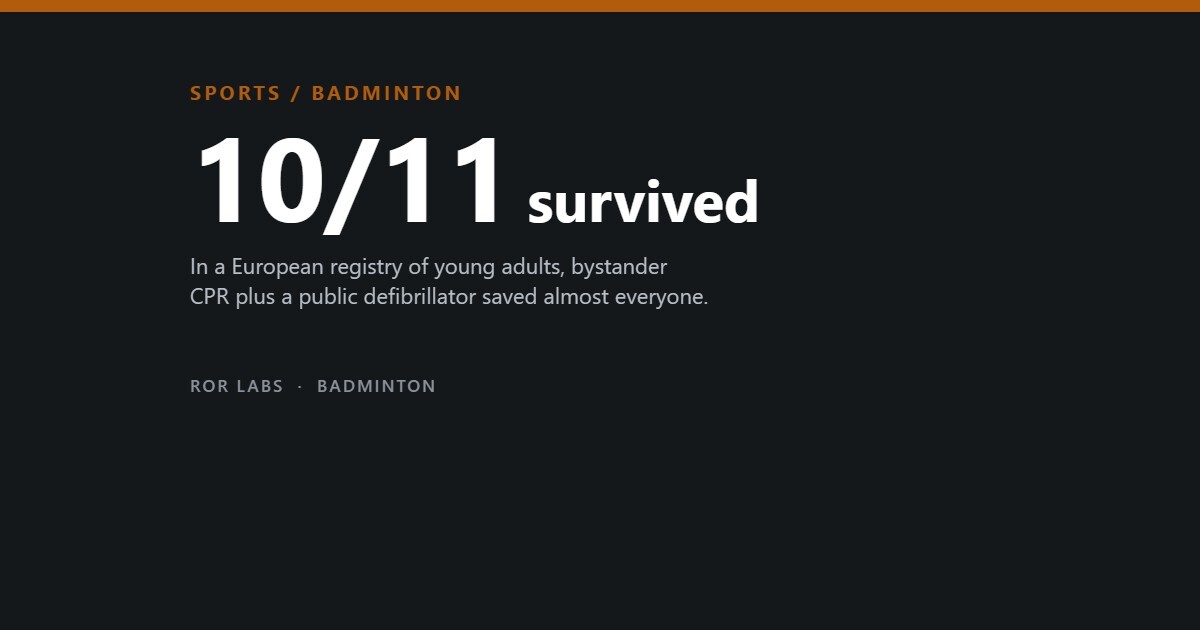
- Where bystanders give CPR and use a public defibrillator, survival can exceed 60%; in one registry, 10 of 11 young adults who received both survived.
On 30 June 2024, Zhang Zhijie, a 17-year-old Chinese player, collapsed on court at the Badminton Asia Junior Championships in Yogyakarta, Indonesia, and died of what doctors described as sudden cardiac arrest. Exactly a year later, in a badminton hall in Sungai Petani, Malaysia, a 51-year-old man told a friend mid-match that he felt dizzy, collapsed as he tried to walk, and died shortly after reaching hospital. Police said an autopsy found a heart attack.
The two deaths illustrate different problems. The teenager belongs to a small group of young people with hidden heart conditions; the club player belongs to a much larger one. In registries from France, Germany and Canada, most cardiac arrests during sport strike middle-aged men playing for fun, usually because of coronary artery disease they did not know they had. In one Chinese province, badminton was the third most common sport in which such deaths occurred.
This article covers what happens when a heart stops during play, who is at risk and when, what has been measured to improve survival, from bystander CPR to defibrillators in sports halls, and the argument over screening. The conclusion is not to give up a game that is good for the heart. It is to play carefully, take warning signs seriously and learn CPR.
What happens when a heart stops on court
Sudden cardiac arrest is an electrical failure. The heart’s lower chambers usually fall into a chaotic rhythm, ventricular fibrillation, and stop pumping, and the player collapses within seconds. A 2025 analysis of 48 filmed cases in the British Journal of Sports Medicine found that many stumbled or swayed first. Afterwards, every victim whose chest was visible kept making breathing movements or gasping, and seizure-like jerking was common. Bystanders often read these as signs of life. They are not.
What lies beneath depends on age. In a French national survey of 820 sports-related sudden deaths from 2005 to 2010, a cause was established in only a quarter, and coronary artery disease made up three-quarters of those. A German registry found myocarditis leading under 35 and coronary disease above it. Even among 147 arrests in 18- to 35-year-olds in Germany and Paris, coronary disease (25.8% of confirmed causes) narrowly outnumbered inherited heart-muscle diseases (21.3%).
Who has a cardiac arrest during sport
Incidence of sports-related sudden cardiac arrest per 100,000 person-years, adults in five Canadian provinces, 2016–2020 (339 cases, during or within an hour of sport).
Source: Visanji et al., Canadian Journal of Cardiology (2025), doi:10.1016/j.cjca.2024.11.017, with age bands as reported by TCTMD, 10 February 2025.
Men dominate everywhere: 93.8% of the Canadian cases, 95% in France and a male-to-female ratio of almost 20 to 1 in Guangdong, China. The average Canadian patient was 58. Women play sport too, so participation does not explain the gap. Researchers suggest higher rates of coronary disease and a stronger trigger effect of hard exercise in men, but admit the reasons are not well understood.
Where the risk concentrates
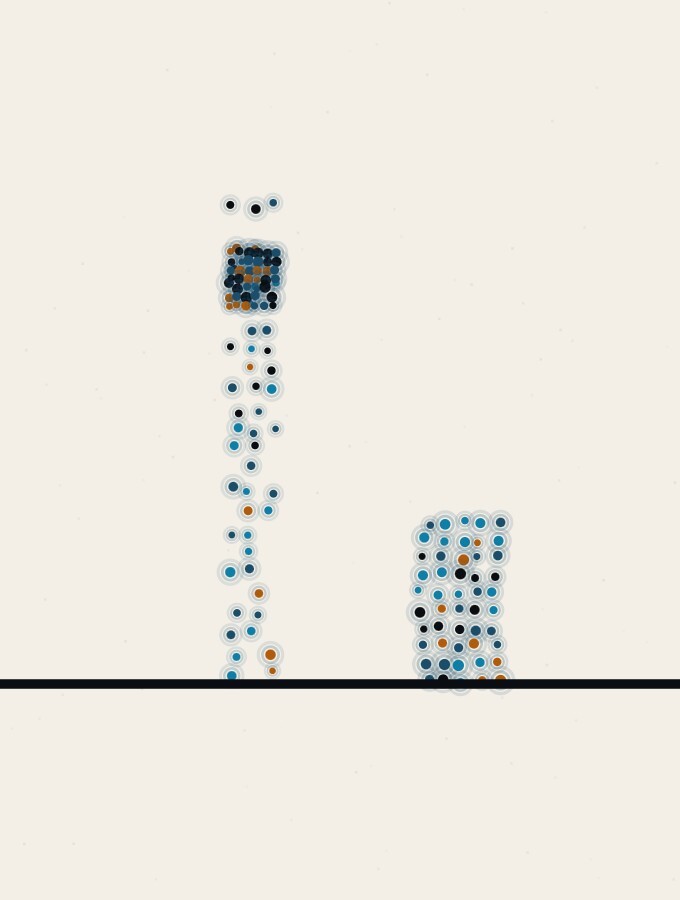
The risk is concentrated in time. Exertion does not create heart disease, but it can tip a diseased heart into fibrillation. In the US Physicians’ Health Study, which followed 21,481 male doctors for 12 years, the risk of sudden death during and up to 30 minutes after vigorous exertion was 16.9 times that at other times. In absolute terms that was still only one death for every 1.51 million episodes of exercise.
How big the jump is depends on habit. A Swedish case-crossover study published in 2026 examined 192 men who died suddenly of heart attacks; 84% had exercised less than once a week. In that group a bout of vigorous exertion was linked to a 108-fold rise in risk, against 12-fold in men who trained more than twice a week. The authors cautioned that the figures rest on assumptions about how long each session lasted.
How habit changes the risk of one hard session
Relative risk of sudden cardiac death during and up to 30 minutes after vigorous exertion, compared with other times. Case-crossover studies; relative, not absolute, risk.
Sources: Vikström et al., IJC Cardiovascular Risk and Prevention (2026), doi:10.1016/j.ijcrp.2026.200588; Albert et al., NEJM (2000); Whang et al., JAMA (2006). The Swedish group declared no competing interests.
Badminton fits the pattern of a trigger sport: fast, stop-start and competitive. In one trial, previously untrained women playing recreational badminton averaged 75% of their maximum heart rate and spent 13% of each session above 90%. When forensic researchers gathered 374 sports-related sudden deaths in Guangdong province from 2017 to 2021, badminton ranked third, behind basketball and running, with 12% of cases. Three in four deaths happened during play and one in five within the following hour.
Sports-related sudden deaths in Guangdong, 2017 to 2021
374 cases collected by forensic researchers. Share of all cases with each characteristic.
Source: Ma et al., Fayixue Zazhi (Journal of Forensic Medicine) 38(2):246 (2022), doi:10.12116/j.issn.1004-5619.2021.410908. Sudden cardiac death was the commonest cause (67.1%).
That 12% is easy to misread. It is a share of deaths, not a rate: the study had no count of how many people in Guangdong play each sport, or for how long, so it cannot show that badminton is riskier than any other activity. It may simply be popular. The causes are also uncertain, because only 1.07% of those who died were autopsied. And just 6.15% received on-site rescue.
Some arrests give notice. In the Franco-German study of young adults, 13 of the 23 with coronary disease had reported cardiac symptoms beforehand, chest pain most often, and the authors noted that people kept exercising through them. The American Heart Association lists chest, neck, jaw or arm discomfort, unusual breathlessness, light-headedness and a racing or irregular heartbeat as reasons to stop and see a doctor before playing again.
What has been measured to improve survival
Most sports arrests are witnessed, which ought to make them survivable, but witnesses do not always act. In the French survey of 2005 to 2010, 93% of collapses were seen by someone, yet bystander CPR was started in only 30.7%, and 15.7% of patients left hospital alive. Bystander CPR was an independent predictor of survival, raising the odds 3.7-fold. What later data show is how much that can change.
In Greater Paris, the same research group tracked 377 sports-related arrests from 2005 to 2018. The number of cases a year barely moved, nor did the patients’ age or sex. The response did: between the first and last two-year periods, bystander CPR rose from 34.9% to 94.7%, use of public defibrillators from 1.6% to 28.8%, and survival to hospital discharge from 23.8% to 66.7%. The study was observational, so other improvements in care may have contributed.
Same arrests, better response
Bystander CPR, public-access defibrillation (an AED shock before the ambulance arrives) and survival after sports- or exercise-related cardiac arrest, early versus late years. Observational registries.
Sources: Karam et al., JACC (2022), doi:10.1016/j.jacc.2021.11.011, two-year periods from 2005 to 2018; Kiyohara et al., JAHA (2017), doi:10.1161/JAHA.117.005786, bystander-witnessed exercise-related arrests.
Japan shows what policy can do. Public AED deployment began there in July 2004, and by 2013 Osaka Prefecture had more than 25,000 public devices. Among witnessed arrests during exercise, the share shocked before the ambulance arrived rose from 7.1% in 2005 to 62.1% in 2012, and survival with good brain function doubled. Japanese cardiology guidelines list sports facilities among recommended AED sites, and arrests inside them had better outcomes.
Survival after a cardiac arrest during sport
Share who survived, to hospital discharge or 30 days, by response or setting. Different registries and definitions, so compare broadly.
Sources: Bohm et al., Europace 25(2):627 (2023); Ungaro et al., British Journal of Sports Medicine 60(1):20 (2026); Wolthers et al., Resuscitation (2022); Frisk Torell et al., PLOS ONE (2019); Marijon et al., Circulation (2011).
The opposite also happens. In April 2025 a Malaysian news site reported that a player who collapsed at an evening badminton session in Puchong, Selangor, died although an AED lay on the floor nearby, because nobody present knew how to use it; some players carried on while one person gave CPR. The Franco-German researchers list likely reasons lay rescuers hold back: no device at hand, unfamiliarity, fear of giving a shock and local rules on public use.
Elite events are not exempt. After Zhang’s death, footage suggested about 40 seconds passed before a doctor reached him. The Badminton World Federation, whose tournament doctors act “under the direction of the referee”, began a review, and the chair of its medical commission recommended an AED, oxygen and an ambulance on site at tournaments.
Screening is the contested part. European guidance recommends that people over 35 taking up sport be assessed according to their individual cardiovascular risk. American guidance is more cautious: the US Preventive Services Task Force advised against resting or exercise ECG screening in low-risk adults without symptoms, and the American Heart Association warns of false positives and cost, reserving exercise testing for higher-risk people, such as inactive men with diabetes planning intense sport.
Why the answer is to play carefully, not to stop
Set against the hours people spend playing, these events are rare. Among middle-aged US nurses there was one sudden cardiac death for every 36.5 million hours of moderate to vigorous exertion. And the trigger studies carry a second message: the men at greatest risk during exercise were those who seldom exercised. In a 1984 American study, men who exercised hard regularly had an overall risk only 40% of that of sedentary men, and, as our article on badminton injuries notes, racket players live longer on average.
So the advice is about how to play, not whether. Build up gradually if you return to the game in middle age, rather than starting with competitive singles. Warm up and cool down. Stop and get checked for chest pain, unusual breathlessness, dizziness or palpitations. Ease off in hot, humid halls, as the AHA advises. Clubs can make sure everyone knows where the nearest defibrillator is, and encourage members to learn CPR.
Questions people ask
Can playing badminton cause a heart attack?
Badminton does not cause heart disease, but like any vigorous exercise it can trigger a heart attack or cardiac arrest in someone whose arteries are already narrowed or who has another heart condition, often undiagnosed. The risk is highest in people who rarely exercise.
What are the warning signs to stop playing?
Chest, neck, jaw or arm discomfort, unusual breathlessness, light-headedness or dizziness, and a racing or irregular heartbeat. Stop, rest and see a doctor before playing again. If symptoms do not settle, call emergency services.
Should I have an ECG before playing at 50?
There is no universal rule. European guidance assesses people over 35 according to their cardiovascular risk; US bodies advise against routine ECGs for low-risk adults without symptoms. Ask your doctor, especially if you have symptoms, diabetes, high blood pressure or a family history of early heart disease.
What should I do if a player collapses?
If they are unresponsive and not breathing normally, and gasping counts as not normal, call emergency services, start chest compressions and send someone for the nearest AED. Switch it on and follow its spoken instructions. Do not wait to see whether they come round.
The short version
- Most cardiac arrests during sport strike middle-aged men playing for fun, usually because of coronary disease they did not know about; young victims more often have inherited or inflammatory heart conditions.
- Vigorous exertion briefly multiplies the risk: about 12-fold in Swedish men who trained more than twice a week, but more than 100-fold in those who rarely exercised.
- Badminton accounted for 12% of 374 sports-related sudden deaths in one Chinese province, a share that reflects popularity as much as risk.
- Where bystanders give CPR and use a public defibrillator, survival can exceed 60%; in one registry, 10 of 11 young adults who received both survived.
- Keep playing, build up gradually, stop for chest pain, dizziness or palpitations, and learn CPR and where your hall’s AED is.
This is a summary of published research and reporting, not medical advice. If you have symptoms during exercise, known heart disease or a family history of sudden death, talk to your doctor before playing hard. CPR and an AED save lives: if someone collapses and is not breathing normally, call emergency services, start chest compressions and use the nearest defibrillator.
Further reading: Franklin et al., Circulation (2020), the American Heart Association statement on exercise-related cardiac events. Bohm et al., Europace (2023), on survival with CPR and AEDs in young adults. Vikström et al. (2026), on how regular training changes the trigger effect.
- Super Agers, Eric Topol (2025). A cardiologist and researcher on what the evidence says about staying healthy into old age, including exercise and heart health.
- The Art of Uncertainty, David Spiegelhalter (2024). A Cambridge statistician on chance and rare events. Useful for telling relative risk from absolute risk.
- Outlive, Peter Attia (2023). A physician on preventing heart disease and building fitness in midlife. Strong on cardiovascular risk; some advice goes beyond the evidence, so read critically.
Sources
- The Lancet Regional Health – Western Pacific. Saving lives from sudden cardiac arrest: every second and action counts. Editorial (July 2024), doi:10.1016/j.lanwpc.2024.101163.
- 17-year-old Chinese badminton player collapses on court and dies; medical response time decried. NBC News, July 2024.
- Seow D. M’sia man, 51, feels dizzy during badminton match, collapses & dies. Mothership, 2 July 2025.
- Visanji M, Allan KS, Charette M, et al. Sports-related sudden cardiac arrest in Canada: incidence and survival. Canadian Journal of Cardiology (2025), doi:10.1016/j.cjca.2024.11.017; TCTMD report, 10 February 2025.
- Marijon E, Tafflet M, Celermajer DS, et al. Sports-related sudden death in the general population. Circulation (2011), doi:10.1161/CIRCULATIONAHA.110.008979; American College of Cardiology journal scan, August 2011.
- Bohm P, Scharhag J, Meyer T. Data from a nationwide registry on sports-related sudden cardiac deaths in Germany. European Journal of Preventive Cardiology (2016), doi:10.1177/2047487315594087.
- Bohm P, Meyer T, Narayanan K, et al. Sports-related sudden cardiac arrest in young adults. Europace 25(2):627 (2023).
- Ungaro S, Truglio TS, Zorzi A, et al. Sports-related sudden cardiac arrest: a video analysis of presenting features, management and outcomes. British Journal of Sports Medicine 60(1):20 (2026; online October 2025).
- Albert CM, Mittleman MA, Chae CU, Lee IM, Hennekens CH, Manson JE. Triggering of sudden death from cardiac causes by vigorous exertion. New England Journal of Medicine (2000).
- Vikström S, Wennberg P, Johansson L, et al. Vigorous exertion, regular exercise training, and the risk of sudden cardiac death due to myocardial infarction in Swedish men. International Journal of Cardiology Cardiovascular Risk and Prevention (2026), doi:10.1016/j.ijcrp.2026.200588.
- Whang W, Manson JE, Hu FB, et al. Physical exertion, exercise, and sudden cardiac death in women. JAMA (2006), doi:10.1001/jama.295.12.1399.
- Thompson PD, Mitchell JH. Exercise and sudden cardiac death: protection or provocation. New England Journal of Medicine (1984), doi:10.1056/NEJM198410043111410, on the study by Siscovick and colleagues.
- Franklin BA, Thompson PD, Al-Zaiti SS, et al. Exercise-related acute cardiovascular events and potential deleterious adaptations following long-term exercise training: placing the risks into perspective – an update. Circulation 141:e705–e736 (2020), doi:10.1161/CIR.0000000000000749.
- Ma C-D, Wu Q-P, Zhao Q-H, et al. Epidemiology of sports-related sudden death in Guangdong Province. Fayixue Zazhi 38(2):246–253 (2022), doi:10.12116/j.issn.1004-5619.2021.410908.
- Patterson SD, Pattison J, Legg HS, Gibson A-M, Brown N. The impact of badminton on health markers in untrained females. Journal of Sports Sciences (2017), doi:10.1080/02640414.2016.1210819.
- Karam N, Pechmajou L, Narayanan K, et al. Evolution of incidence, management, and outcomes over time in sports-related sudden cardiac arrest. Journal of the American College of Cardiology (2022), doi:10.1016/j.jacc.2021.11.011; American College of Cardiology journal scan, January 2022.
- Kiyohara K, Nishiyama C, Kiguchi T, et al. Exercise-related out-of-hospital cardiac arrest among the general population in the era of public-access defibrillation. Journal of the American Heart Association (2017), doi:10.1161/JAHA.117.005786.
- Wolthers SA, Jensen TW, Blomberg SNF, et al. Out-of-hospital cardiac arrest related to exercise in the general population: incidence, survival and bystander response. Resuscitation (2022).
- Frisk Torell M, Strömsöe A, Herlitz J, et al. Outcome of exercise-related out-of-hospital cardiac arrest is dependent on location: sports arenas vs outside of arenas. PLOS ONE (2019), doi:10.1371/journal.pone.0211723.
- Fong F. Badminton player dies despite CPR attempt: ‘No one knew how to use the AED’. The Rakyat Post, 4 April 2025.
- BWF reviewing medical protocols following the death of Zhang Zhijie. Bernama, 12 July 2024; Jiji Press/AFP, July 2024.
- Weise A, Könsgen N, Joisten C, et al. Pre-participation evaluation of recreational and competitive athletes: a systematic review of guidelines and consensus statements. Sports Medicine – Open (2025), doi:10.1186/s40798-025-00837-6, summarising the European Society of Cardiology sports cardiology guidelines.
- Man who survived heart attack while playing badminton backs CPR campaign. STV News, 2 October 2026.