Tennis lower back pain, and the scans of players who felt fine
Key takeaways · 10 min read
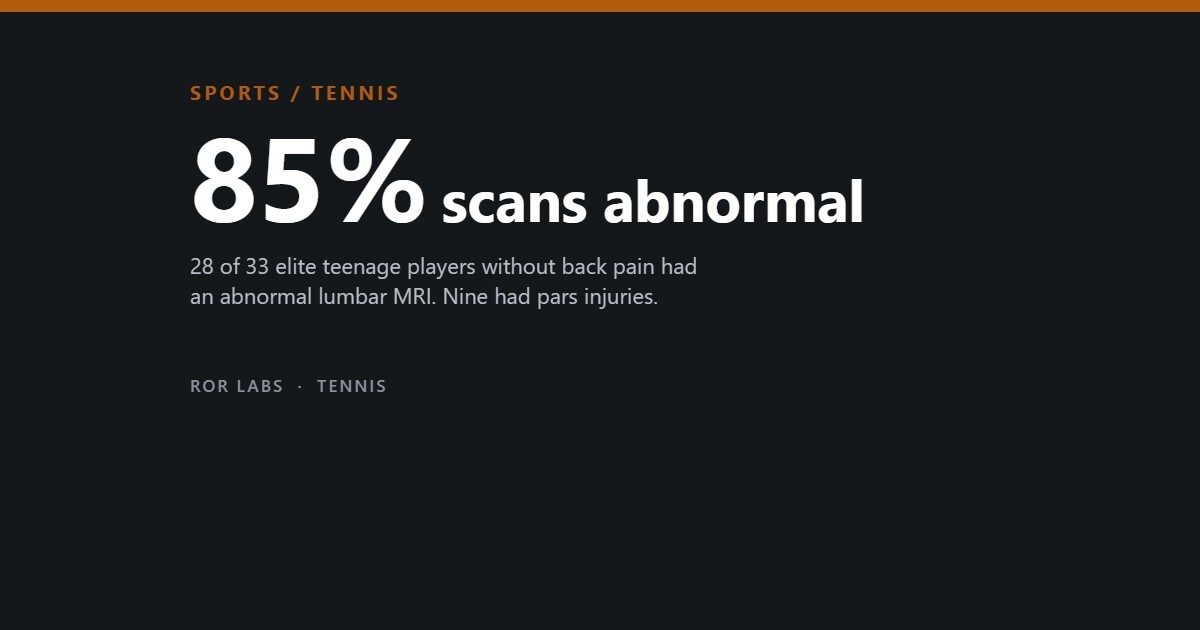
- Of 33 elite teenage players with no back pain, 28 had an abnormal lumbar MRI and nine had a pars injury, all at the fifth lumbar vertebra.
- The serve combines extension, rotation and side bending; the kick serve adds side bending, and lumbar loads reach up to four times body weight.
- Risk concentrates in juniors during growth and in weeks when training jumps; in a Swedish cohort 43% of players had back pain within a year.
- No randomised trial has tested back protection in tennis, but steady load was linked to less pain, and about nine in ten athletes return after spondylolysis.
In 2007 a London team scanned the lower backs of 33 elite tennis players with an average age of 17, none of whom had back pain. Only five scans were normal. Nine players had injuries to the pars interarticularis, a thin bridge of bone at the back of each vertebra, and three of those were established stress fractures. Every one involved the fifth lumbar vertebra, at the very bottom of the lower back.
At the French Open in May 2025, the 20-year-old Frenchman Arthur Fils won a five-set match against Jaume Munar and then withdrew before his next round. He told reporters his back had been sore for a while and had got worse during the match; the diagnosis was a stress fracture in his lower back. A comeback that August proved premature, and he returned properly only in February 2026, about eight months later.
This article covers what the serve, and the kick serve in particular, does to the lumbar spine, where the risk concentrates, what has been measured to help, and why scans of players without pain argue for playing carefully rather than stopping. For the wider picture of tennis injuries, including rates per hour of play, see our article on tennis elbow and the injection that backfired.
What the serve does to the lower back
The pars interarticularis links the small joints above and below each vertebra. When the lower back arches, twists and bends sideways at the same time, the pars is sheared and stretched, and repeated loading can produce a stress reaction and then a crack, a condition called spondylolysis. If both sides break, the vertebra can slip forward, which is spondylolisthesis. The American Academy of Orthopaedic Surgeons notes that the fifth lumbar vertebra is the usual site and that many people with the defect have no symptoms.
The serve asks for exactly that combination. In motion-capture studies of elite juniors, the lower back extended by up to about 22 degrees during the serve and lumbar loads reached up to four times body weight. The kick serve, hit with heavy topspin from a contact point further to the side, demands more side bending than the flat serve. In a 2013 study of 20 elite adolescent boys, the seven with a history of disabling back pain and confirmed L4/L5 injury produced larger peak lumbar forces than matched controls, with no difference in racket speed.
The pattern shows up in clinics too. A Spanish series of 66 young tennis players diagnosed with spondylolysis between 2000 and 2004 found 53 of the lesions at the fifth lumbar vertebra and eight at the fourth, with only a handful higher up. Groundstrokes load the lower back as well, particularly the forehand, but the research the Australian group drew on found that the serve, and above all the kick serve, loads the spine more.
Where the risk concentrates
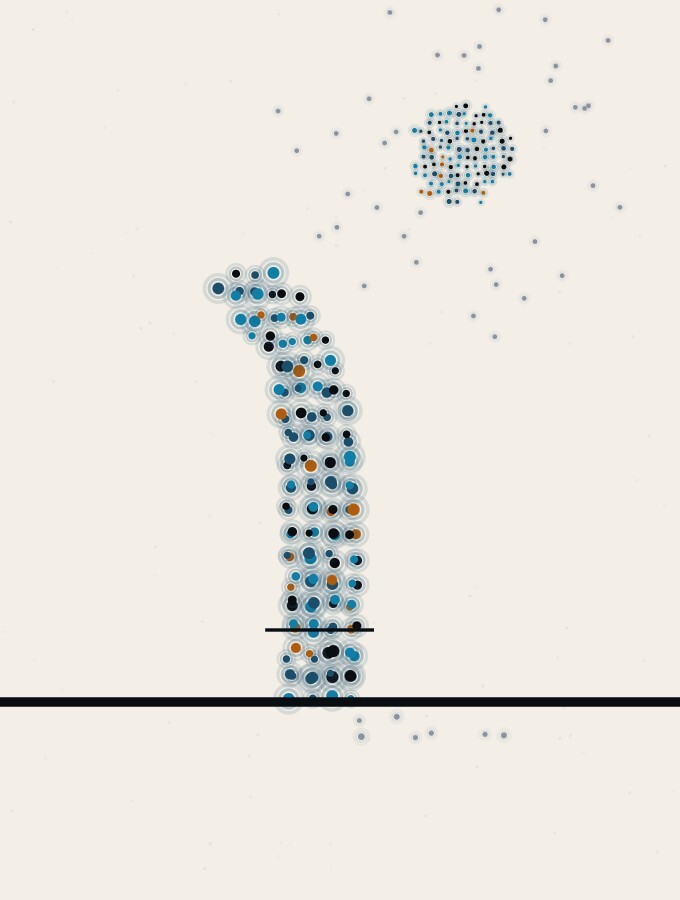
Age matters most. In an Argentine cohort of 139 elite players followed for two years, stress fractures at any site affected 20.3% of juniors under 18 and 7.5% of professionals; three of the 18 fractures were in the pars. Unpublished Tennis Australia data, cited by researchers at Victoria University, suggest that about 60% of players aged 11 to 19 who came to the medical team with back pain between 2008 and 2016 had a symptomatic pars injury, and that they took about 160 days to return.
The vulnerable window seems to coincide with growth and with promotion. Bone mineral density peaks some time after the fastest growth in height, leaving a spell when bone is relatively weak, and that spell often overlaps with the move from club tennis to an academy, where hitting volume and intensity rise, coaches change and gym work begins. The Australian researchers flagged both as possible contributors; neither has been tested directly in tennis.
Pars injuries in elite players with no back pain
Share of players with a pars stress reaction or fracture on MRI. All players were free of back pain when scanned. Ranges in brackets are 95% confidence intervals. The general-population figure is from CT and counts established defects only.
Sources: Connolly et al. (2020); Rajeswaran et al., Skeletal Radiology (2014); Alyas et al., British Journal of Sports Medicine 41(11):836 (2007); Sakai et al., Spine (2009). Numbers of players in brackets.
Sudden jumps in load are the best-measured risk. The Swedish SMASH study followed 198 competitive players aged 13 to 19 every week for a year, and 43% had at least one episode of back pain that limited what they could do. Each additional week in which a player’s training load spiked well above their recent average raised the rate of back pain by 17% for tennis and 13% for fitness work. The study was observational and supported by the Swedish Tennis Association.
Back pain over a year in Swedish junior players
Episodes of back pain with disability per 1,000 hours of tennis training and match play, including repeat episodes. 198 players aged 13 to 19, followed weekly for 52 weeks.
Source: Johansson et al., Sports Health (2021), SMASH cohort, observational. Numbers of players in brackets.
Two details complicate the simple story. National-squad players trained more hours than regional players yet had less back pain, and only 9% of them had more than ten load spikes in the year, against 33% of regional players: steady training, not just less training, looked protective. And girls reported more back pain per hour than boys even though boys trained more, while the imaging studies found more pars injuries in boys. Pain and bone are not the same measurement.
What has been measured to help
We could find no randomised trial that has tested a back-protection programme in tennis players, so the evidence is observational. The clearest signal concerns load. In SMASH, players whose training had climbed over the previous four weeks had nearly seven times the odds of back pain the following week compared with players whose load had stayed level, and the authors recommended planning each week to avoid spikes. The Argentine researchers suggested at least one rest day a week and a light week each month for adolescents.
Movement control is the second lead. In two Belgian academies, 40% of 35 elite players reported a disabling episode of back pain lasting more than five days in the previous year, and those players passed fewer trunk-control tests, 1.7 of five against 3.3. Australian juniors with a history of back pain had stiffer lower backs in every direction. These are snapshots, though: stiffness and poor control could be a result of pain as easily as a cause.
How long athletes with spondylolysis took to return
Average time from the start of treatment to return to sport, in months. Pooled figures mix sports; the tennis figures are smaller series.
Sources: Panteliadis et al., Global Spine Journal (2016); Iwamoto et al., Scandinavian Journal of Medicine & Science in Sports (2004); Connolly et al. (2020), citing unpublished Tennis Australia data; Maquirriain and Ghisi, British Journal of Sports Medicine 40(5):454 (2006).
Most athletes do get back. A meta-analysis of 11 studies and 376 adolescents with a pars defect but no slip found return-to-sport rates of 92.2% with non-operative care and 90.3% after surgery. In the Spanish tennis series, a brace did not appear to add much. In the Argentine cohort, time away tracked the grade of injury on MRI: the worse the scan, the longer the absence, which is one argument for having persistent pain assessed early.
Fils described what that looks like at the top level. He and his team built his back up slowly, with a lot of strengthening and flexibility work to restore mobility, and were very careful, he said, because the back is such a major area. His first return, in August 2025, came too soon. By February 2026 he was winning matches again and said he was not worried about the back.
Why the answer is to play carefully, not to stop
The scans that alarm parents also argue against panic. In a British series of 98 elite juniors without back pain, only four had a completely normal lumbar MRI. Facet-joint wear appeared in 89.7%, disc degeneration in 62.2% and pars abnormalities in 29.6%, most of them mild. The London authors of the first study concluded that so many abnormalities in players without symptoms show how poorly such findings predict pain, and that doctors should consider other sources of pain.
Movement studies point the same way. When an Australian team filmed 24 elite juniors without pain, nine of whom had lumbar abnormalities on MRI, the peak angles of their lower backs in flat and kick serves did not differ from those of players with clean scans; only the timing and order of movements did. These studies are small, cross-sectional and drawn from single academies, and their authors say so.
MRI findings in elite teenage players without back pain
Share of 33 players, mean age 17, with each finding, set against figures the authors cited for people without symptoms; the facet-joint comparison came from studies of older adults.
Source: Alyas et al., British Journal of Sports Medicine 41(11):836 (2007), observational, no control group.
One famous comparison deserves a footnote. The 2007 MRI paper set its 27.3% pars rate beside published figures of 20.3% for elite players under 18 and 7.5% for those over 18. Those numbers come from the Argentine study, where they describe stress fractures at any site; only three of its 18 fractures were in the pars. The point about youth survives, but the comparison is weaker than it looks.
Back pain in the past week: adult players and non-players
Share reporting low back pain in the previous seven days, from interviews with 633 adult spectators at a tournament in Brest, France.
Source: Saraux et al. (1999), PMID 10327492, cross-sectional. Numbers of people in brackets.
Among adults, tennis does not look like a back hazard: the French study found no more back pain, and no more sciatica, among players than among non-players. The risk described here belongs mainly to adolescents training hard through growth spurts. The sensible response is to build serve volume steadily, introduce heavy kick serving gradually, avoid sudden jumps in training and get persistent back pain assessed, not to stop playing.
Questions people ask
Is back pain normal in junior tennis players?
It is common: in the Swedish study 43% of competitive juniors had at least one episode in a year. Common is not the same as harmless, so pain that persists, keeps returning or is worse when arching backwards should be checked by a doctor or sports physiotherapist.
Should young players stop hitting kick serves?
No study has tested restricting the kick serve. It demands more side bending than the flat serve, so it makes sense to build it up gradually, especially during rapid growth, and to work on technique with a qualified coach.
Can players return after a lumbar stress fracture?
Most do. Pooled studies report that about nine in ten adolescent athletes return to sport, typically after three to eight months depending on treatment. The decision belongs to the treating doctor.
Does an abnormal MRI mean a player has to stop?
Not necessarily. Most elite juniors without pain have something on MRI, and many findings are mild. What a scan means depends on symptoms and examination, which is a conversation for a doctor.
The short version
- Of 33 elite teenage players with no back pain, 28 had an abnormal lumbar MRI and nine had a pars injury, all at the fifth lumbar vertebra.
- The serve combines extension, rotation and side bending; the kick serve adds side bending, and lumbar loads reach up to four times body weight.
- Risk concentrates in juniors during growth and in weeks when training jumps; in a Swedish cohort 43% of players had back pain within a year.
- No randomised trial has tested back protection in tennis, but steady load was linked to less pain, and about nine in ten athletes return after spondylolysis.
- Abnormal scans are common in players without pain, and adult players have no more back pain than non-players. Play carefully, not less.
This is a summary of published research, not medical advice. Back pain in a young athlete that persists, recurs or comes with leg pain, numbness or weakness should be assessed by a doctor or sports physiotherapist, who can decide whether imaging or time away from serving is needed.
Further reading: Alyas et al., British Journal of Sports Medicine (2007), for the MRI study of players without pain. Johansson et al., Sports Health (2021), for training load and back pain over a year. Connolly et al., Sports Medicine – Open (2021), for serve kinematics with and without lumbar abnormalities.
- The Painful Truth, Monty Lyman (2021). A doctor explains the new science of pain, including why scans and pain so often disagree.
- Built to Move, Kelly Starrett and Juliet Starrett (2023). Practical habits for mobility and everyday movement from two well-known coaches; general, not tennis-specific.
- The Data Detective, Tim Harford (2021). Ten rules for judging statistics, handy when a scary percentage comes from 33 players.
Sources
- Alyas F, Turner M, Connell D. MRI findings in the lumbar spines of asymptomatic, adolescent, elite tennis players. British Journal of Sports Medicine 41(11):836 (2007).
- Rajeswaran G, Turner M, Gissane C, Healy JC. MRI findings in the lumbar spines of asymptomatic elite junior tennis players. Skeletal Radiology (2014), doi:10.1007/s00256-014-1862-1.
- Connolly M, Rotstein A, Roebert J, Grabinski R, Malara F, O’Shea T, et al. Lumbar spine abnormalities and facet joint angles in asymptomatic elite junior tennis players (2020), doi:10.26181/13377635; includes unpublished Tennis Australia data.
- Connolly M, Middleton K, Spence G, Cant O, Reid M. Effects of lumbar spine abnormality and serve types on lumbar kinematics in elite adolescent tennis players. Sports Medicine – Open (2021), doi:10.1186/s40798-020-00295-2.
- Campbell A, Straker L, O’Sullivan P, Elliott B, Reid M. Lumbar loading in the elite adolescent tennis serve: link to low back pain. Medicine & Science in Sports & Exercise (2013), doi:10.1249/MSS.0b013e31828bea5e.
- Campbell A, O’Sullivan P, Straker L, Elliott B, Reid M. Back pain in tennis players: a link with lumbar serve kinematics and range of motion. Medicine & Science in Sports & Exercise (2014), doi:10.1249/MSS.0b013e3182a45cca.
- Ruiz-Cotorro A, Balius-Matas R, Estruch-Massana AE, Vilaró Angulo J. Spondylolysis in young tennis players. British Journal of Sports Medicine 40(5):441 (2006).
- Maquirriain J, Ghisi JP. The incidence and distribution of stress fractures in elite tennis players. British Journal of Sports Medicine 40(5):454 (2006).
- Johansson FR, Gabbett TJ, Svedmark P, Skillgate E. External training load and the association with back pain in competitive adolescent tennis players: results from the SMASH cohort study. Sports Health (2021), doi:10.1177/19417381211051636.
- Grosdent S, Colman D, Demoulin C, Kaux JF, Roussel N, Vanderthommen M. Lumbopelvic motor control in elite tennis players with and without a history of low back pain (2023), ORBi repository, University of Liège.
- Overley SC, McAnany SJ, Andelman S, et al. Return to play in adolescent athletes with symptomatic spondylolysis without listhesis: a meta-analysis. Global Spine Journal, doi:10.1177/2192568217734520.
- Panteliadis P, Nagra NS, Edwards K, Behrbalk E, Boszczyk B. Athletic population with spondylolysis: review of outcomes following surgical repair or conservative management. Global Spine Journal (2016), doi:10.1055/s-0036-1586743.
- Iwamoto J, Takeda T, Wakano K. Returning athletes with severe low back pain and spondylolysis to original sporting activities with conservative treatment. Scandinavian Journal of Medicine & Science in Sports (2004), doi:10.1111/j.1600-0838.2004.00379.x.
- Sakai T, Sairyo K, Takao S, Nishitani H, Yasui N. Incidence of lumbar spondylolysis in the general population in Japan based on multidetector computed tomography scans from two thousand subjects. Spine (2009), doi:10.1097/BRS.0b013e3181b4abbe.
- Saraux A, Guillodo Y, Devauchelle V, et al. Are tennis players at increased risk for low back pain and sciatica? (1999), PMID 10327492.
- American Academy of Orthopaedic Surgeons. Spondylolysis and spondylolisthesis. OrthoInfo, accessed October 2026.
- Associated Press. French Open: Arthur Fils has a stress fracture in his back. Via Coast Reporter, May 2025.
- ATP Tour. Arthur Fils return feature, 9 February 2026.