Cricket in extreme heat, and the degree a batter gains each session
Key takeaways · 10 min read
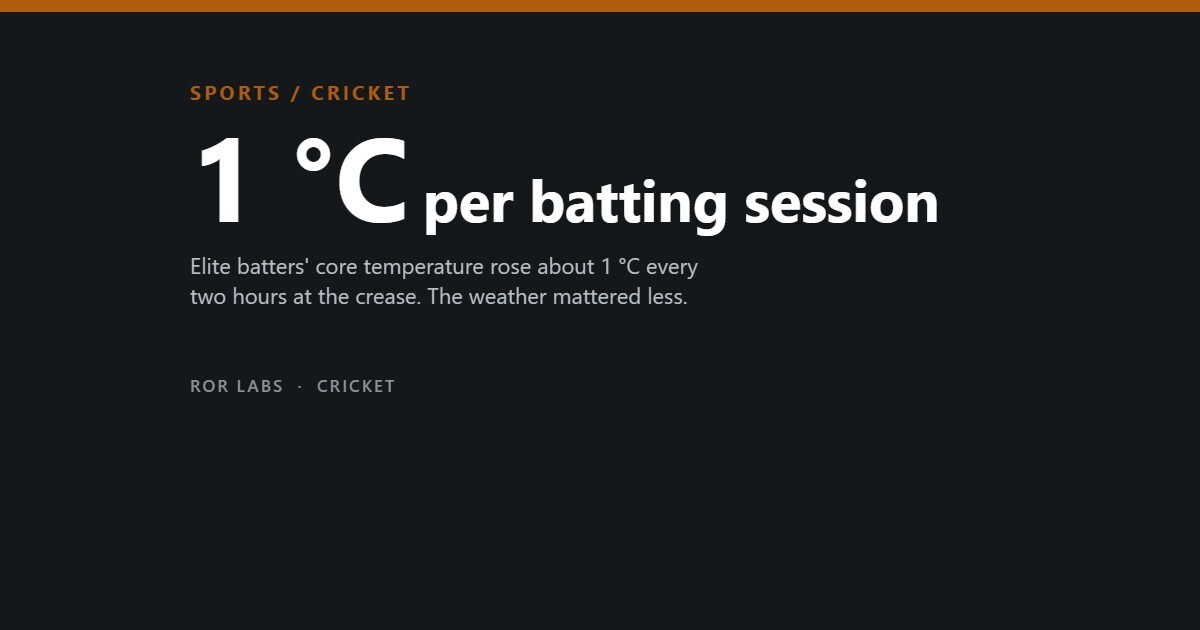
- Elite batters’ core temperature rose by about 1 °C for every two-hour session at the crease; fielders barely warmed, and weather mattered less than time batting.
- Cricketers lost 2.8% to 4.3% of body mass in hot sessions without enough fluid, and dehydration of 3.7% cut bowling accuracy for line by almost 20%.
- Risk concentrates in batters wearing full kit, fast bowlers, hot humid regions, juniors who underrate humidity and amateurs with little medical cover; women are barely studied.
- Heat policies add drinks and cooling breaks and suspend play at extremes, but their thresholds are modelled and rarely tested on cricket fields.
On 15 March 2025 Junaid Zafar Khan, a club cricketer in his forties, fielded for 40 overs at Concordia College Oval in Adelaide and then went out to bat. The temperature had passed 40 °C. Seven overs into his innings he collapsed, and paramedics could not revive him. Under his association’s rules, matches stopped only above 42 °C. He was reported to be observing the Ramadan fast, and no cause of death has been made public.
Cricket’s own measurements show why the batter’s end deserves attention. When 38 Sheffield Shield players swallowed temperature-sensing capsules during six four-day matches, batters’ core temperature rose by about 1 °C for every two-hour session at the crease. Fielders barely warmed up, and the weather itself made surprisingly little difference to either.
This article covers what long hot days do to the body, the fluid and the skill of cricketers, where the risk concentrates, what heat policies, cooling and acclimatisation have been shown to do, where that evidence is thinner than it looks, and why the answer is to play carefully rather than to stop. A July 2025 report found nearly half of that season’s IPL matches were played in “extreme caution” or “danger” heat.
What long days in the sun do to a cricketer
Cricketers can spend up to eight hours a day on the field, and a bowler may sprint in to deliver up to 150 times. In the Australian capsule study, published in Sports in 2018, the median core temperature of players while batting was 38.5 °C, against 37.6 °C before play. Eighteen readings exceeded 39 °C, yet nobody was diagnosed with heat illness. Air temperature, humidity and the wet bulb globe temperature (WBGT) had only trivial effects; time batting and effort dominated.
What raised a batter’s core temperature
Modelled rise in core temperature for each unit of the factor shown, from 47 readings taken while batting in Australian first-class matches. Fielders showed no link with weather at all.
Source: Stay et al., Sports 6(4):164 (2018), observational; funded by Cricket Australia, which had no role in the analysis.
Sweat is the other cost. In a 1993 study in the International Journal of Sports Medicine, three fast bowlers measured in a real match on a hot day had lost 4.3% of their body mass after only two sessions. A thesis from tropical northern Australia found moderate sweat rates of 0.72 to 1.11 litres an hour in one-day cricket but some cases of substantial dehydration. Each 1% of body mass lost raises core temperature by roughly 0.15 to 0.20 °C.
Body mass lost by cricketers in the heat
Percentage of starting body mass, a measure of sweat not replaced by drinking. Small samples; numbers of players in brackets.
Sources: Gore et al., International Journal of Sports Medicine (1993); Gamage et al., IJSNEM 26(6):531 (2016); Devlin et al., Journal of Science and Medicine in Sport (2001).
Skill goes with the fluid. In Sri Lanka, 30 players trained for two hours in heat and humidity twice, once drinking freely and once with fluid restricted. Kept within 1% of starting weight, they showed no significant decline. Dehydrated by 3.7%, their bowling accuracy for line fell by almost 20%. An earlier Australian trial found the same pattern in seven bowlers: accuracy suffered, speed did not. In 16 teenagers, batting in a helmet also impaired attention and slowed reaction times.
Bowling after two hours in heat, with and without drinks
Percentage fall from pre-training values in 30 Sri Lankan cricketers. Bowling length was not affected.
Source: Gamage et al., International Journal of Sport Nutrition and Exercise Metabolism 26(6):531 (2016).
Most heat trouble on a cricket field is heat exhaustion: a player who is spent, dizzy or cramping and cannot carry on. Exertional heat stroke is different and far rarer. It is defined as a core temperature above about 40.5 °C with signs that the brain is failing, such as confusion, odd behaviour or collapse. It is an emergency, and the damage depends on how long the body stays that hot.
Where the risk concentrates

Batters carry the most. The Australian study found the rise only at the crease, and the authors pointed to the combination of effort, running between wickets and the kit: long trousers, pads, thigh and arm guards, gloves and a helmet over the parts of the body that sweat most. Wicketkeepers and close fielders wear much of the same equipment but did not warm in the same way, probably because they work less hard. Fast bowlers lose the most fluid, on top of the strains described in our article on fast bowlers and the neck guard.
Place matters too. In July 2025 a report called Hit for Six: The Danger Zone, produced by Climate Central, FrontRunners, the British Association for Sustainability in Sport and The Next Test, counted days at or above 37 °C, a level it treats as hazardous. India had 52 such days in 2024, against a five-year average of 46. Pakistan averages 83 and Australia 46. These are weather counts by advocacy groups, not measurements on players.
What young cricketers think raises heat illness risk
Share of 365 Sri Lankan under-13 school cricketers who said each situation gave a “high chance” of heat illness.
Source: Gamage, Fortington and Finch, BMJ Open Sport & Exercise Medicine 5(1):e000508 (2019), cross-sectional survey.
Juniors are a particular concern. Most of the Sri Lankan under-13s surveyed recognised heat and thirst as risks, but only about a quarter saw humidity as one, and fewer than one in five saw danger in helmets and pads. Their researchers concluded that coaches, umpires and organisers have to manage the risk on their behalf. In February 2019 Cricket Australia shortened games at its under-15 national championships because of the heat.
Amateurs carry the heaviest unrecorded load. Australian hospital records for 2002 to 2004 found 148 heat cases across all sport, and cricket was among the sports with the highest rates. Women’s cricket is barely studied: a 2025 review found 179 studies of female cricketers, only four on physiology and two on nutrition and hydration. We found no study measuring female cricketers’ core temperature during a match.
What has been measured to work
Cricket Australia’s community guidance uses a Heat Stress Risk Index built from shade temperature, humidity, wind and sun. From 4 to 7 on the index, umpires should consider extra drinks breaks every 20 to 30 minutes; from 8 to 10, longer cooling breaks of 15 to 30 minutes. Above 10, play is suspended, and abandoned if the index does not fall. A separate, more conservative tool applies to under-18s. Sports Medicine Australia’s heat policy, covering 40 sports, was rebuilt in 2024.
England’s recreational guidance, updated in June 2026, sets no numerical trigger. It uses national heat-health alerts and lists longer drinks breaks, ice towels, shade, shorter hours and moving play away from midday, while reminding batters that helmets stay on. International playing conditions, as described in 2018, left extra drinks intervals to the umpires. The physiology behind such breaks is acclimatisation, cooling and fluid, and each has been tested in cricketers, though only in small groups.
What heat training and pre-cooling changed in cricketers
Percentage change against control. Acclimatisation: 12 club cricketers, four cycling sessions at about 30 °C. Pre-cooling: 10 medium-fast bowlers. Ranges are 90% confidence intervals.
Sources: Petersen et al., International Journal of Sports Physiology and Performance 5(4):535 (2010); Minett et al., Journal of Sports Sciences (2012).
Four short sessions of hard cycling in the heat lowered club cricketers’ heart rate during a later hot run by about 11 beats a minute and made their sweat less salty, the classic signs of partial acclimatisation. Pre-cooling with mixed methods before a six-over spell at about 32 °C lowered physiological strain and helped bowlers sprint between overs, but did not change ball speed or accuracy. In tennis, a ten-minute break lowered players’ core temperature by 0.25 °C.
For the rare collapse, the evidence is strongest of all. Whole-body cold-water immersion cooled 274 runners with exertional heat stroke at the Falmouth Road Race over 18 years at about 0.22 °C a minute, and all of them survived. Consensus advice is to cool first and transport second, bringing core temperature to 39 °C within 30 minutes of collapse.
The evidence under cricket’s heat rules is thinner than the tidy bands suggest. A 2007 review by the physiologist John Brotherhood argued that the environmental limits sports set are “not justified by evidence”. Sports Medicine Australia’s policy is modelled, from an international heat-strain standard, and its first version drew feedback that it underestimated risk in hot, dry extremes and overestimated it in humid ones. In cricket’s best field study, time batting mattered far more than weather, which no forecast can see. And heat illness in sport is under-reported, partly because of how hospitals code it.
Why the answer is to play carefully, not to stop

Serious heat illness in cricket is uncommon. Australian researchers called heat an uncommon cause of significant harm in sport, and elite players in the capsule study passed 39 °C without falling ill. Cricket also has something many sports lack: breaks between overs, drinks intervals, lunch and tea. The risk comes from using them badly, playing on through the hottest hours with no shade, no ice and no one watching the batter who has been out there since lunch.
The measured steps are simple. Check the forecast or heat index, and in hot spells start earlier, add drinks breaks, provide shade and iced towels, and take helmets and pads off whenever not in play. Drink enough to stay within about 1% of starting weight, build heat tolerance over the first warm weeks, and sit out when ill or feverish. Anyone confused or collapsed in the heat needs cooling at once, ideally in cold water, and an ambulance.
Questions people ask
What temperature is too hot to play cricket?
There is no single number. Cricket Australia combines temperature, humidity, wind and sun into an index and suspends play above 10. Some local associations use air temperature alone, such as 42 °C in Adelaide, while the ECB relies on national heat-health alerts.
How much fluid do cricketers lose?
In small studies, players lost 2.8% to 4.3% of body mass in hot sessions without enough drinking. Staying within about 1% protected bowling accuracy in a Sri Lankan trial.
Do helmets make batters overheat?
Kit and effort together seem to warm batters more than other players, and one small study linked helmets to slower reactions. Helmets still prevent serious head injuries, so keep them on while batting and take them off between overs.
What is the difference between heat exhaustion and heat stroke?
Heat exhaustion leaves a player too tired or dizzy to continue and usually settles with rest, shade and fluid. Heat stroke involves very high core temperature with confusion or collapse, and needs immediate cooling and emergency care.
The short version
- Elite batters’ core temperature rose by about 1 °C for every two-hour session at the crease; fielders barely warmed, and weather mattered less than time batting.
- Cricketers lost 2.8% to 4.3% of body mass in hot sessions without enough fluid, and dehydration of 3.7% cut bowling accuracy for line by almost 20%.
- Risk concentrates in batters wearing full kit, fast bowlers, hot humid regions, juniors who underrate humidity and amateurs with little medical cover; women are barely studied.
- Heat policies add drinks and cooling breaks and suspend play at extremes, but their thresholds are modelled and rarely tested on cricket fields.
- Play carefully: schedule around the heat, cool and drink at every break, acclimatise, and cool anyone who collapses immediately.
This is a summary of published research, not medical advice. If you have heart, kidney or other long-term conditions, take regular medicines, are fasting, or have had heat illness before, talk to your doctor or physiotherapist before playing in hot weather. Confusion or collapse in the heat is an emergency: call emergency services and start cooling at once.
Further reading: Stay et al., Sports (2018), for core temperature in first-class matches. Gamage et al., International Journal of Sport Nutrition and Exercise Metabolism (2016), for dehydration and skill. Tartarini et al., Journal of Science and Medicine in Sport (2025), for how Australia’s heat index was built.
- The Heat Will Kill You First, Jeff Goodell (2023). A journalist’s account of what extreme heat does to bodies, cities and work; broad context for why sport is rewriting its heat rules.
- The Art of Uncertainty, David Spiegelhalter (2024). A Cambridge statistician on acting under uncertainty, useful when a policy rests on modelled thresholds and small studies.
- The Data Detective, Tim Harford (2021). Ten rules for judging statistics, handy when a headline number comes from three bowlers or a weather count.
Sources
- Mascarenhas C. Tributes flow for SA cricketer Junaid Khan in heat tragedy. Australian Community Media (Newcastle Herald), 17 March 2025; Gulf News, Pakistan cricketer dies during match in extreme heat in Australia, 18 March 2025.
- Stay S, Cort M, Ward D, Kountouris A, Orchard J, Holland J, et al. Core temperature responses in elite cricket players during Australian summer conditions. Sports 6(4):164 (2018), doi:10.3390/sports6040164.
- Gore CJ, Bourdon PC, Woolford SM, Pederson DG. Involuntary dehydration during cricket. International Journal of Sports Medicine (1993), doi:10.1055/s-2007-1021197.
- Brearley MB. Responses to intermittent high intensity activity in tropical conditions and the development of pre-cooling protocols. PhD thesis, Charles Darwin University (2006), doi:10.25913/5ea284be5d019.
- Gamage JP, De Silva AP, Nalliah AK, Galloway SDR. Effects of dehydration on cricket specific skill performance in hot and humid conditions. International Journal of Sport Nutrition and Exercise Metabolism 26(6):531 (2016).
- Devlin LH, Fraser SF, Barras NS, Hawley JA. Moderate levels of hypohydration impairs bowling accuracy but not bowling velocity in skilled cricket players. Journal of Science and Medicine in Sport (2001), doi:10.1016/S1440-2440(01)80028-1.
- Neave N, Emmett J, Moss M, Ayton R, Scholey A, Wesnes K. The effects of protective helmet use on physiology and cognition in young cricketers. Applied Cognitive Psychology (2004), doi:10.1002/acp.1065.
- Hosokawa Y, Casa DJ, Racinais S. Translating evidence-based practice to clinical practice in Tokyo 2020: how to diagnose and manage exertional heat stroke. British Journal of Sports Medicine (2020), doi:10.1136/bjsports-2020-102153.
- Roberts WO, Armstrong LE, Sawka MN, Yeargin SW, Heled Y, O’Connor FG. ACSM expert consensus statement on exertional heat illness. Current Sports Medicine Reports (2021), doi:10.1249/JSR.0000000000000878.
- Climate Central, FrontRunners, BASIS and The Next Test. Hit for Six: The Danger Zone (2025), as reported by Australasian Leisure Management, 23 July 2025, and Region Riverina, 1 August 2025.
- Gamage PJ, Fortington LV, Finch CF. Risk perceptions for exertional heat illnesses in junior cricket in Sri Lanka. BMJ Open Sport & Exercise Medicine 5(1):e000508 (2019).
- Australian Conservation Foundation. Climate change a body blow for cricket. Media release, 10 September 2019.
- Driscoll TR, Cripps R, Brotherhood JR. Heat-related injuries resulting in hospitalisation in Australian sport. Journal of Science and Medicine in Sport (2007), doi:10.1016/j.jsams.2007.04.003.
- Jacobs J, Brandt C, Grobler N, Saw AE, Olivier B. Applied sports science and medicine for female cricket players: systematic scoping review. Journal of Sports Sciences (2025), doi:10.1080/02640414.2025.2477415.
- Cricket Australia. Weather conditions: Heat Stress Risk Index. Play.cricket.com.au community resources, accessed October 2026.
- Tartarini F, Smallcombe JW, Lynch GP, Cross TJ, Broderick CR, Jay O. A modified Sports Medicine Australia extreme heat policy and web tool. Journal of Science and Medicine in Sport (2025).
- England and Wales Cricket Board. Extreme weather guidelines for the recreational game, June 2026, as published by Devon Cricket.
- Petersen CJ, Portus MR, Pyne DB, Dawson BT, Cramer MN, Kellett AD. Partial heat acclimation in cricketers using a 4-day high intensity cycling protocol. International Journal of Sports Physiology and Performance 5(4):535 (2010).
- Minett GM, Duffield R, Kellett A, Portus M. Mixed-method pre-cooling reduces physiological demand without improving performance of medium-fast bowling in the heat. Journal of Sports Sciences (2012).
- Tippet ML, Stofan JR, Lacambra M, Horswill CA. Core temperature and sweat responses in professional women’s tennis players during tournament play in the heat. Journal of Athletic Training 46(1):55 (2011).
- Brotherhood JR. Heat stress and strain in exercise and sport. Journal of Science and Medicine in Sport (2007), doi:10.1016/j.jsams.2007.08.017.
- Chalmers S, Jay O. Australian community sport extreme heat policies: limitations and opportunities for improvement. Journal of Science and Medicine in Sport (2018), doi:10.1016/j.jsams.2018.01.003.