Parental Divorce and Children: What the Evidence Shows
Key takeaways · 14 min read
- Across 92 studies, children of divorced parents scored lower on well-being than other children, but the median gap was small: 0.14 of a standard deviation.
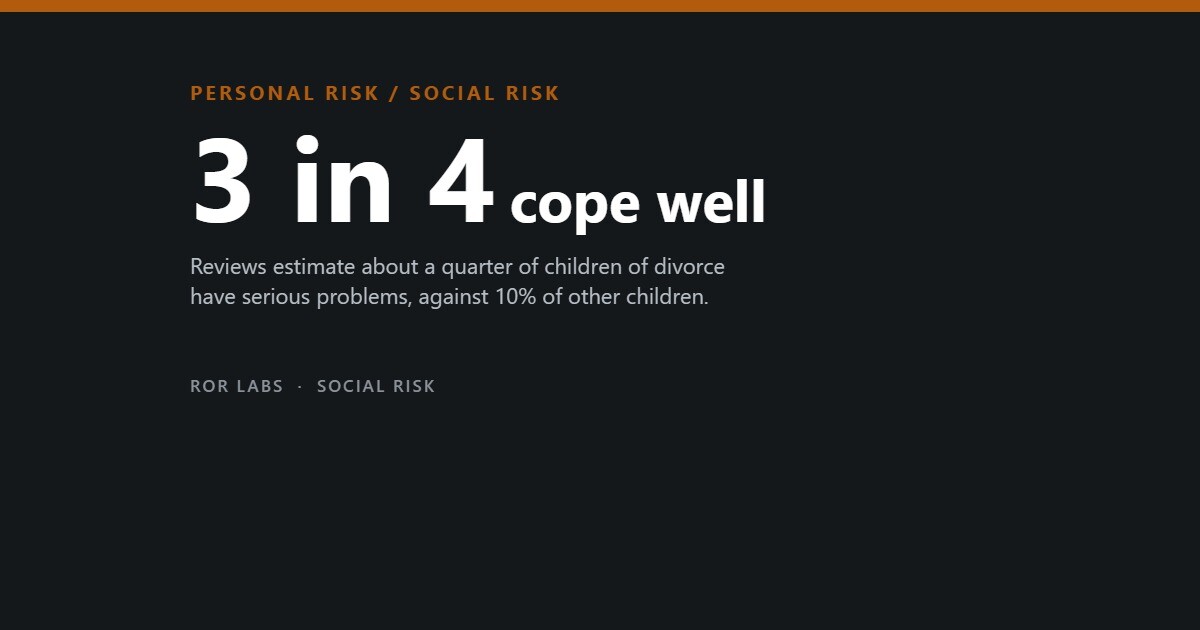
- Reviews estimate that about a quarter of children of divorce have serious problems, against about 10% of other children. Most cope well.
- Much of the gap appears before the separation, and conflict between parents predicts children’s outcomes more strongly than the divorce itself.
- In a randomised trial, 15.5% of young adults whose mothers took a parenting programme had an internalising disorder over 15 years, against 34.6% in the comparison group.
Few family decisions carry as much worry as separating when there are children in the house. Parents tend to ask the same questions: will this damage them, will it last, and is staying together for the children worth it? The research on those questions is large, more than half a century deep, and more reassuring in places than the headlines that usually accompany it.
It is not uniformly reassuring. On average, children whose parents divorce do a little worse on many measures, and some of that gap follows them into adulthood. But averages hide a great deal. The same studies show that most children adjust well, that much of the difference was visible before anyone moved out, and that how parents handle conflict matters more than whether they share an address.
This article sets out what the main meta-analyses found, how big the effects really are, why researchers argue about cause and effect, what conflict does, what follows children into adult life, and which programmes have been tested in randomised trials. It is written for parents and for anyone who works with families, and it does not assume that anyone has done anything wrong.
How common parental divorce is
Divorce is common enough that most classrooms include children who live across two homes. In England and Wales there were 105,002 divorces in 2025, according to the Office for National Statistics. That is well below the peaks of the 1980s to early 2000s, when there were around 150,000 a year, and the rate among opposite-sex married couples was 8.4 per 1,000. Marriages that ended had lasted a median of 13.0 years.
In the United States, a 2026 analysis of linked Census Bureau, tax and Social Security records by Maggie Jones, Andrew Johnston and Nolan Pope found that nearly one-third of Americans born between 1988 and 1993 experienced a parental divorce before adulthood. Many more children see parents who never married separate, a group that official divorce statistics do not count at all.
What the big reviews found
The foundation of this field is a pair of meta-analyses by the sociologist Paul Amato. In 1991, with Bruce Keith, he pooled 92 studies comparing children in divorced single-parent families with children whose parents stayed married. Children of divorce scored lower across outcomes including school achievement, conduct, psychological adjustment, self-concept and social relations, but the median difference was 0.14 of a standard deviation.
A consistent gap, but a small one
Average difference in well-being between children of divorced and continuously married parents, in standard deviations. Larger means a bigger gap.
Sources: Amato PR, Keith B, Psychological Bulletin (1991), doi:10.1037/0033-2909.110.1.26; Amato PR, Journal of Family Psychology (2001), doi:10.1037//0893-3200.15.3.355; averages as reported in Amato (2014). The weighted average gives more influence to larger studies.
Two details from the 1991 paper are often forgotten. For some outcomes, the more careful studies found smaller gaps than the weaker ones. And of the explanations tested, the most consistent support was for family conflict, not for the absence of a parent or for lost income. A 2001 update covering 67 studies from the 1990s found the same pattern of disadvantage, with a weighted average gap of 0.18.
The 2001 update also found that the gap had narrowed during the 1980s and widened again during the 1990s, so there is no simple story of divorce becoming harmless as it became normal. Amato later noted that European studies produced effect sizes nearly identical to American ones. Whatever the gap reflects, it is not peculiar to one country’s laws or culture.
How small is small?
A gap of 0.14 standard deviations means the two groups overlap almost entirely. Plenty of children from divorced families do better than plenty of children from intact ones. A clearer way to see it is through the share of children who have serious difficulties. Reviews by Mavis Hetherington and by Joan Kelly and Robert Emery put it at about 25% of children of divorce, against about 10% of children whose parents stay married.
Higher risk, but most children are fine
Share of children or young adults with serious problems, by whether their parents divorced.
Sources: Hetherington and Kelly (2002) and Kelly JB, Emery RE, Family Relations (2003), doi:10.1111/j.1741-3729.2003.00352.x, as summarised in later reviews; Chase-Lansdale PL, Cherlin AJ, Kiernan KE, Child Development (1995), doi:10.1111/j.1467-8624.1995.tb00955.x.
Read the other way, roughly three in four children of divorce do not have serious long-term problems. A British study of 17,414 people born in one week of 1958 found something similar at age 23: parental divorce raised the share scoring above a clinical cut-off for emotional distress from 8% to 11%, after allowing for problems and circumstances before the split. The relative risk rose, but the large majority were unaffected.
Small average effects still matter. Because divorce is common, a modest increase in risk spread across many children adds up to a real number of extra young people who struggle. Both statements are true at once, and the useful question for any one family is less whether divorce harms children in general than which circumstances make the difference for theirs.
Trouble before the split
Comparing children of divorced and married parents at one moment cannot show what caused the difference. Families that later separate often differ beforehand, in money, in parental health and in the amount of tension at home. In 1991, Andrew Cherlin and colleagues used national surveys in Britain and the United States that had assessed children before any of their families broke up.
For boys, the apparent effect of divorce on behaviour and school achievement shrank sharply once problems already present before the separation were taken into account. For girls the reduction was smaller but still noticeable. A Canadian study by Lisa Strohschein, following 2,819 children from ages 4 to 7, found the same pattern: children whose parents later divorced already had higher anxiety, depression and antisocial behaviour while their parents were still together.
That does not mean the split itself does nothing. In the Canadian data, anxiety and depression rose further around the time of the divorce, even after earlier family differences were accounted for. In 2014, Amato and Christopher Anthony used child fixed-effects models, which compare each child with themselves over time, in two large US studies. They judged the evidence for a causal effect reasonably strong, but the effects were small.
Looking before the separation changes the picture
Studies that measured children before their parents separated, and what they found.
| Study | Design | Main finding |
|---|---|---|
| Cherlin et al. 1991 | British and US national panels | For boys, apparent effect sharply reduced by pre-separation problems |
| Strohschein 2005 | 2,819 Canadian children, aged 4–7 at start | More anxiety and antisocial behaviour before the break-up; a further rise in anxiety after it |
| Amato & Anthony 2014 | Child fixed effects, two US cohorts | Causal effect likely but small; most children did not change |
Sources: Cherlin AJ et al., Science (1991), doi:10.1126/science.2047851; Strohschein L, Journal of Marriage and Family (2005), doi:10.1111/j.1741-3737.2005.00217.x; Amato PR, Anthony CJ, Journal of Marriage and Family (2014), doi:10.1111/jomf.12100.
Their second finding matters as much. Outcomes after divorce varied widely: some children declined, others improved, and most did not change at all. The estimated effects were strongest among children whose family circumstances made a divorce most likely. A single average, in other words, describes almost nobody. It blends children who were relieved, children who struggled for a while and children who carried on much as before.
Conflict matters more than the split
The best-known study on staying together for the children came from Amato, Laura Spencer Loomis and Alan Booth in 1995. Following families for 12 years, they found that the answer depended on how much conflict there had been. Where parents fought a great deal, their children were doing better as young adults if the parents had divorced. Where conflict was low, children did better if their parents had stayed together.
Staying together for the children: it depends
Offspring well-being in early adulthood, by level of parental conflict before any divorce.
Children were better off as young adults if their parents divorced
Children staying in high conflict generally had lower well-being (US national youth survey, 1,640 children aged 6–14)
Children were better off if their parents stayed together
A divorce that ends a calm marriage may come as a bigger shock
Sources: Amato PR, Loomis LS, Booth A, Social Forces 73(3) (1995), doi:10.1093/sf/73.3.895; Jekielek SM, Social Forces (1998), doi:10.2307/3005698.
Later work points the same way. A 2016 review for the UK’s Early Intervention Foundation concluded that frequent, intense and poorly resolved conflict between parents puts children’s mental health and life chances at risk, whether or not the parents live together. It also found that helping parents with their relationship with the child, while ignoring conflict between the adults, tended to produce improvements that did not last.
A 2020 meta-analysis by Rianne van Dijk and colleagues pooled 115 samples covering 24,854 divorced families. Conflict between ex-partners, parenting and children’s adjustment were linked, mostly modestly, and much of the link between conflict and children’s difficulties ran through parenting: warmth, hostility and consistent structure. The practical reading is that the climate around a child after separation is something families can partly shape.
Into adulthood
The largest recent synthesis of long-term mental health is a 2019 meta-analysis by Felicitas Auersperg and colleagues in the Journal of Psychiatric Research. Pooling 54 studies and 506,299 participants, they found that adults whose parents divorced had modestly higher odds of depression, distress and anxiety, and of using alcohol, tobacco and drugs. The odds ratio for depression was 1.29, meaning roughly 29% higher odds, not 29 percentage points.
Modestly higher odds in adult life
Pooled odds ratios for adults who experienced parental divorce in childhood. 1.00 means no difference.
Source: Auersperg F, Vlasak T, Ponocny I, Barth A, Journal of Psychiatric Research 119:107–115 (2019), doi:10.1016/j.jpsychires.2019.09.011. 54 studies published 1990–2018; most outcomes were self-reported.
The authors list the limits plainly: the studies varied widely, most outcomes were self-reported rather than diagnosed, the time since divorce was rarely measured in a standard way, and publication bias may inflate the totals. Like most of the field, these studies are observational. They cannot fully separate the divorce from the strain, poverty or illness that sometimes comes before it.

The US records study shows how divorce reshapes a child’s surroundings. After a divorce, the chance of moving home tripled, families moved to neighbourhoods with about 7% lower incomes, and the distance to the parent living elsewhere grew by about 100 miles on average. Children whose parents divorced before age six earned 9% to 13% less at ages 25 to 27. The authors warn that divorce here is a marker of family disruption, not proof of cause.
Programmes that help
The most tested programme is the New Beginnings Program, developed by Sharlene Wolchik, Irwin Sandler and colleagues. It teaches separated parents skills such as warm one-to-one time with children, consistent discipline and keeping children out of adult conflict. In a trial with 240 families and children aged 9 to 12, mothers were randomly assigned to the programme or to a comparison group that received books on adjusting after divorce.
A parenting programme, 15 years on
Share of young adults with an internalising disorder, such as depression or anxiety, in the 15 years after their family entered the New Beginnings trial.
Source: Wolchik SA et al., Journal of Consulting and Clinical Psychology (2013), doi:10.1037/a0033235. 240 families; the programme group combines the mother-only and mother-plus-child arms.
Fifteen years later, 15.5% of young adults from programme families had had an internalising disorder, against 34.6% in the comparison group. A larger effectiveness trial with 830 parents, recruited through family courts and run by community agencies, found smaller benefits that depended on family characteristics. Many benefits appeared for non-Hispanic White families but not for Hispanic families, a reminder that programmes do not transfer automatically.
Across the wider field, results are mixed. A 2023 meta-analysis in Family Process pooled 30 studies of programmes for children and found no significant effect on children’s overall mental health, though programmes did improve adjustment to the divorce and self-esteem. In April 2026, a Danish randomised trial of a digital programme, SES NXT, reported medium to large improvements in 866 children. Its follow-up was only 12 weeks, and dropout was higher in the programme group.
What the evidence suggests
Parental divorce is linked with a real but small rise in children’s difficulties, on average, and with modestly higher odds of distress and depression in adult life. Part of that gap reflects what families were going through before they separated, and the strongest predictor of how children fare is the conflict and parenting around them, not the legal event. Most children adjust well. Structured parenting programmes can help, but the best results come from a few trials and have not always held up in wider use.
What to do
Steps sorted by when they matter. Each one says how strong the evidence is: Measured Official advice Untested
If it happens
- Keep children out of adult conflict. The strongest predictor of how children fare is the conflict and parenting around them, not the legal event. Measured see Sources
- Make warm one-to-one time and consistent discipline the routine. Measured see Sources
- Look for a structured parenting programme. In one trial, internalising disorders over 15 years fell from 34.6% to 15.5%, though results have not always held up in wider use. Measured see Sources
Questions people ask
Does divorce damage children?
On average it is linked with slightly worse outcomes, but the gap is small and most children cope well. Reviews put serious problems at about 25% of children of divorce against about 10% of others.
Should parents stay together for the children?
It depends on conflict. In a 12-year US study, children from high-conflict marriages did better if their parents divorced, while children from low-conflict marriages did better if their parents stayed together.
Is there a best age for children when parents separate?
The evidence does not identify a safe age. The records study found larger income effects when divorce happened before age six, but conflict and parenting matter at every age.
Do the effects last into adulthood?
For some people. A 2019 meta-analysis found modestly higher odds of depression in adults whose parents divorced, an odds ratio of 1.29, but most adults of divorced parents do not develop mental health problems.
Do parenting programmes work?
Some do. The New Beginnings Program roughly halved internalising disorders over 15 years in one trial, but a meta-analysis of 30 programmes found no overall effect on children’s mental health.
The short version
- Across 92 studies, children of divorced parents scored lower on well-being than other children, but the median gap was small: 0.14 of a standard deviation.
- Reviews estimate that about a quarter of children of divorce have serious problems, against about 10% of other children. Most cope well.
- Much of the gap appears before the separation, and conflict between parents predicts children’s outcomes more strongly than the divorce itself.
- In a randomised trial, 15.5% of young adults whose mothers took a parenting programme had an internalising disorder over 15 years, against 34.6% in the comparison group.
- Effects vary widely between children: some decline, some improve, and most do not change much at all.
This article summarises published research for general information. It is not a screening or diagnostic tool and not legal or medical advice, and no family’s situation is captured by an average. If you are worried about how a child is coping with a separation, talk to your family doctor, the school counsellor or a child mental-health professional. Family mediation services can help separated parents reduce conflict. If anyone is in immediate danger, contact local emergency services.
Further reading: Amato and Keith, Psychological Bulletin (1991), for the original meta-analysis of 92 studies. Amato, Loomis and Booth, Social Forces 73(3) (1995), for the study of conflict and staying together. Wolchik et al., Journal of Consulting and Clinical Psychology (2013), for the 15-year follow-up of the New Beginnings trial.
- The Power of Showing Up, Daniel J. Siegel and Tina Payne Bryson (2020). Two clinicians on how a child’s sense of security grows from parents being reliably present. Useful for co-parents; it is about attachment in general, not divorce in particular.
- The Emotional Lives of Teenagers, Lisa Damour (2023). A psychologist explains what normal adolescent distress looks like and when to worry. Grounded and calm; family separation is only one of many topics.
- Good Inside, Becky Kennedy (2022). A practical guide to repairing ruptures and staying connected with children through hard moments. Warm and readable; it draws more on clinical experience than on trial evidence.
Sources
Office for National Statistics. Divorces and dissolutions in England and Wales: 2024 and 2025 (23 September 2026); Family Law, 28 September 2026. — Jones MR, Johnston AC, Pope NG. US Census Bureau, Center for Economic Studies working paper CES-WP-25-28; Census Bureau story, January 2026. — Amato PR, Keith B. Psychological Bulletin (1991), doi:10.1037/0033-2909.110.1.26. — Amato PR. J Fam Psychol (2001), doi:10.1037//0893-3200.15.3.355. — Amato PR. The consequences of divorce for adults and children: an update (2014). — Hetherington EM, Kelly J. For Better or for Worse: Divorce Reconsidered (2002). — Kelly JB, Emery RE. Family Relations (2003), doi:10.1111/j.1741-3729.2003.00352.x. — Chase-Lansdale PL, Cherlin AJ, Kiernan KE. Child Development (1995), doi:10.1111/j.1467-8624.1995.tb00955.x. — Cherlin AJ et al. Science (1991), doi:10.1126/science.2047851. — Strohschein L. J Marriage Fam (2005), doi:10.1111/j.1741-3737.2005.00217.x. — Amato PR, Anthony CJ. J Marriage Fam (2014), doi:10.1111/jomf.12100. — Amato PR, Loomis LS, Booth A. Social Forces 73(3) (1995), doi:10.1093/sf/73.3.895. — Jekielek SM. Social Forces (1998), doi:10.2307/3005698. — Harold G, Acquah D, Sellers R, Chowdry H. What works to enhance inter-parental relationships and improve outcomes for children? Early Intervention Foundation (2016). — van Dijk R et al. Clin Psychol Rev (2020), doi:10.1016/j.cpr.2020.101861. — Auersperg F et al. J Psychiatr Res 119:107–115 (2019), doi:10.1016/j.jpsychires.2019.09.011. — Wolchik SA et al. J Consult Clin Psychol (2013), doi:10.1037/a0033235. — Sandler IN et al. J Clin Child Adolesc Psychol (2019), doi:10.1080/15374416.2018.1540008. — Herrero M et al. Family Process (2023), doi:10.1111/famp.12807. — Hald GM et al. Effects of the SES NXT intervention on mental health and well-being for children of divorce. npj Digital Medicine (2026).