Buy Now, Pay Later: What the Evidence Shows
Key takeaways · 14 min read
- In 2025, 16% of US adults used buy now, pay later, up from 10% in 2021; 26% of users paid late at least once.
- Late payment tracks income: 40% of users earning under $25,000 paid late, against 11% of those earning $100,000 or more.
- In US credit-record data for 2022, 63% of borrowers had several BNPL loans open at the same time and 33% borrowed from more than one lender.
- Default on the loans themselves was low, about 2% of BNPL loans, against 10% of the credit cards the same borrowers held.
Buy now, pay later looks like the gentlest kind of debt. A purchase is split into four equal payments over six weeks, there is usually no interest, and approval takes seconds at the checkout. In 2025, according to the Federal Reserve’s annual household survey, 16% of American adults used it. Most of them paid every instalment on time.
The trouble sits in a minority, and it is not a small one. In the same survey, 26% of users said they had paid late at least once in the year. Credit-record data from the Consumer Financial Protection Bureau show that most borrowers carried several of these loans at once, and that they were more likely than non-users to be stretched on their credit cards already.
This article sets out what regulators and researchers have measured: who uses these loans, how often they go wrong, whether they make people spend more, and how the rules are changing in the United States, Britain and Australia. It is not financial advice and does not compare providers.

How pay-in-four works
The standard product is called pay-in-four. The shopper pays a quarter of the price at checkout, and the other three quarters are taken automatically, usually every two weeks, from a linked debit or credit card. The lender earns most of its money from the merchant, who pays a fee for the higher sales. Some lenders also charge late fees; the size and rules vary by company and by country.
Two design features matter for risk. First, approval is quick and the checks are light, so a person can open several loans with different lenders in one afternoon. Second, these loans have mostly not been reported to the big credit bureaus. The CFPB said in January 2025 that because lenders do not usually report them, data on borrowers with multiple loans and on their total debts is limited. Other lenders, in other words, often cannot see them.
How fast it grew
The CFPB’s first market report, published in September 2022 and based on data from five large lenders, found that they originated 180 million loans worth more than $24 billion in 2021, roughly ten times the number in 2019. Approval rates rose from 69% to 73% between 2020 and 2021, and the share of users charged at least one late fee rose from 7.8% to 10.5%.
Pay-in-four loans in the United States
Estimated number of pay-in-four loans originated in a year, millions.
Sources: CFPB, Buy Now, Pay Later: Market Trends and Consumer Impacts (September 2022); CFPB estimates for 2019 and 2023 as cited by the Federal Reserve Board, Consumer & Community Context (August 2026). Lender coverage differs between years.
Britain and Australia saw the same surge. The Woolard Review for the UK Financial Conduct Authority, published in February 2021, put the British market at £2.7 billion and said use had nearly quadrupled in 2020. In Australia, the securities regulator ASIC reported in November 2020 that the value of these transactions rose by 79%, from A$3.1 billion in 2017–18 to A$5.6 billion in 2018–19.
Who uses it
The Federal Reserve’s Survey of Household Economics and Decisionmaking asks a large national sample about these loans every year. In the 2025 survey, published in May 2026, use had risen to 16% of adults from 10% in 2021. Women used them more than men, 19% against 14%, and use was highest among adults aged 18 to 44. Black and Hispanic adults reported much higher use than white or Asian adults.
Who uses it, and who pays late
US adults in 2025: share who used buy now, pay later in the past year, and share of those users who paid late at least once.
| Group | Used it | Users who paid late |
|---|---|---|
| Income under $25,000 | 18% | 40% |
| $25,000–$49,999 | 23% | 33% |
| $50,000–$99,999 | 18% | 25% |
| $100,000 or more | 12% | 11% |
| Age 18–29 | 22% | 32% |
| Age 60 and over | 9% | 12% |
| All adults | 16% | 26% |
Source: Federal Reserve Board, Economic Well-Being of U.S. Households in 2025 (May 2026), Table 41. Self-reported survey data.
The pattern by income is the clearest in the table. Middle-income adults used the loans most, but the chance of paying late fell steeply as income rose. In the Fed’s August 2026 analysis, use reached 31% among adults whose savings could cover an emergency expense of less than $100. Clothing was the most common purchase, named by 49% of users; 20% used the loans for groceries or food delivery.
Research from regional Federal Reserve banks points the same way. A Kansas City Fed study of the 2023 survey found users more financially vulnerable than non-users, and late payers especially so. A 2025 paper in Finance Research Letters, using more than 7,000 survey responses, concluded that the loans may be both a marker and a consequence of financial stress. Survey data like these show who uses the product; they cannot show that it causes the strain.
Most loans are repaid

The most reassuring number in the research comes from the CFPB’s January 2025 report, which matched loan records from large lenders to anonymised credit files for 2019 to 2022. Borrowers defaulted on about 2% of their BNPL loans. Over the same period, the same borrowers defaulted on 10% of the credit cards they held. The bureau suggested that the difference may reflect how repayments are set up: instalments are pulled automatically from a linked card or account on fixed dates.
That design protects the lender more than the household. A payment that is taken automatically can still empty a current account. In the Fed’s 2025 survey, 11% of users said a payment had triggered an overdraft or insufficient-funds fee, a cost that does not show up in the lender’s default figures. A defaulted loan and a hard month are different things, and the evidence measures the first far better than the second. A borrower can repay every instalment on time and still pay for it in bank charges, missed bills or a credit card balance that grows instead.
The same borrowers, two kinds of credit
CFPB credit-record analysis of buy now, pay later borrowers, 2019–2022.
Share of loans defaulted: about 2%
Loans to subprime or deep subprime borrowers: 61%
Payments taken automatically on fixed dates
Share of cards defaulted: about 10%
Average card utilisation: 60–66%, against 34% for non-users
Utilisation rose before first BNPL use
Source: CFPB, Consumer Use of Buy Now, Pay Later and Other Unsecured Debt (January 2025). Data from five lenders matched to credit records.
The stacking problem
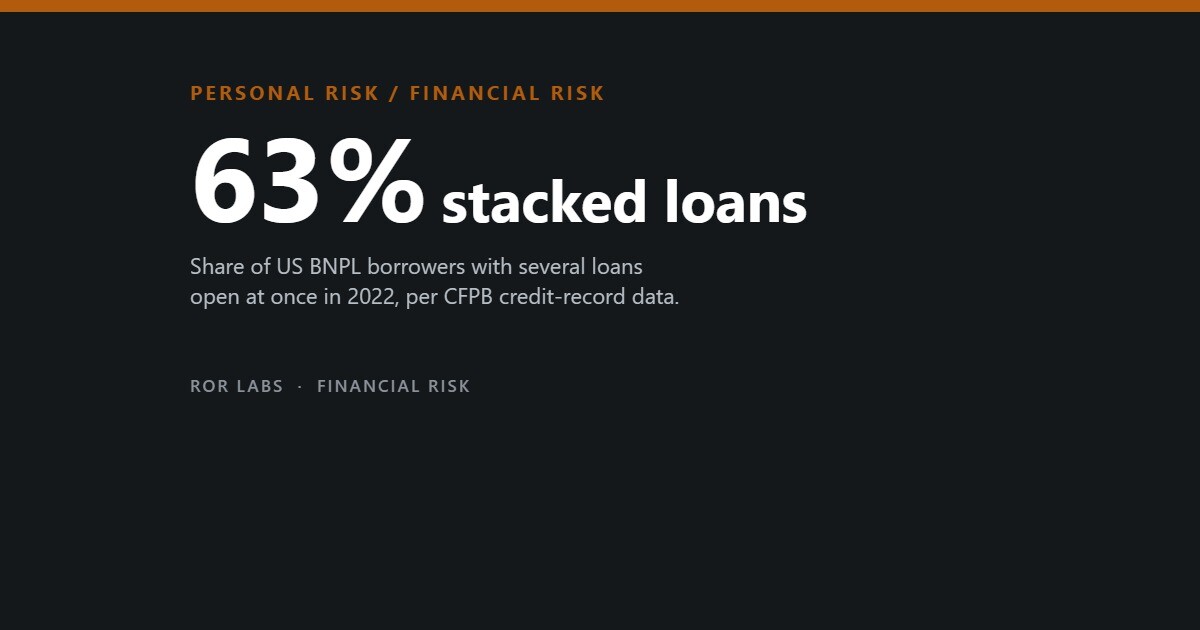
The same CFPB report found that 21.2% of consumers with a credit record used these loans in 2022, up from 17.6% in 2021, and that the average borrower took out 9.5 loans in the year. About a fifth were heavy users, opening more than one loan a month. And 63% of borrowers had several loans open at the same time at some point during the year, a pattern often called stacking.
Several loans at once
US buy now, pay later borrowers with a credit record, 2022.
Source: CFPB, Consumer Use of Buy Now, Pay Later and Other Unsecured Debt (January 2025).
Borrowing from several lenders matters because no single lender sees the whole picture. In months when they borrowed, BNPL users held $871 more in credit card debt and $453 more in personal loans than non-users with similar credit scores and ages. Among borrowers aged 18 to 24, these loans made up 28% of their unsecured debt in those months, against 17% across all ages.
Australia measured the human side earlier. In a 2020 ASIC survey of 1,655 users, 21% had missed a payment in the past year, 20% had cut back on or gone without essentials such as meals to keep up, and 15% had taken out another loan to pay on time. Late-fee revenue across the lenders ASIC reviewed rose 38% to more than A$43 million in 2018–19.
When paying on time costs something else
Share of users reporting each outcome in the past year.
Sources: Federal Reserve Board, Consumer & Community Context (August 2026); ASIC Report 672, Buy now pay later: an industry update (November 2020), survey of 1,655 users. Different surveys and years; not directly comparable.
Not every study finds knock-on damage. A July 2025 FCA occasional paper, using records for about 1.2 million British borrowers matched to credit files, found no clear effect of extra borrowing on 30-day arrears on other credit, though it did find modest evidence of more arrears on the loans themselves. Its data stopped before 2022, when the authors noted that harms may have grown.
Does it make people spend more
Lenders tell merchants that the product raises sales, and the academic evidence agrees. Marco Di Maggio, Justin Katz and Emily Williams of Harvard built a panel of about 400,000 users from the transaction records of roughly 10 million US consumers. Weekly spending rose by about $130 at the time of first use and stayed higher for the next 24 weeks. Only about $30 of that rise was the purchase made on the loan itself.
The increase was too large to be explained by people simply bringing forward purchases they would have made anyway, and it appeared even among users who did not seem short of cash. The authors called it a liquidity flypaper effect: extra credit offered at a shop tends to stick to shopping. Spending shifted towards retail, by around 12% as a share of the total at the time of use.
Two large studies of US bank and card data
What happened to people after they started using buy now, pay later.
Rise in weekly spending at first use: about $130
Part spent on the BNPL purchase itself: about $30
Stayed higher for 24 weeks; about 400,000 users
Overdraft charges: rose quickly
Credit card interest and fees: rose quickly
Compared with non-users; 10.6 million consumers
Sources: Di Maggio M, Katz J, Williams EC, NBER Working Paper 30508 (2022); deHaan E et al., Management Science (2024), doi:10.1287/mnsc.2022.03266.
A second study, by Ed deHaan and colleagues and published in Management Science in 2024, used bank data for 10.6 million US consumers. New users saw rapid increases in overdraft charges and credit card interest and fees compared with non-users, which the authors read as a sign of overborrowing. Experiments point to one mechanism: showing a price as four small instalments makes it feel cheaper, and people spend more.
The caution is the usual one for observational data. People start using these loans at particular moments, sometimes when money is already tight, and the CFPB found that credit card utilisation rose before first use. Both research teams used designs meant to deal with this, but neither is a randomised trial, and the Harvard study is a working paper.
The rules are changing
Britain has moved furthest. From 15 July 2026 the FCA regulates these loans as deferred payment credit. Lenders must check whether a borrower can afford to repay, give clear information before the agreement, contact borrowers who miss a payment and support those in difficulty. Borrowers can take complaints to the Financial Ombudsman Service, and the FCA says Section 75 refund protection applies. The rules cover new agreements only.
Australia brought the product under its national credit law on 10 June 2025. Providers now need a credit licence, and those offering low-cost contracts can follow modified responsible-lending rules. In the United States the picture is less settled. The CFPB issued an interpretive rule in May 2024 treating these lenders like credit card issuers, then said in May 2025 that it would not prioritise enforcing it. New York has since proposed its own licensing regime.
Credit reporting is shifting too. In June 2025 the main US credit-scoring company announced score versions that can include these loans, and at least one large lender began reporting them to bureaus. That could help other lenders see stacking. It could also mean that a missed instalment, which once stayed between borrower and lender, starts to follow people into a credit file.
What the evidence suggests
For most users, most of the time, pay-in-four behaves as advertised: about 2% of loans default, far below credit cards. The risk sits with a sizeable minority. A quarter of US users paid late in 2025, two in five among the lowest earners, and most borrowers had several loans open at once, often from different lenders who could not see each other. Large studies also find that easy instalments raise spending well beyond the item bought. Low default rates and real strain can both be true, because automatic payments shift the pain to bank accounts and other bills.
What to do
Steps sorted by when they matter. Each one says how strong the evidence is: Measured Official advice Untested
Before
- Count how many pay-later loans you have open at once, across all lenders. No single lender sees the whole picture. Measured see Sources
- Check that the linked account can cover each instalment date. Automatic payments shift the strain to overdrafts and other bills. Measured see Sources
Afterwards
- In the UK, new agreements from 15 July 2026 are regulated; complaints can go to the Financial Ombudsman Service. Official advice see Sources
What not to do
- Do not take another loan to make a payment on time. 15% of Australian users did. Measured see Sources
Not financial advice.
Questions people ask
Is buy now, pay later a loan?
Yes. It is short-term credit, usually without interest, repaid in instalments. Britain and Australia now regulate it as credit; US rules are still unsettled.
How many people pay late?
In the Federal Reserve’s 2025 survey, 26% of US users said they paid late at least once in the year, ranging from 11% among high earners to 40% among the lowest earners.
What is loan stacking?
Having several loans open at the same time, often with different lenders. In CFPB data for 2022, 63% of borrowers did this at some point.
Does it affect credit scores?
Historically, most lenders did not report these loans to credit bureaus. That is changing: new US score versions can include them, and some lenders now report.
Does it make people spend more?
Large US studies suggest so. One found weekly spending rose by about $130 at first use and stayed higher for 24 weeks.
The short version
- In 2025, 16% of US adults used buy now, pay later, up from 10% in 2021; 26% of users paid late at least once.
- Late payment tracks income: 40% of users earning under $25,000 paid late, against 11% of those earning $100,000 or more.
- In US credit-record data for 2022, 63% of borrowers had several BNPL loans open at the same time and 33% borrowed from more than one lender.
- Default on the loans themselves was low, about 2% of BNPL loans, against 10% of the credit cards the same borrowers held.
- Easy instalments appear to raise spending beyond the item bought, and Britain and Australia now regulate the loans as credit; US rules remain unsettled.
This article summarises published research and official reports for general information. It is not financial advice and does not recommend or compare any lender, product or app. If repayments are becoming hard to manage, a free, non-profit debt advice service in your country can help you look at your options.
Further reading: CFPB, Consumer Use of Buy Now, Pay Later and Other Unsecured Debt (January 2025), for the credit-record evidence on stacking. Federal Reserve Board, Economic Well-Being of U.S. Households in 2025, for who uses these loans and who pays late. Di Maggio, Katz and Williams, NBER Working Paper 30508, for the spending effect.
- Nudge: The Final Edition, Richard Thaler and Cass Sunstein (2021). How the way a choice is presented changes what people choose, from pensions to credit. Useful for understanding instalment framing; it does not deal with buy now, pay later in any depth.
- Broke in America, Joanne Samuel Goldblum and Colleen Shaddox (2021). An account of how US households on low incomes juggle bills and basic needs. Strong on the realities behind late-payment statistics; it is advocacy as much as analysis.
- The Psychology of Money, Morgan Housel (2020). Short essays on why people behave as they do with money. Readable and humane; it rests on stories rather than data and says little about credit products.
Sources
- Consumer Financial Protection Bureau. Buy Now, Pay Later: Market Trends and Consumer Impacts (September 2022).
- Consumer Financial Protection Bureau. Consumer Use of Buy Now, Pay Later and Other Unsecured Debt (January 2025).
- Federal Reserve Board. Economic Well-Being of U.S. Households in 2025 (May 2026), credit section and Table 41.
- Federal Reserve Board. Consumer & Community Context (August 2026).
- Di Maggio M, Katz J, Williams EC. Buy Now, Pay Later Credit: User Characteristics and Effects on Spending Patterns. NBER Working Paper 30508 (2022).
- deHaan E, Kim J, Lourie B, Zhu C. Buy Now Pay (Pain?) Later. Management Science (2024), doi:10.1287/mnsc.2022.03266.
- Maesen S, Ang D. Journal of Marketing (2024), doi:10.1177/00222429241282414.
- Ashby R et al. Journal of Retailing (2025), doi:10.1016/j.jretai.2025.01.003.
- Hayashi F, Routh A. Financial Constraints Among Buy Now, Pay Later Users. Federal Reserve Bank of Kansas City Economic Review (2025).
- Donou-Adonsou F, Leslie-Piper N. BNPL and financial fragility in U.S. households. Finance Research Letters 86:108423 (2025).
- Chan E et al. Occasional Paper 69: Impact of Buy Now Pay Later credit on consumer arrears. Financial Conduct Authority (July 2025).
- Financial Conduct Authority. The Woolard Review: a review of change and innovation in the unsecured credit market (February 2021).
- Financial Conduct Authority. Buy Now Pay Later, consumer information page (accessed October 2026).
- ASIC. Report 672, Buy now pay later: an industry update (November 2020).
- ASIC. Media release 25-069MR (2025).
- CFPB interpretive rule on BNPL (May 2024) and statement on enforcement priorities (May 2025), as reported by Orrick InfoBytes, 9 May 2025.
- Wang Z. Buy Now, Pay Later: Recent Developments and Implications. Federal Reserve Bank of Richmond Economic Brief 26-05 (February 2026).