Bank Branch Closures and Access to Cash: What the Evidence Shows
Key takeaways · 15 min read
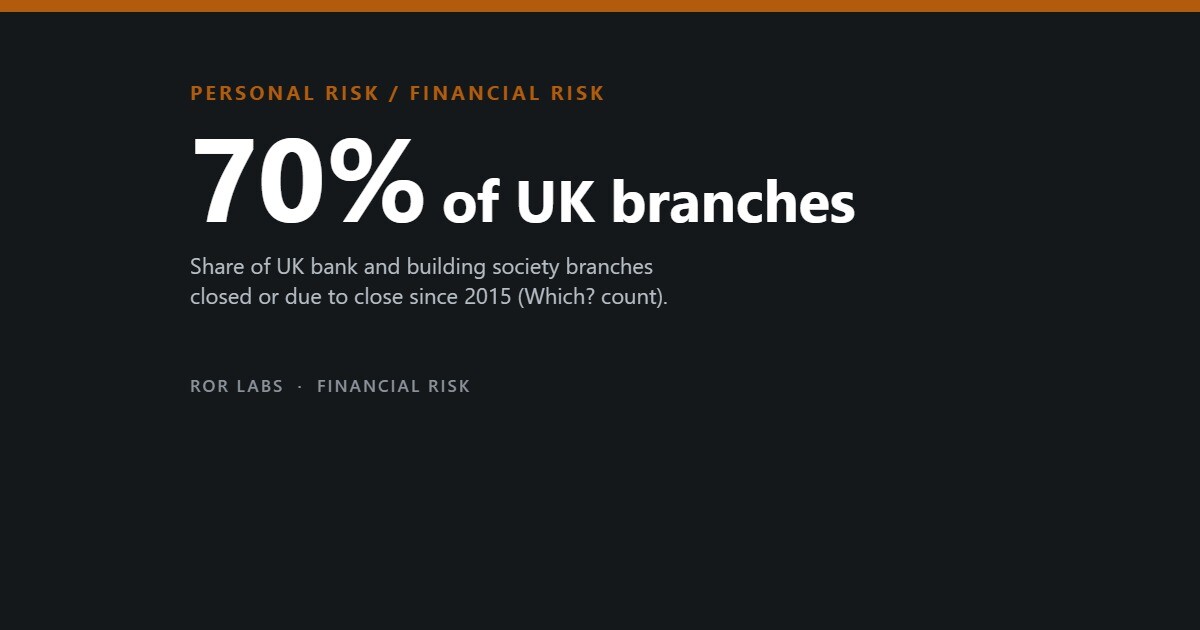
- Which? counts 6,896 UK bank and building society branch closures since January 2015, including those scheduled, about 70% of the network.
- Closures track falling use: cash fell from 58% of UK payments in 2009 to 9% in 2024, and it was 14% of US payments in 2025.
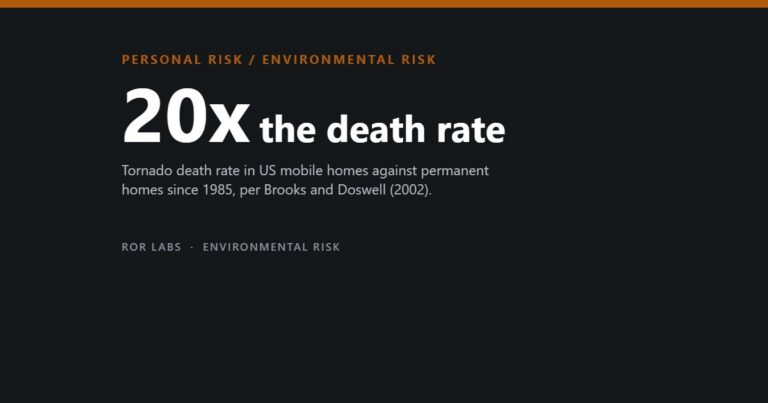
- The harm is concentrated. In the US, cash makes up 19% of payments by people aged 55 and over, against 6% for 18 to 24-year-olds, and the US counties that lost most of their branches were poorer than average.
- Branches still matter for small firms: one US study found a closing cut local small-business loan originations by $453,000 a year, off a $4.7 million baseline, for up to six years.
In this article
In January 2015 there were roughly ten thousand bank and building society branches in the United Kingdom. By the autumn of 2026, according to the consumer group Which?, 6,896 of them had closed or were scheduled to close, about 70% of the network. The pattern is similar, if slower, in the United States, and faster in Sweden. Each closure is a small local event. Taken together, they change how a country handles money.
Banks say they are following their customers, and the payment data largely back them. Cash fell from more than half of UK payments in 2009 to under a tenth in 2024. Yet the people who still depend on branches and cash are not a random tenth of the population. They are disproportionately older, poorer, rural or less confident online, and for them a closure can mean a bus ride, a fee or a lost loan.
This article looks at how far closures have gone, why they happen, who is affected, what they do to local lending, and how the UK and Sweden are responding. It describes research and official data. It is not financial advice and does not recommend any bank, account or provider.
How many branches have gone
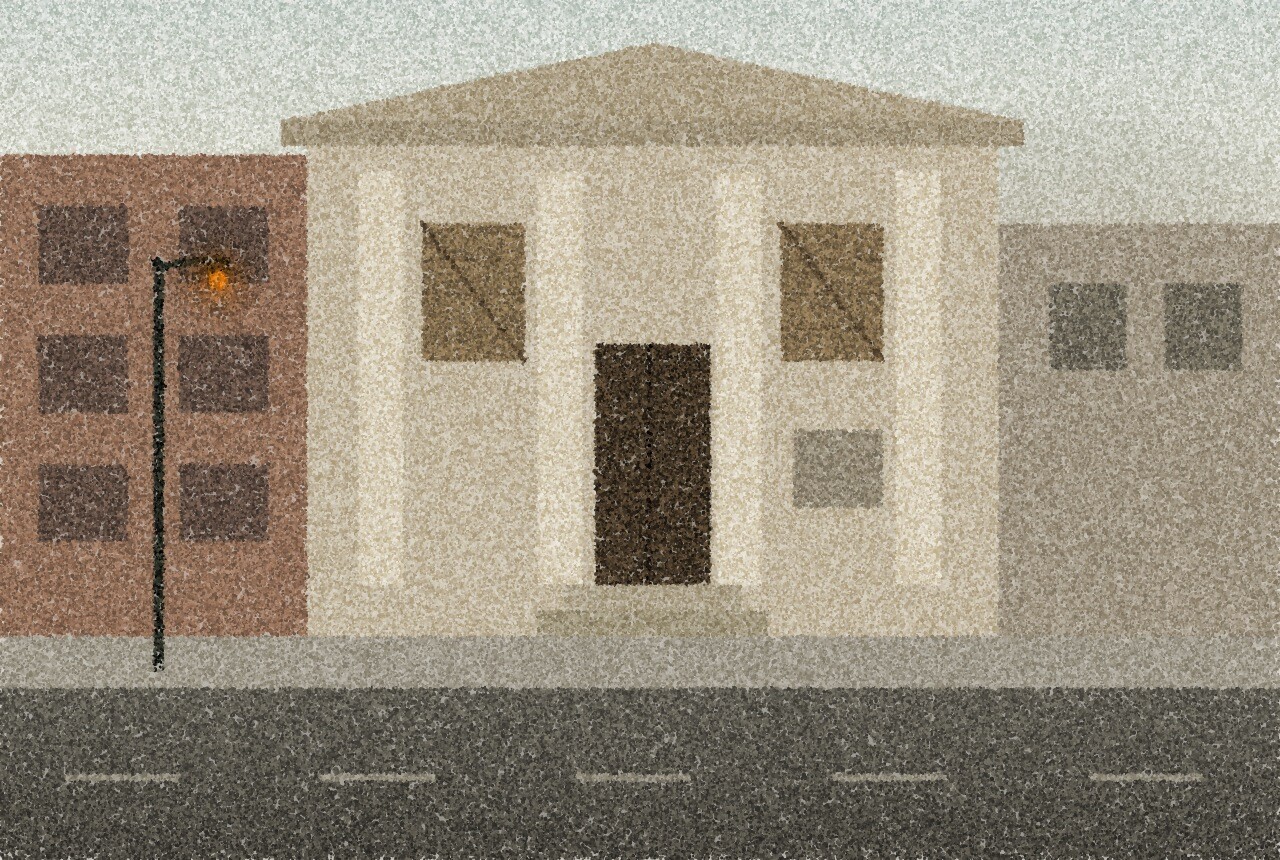
The UK count comes from Which?, which has tracked announcements since 2015. Closures peaked at 867 in 2017 and were still running at 433 in 2025, an average of about 53 a month over the whole period. Scotland has been hit hardest in proportion: 757 of its 1,041 branches have gone. Most closures came from a handful of large groups, which had the biggest networks to cut.
Other countries have followed different paths. In the United States, Jan Keil and Steven Ongena counted more than 11,000 branches closed by the early 2020s, about 11% of the peak stock in 2009. In Sweden, Niklas Amberg and Bo Becker report in a working paper that two-thirds of all branches closed over roughly two decades. Some OECD countries, Keil and Ongena found, have lost up to four in five.
How much of the branch network has gone
Share of bank branches closed, by country and period. Different sources and definitions.
Sources: Which? branch closure tracker (2026); Amberg N, Becker B, SSRN working paper (2024), “two thirds”; Keil J, Ongena S, Journal of Banking & Finance (2023), doi:10.1016/j.jbankfin.2023.107038.
These numbers are not strictly comparable. Which? includes closures that have been announced but not yet happened, and the American figure comes from a period before the most recent wave. But the direction is the same everywhere, and the UK has moved further than most large economies.
Closures follow falling use
The banks’ case rests on usage. According to UK Finance, cash was used for 58% of UK payments in 2009, 48% in 2014, 23% in 2019 and 9% in 2024. It forecasts 4% by 2034. In the United States, the Federal Reserve’s payment diary found cash was 14% of payments in 2025. In the euro area, where cash has held up better, its share of shop payments fell from 72% in 2019 to 52% in 2024.
Cash as a share of all UK payments
Share of payments by number made in cash. The 2034 figure is a forecast.
Source: UK Finance, UK Payment Markets 2025 (summary). 4.4 billion cash payments were still made in 2024.
Usage is not the whole story, though. When Keil and Ongena studied branch dynamics across 36 OECD countries and more than 84,000 American branches, technology explained some of the decline, but bank fragility and mergers explained an even larger part. Large banks used technology to shed branches; small banks closed them when they were weak or merging. Online banking itself mattered less than banks’ internal processing systems.
Causation can also run the other way. In a study published in Management Science, Hyun-Soo Choi and Roger Loh found that when cash machines closed in a densely populated city, affected customers increased their use of digital banking and used less cash. Closures follow falling use, but they also accelerate it, which makes the banks’ argument partly self-fulfilling.
Who still relies on cash

Falling averages hide a stable minority. The Financial Conduct Authority’s Financial Lives survey found that over 6% of UK adults, about 3.1 million people, used cash to pay for everything or most things in the year to May 2022. Among vulnerable groups the figure rose to 9%. The regulator said the strongest links with cash reliance were a household income below £15,000 and limited digital skills or access.
UK Finance notes that the decline in cash has slowed because the remaining use is concentrated among people with a strong preference for it. For some that is habit. For others, cash is a budgeting tool: notes in an envelope are harder to overspend than a contactless card. People in debt, on irregular incomes, or helping an older relative manage money often say the same. Closing the last branch in town does not change those needs, only the cost of meeting them.
Who still pays in cash
Cash share of payments by group, from three large surveys. Not directly comparable across countries.
| Survey | Group | Cash share | Comparison group |
|---|---|---|---|
| US payment diary, 2025 | Aged 55 and over | 19% | 6% (aged 18–24) |
| US payment diary, 2025 | Household income under $25,000 | about 17% | about 9% (over $150,000) |
| Euro area SPACE, 2024 | Aged 65 and over, in shops | 57% | 52% (all consumers) |
Sources: Federal Reserve Financial Services, 2026 Findings from the Diary of Consumer Payment Choice; European Central Bank, SPACE 2024 (December 2024).
The pattern holds elsewhere. In the American diary, cash made up 19% of payments by people aged 55 and over and 6% for those aged 18 to 24; it was about 17% for households earning under $25,000 and about 9% above $150,000. In the euro area, people aged 65 and over used cash for 57% of shop payments. Most people still find cash easy to get: 87% of euro-area adults said ATM access was fairly or very easy.
Banking deserts in the United States
In the United States the debate is framed around banking deserts, places where the nearest branch is far away. In a 2019 report, the Federal Reserve Board identified 44 counties that had 10 or fewer branches in 2012 and lost at least half of them by 2017. Thirty-nine were rural. In those rural counties, branches per 10,000 people fell from 5.5 to 2.3.
The affected counties were not typical. Their median poverty rate was 21%, against 17% for all rural counties; 20% of adults had no high-school diploma, against 14%; and African Americans made up 24% of the population, against 8% in other rural areas. The report noted that older adults and lower-income households were more likely than others to rely on tellers.
Where the US branch losses bit hardest
Rural counties that had 10 or fewer branches in 2012 and lost at least half by 2017.
Rural: 39 of 44
Branches per 10,000 people, rural ones: 5.5 → 2.3
Median poverty rate: 21%
No high-school diploma: 20%
Median poverty rate: 17%
No high-school diploma: 14%
Federal Reserve analysis, 2012–2017
Source: Board of Governors of the Federal Reserve System, Perspectives from Main Street: Bank Branch Access in Rural Communities (November 2019).
The national picture is less one-sided. A Federal Reserve Bank of New York study found that the evidence on whether low-income and minority neighbourhoods were especially exposed to closures was mixed. In the UK, a 2023 study of closures from 2015 to 2021 found that, unlike in earlier decades, affluent neighbourhoods were more at risk of losing a branch than more diverse ones, although rural areas remained the worst affected.
There are also signs of a turn. The National Community Reinvestment Coalition reported that American banks opened 267 branches and closed 217 in the first quarter of 2026, a net gain of 50, mostly in fast-growing southern metropolitan areas. That does little for the 209 counties it counts with only one full-service branch left.
What closures do to local lending
Branches are not only for cash. They are where loan officers learn about local businesses, information that is hard to put into a credit score. Hoai-Luu Nguyen tested whether that still matters by studying closures that followed bank mergers in the 2000s, which gave closures a cause unrelated to local business conditions. The result, published in 2019, was clear: after a closure, annual small-business loan originations in a census tract fell by $453,000, off a baseline of $4.7 million.
What one closure did to local small-business lending
Annual small-business loan originations in a US census tract, before and after a branch closing. Closings that followed 2000s mergers.
Source: Nguyen H-LQ, American Economic Journal: Applied Economics 11(1) (2019). The fall persisted for up to six years and faded within six miles.
The drop lasted for up to six years and was highly local, fading within about six miles, and it was especially severe during the financial crisis. Mortgage lending, which relies more on standardised information, recovered faster. Amberg and Becker found a similar pattern in Sweden: lending fell mainly to small, risky firms with little collateral, and local employment and sales declined. Their study is a working paper and has not yet been peer reviewed.
Not every study finds lasting damage. An analysis of Italian closures from 2010 to 2014 found that a closure made it more likely that a firm’s relationship with that bank would end, but did not generally reduce the total credit firms received; only small borrowers and short-term credit lines saw a temporary squeeze. The likely difference is competition: where other lenders are nearby and willing, firms can switch.
The UK access to cash rules
In 2024 the UK put access to cash on a statutory footing. Rules from the Financial Conduct Authority took effect on 18 September 2024. They require 14 designated banks and building societies to assess whether a community has an access gap whenever a branch or cash machine is due to close, and to respond to requests from residents and local groups.
If an assessment finds a significant gap, the firms must provide something reasonable, such as a banking hub, a deposit-taking machine or services through the Post Office, and keep the existing facility open until it is in place, with a three-month backstop. The government’s benchmark is that 95% of people should be within one mile of free cash withdrawal in urban areas and three miles in rural areas. LINK, which runs the UK’s cash machine network, carries out the assessments.
The UK’s replacement: banking hubs
Shared counters where customers of several banks can withdraw and deposit cash. Autumn 2026.
Sources: LINK, bank branches and banking hubs data (2 October 2026); GOV.UK, 18 September 2026. Which? counts 6,896 branch closures since 2015 over the same period.
Hubs are the visible result. LINK had recommended 283 by October 2026, and the 250th opened in Chepstow in September after the town lost its last branch. The government has promised at least 350. A hub is not a branch: it offers counter services for cash and a rotating community banker on certain days, and residents of places that do not qualify can still face long trips.
Sweden’s cashless shift and second thoughts
Sweden is the test case for what happens when cash nearly disappears. In the Riksbank’s 2026 Payments Report, only 5% of respondents said they had used cash for their most recent purchase in a shop in 2025, against around 40% a decade earlier. Only 67% of small businesses surveyed accepted cash, although acceptance was much higher among those selling food, medicine and fuel.
The central bank is now among the strongest voices for keeping cash. It has recommended that retailers of essential goods be obliged to accept it, and a government inquiry proposed that food, medicine and public charges should be payable in cash. The Riksbank’s worry is resilience as much as inclusion: between May and September 2025, up to 30% of the main shared ATM network’s machines were temporarily out of service.
Whether this is a reversal is debatable. Cash use has not recovered, and the proposals had not become law by the time of the 2026 report. What has changed is the argument. Sweden’s experience suggests that once a country is mostly cashless, keeping the remaining system working costs more per user, and someone has to decide who pays for it.
What the evidence suggests
Branch and cash machine closures mostly follow how people already pay, and most people adapt without much trouble. But closures are also driven by mergers and bank finances, and they speed up the shift they respond to. The costs fall on a minority that is older, poorer, more rural and less digitally confident than average, and on small firms that depend on a local lender. The UK now treats access to cash as something banks must plan for, Sweden is debating how to protect what is left, and the United States still leaves it largely to the market.
Questions people ask
How many UK bank branches have closed since 2015?
Which? counts 6,896 closures, including those already scheduled, by autumn 2026. That is about 70% of the branches open at the start of 2015.
What is a banking hub?
A shared counter, usually run with the Post Office, where customers of several banks can withdraw and deposit cash and see a community banker on set days.
Who is most affected by bank branch closures?
People who rely most on cash and counters: older adults, low-income households, rural residents and people with limited digital skills, plus small businesses that borrow locally.
Do branch closures reduce lending?
For small businesses, often. A US study found local small-business lending fell by about a tenth for up to six years, though an Italian study found little overall effect.
Is Sweden going back to cash?
Not in practice: only 5% paid cash at their last shop purchase in 2025. But its central bank wants shops selling essentials to be required to accept cash.
The short version
- Which? counts 6,896 UK bank and building society branch closures since January 2015, including those scheduled, about 70% of the network.
- Closures track falling use: cash fell from 58% of UK payments in 2009 to 9% in 2024, and it was 14% of US payments in 2025.
- The harm is concentrated. In the US, cash makes up 19% of payments by people aged 55 and over, against 6% for 18 to 24-year-olds, and the US counties that lost most of their branches were poorer than average.
- Branches still matter for small firms: one US study found a closing cut local small-business loan originations by $453,000 a year, off a $4.7 million baseline, for up to six years.
- Since September 2024 UK banks must assess cash access when services close; 283 banking hubs had been recommended by October 2026. Sweden, where only 5% paid cash at their last purchase, is now debating an obligation to accept it.
This article summarises published research and official data for general information. It is not financial advice and does not recommend any bank, account, payment method or provider. If a closure affects you or your community, your bank, LINK in the UK, or local consumer and advice services can explain what alternatives are available.
Further reading: Nguyen, American Economic Journal: Applied Economics 11(1) (2019), for the clearest evidence that branches still matter for local lending. The FCA’s PS24/8 policy statement (2024), for how the UK access to cash rules work. The Riksbank’s Payments Report 2026, for what a nearly cashless country is now worried about.
- Cloudmoney, Brett Scott (2022). A former broker’s argument that the push towards digital payments serves banks and tech firms more than users. Lively and well informed; it is an advocate’s case for cash rather than a balanced survey.
- The Future of Money, Eswar Prasad (2021). An economist on how digital payments, central bank digital currencies and the decline of cash may reshape finance. Thorough on the system; it says less about people left behind at the local level.
- Broke in America, Joanne Samuel Goldblum and Colleen Shaddox (2021). An account of what poverty costs in the United States, including the price of basic financial services. Grounded in real households; banking access is one theme among many.
Sources
- Nguyen H-LQ. Are credit markets still local? Evidence from bank branch closings. American Economic Journal: Applied Economics 11(1) (2019).
- Keil J, Ongena S. The demise of branch banking: technology, consolidation, bank fragility. Journal of Banking & Finance (2023), doi:10.1016/j.jbankfin.2023.107038.
- Amberg N, Becker B. Banking without branches. SSRN working paper (2024), doi:10.2139/ssrn.4723120. Not peer reviewed.
- Clark S, Newing A, Hood N, Birkin MH. Retail banking closures in the United Kingdom. Transactions of the Institute of British Geographers (2023), doi:10.1111/tran.12656.
- Choi H-S, Loh RK. Physical frictions and digital banking adoption. Management Science (2023), doi:10.1287/mnsc.2023.4972.
- Morgan DP, Pinkovskiy ML, Yang B. Banking deserts, branch closings, and soft information. Federal Reserve Bank of New York (2016).
- Garrì I. The effects of bank branch closures on credit relationships. Banca d’Italia working paper 1254 (2019).
- Board of Governors of the Federal Reserve System. Perspectives from Main Street: Bank Branch Access in Rural Communities (November 2019).
- Financial Conduct Authority. PS24/8: Access to cash, final rules (2024), and press release.
- LINK. Bank branches and banking hubs data (accessed October 2026).
- GOV.UK. UK’s 250th banking hub opens in Chepstow, 18 September 2026.
- Which?. Bank branch closures tracker (accessed October 2026).
- UK Finance. UK Payment Markets 2025, summary.
- Bank of England. Will cash die out? (updated August 2025).
- European Central Bank. Study on the payment attitudes of consumers in the euro area (SPACE) 2024.
- Federal Reserve Financial Services. 2026 Findings from the Diary of Consumer Payment Choice.
- National Community Reinvestment Coalition. After 15 years of bank closures, new branches are having a resurgence (2026).
- Sveriges Riksbank. Payments Report 2025 and Payments Report 2026.