Prebunking and Psychological Inoculation: What the Evidence Shows
Key takeaways · 14 min read
- A 2023 meta-analysis of 42 studies and 42,530 people found prebunking made misinformation look less credible, a small-to-moderate effect, and slightly improved people’s ability to tell true from false.
- In a YouTube field test, a 30-second prebunking ad improved recognition of a manipulation technique, but the effect was small and was measured only within 24 hours.
- A 2023 reanalysis of the game studies argued players became more sceptical of all news, true and false, rather than better at telling them apart. The developers’ own reanalysis disagrees.
- The effect fades: in one experiment it fell by more than half within a month, unless people got a booster.
Correcting a false claim after it has spread is slow, and the correction rarely reaches everyone who saw the original. Prebunking tries the opposite order. Instead of chasing each falsehood, it warns people in advance about the tricks that misinformation tends to use, such as scapegoating, fake experts or emotionally loaded language, and shows them a weakened example so they can recognise it later.
The idea has moved quickly from the psychology lab to Google advertising campaigns seen by tens of millions of people in Europe. It has also drawn serious criticism: that its measured effects are small, that they fade within weeks, and that some versions may simply make people distrust everything, including accurate news.
This article sets out what the trials found, how large the effects are, how long they last, and where the critics have a point. Much of the research comes from one academic network working with Google’s Jigsaw unit, which is worth keeping in mind throughout.

What prebunking is
Prebunking rests on inoculation theory, which dates from the 1960s, when it was proposed as a kind of vaccine against persuasion. The medical analogy is deliberate: expose people to a weakened dose of a misleading argument, explain why it is misleading, and they should resist the full-strength version. Early work inoculated people against particular claims. The newer approach targets techniques, on the theory that one lesson about, say, false dichotomies protects against many different falsehoods that use it.
The best-known tools are free online games developed with researchers at the University of Cambridge. In Bad News, which takes about 15 minutes, players act as a fake-news producer, gaining followers by using six techniques, from impersonation and emotional language to conspiracy theories and trolling. Go Viral!, a five-minute version about COVID-19, was supported by the UK Cabinet Office, the World Health Organization and the United Nations. By late 2022, Bad News had been played more than a million times in 19 languages.
What the lab studies show
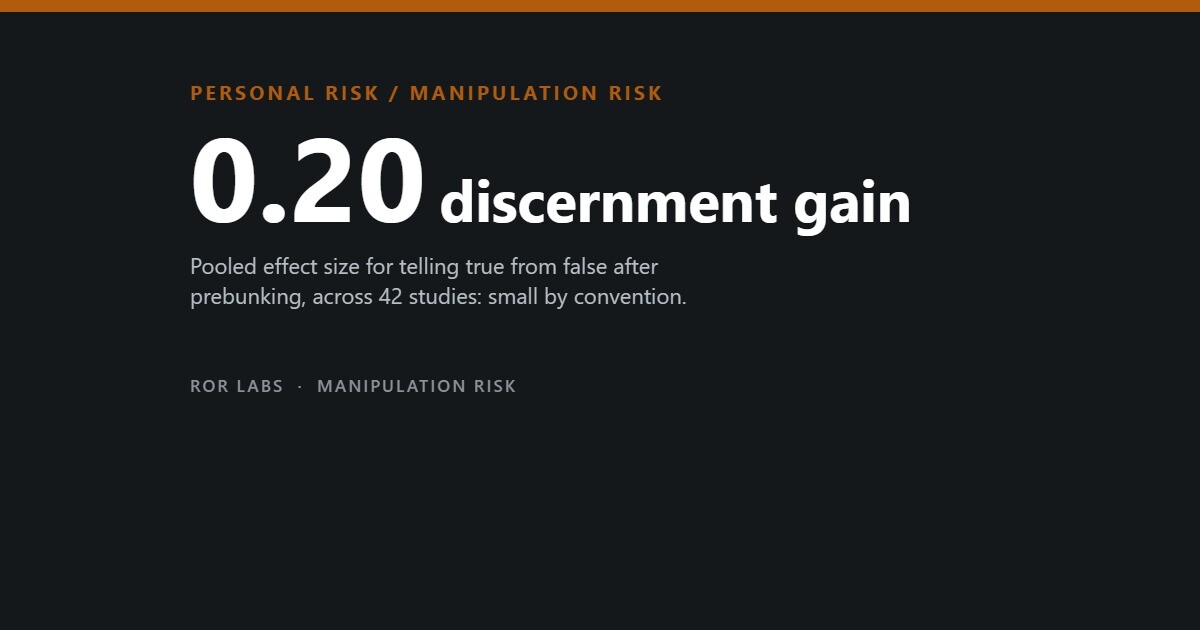
The fairest single summary is a 2023 meta-analysis in the Journal of Medical Internet Research, pooling 42 independent studies with 42,530 participants. Prebunking reduced how credible people found misinformation, with an effect size of 0.36, small to moderate by conventional standards. It also slightly raised the credibility of accurate information and improved credibility discernment, the ability to tell the two apart, by 0.20.
What prebunking changed, on average
Pooled effect sizes (Cohen’s d, absolute values) from 42 studies. Around 0.2 is conventionally small; around 0.5, moderate.
Source: Lu C et al., Journal of Medical Internet Research 25:e49255 (2023), doi:10.2196/49255. The sharing effect had a 95% confidence interval spanning zero.
Two cautions apply. The effect on willingness to share misinformation looked sizeable but was not statistically significant: its confidence interval ran from a large benefit to a slight harm. And most of these studies measure judgements of headlines in a survey a few minutes after the intervention, not what people believe or do weeks later on their own phones.
The YouTube experiment
Games take time; few people will play one. So in 2022 the Cambridge group and Jigsaw tested five short animated videos, each explaining one technique: emotionally manipulative language, incoherence, false dichotomies, scapegoating and ad hominem attacks. In six randomised online studies with 6,464 participants, published in Science Advances, the videos improved people’s recognition of the techniques and the quality of their sharing decisions, across the political spectrum.
The researchers then ran two of the videos as real YouTube adverts in the United States. According to the press release, about 5.4 million people were shown one, and almost a million watched for at least 30 seconds. A random 30% of viewers, and a matched control group, were later asked a single test question inside YouTube, a median of 18.4 hours afterwards; 22,632 answered. Recognition was higher in the treated group, by about 5% on average.
The YouTube field test in numbers
Two prebunking videos run as adverts to US YouTube users, 2022.
| Measure | Result |
|---|---|
| Watched at least 30 seconds | about 967,000 |
| Answered the test question | 22,632 |
| Timing of the question | within 24 hours (median 18.4 hours) |
| Effect size, both videos combined | h = 0.09 |
| Effect size, emotional language / false dichotomies | h = 0.05 / h = 0.13 |
| Cost per 30-second view | about $0.05 |
Source: Roozenbeek J et al., Science Advances 8(34):eabo6254 (2022), doi:10.1126/sciadv.abo6254. Cohen’s h of 0.2 is conventionally small.
Measured by Cohen’s h, a standard effect size for proportions, the combined effect was 0.09, well under the usual threshold for “small”. The authors listed the limits themselves: one test item per person, a 24-hour window, US viewers only, and no measure of behaviour. At five cents a view, a small effect across millions of people may still be worth having, but it is a modest result.
Campaigns at scale

Jigsaw has since run prebunking adverts as public campaigns. From September 2022 it targeted false claims about Ukrainian refugees in Poland, Czechia and Slovakia. By its own account the videos were watched more than 38 million times, reaching nearly a third of the three populations, and the best result was an 8 percentage-point rise in the share of viewers who identified a manipulation technique. The effect was strongest in Poland and minimal in Slovakia. These figures come from the platform running the campaign, from short surveys of viewers, and were not published as peer-reviewed research.
Before the 2024 European Parliament elections, a larger campaign with similar videos reached more than 120 million YouTube users. A peer-reviewed test of those videos, published in March 2026, ran 13 survey experiments in 12 EU countries with 19,735 participants.
Two European campaigns
Prebunking adverts run by Google’s Jigsaw unit and the evidence behind them.
Views: 38 million+
Best gain in spotting a technique: 8 points
Slovakia: minimal effect
Jigsaw’s own figures, not peer reviewed
Users reached: 120 million+
Gain in telling manipulative from neutral posts: d 0.03–0.12
Gain in recognising the technique: d 0.20–0.38
13 survey experiments, 19,735 people
Sources: Jigsaw, Medium, 13 February 2023; Biddlestone M et al., Communications Psychology 4:77 (2026), doi:10.1038/s44271-025-00379-3.
That study found the videos made people better at recognising the technique being taught, but its effect on telling manipulative from neutral posts was very small, with effect sizes between 0.03 and 0.12; the authors called the effects small. A January 2026 field study on Instagram, by members of the same group, reported larger gains: UK users shown a 19-second advert scored 21 percentage points better than controls on a quiz, with effects lasting five months. But only 806 of the 375,597 people shown the advert took the quiz, and people who choose to answer may differ from those who do not.
Discernment or blanket scepticism
The sharpest criticism concerns what the games actually change. An intervention can lower belief in false headlines in two ways: by making people better at spotting falsehood, or by making them more doubtful of everything. Only the first is useful. A person who rejects all news has not become well informed; they have swapped one error for another.
In 2023 the psychologists Ariana Modirrousta-Galian and Philip Higham reanalysed five Bad News and Go Viral! studies using signal detection methods, which separate these two effects. Where the true and false headlines were comparable, they found the games did not improve discrimination. Players instead answered “false” more often to every item. They concluded the games were not as effective as previously thought and might even be counterproductive.
The developers replied with their own signal detection reanalysis. Published in 2025, it pooled 33 inoculation experiments with 37,025 participants and found that both games and videos improved discrimination without shifting people towards blanket scepticism. That is reassuring, but the studies came from the developers’ own research group, and an independent replication would carry more weight. A classroom study of a similar game found it worked better than a standard source-checking checklist but left some students overly sceptical of trustworthy messages.
Two reanalyses, two conclusions
Signal detection reanalyses separating real discernment from a general shift towards doubt.
| Reanalysis | Data | Finding |
|---|---|---|
| Modirrousta-Galian and Higham, 2023 (independent) | 5 studies of Bad News and Go Viral! | No better discrimination; more “false” answers to all news |
| Simchon et al., 2025 (developers’ group) | 33 experiments, 37,025 people | Better discrimination; no shift towards doubt |
Sources: Modirrousta-Galian A, Higham PA, J Exp Psychol Gen (2023), doi:10.1037/xge0001395; Simchon A et al., Curr Opin Psychol (2025), doi:10.1016/j.copsyc.2025.102194.
Some of the disagreement is about test items: if true headlines in a study are blander than the false ones, any intervention can look better or worse than it is. The safer reading is that technique-based prebunking does help people recognise techniques, while its effect on judging real news remains contested.
How long it lasts
Vaccines need boosters, and so, it seems, does inoculation. In three longitudinal experiments with Bad News published in 2021, the effect held for at least three months when participants were tested repeatedly, but decayed significantly over two months when they were not, to the point where it was no longer statistically significant.
A 2025 study in Nature Communications measured the decline more precisely. In one experiment on climate misinformation, the inoculation effect fell from an effect size of 0.74 at the start to 0.28 after a median of 29 days, a loss of more than half. Participants who received a second, booster dose around ten days in were still at 0.48 after a month. The booster worked by improving memory of the lesson, not motivation.
The fading effect, and the booster
Effect of a text-based inoculation against climate misinformation, compared with controls (Cohen’s d).
Source: Maertens R et al., Nature Communications (2025), doi:10.1038/s41467-025-57205-x, Study 1. Median follow-up 29 days.
For a short video, the window may be much shorter. The authors of a later field study noted that earlier work had found the effect of their emotional-language video decaying within 48 hours. A campaign that runs once before an election may protect people for days, not for the whole campaign.
From belief to behaviour

The ultimate aim is to change what people share, not just how they rate headlines. The most direct test so far, published in 2025, ran the emotional-language video as adverts on Twitter, now X, to US users who followed accounts that had shared misinformation. It found no meaningful difference in what the treated and control groups posted. In the first study, links to unreliable sites made up 0.47% of link-carrying posts in both groups.
The authors, including the field’s leading researchers, were candid that this was not a clean test. Because of how the platform matched advertising lists, at most about 7.5% of targeted users could have seen the video, and nobody knew which. They argued the null result probably reflects that noise rather than proof the video does nothing. A 2026 systematic review of 72 studies added a different doubt: few tested whether the interventions work through the mechanisms inoculation theory proposes.
A field test of sharing behaviour
Prebunking video run as Twitter/X adverts to US users linked to misinformation accounts.
| Measure | Result |
|---|---|
| Accounts in the study | 967,640 |
| Share who could have seen the video | at most about 7.5% |
| Unreliable links, treated group | 0.47% of posts with links |
| Unreliable links, control group | 0.47% of posts with links |
| Follow-up survey responses | 68 |
Source: Roozenbeek J et al., Royal Society Open Science (2025), doi:10.1098/rsos.251377. Figures for links are from Study 1.
What the evidence suggests
Prebunking is one of the better-tested tools against misinformation, and it is cheap. In surveys it reliably helps people recognise specific manipulation techniques, and on average it makes false headlines look somewhat less credible. Beyond that the evidence thins. Whether it improves the judgement of real news or just breeds general doubt is disputed; the effects fade within weeks without a booster; field effects are small; and the one large test of real sharing behaviour found nothing it could detect. Much of the research comes from the same group that designs the tools, often with Google, so independent replication matters. Better discernment, not blanket scepticism, is the goal to judge it by.
Questions people ask
What is prebunking?
Warning people in advance about a misleading technique or claim, with a weakened example, so they recognise it when they meet it. It is based on inoculation theory from social psychology.
Does prebunking work?
In surveys, modestly. A meta-analysis of 42 studies found misinformation was judged less credible, with a small-to-moderate effect; field effects are smaller.
Can prebunking make people distrust true news?
Possibly. An independent reanalysis found two popular games made players doubt all news more; the developers’ own larger reanalysis found no such shift.
How long does the effect last?
Often weeks rather than months. In one study the effect fell by more than half within a month, while a booster dose after ten days kept more of it.
What is the Bad News game?
A free 15-minute online game in which players act as a fake-news producer and learn six common manipulation techniques by using them.
The short version
- A 2023 meta-analysis of 42 studies and 42,530 people found prebunking made misinformation look less credible, a small-to-moderate effect, and slightly improved people’s ability to tell true from false.
- In a YouTube field test, a 30-second prebunking ad improved recognition of a manipulation technique, but the effect was small and was measured only within 24 hours.
- A 2023 reanalysis of the game studies argued players became more sceptical of all news, true and false, rather than better at telling them apart. The developers’ own reanalysis disagrees.
- The effect fades: in one experiment it fell by more than half within a month, unless people got a booster.
- The one large field test of real sharing behaviour found no detectable change, though so few targeted users saw the video that the test was inconclusive.
This article summarises published research for general information. It does not endorse any campaign, platform or organisation, and it is not a guide to whether any particular claim is true. For questions about a specific claim, look for established fact-checking organisations and the original sources they cite, and be as careful about rejecting accurate reporting as about accepting false claims.
Further reading: Lu et al., Journal of Medical Internet Research (2023), for the pooled evidence. Modirrousta-Galian and Higham, Journal of Experimental Psychology: General (2023), for the strongest critique. Maertens et al., Nature Communications (2025), for why the effect fades and what boosters do.
- Foolproof, Sander van der Linden (2023). The leading researcher behind prebunking explains why people fall for misinformation and how inoculation is meant to work. Clear and lively; it is the developer’s own case and gives the critics limited space.
- Not Born Yesterday, Hugo Mercier (2020). A cognitive scientist argues that people are far less gullible than commonly feared, and that the bigger problem is rejecting good information. A useful counterweight; some readers find it too relaxed about online falsehood.
- The Misinformation Age, Cailin O’Connor and James Owen Weatherall (2019). Two philosophers of science show how false beliefs spread through social networks even among careful people. Thoughtful on the social side; it relies on models and history rather than intervention trials.
Sources
- Lu C, Hu B, Li Q, Bi C, Ju X-D. Psychological inoculation for credibility assessment, sharing intention, and discernment of misinformation: systematic review and meta-analysis. J Med Internet Res 25:e49255 (2023), doi:10.2196/49255.
- Roozenbeek J, van der Linden S, Goldberg B, Rathje S, Lewandowsky S. Science Advances 8(34):eabo6254 (2022), doi:10.1126/sciadv.abo6254.
- University of Cambridge press release on the YouTube experiment, reported by Phys.org, August 2022.
- Modirrousta-Galian A, Higham PA. J Exp Psychol Gen (2023), doi:10.1037/xge0001395.
- Simchon A, Zipori T, Teitelbaum L, Lewandowsky S, van der Linden S. Curr Opin Psychol (2025), doi:10.1016/j.copsyc.2025.102194.
- Maertens R, Roozenbeek J, Basol M, van der Linden S. J Exp Psychol Appl (2021), doi:10.1037/xap0000315.
- Maertens R et al. Psychological booster shots targeting memory increase long-term resistance against misinformation. Nature Communications (2025), doi:10.1038/s41467-025-57205-x.
- Roozenbeek J et al. Misinformation interventions and online sharing behaviour. R Soc Open Sci (2025), doi:10.1098/rsos.251377.
- Biddlestone M et al. Video inoculation against election misinformation across 12 EU nations. Communications Psychology 4:77 (2026), doi:10.1038/s44271-025-00379-3.
- van der Linden S et al. Prebunking misinformation techniques in social media feeds: results from an Instagram field study. Harvard Kennedy School Misinformation Review 7(1) (2026).
- Loughnan D et al. An analysis of studies testing digital interventions to inoculate against misinformation: a systematic review (2026), doi:10.1177/00936502251411467.
- Traberg CS, Roozenbeek J, van der Linden S. Annals of the American Academy of Political and Social Science (2022), doi:10.1177/00027162221087936.
- Goodsett M. Chaos creator. Journal of Information Literacy (2024).
- Jigsaw. Defanging disinformation’s threat to Ukrainian refugees. Medium, 13 February 2023.
- UW Center for an Informed Public, 3 September 2026.