Surfing injuries, your own board and the shark in proportion
Key takeaways · 9 min read
- Most acute surfing injuries are cuts from the surfer’s own board, often the fin.
- Big waves, reef or rock bottoms and inexperience raise injury risk two- to threefold.
- Shark deaths are rare; drowning, mostly in rip currents and away from patrols, is the bigger risk.
- No prevention trials exist, but patrolled beaches, leashes, soft boards and earplugs follow the evidence.
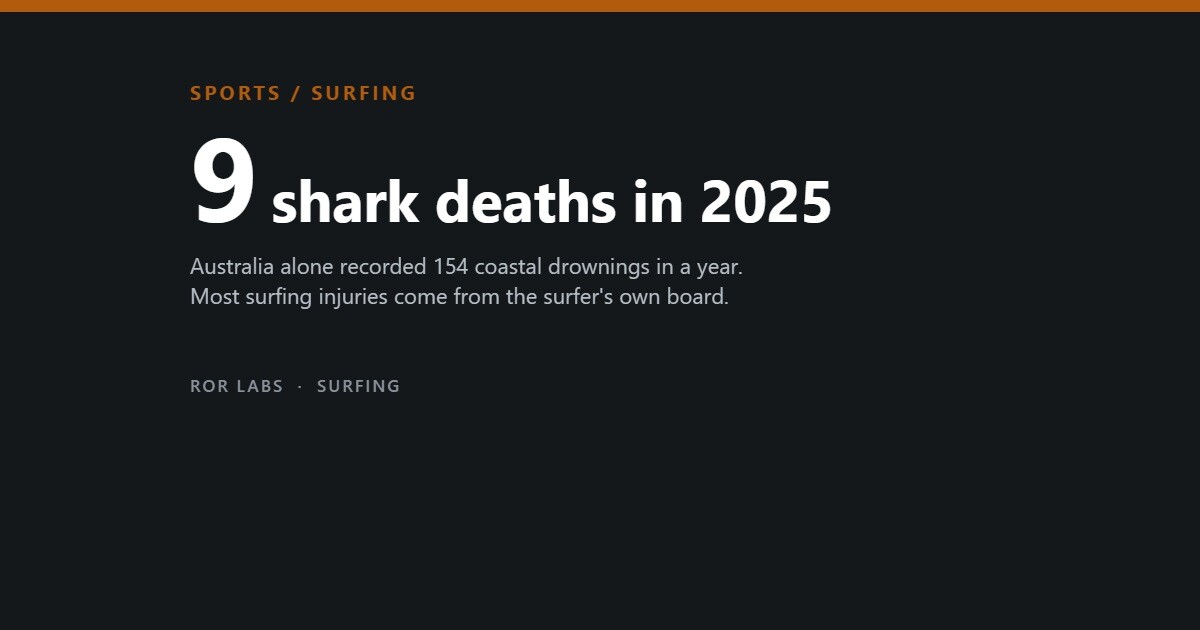
On 6 September 2025 a surfer was killed by a shark about 100 metres off Long Reef, a northern Sydney beach, in an unpatrolled area. It made news around the world, as shark deaths always do. That year the International Shark Attack File recorded 65 unprovoked bites worldwide and nine unprovoked deaths, five of them in Australia. In roughly the same twelve months, Australia recorded 154 coastal drowning deaths.
For surfers, the shark is the most feared risk and one of the least likely. The commonest injury is caused by the surfer’s own board, and the most serious everyday risks are water, rock and wave size. All of these follow patterns that experienced surfers learn, and that beginners can learn faster.
This article follows the series format: what surfers actually injure, where the risk concentrates, what has been measured to reduce it, and why the answer is not to stay on the beach.
What actually gets injured
Surfing injury rates vary widely between studies because surfers are hard to count. A 2021 review found rates from 1.1 to 13 injuries per 1,000 hours of surfing. An online survey of 1,348 recreational and competitive surfers found 1.79 major acute injuries per 1,000 hours, most often to the shoulder, ankle and head. A Portuguese survey of 1,016 surfers found 1.23 per 1,000 hours.
The mechanism is remarkably consistent. In a 22-nation survey of 471 surfers, cuts were the commonest injury at 37.4%, and 52.4% of injuries came from the surfer’s own board; the fin caused half of those. In Victoria, Australia, striking a board or another surfer caused 45.2% of significant injuries and wipeouts 36.3%; the head and face made up 26.2% of injuries in the survey but 42% of those seen in emergency departments. A systematic review of 19 studies found being struck by one’s own board caused 38.6% of injuries in surveys and 73.4% of those seen in hospitals, where the face, head and neck were the site in 43.1% of cases.
What hurts surfers
Mechanism and type of acute surfing injuries across surveys and hospital studies.
Source: McArthur et al., Sports 8(2):25 (2020); Dau, Dingerkus and Lorenz, 22-nation surfing injury survey (2005).
Surfing also wears people down. A New Zealand study of 1,473 surfers found chronic and gradual-onset injuries at 1.72 per 1,000 hours, led by the shoulder, lower back and neck, with prolonged paddling the cause of 40%. That is not surprising: about half of surfing time is spent paddling and only 4% to 5% riding waves. In US emergency departments, an estimated 131,494 surfing injuries were treated from 2002 to 2013. Lacerations were 40.7%, and 95.7% of patients were treated and sent home.
Chronic and emergency injuries
Slow-onset injuries in New Zealand surfers, and US emergency department data.
Source: Remnant, Unitec research thesis (2017); Méndez-Villanueva and Bishop, Sports Medicine 35(1) (2005); Klick, Jones and Adler, American Journal of Emergency Medicine (2016).
When the risk concentrates
Wave size and what lies underneath matter most. In a study of 32 competitive surfing contests, waves overhead or bigger raised injury risk 2.4 times, and surfing over rock or reef rather than sand raised it 2.6 times. Among recreational surfers, the most catastrophic outcomes are drowning and head and neck injuries, often from hitting the seafloor. Experience helps: in the Portuguese survey, surfers with less than five years in the water had 1.65 times the injury risk of more experienced surfers.
Two conditions are specific to surfing. Surfer’s myelopathy is a rare, non-traumatic injury to the spinal cord that affects beginners. In a Hawaiian series of 19 patients, all were novices and 17 were surfing for the first time; sudden low back pain was followed by weakness or paralysis within an hour. A review of 64 cases found only 42% recovered neurological function. A wider review of 104 cases of this kind of spinal cord injury found 58% followed surfing, and only about half of patients partly recovered. Surfer’s ear is common and slow: bony growths narrow the ear canal after years in cold water and wind. In New Zealand, more than 90% of those who had surfed for over ten years had them, and in one US study 73.5% of avid surfers did. In a New Zealand survey, self-reported prevalence rose from 7.1% of beginners to 55.6% of expert surfers.
The shark, in proportion
Shark bites worldwide in 2025, against coastal drowning in Australia alone.
Unprovoked bites: 65
Unprovoked deaths: 9
Share of incidents involving surfers or board sports: 32%
International Shark Attack File
Coastal drowning deaths: 154
Share involving rip currents: at least 37%
Aged 55 or older: 55%
Surf Life Saving Australia
Source: International Shark Attack File, Florida Museum, 2025 summary; Surf Life Saving Australia, National Coastal Safety Report 2025, as summarised by Surf Life Saving Queensland.
Drowning is the risk that deserves the attention sharks receive. The US National Weather Service counted 56 surf-zone deaths in the United States from January to mid-September 2026. The Australian coastal report found rip currents behind at least 37% of beach drownings, and every coastal drowning in the year happened outside the flags, outside patrol hours or at an unpatrolled location.
What has been measured to work
There are no randomised trials of surfing injury prevention. Nothing has tested leashes, soft-top boards, fin guards, rounded fins or helmets against injury outcomes, and the case for each rests on the mechanism data above. No study has yet published injury data comparing soft-top boards with hard ones. An Australian study in the 1980s found more than a quarter of lacerations came from the fin, tail or nose of the board, and suggested design changes; a 2005 survey reached similar conclusions about safety fins and nose guards. Helmets remain rare: in a small US survey, 70% of surfers reported a head injury and only two of 50 wore one. A 2026 review described the evidence on helmet effectiveness as underdeveloped.
For surfer’s ear, the evidence is observational but consistent. Among 207 English surfers, those who wore earplugs or a hood had a lower risk of the bony growths. For drowning, the strongest protection is a patrolled beach. The US Lifesaving Association estimates the chance of drowning at a beach guarded by its affiliated lifeguards at about 1 in 18 million visits. In the UK, RNLI lifeguards recorded 3,126 rescues and 117 lives saved in 2025. An evaluation of a rip-current education talk found attendees were better at spotting rips and more likely to avoid unpatrolled beaches four weeks later, although there was no control group and some showed signs of overconfidence. Surfers are part of the safety system too: Australian research estimated surfers perform about as many rescues each year as volunteer surf lifesavers, three quarters of them in rip currents.
Where protection comes from
Selected findings on patrols, rescues and equipment.
Source: Attard, Brander and Shaw, Accident Analysis & Prevention (2015); Swinney, Hawaii Journal of Medicine & Public Health (2015).
Why the answer is not to stop
The strongest recent evidence for surfing’s benefits comes from a randomised trial. In 2023, US researchers randomised 96 active-duty service members with major depression to six weeks of surf therapy or hike therapy. Straight after the programme, the difference was not significant. Three months later, 74% of the surf group no longer met the criteria for major depression, against 47% of the hike group. A later systematic review of surf therapy studies found the research too varied to combine, so the trial is promising rather than settled.
Surf therapy for depression
Share of service members no longer meeting criteria for major depression, randomised trial of 96 people.
Source: Walter et al., BMC Psychiatry 23:109 (2023).
The wider research on time near water points the same way. In a survey of almost 20,000 people in England, spending at least two hours a week in nature, including coasts, was linked to better health and wellbeing, with the benefit levelling off at three to five hours. Australian competitive surfers scored above population norms on both physical and mental health scales. These are associations, and people who surf may simply be healthier to begin with, but they are consistent with what surfers themselves report.
The injury evidence also shows where to be careful. Most acute injuries come from the surfer’s own board, so a leash, a soft-top board while learning and blunter fins make sense even without trials. Beginners should start on small waves over sand, stop at the first sign of unusual back pain, and learn to read rip currents before they need to. Big waves and shallow reefs are where serious injuries concentrate, and patrolled beaches are where drowning is rarest. Experienced cold-water surfers can protect their ears with earplugs or a hood. The shark gets the headlines. The board, the water and the reef are the risks that can actually be managed.
Questions people ask
What is the most common surfing injury?
Cuts, usually from the surfer’s own board and especially the fin. The head and face are the commonest site among injuries treated in hospital.
How likely is a shark attack while surfing?
Very unlikely. In 2025 there were nine unprovoked shark deaths worldwide, while Australia alone recorded 154 coastal drownings in a year.
What is surfer’s myelopathy?
A rare spinal cord injury in beginners, often on their first surf, that starts with sudden low back pain. It needs emergency medical care.
How do you prevent surfer’s ear?
Observational studies link earplugs or a hood to a lower risk of the bony growths that narrow the ear canal after years of cold-water surfing.
Is surfing good for mental health?
A randomised trial in service members with depression found better results three months after surf therapy than hike therapy. The wider evidence is promising but mixed.
The short version
- Most acute surfing injuries are cuts from the surfer’s own board, often the fin.
- Big waves, reef or rock bottoms and inexperience raise injury risk two- to threefold.
- Shark deaths are rare; drowning, mostly in rip currents and away from patrols, is the bigger risk.
- No prevention trials exist, but patrolled beaches, leashes, soft boards and earplugs follow the evidence.
- A randomised trial found lasting benefits of surf therapy for depression.
This is a summary of published research, not medical advice. Swim and surf at patrolled beaches where possible, and seek emergency care for any head injury, near-drowning or sudden back pain with weakness or numbness.
Further reading: McArthur et al., Sports 8(2):25 (2020), for the systematic review of surfing injuries. Walter et al., BMC Psychiatry 23:109 (2023), for the surf therapy trial. Our article on swimming injuries and drowning covers the swimming lesson evidence.
- Surf Survival, Andrew Nathanson, Clayton Everline and colleagues (2019). A surfer’s health handbook by the emergency physician behind several of the injury studies cited here.
- Dr Rip’s Essential Beach Book, Rob Brander (2023). A coastal scientist explains rip currents, waves and beach safety in plain language — the practical side of the drowning numbers.
- Blue Spaces, Catherine Kelly (2021). A geographer on why time near water seems to make people feel better, and what the research can and cannot show.
Sources
International Shark Attack File, Florida Museum of Natural History. Yearly worldwide summary, 2025. — Al Jazeera, 6 September 2025; ABC News, 7 September 2025. — Surf Life Saving Australia. National Coastal Safety Report 2025, as summarised by Surf Life Saving Queensland. — Bickley RJ, et al. JBJS Reviews (2021), doi:10.2106/JBJS.RVW.20.00152. — Furness JW, et al. Orthopaedic Journal of Sports Medicine (2015). — Minghelli B, Nunes C, Oliveira R. Journal of Sports Medicine and Physical Fitness (2018), doi:10.23736/S0022-4707.17.07773-8. — Dau L, Dingerkus ML, Lorenz S. Injury patterns in surfing (2005). — Taylor DMcD, et al. Journal of Science and Medicine in Sport (2004), doi:10.1016/S1440-2440(04)80260-3. — McArthur K, Jorgensen D, Climstein M, Furness J. Sports 8(2):25 (2020). — Remnant D. Unitec research thesis (2017). — Méndez-Villanueva A, Bishop DJ. Sports Medicine 35(1) (2005). — Klick C, Jones CMC, Adler D. American Journal of Emergency Medicine (2016), doi:10.1016/j.ajem.2016.05.008. — Nathanson A, et al. American Journal of Sports Medicine 35(1):113–117 (2007). — Nathanson AT. Muscles, Ligaments and Tendons Journal (2020), doi:10.32098/mltj.02.2020.03. — Chang CWJ, et al. Neurology (2012), doi:10.1212/WNL.0b013e31827595cd. — Freedman BA, et al. Neurosurgery (2017), doi:10.1227/NEU.0000000000001089. — Chaplin JM, Stewart IA. Clinical Otolaryngology (1998). — Wong BJF, et al. Archives of Otolaryngology–Head & Neck Surgery 125(9):969 (1999). — US National Weather Service. Surf zone fatalities, 2026. — Lowdon BJ, Pateman NA, Pitman AJ. Medical Journal of Australia (1983). — Alva-Díaz C, et al. Journal of Neurology (2021), doi:10.1007/s00415-021-10775-4. — Simas V, et al. Journal of Primary Health Care (2019). — RNLI. Lifeguard Annual Report 2025. — Swinney CC. Hawaii Journal of Medicine & Public Health (2015). — Ratz C, et al. Acta Neurochirurgica (2026), doi:10.1007/s00701-026-06844-0. — Alexander VRC, et al. European Archives of Oto-Rhino-Laryngology (2014), doi:10.1007/s00405-014-2950-5. — United States Lifesaving Association. Statistics. — Brander RW, et al. Continental Shelf Research (2022), doi:10.1016/j.csr.2022.104722. — Attard A, Brander RW, Shaw WS. Accident Analysis & Prevention (2015), doi:10.1016/j.aap.2015.05.017. — Walter KH, et al. BMC Psychiatry 23:109 (2023), doi:10.1186/s12888-022-04452-7. — Carneiro LSRSF, et al. BMC Complementary Medicine and Therapies (2024), doi:10.1186/s12906-024-04674-0. — White MP, et al. Scientific Reports (2019), doi:10.1038/s41598-019-44097-3. — Burgess AR, Swain MS, Lystad RP. Journal of Sports Medicine and Physical Fitness (2019).