Money Mistakes Before a Dementia Diagnosis: What the Evidence Shows
Key takeaways · 11 min read
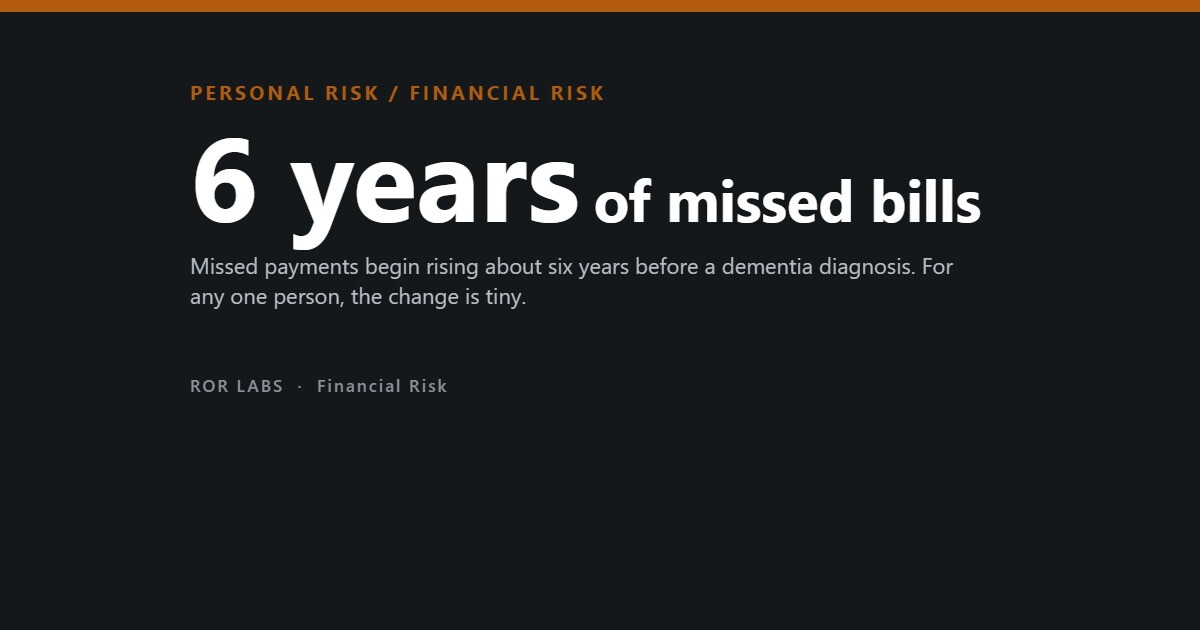
- In linked Medicare and credit data, missed payments began rising about six years before a dementia diagnosis.
- The difference was small in absolute terms: 7.7% against 7.3% missing a payment in a quarter, six years out.
- The pattern did not appear before arthritis, glaucoma or hip fracture.
- Financial mistakes follow a U shape with age, lowest at about 53 in one large study.
A bill goes unpaid for the first time in decades. A credit card that was always cleared in full starts carrying a balance. A cheque is written twice. Families often notice these things only in hindsight, after a diagnosis of dementia, and wonder whether they were early signs.
The evidence says they often were. Large studies linking credit records to medical records show missed payments rising years before dementia is diagnosed, and research on financial decision-making shows a gap opening between how well older people manage money and how well they think they manage it.
This is what the research shows about money, ageing and cognitive decline, how large the effects are, and what the numbers do not support. The headline figure is six years. The detail underneath it is that the change in any one person’s record is small, which is exactly why it is so easy to miss.
Six years before the diagnosis
The clearest evidence comes from a 2021 study in JAMA Internal Medicine by Lauren Hersch Nicholas, Kenneth Langa, Julie Bynum and Joanne Hsu. They linked Medicare claims to consumer credit reports from 1999 to 2018 for 81,364 older Americans living alone. Of these, 27,302 were diagnosed with Alzheimer disease or a related dementia during the study.
Missed payments on credit accounts, 30 days or more late, began to rise about six years before the diagnosis. Subprime credit scores began to rise about two and a half years before. Both remained elevated for at least three and a half years after diagnosis.
The authors checked whether any illness would do the same. It did not. They found no similar pattern before arthritis, glaucoma or hip fracture, and no long-term pattern with heart attack. Among the conditions they tested, the financial signal was specific to dementia.
The timing depended on education. In areas with lower educational attainment, payment problems began rising about seven years before diagnosis. In areas with higher attainment, about two and a half years before. One plausible reading is that people with more education and resources are better able to compensate, or that their dementia is diagnosed at a different point. The study cannot say which.
When the financial signal appears
Years before a dementia diagnosis that adverse credit events began to rise, 81,364 Medicare beneficiaries living alone.
Nicholas, Langa, Bynum and Hsu, JAMA Internal Medicine, 2021. Associations in administrative data; timing is estimated from group averages.

How small the difference is
The six-year figure is striking. The size of the effect is not, and that matters a great deal for how the finding is used, by families and by banks.
Six years before diagnosis, 7.7% of the people who would later be diagnosed had a missed payment in a given quarter, against 7.3% of those who were never diagnosed. That is a gap of 0.4 percentage points. In the quarter after diagnosis the gap was about one percentage point: 7.9% against 6.9%. For subprime credit scores, the gap two and a half years before diagnosis was 8.5% against 8.1%.
Across a population of tens of thousands, those differences are clear and statistically robust. For a single person, a missed payment is far more likely to have an ordinary explanation than a neurological one. Most people who miss a payment do not have dementia, and most people who will develop dementia do not miss one in a given quarter.
There is also a reason the diagnosis comes late. Dementia is often not diagnosed until symptoms are well established, and people living alone, the group in this study, may have no one close enough to notice small changes in how bills are handled. The credit record, in that sense, noticed first.
So the finding is not a screening test. It is evidence that financial management is among the first things to change as dementia develops, and that the change starts long before most people see a doctor about it. The practical value is in what families and banks watch for, not in diagnosing anyone from a credit report.
Missed payments, six years before diagnosis
Share with a payment 30 or more days late in a quarter.
Nicholas and colleagues, JAMA Internal Medicine, 2021. The gap widened to about one percentage point (7.9% against 6.9%) in the quarter after diagnosis.
Why money is one of the first things to go
Managing money is a demanding task. It combines memory, arithmetic, planning, and judgment about risk and trust. Research by Daniel Marson and colleagues on financial capacity found that people with mild cognitive impairment, often a precursor of Alzheimer disease, already struggle with complex tasks such as managing a chequebook or reading a bank statement.
The problems are not only with dementia. In a widely cited 2009 study in Brookings Papers on Economic Activity, Sumit Agarwal, John Driscoll, Xavier Gabaix and David Laibson looked at ten types of credit decisions, including credit card fees, balance transfer offers, mortgage rates and car loans. Younger and older borrowers both paid more than the middle-aged. The mistakes traced a U shape, with the lowest cost at around age 53.

Their explanation was that experience rises with age while the ability to process new information declines. The young make mistakes because they lack experience; older adults because the tools they need to use that experience are wearing down. The authors noted that about half of people aged 80 to 89 have either dementia or a medical diagnosis of cognitive impairment without dementia.
The same logic explains why the errors are often in unfamiliar decisions rather than routine ones. Paying the same utility bill every month draws on habit. Comparing a balance transfer offer, judging a new investment or spotting an unusual request draws on exactly the abilities that decline first.
This is a cross-sectional pattern among prime borrowers in one data set, and the authors were careful to describe the U shape as a hypothesis supported across contexts rather than a proven law. But the pattern has held up in later work, and it fits the credit-record data from the dementia studies.
Financial mistakes by age
Pattern of excess fees and interest across ten credit decisions among prime borrowers.
Agarwal, Driscoll, Gabaix and Laibson, Brookings Papers on Economic Activity, 2009. Bar lengths are schematic, showing the U shape, not measured values.
The confidence gap
Declining ability would matter less if people noticed it. The evidence suggests they often do not.
Keith Jacks Gamble, Patricia Boyle, Lei Yu and David Bennett followed older adults in the Rush Memory and Aging Project in Chicago. In a 2015 paper in Management Science, they found that a decline in cognition was associated with a decline in financial literacy, both numeracy and financial knowledge. But it was not associated with a drop in confidence in managing one’s own finances. Participants whose cognition fell were more likely to get help with financial decisions, yet many with significant declines still did not.
Michael Finke, John Howe and Sandra Huston found the same shape in a larger national sample. Financial literacy scores declined steadily after age 60, at a nearly identical rate among men, stock owners and college graduates, while confidence in financial decision-making did not decline with age.
The consequences show up in wealth. Fabrizio Mazzonna and Franco Peracchi, using European survey data, found that older people tended to underestimate their own cognitive decline, and that those who experienced a severe decline without recognising it were more likely to suffer wealth losses. The losses were concentrated among wealthier people who had been active in the stock market.
What changes with cognitive decline
Findings from the Rush Memory and Aging Project and a national survey of older adults.
Gamble, Boyle, Yu and Bennett, Management Science, 2015; Finke, Howe and Huston, Management Science, 2017. Bar lengths are schematic.
Exploitation
Declining capacity and undiminished confidence together make older adults attractive targets. In April 2024 the US Financial Crimes Enforcement Network reported that banks and other institutions filed suspicious activity reports on about $27 billion of elder financial exploitation in the year to June 2023. About 80% of the reported activity involved scams by strangers; the rest was theft by people the victim knew, mostly family members.
In December 2024, the Federal Reserve, the Consumer Financial Protection Bureau, the FDIC and other regulators issued a joint statement urging financial institutions to train staff, use transaction holds where appropriate, report suspected exploitation, and set up a process for customers to name a trusted contact.
The most common method in the reports was account takeover, often by unsophisticated means such as guessing passwords, which let the thief avoid speaking to bank staff at all. Banks filed 72% of the reports.
Those figures are reports of suspicious activity, not confirmed losses, and they cannot say how many victims had cognitive impairment. But the research on confidence helps explain why an older person who is being defrauded may be the last to believe it.
Reported elder financial exploitation, United States
Suspicious activity reports to FinCEN, one year to June 2023.
Financial Crimes Enforcement Network, April 2024, as reported by the ABA Banking Journal. Reported suspicious activity, not confirmed losses.

What families can do
The research points to planning rather than surveillance. Because financial skills can decline before anyone is aware of it, the decisions that protect someone are easiest to make while they are still fully able to make them: a lasting power of attorney or its equivalent, a trusted contact on bank and investment accounts, and a conversation about who helps with money if help is needed.
The research also suggests watching for changes against a person’s own history rather than against a rule. A single late payment means little. A run of unusual transactions, unfamiliar new payees, a sudden interest in high-risk investments, or bills that were always paid now going unpaid are the kinds of change the credit-record studies picked up in aggregate.
The confidence research also suggests how to raise the subject. Someone whose financial skills are slipping is unlikely to feel that they are, so a conversation framed around their abilities tends to go badly. Framing it as ordinary planning, the same arrangements anyone sensible makes in their sixties or seventies, avoids asking them to agree that something is wrong. It also has the advantage of being true: the arrangements are worth making whether or not decline ever comes.
Some banks now offer tools to monitor accounts or add view-only access for a family member. Those can help, but none has been tested in a trial for whether it reduces losses, and the evidence for them is practical experience rather than research.
What the evidence does not show
It does not show that a missed payment is a sign of dementia. The differences in the credit-record study were fractions of a percentage point, visible only across large populations.
It does not show exactly when decline begins in any individual. The six-year figure is when the group average began to diverge, and it varied with education by several years.
It does not show which protective measures work best, or how much they would save. There are no randomised trials of trusted contacts, account alerts or joint accounts against financial loss in cognitive decline.
And the age-53 figure comes from one cross-sectional study of prime borrowers. Cohort differences, and differences in who is still borrowing at older ages, could shape the pattern.
Questions people ask
Can financial problems be an early sign of dementia?
Yes, on average. A study of 81,364 Medicare beneficiaries found missed payments began rising about six years before a dementia diagnosis, and no similar pattern before arthritis, glaucoma or hip fracture.
Does one missed bill mean something is wrong?
Usually not. Six years before diagnosis the difference was 7.7% against 7.3% missing a payment in a quarter. The pattern is visible across populations, not in single events.
At what age are people best with money?
One study of ten types of credit decision found the lowest fees and interest costs at around age 53, with younger and older borrowers paying more.
Do people notice their own decline?
Often not. Studies found financial literacy falling with age and cognitive decline while confidence in managing money stayed the same.
What can families do early?
Put legal and practical arrangements in place while the person can decide for themselves, including powers of attorney and trusted contacts, and watch for changes against the person’s own usual habits.
The short version
- In linked Medicare and credit data, missed payments began rising about six years before a dementia diagnosis.
- The difference was small in absolute terms: 7.7% against 7.3% missing a payment in a quarter, six years out.
- The pattern did not appear before arthritis, glaucoma or hip fracture.
- Financial mistakes follow a U shape with age, lowest at about 53 in one large study.
- Financial literacy falls with cognitive decline; confidence in managing money does not.
This article summarises published research on ageing, cognition and money. It is not financial, legal or medical advice, and it is not a diagnostic tool. Nothing here is a recommendation to buy or use any financial product. For concerns about memory or thinking, speak to a doctor; for legal arrangements such as powers of attorney, speak to a qualified legal adviser where you live.
Further reading. Nicholas, Langa, Bynum and Hsu, ‘Financial Presentation of Alzheimer Disease and Related Dementias’, JAMA Internal Medicine, 2021, is the credit-record study. Agarwal, Driscoll, Gabaix and Laibson, ‘The Age of Reason’, Brookings Papers on Economic Activity, 2009, is the age-53 study.
- How to Retire, Christine Benz (2024). Interviews with twenty retirement experts on the practical decisions of later life, including who manages money when managing it gets harder.
- Die With Zero, Bill Perkins (2020). A provocative argument about spending money while you can enjoy it. Useful here for its blunt point that financial ability, like health, does not last indefinitely.
- The Psychology of Money, Morgan Housel (2020). Short essays on why financial behaviour is about more than knowledge, which is the gap the confidence research measures.
Sources
- Nicholas LH, Langa KM, Bynum JPW, Hsu JW. Financial presentation of Alzheimer disease and related dementias. JAMA Internal Medicine, 2021;181(2):220–227. doi:10.1001/jamainternmed.2020.6432.
- Agarwal S, Driscoll JC, Gabaix X, Laibson D. The age of reason: financial decisions over the life cycle and implications for regulation. Brookings Papers on Economic Activity, 2009;(2):51–117.
- Gamble KJ, Boyle PA, Yu L, Bennett DA. Aging and financial decision making. Management Science, 2015;61(11):2603–2610. doi:10.1287/mnsc.2014.2010.
- Finke MS, Howe JS, Huston SJ. Old age and the decline in financial literacy. Management Science, 2017;63(1):213–230. doi:10.1287/mnsc.2015.2293.
- Mazzonna F, Peracchi F. Are older people aware of their cognitive decline? Misperception and financial decision-making. Journal of Political Economy, 2024;132(6):1793–1830. doi:10.1086/728697.
- Triebel KL, Marson DC. The warning signs of diminished financial capacity in older adults. Generations, 2012.
- Spreng RN, Karlawish J, Marson DC. Cognitive, social, and neural determinants of diminished decision-making and financial exploitation risk in aging and dementia. Journal of Elder Abuse and Neglect, 2016. doi:10.1080/08946566.2016.1237918.
- Financial Crimes Enforcement Network. Financial Trend Analysis: Elder financial exploitation. April 2024 (as reported by the ABA Banking Journal, 18 April 2024).
- Board of Governors of the Federal Reserve System and others. Interagency statement on elder financial exploitation. 4 December 2024.
- Johns Hopkins Bloomberg School of Public Health. Older adults with dementia exhibit financial ‘symptoms’ up to six years before diagnosis. News release, 30 November 2020.