The Same Offer Went From 11% Acceptance to 42%. Only the Buttons Changed.
In This Series: Fraud & Digital Security
- Nobody Updates the Router. The FBI Says Criminals Are Living in the Old Ones.
- Your Voice Is No Longer Proof That It Is You
- A Credit Freeze Blocks the Rarer Kind of Identity Theft. Here Is What Blocks the Rest.
- Four Points Identify You. That Is Why Your Location Is Worth Selling.
- The Two-Factor Code on Your Phone Will Not Stop This
- Changing Your Password Every 90 Days Made It Easier to Guess. The Standard That Started the Rule Now Says to Stop.
- They Asked 422 Burglars What Made Them Walk Away. The Locks Did Not Come First.
- Romance Scam Victims Were Better Educated Than People Who Never Fell for One. The Newest Version Never Asks for Money.
Key takeaways · 15 min read
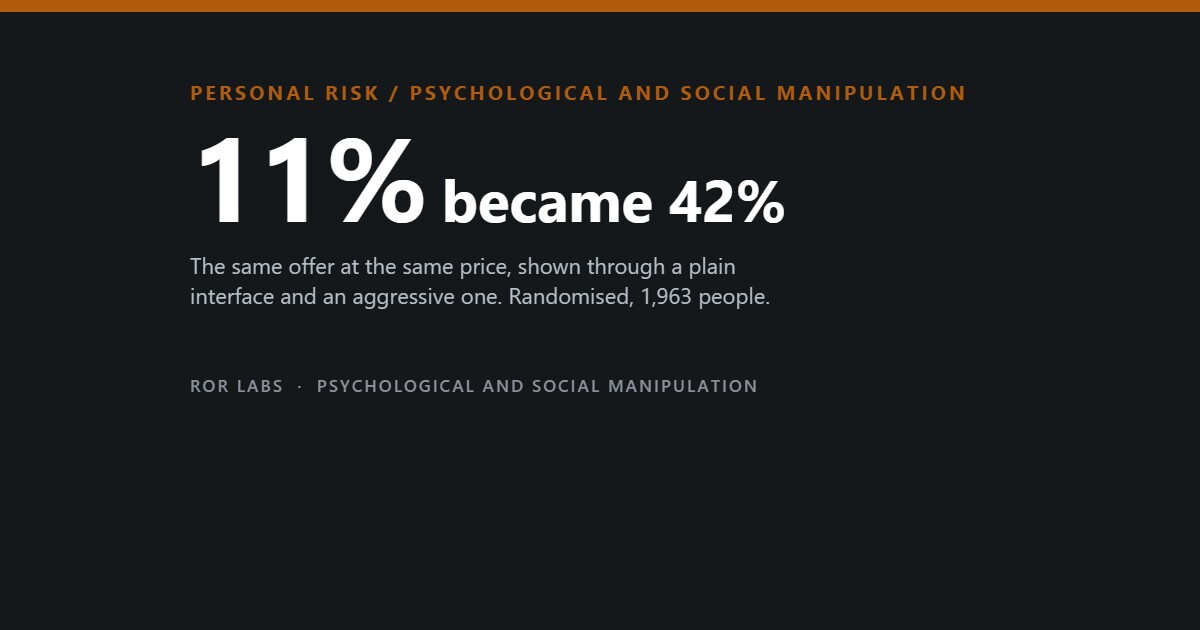
- The same offer at the same price was accepted by 11.3% of people through a plain interface and 41.9% through an aggressive one. Raising the price fourfold changed nothing.
- The reliable levers are structural, not visual: removing the opt-out from the first screen raised consent by 22 to 23 percentage points; putting real controls there lowered it by 8 to 20. Banner style made no difference at all.
- It is a purchased product. The 11,000-site crawl found 22 companies selling these patterns as a service.
- Awareness is not a defence. 406 people who could identify manipulative design were not protected by identifying it, and the effect falls hardest on people with less formal education.
In this article
Two groups of people were shown the same offer. Same product — a paid data protection plan — same price, same terms, same words describing what it did. In the first group, 11.3% accepted it. In the second, 41.9% did. Nothing about the deal had changed. The buttons had.
The design choices that produce that gap have a name. Dark patterns, increasingly called deceptive or manipulative design, are interface choices that coerce, steer or deceive people into decisions they would not otherwise make. They are not a fringe practice and they are not accidents: an automated crawl of roughly 11,000 shopping sites found 1,818 instances of them, along with 22 separate companies selling them to those sites as a service.
This article covers four things: how much manipulative design actually moves behaviour, how widespread it is, why noticing it does not protect you, and — the part most coverage leaves out — where the case against it is overstated. The last section is the practical one, because the thing that has actually changed these interfaces is not consumer vigilance. It is enforcement, and the amounts involved have recently gone up by three orders of magnitude.

What the experiments actually measured
Jamie Luguri and Lior Strahilevitz ran two large randomised experiments, published in the Journal of Legal Analysis in 2021. Participants were offered a data protection plan they had not asked for. One group saw a plain interface. A second saw mild manipulative design — the sort nobody complains about, where declining is available but takes a second step. A third saw aggressive design: confirmshaming, obstruction, a trick question.
Share who accepted the same offer
Study one, 1,963 US participants after exclusions, randomly assigned. Identical product and price in every condition.
Source: Luguri, J. and Strahilevitz, L.J., “Shining a Light on Dark Patterns”, Journal of Legal Analysis 13(1), 2021.
A second experiment with 3,777 participants took the techniques apart. Against a baseline of 14.8% acceptance, hiding relevant information raised it to 30.1%. A trick question — where answering yes meant the opposite of what it appeared to mean — produced 33.4% acceptance against 19.2% without it. Confirmshaming and social proof produced modest increases. A countdown timer produced no significant effect at all, which is worth remembering the next time one is described as predatory.
The finding that should unsettle you is the one about price. Study one offered the plan at $2.99 and at $8.99 a month. Study two went further, testing $8.99 against $38.99. In both, acceptance was unrelated to the stakes. Quadrupling the cost of the thing being sold moved nothing. Moving where the decline option sat moved everything.
What did not change the decision, and what did
Source: Luguri and Strahilevitz, 2021, studies one and two.
How much of the web this describes
Three audits, run by different people with different methods, on different corners of the web.
Three counts of the same problem
| Audit | What was measured | Result |
|---|---|---|
| Mathur and colleagues, 2019 ~11,000 shopping sites, ~53,000 product pages | Automated detection of manipulative interface elements, validated by hand | 1,818 instances across 15 types and 7 categories. 183 sites made claims the authors judged outright false. 22 third-party firms sold these patterns as a turnkey service. |
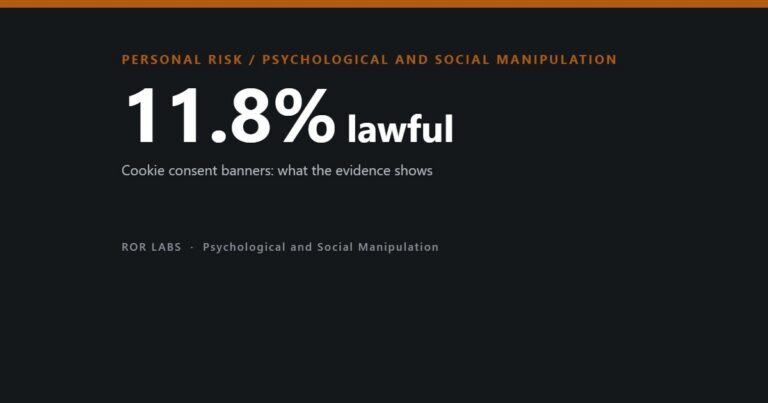
| Nouwens and colleagues, 2020 top 10,000 UK sites, n=680 | Whether the five most used consent management platforms met a minimal reading of European law | 11.8% did. Implied consent and pre-selected options were close to universal. |
| McGarrigle and colleagues, 2026 all 624 UK-licensed gambling sites | Consent banner design and data protection compliance | 86% used at least one dark pattern. 24% offered no way to reject tracking. 67% processed identifiable data before asking. 14% were compliant. |
Sources: Mathur et al., “Dark Patterns at Scale”, Proceedings of the ACM on Human-Computer Interaction, 2019. Nouwens et al., “Dark Patterns after the GDPR”, CHI 2020. McGarrigle et al., Computers in Human Behavior Reports, 2026.
The consent banner is the cleanest test anyone has run
Cookie banners are an unusually good natural experiment, because the offer behind them never changes. The only variable is the interface. Nouwens and colleagues took the eight most common designs and ran them past 40 participants in a field study. The results separate cleanly into things that matter and things that do not.
Effect of each design change on the share who consented
Percentage points, against the same underlying request. Field experiment, 40 participants, eight of the most common real-world designs.
Source: Nouwens, M., Liccardi, I., Veale, M., Karger, D. and Kagal, L., “Dark Patterns after the GDPR”, CHI 2020.
Regulators reached the same conclusion by a different route. On 6 January 2022 the French data protection authority fined Google €150 million and Facebook €60 million, not for collecting anything they should not have, but for the specific fact that refusing cookies took more clicks than accepting them. Microsoft was fined €60 million in December 2022 on the same reasoning. The offence, in each case, was a layout.
Knowing about it does not protect you

The standard response to all this is that people should be more careful. That has been tested. Bongard-Blanchy and colleagues surveyed 406 people about manipulative design: whether they knew it existed, whether they could spot it, and whether they could resist it. The answers were yes, often, and no. People were generally aware of the influence these designs exert and could frequently identify specific ones. Awareness did not equip them to oppose it. Younger respondents recognised more of the patterns and were less sure what harm they were exposed to.
The distribution is worse than that. In Luguri and Strahilevitz’s control condition, education was not related to whether someone accepted the offer. Under mild dark patterns, it was: the less education a participant had, the more likely they were to accept (b = −0.19, p = 0.002), and the aggressive condition showed the same pattern. Manipulative design does not just move the average. It moves some people much further than others, and the mild version does the most redistributing, because it is the version that survives.
Why the mild version is the one that lasts
Sources: Luguri and Strahilevitz, 2021 (dropout and affect measures). Bongard-Blanchy, K. et al., “I am Definitely Manipulated, Even When I am Aware of It”, DIS 2021, n=406.
Where the case against dark patterns is overstated
Every article on this subject reaches the same conclusion, which is a reason to be suspicious of it. Here is the evidence that pulls the other way.
Chiara Farronato, Andrey Fradkin and Tesary Lin ran a field experiment in which a browser extension randomised consent interfaces while participants went about their ordinary browsing — real sites, real decisions, not a survey. Three of their findings complicate the standard story. First, with no dark patterns present at all, people still accepted every cookie more than half the time. A large share of what looks like manipulation is indifference, or a settled preference to get on with the page. Second, purely visual manipulation had smaller effects than structural ones; making the accept button brighter matters much less than putting the reject option behind a click. Third, their welfare model does not conclude that banners should default to refusing. It concludes that the best banner for consumers removes the dark patterns and defaults to accepting on inaction, because the cost of being made to decide, on every site, outweighs what the decision is worth.
Two honest caveats about that paper. It is a working paper and has not been through peer review. And the welfare conclusion rests on modelling assumptions about how much people value their own data, which is a quantity nobody measures well. The field results deserve more weight than the welfare number.
There is also a definitional problem. “Dark pattern” covers everything from a countdown timer to a fabricated claim that four other people are looking at this room. Mathur’s own taxonomy distinguishes patterns that merely steer from those that deceive, and the distinction is not decorative: in a 3,777-person experiment the countdown timer did nothing measurable, while a trick question moved acceptance by 14 percentage points. Treating them as one category makes the problem sound larger and the solution sound simpler than either is.
Three claims this research does not license
Sources: Farronato, C., Fradkin, A. and Lin, T., “Designing Consent: Choice Architecture and Consumer Welfare in Data Sharing”, NBER working paper 34025, 2025 (not peer reviewed). Luguri and Strahilevitz, 2021. Bongard-Blanchy et al., 2021.
What has actually changed these interfaces
Not vigilance. Money, and the threat of more of it. The US Federal Trade Commission published a staff report on 15 September 2022 setting out four families of tactic: disguising advertisements as independent content; making subscriptions difficult to cancel; burying material terms and fees; and steering people into sharing more data than they intended. What followed is the part worth knowing about.
What the enforcement has cost, and for what design
| Action | Amount | What the interface did |
|---|---|---|
| FTC and Amazon settled 25 September 2025 | $2.5 billion $1bn civil penalty, $1.5bn to about 35 million people | An enrolment flow the FTC said led people into Prime without their knowledge, and a cancellation process it described as built to prevent cancelling. One internal Amazon document quoted in the case calls subscription driving “a bit of a shady world”. Amazon must now let people cancel by the same route they joined. |
| FTC and Epic Games order finalised 2023 | $245 million in refunds, part of a $520m total | Button layouts in Fortnite that produced charges players had not intended, and account locks when they disputed them. |
| CNIL, France 6 January 2022 | €150m Google €60m Facebook | Refusing cookies required more clicks than accepting them. Microsoft was fined €60m in December 2022 on the same point. |
| California Attorney General and Sephora August 2022 | $1.2 million | Ignoring browser opt-out signals while continuing to share data with advertising partners. |
Sources: FTC press releases, 25 September 2025 (Amazon), March 2023 (Epic Games) and 15 September 2022 (staff report). CNIL decisions announced 6 January 2022. California Attorney General settlement with Sephora, August 2022.
The rulemaking picture is less tidy, and anyone telling you otherwise is simplifying. The FTC’s click-to-cancel rule — which would have required cancelling to be as easy as signing up — was vacated by the Eighth Circuit in July 2025. The court did not rule that the substance was wrong; it held that the Commission had skipped a preliminary regulatory analysis the statute requires for major rules, and that doing the analysis later could not cure the defect. The underlying statute, ROSCA, still applies and is still being enforced, and the FTC opened a fresh rulemaking, with public comment closing on 13 April 2026. In the European Union, Article 25 of the Digital Services Act prohibits platform interfaces that deceive or manipulate users into choices — the first time the practice has been named as such in primary law.
For a person rather than a regulator, one structural move matches the evidence. Because the reliable lever is what happens by default rather than what any individual banner says, the useful thing is a browser-level signal rather than a per-site fight. The Global Privacy Control signal is legally binding on businesses in around ten US states, California included, with two more from July 2026; it carries the same weight as clicking the opt-out yourself. It does not stop data collection in general, it has no force in most of the world, and it does nothing about checkout flows or cancellation. It is one setting that removes one recurring decision. That is all it is, and it is more than reading banners achieves.

Questions people ask
Is a countdown timer on a booking site a dark pattern?
It depends on whether it is true. A timer that reflects a real deadline is information. A timer that resets when you reload is a fabricated claim, and in the 11,000-site crawl 183 sites were found making claims of that kind. As a matter of effect, though, the timer is oversold: in a 3,777-person randomised experiment, scarcity cues produced no significant change in acceptance. The elements that worked were the ones that hid something or made the alternative harder to reach.
Will an extension that auto-rejects cookie banners fix this?
Partly, and only for banners. It does nothing about subscription flows, cancellation paths, drip pricing at checkout or default-selected add-ons, which is where the money is.
If I can spot the manipulation, am I safe?
No. That is the most robust finding here and the least comfortable one. Of 406 people surveyed, most knew manipulative design existed and could identify examples of it; knowing did not translate into resisting it. The effects also fall hardest on people with less formal education, and specifically under the mild patterns that nobody objects to.
Is this just nudging with a bad name?
There is a real line, and the research draws it rather than assuming it. A nudge changes the presentation while leaving the choice intact and the information complete. The techniques that moved behaviour most in these experiments did the opposite: they withheld information (30.1% acceptance against 14.8%) or inverted the meaning of an answer. Defaults sit awkwardly in between, which is why the Farronato paper argues for a well-designed default rather than for no default at all.
What is the one habit worth having?
Look for asymmetry rather than for tricks. If accepting is one click and declining is two, or if the thing you want is on the second screen and the thing they want is on the first, you have found the design — regardless of how polite the wording is. That single test captures the two changes that actually moved consent by double digits, and ignores the ones that did not.
Does any of this apply outside the US and the EU?
The designs do; the remedies mostly do not. Every figure above comes from the US, the UK or the EU, because those are the jurisdictions that have measured and enforced. India’s consumer authority issued dark pattern guidelines in 2023 and other regulators are moving, but if you are outside those systems, read the enforcement section as a description of what is possible rather than of what protects you.
The short version
- The same offer at the same price was accepted by 11.3% of people through a plain interface and 41.9% through an aggressive one. Raising the price fourfold changed nothing.
- The reliable levers are structural, not visual: removing the opt-out from the first screen raised consent by 22 to 23 percentage points; putting real controls there lowered it by 8 to 20. Banner style made no difference at all.
- It is a purchased product. The 11,000-site crawl found 22 companies selling these patterns as a service.
- Awareness is not a defence. 406 people who could identify manipulative design were not protected by identifying it, and the effect falls hardest on people with less formal education.
- Mild manipulation is the problem, not aggressive manipulation. The aggressive kind makes people angry and they leave; the mild kind produces no backlash, which is why it survives.
- Not everything is manipulation: with the dark patterns removed, people still accepted all cookies more than half the time, and countdown timers had no measurable effect.
- What changed the interfaces was enforcement, not vigilance — $2.5 billion from Amazon in September 2025, against a few million dollars a few years earlier.
This article describes research findings and enforcement actions. It is not legal advice, and the position differs sharply by jurisdiction: the fines and rules above are US, UK and EU. If you have been charged for something you did not agree to, the route that has actually recovered money for people is a complaint to the relevant consumer protection or data protection authority, not an argument with the company.
Further reading: Deceptive Patterns — Harry Brignull (2023). Brignull coined the term in 2010, and the book is the field’s own account of itself, with a large catalogue of examples. Read it knowing that the author consults and gives expert evidence in this area, so it argues a case rather than weighing one.
- Deceptive Patterns, Harry Brignull (2023). Written by the researcher who coined the term “dark patterns,” now the definitive catalogue of them.
- The Data Detective, Tim Harford (2020). Ten rules for reading numbers in the news skeptically.
- How to Talk to a Science Denier, Lee McIntyre (2021). On engaging contested claims without dismissing or overselling them.
Sources
- Luguri, J. and Strahilevitz, L.J., “Shining a Light on Dark Patterns”, Journal of Legal Analysis 13(1), 2021. (Study one: 1,963 participants after exclusions; acceptance 11.3% control, 25.8% mild, 41.9% aggressive. Study two: 3,777 participants; content control 14.8%, hidden information 30.1%, trick question 33.4% against 19.2%; scarcity no significant effect. Price tested at $2.99 against $8.99, and $8.99 against $38.99 — acceptance unrelated to stakes. Dropout 9 under mild conditions against 65 under aggressive. Education effect b = −0.19, p = 0.002 mild; b = −0.17, p = 0.003 aggressive.)
- Mathur, A., Acar, G., Friedman, M.J., Lucherini, E., Mayer, J., Chetty, M. and Narayanan, A., “Dark Patterns at Scale: Findings from a Crawl of 11K Shopping Websites”, Proceedings of the ACM on Human-Computer Interaction 3 (CSCW), 2019. (About 53,000 product pages across about 11,000 sites; 1,818 instances; 15 types in 7 categories; 183 sites with deceptive claims; 22 third-party providers.)
- Nouwens, M., Liccardi, I., Veale, M., Karger, D. and Kagal, L., “Dark Patterns after the GDPR: Scraping Consent Pop-ups and Demonstrating their Influence”, CHI 2020. (Five most popular consent platforms across the top 10,000 UK sites, n=680; 11.8% met the minimal legal requirements applied. Field experiment, 40 participants: banner against barrier, no effect; removing the opt-out from the first page, +22 to 23 percentage points; granular controls on the first page, −8 to 20.)
- Bongard-Blanchy, K., Rossi, A., Rivas, S., Doublet, S., Koenig, V. and Lenzini, G., “I am Definitely Manipulated, Even When I am Aware of It. It’s Ridiculous! Dark Patterns from the End-User Perspective”, DIS 2021. (Survey of 406 individuals; awareness widespread, resistance not.)
- McGarrigle, J., Torrance, J., Quigley, M. and Dymond, S., “Consent banners, dark patterns, and GDPR infringements in online gambling”, Computers in Human Behavior Reports, 2026. (Audit of all 624 UK-licensed gambling sites: 86% used at least one dark pattern, 24% offered no reject option, 67% processed identifiable data before consent, 14% were compliant. Accompanying online experiment, n=615.)
- Farronato, C., Fradkin, A. and Lin, T., “Designing Consent: Choice Architecture and Consumer Welfare in Data Sharing”, NBER working paper 34025, July 2025. Working paper, not peer reviewed. (Browser-extension field experiment: over half accept all cookies with no dark patterns present; hiding options behind an extra click sways choices, purely visual manipulation less so; the welfare-maximising banner removes dark patterns and defaults to accepting on inaction; a browser-level global consent choice improves welfare further.)
- US Federal Trade Commission, “Bringing Dark Patterns to Light”, staff report, 15 September 2022. (The four categories of tactic.)
- US Federal Trade Commission, press release of 25 September 2025: Amazon settlement of $2.5 billion — $1 billion civil penalty and $1.5 billion in redress for approximately 35 million consumers — over Prime enrolment and cancellation design.
- US Federal Trade Commission, press release of March 2023: Epic Games ordered to pay $245 million in refunds over unwanted charges, part of $520 million in total settlements announced December 2022.
- United States Court of Appeals for the Eighth Circuit, July 2025: the FTC Negative Option (“click to cancel”) Rule vacated for failure to conduct the required preliminary regulatory analysis. FTC Advance Notice of Proposed Rulemaking announced 11 March 2026, comments closing 13 April 2026. ROSCA remains in force and in use.
- Commission Nationale de l’Informatique et des Libertés (CNIL), decisions announced 6 January 2022: Google fined €150 million and Facebook €60 million for making cookie refusal harder than acceptance; Microsoft fined €60 million in December 2022.
- California Attorney General, settlement with Sephora, August 2022, $1.2 million, for failing to honour browser opt-out signals.
- Regulation (EU) 2022/2065 (Digital Services Act), Article 25, on deceptive or manipulative online interface design.
- Global Privacy Control: recognised as a legally binding opt-out under the CCPA and CPRA in California since 1 January 2023, and required in around ten US states, with two more from July 2026.