A Quarter of School Epinephrine Goes to Children Nobody Knew Were Allergic
Disclosure: this article contains affiliate links, marked (paid link). If you buy through one we may earn a commission, at no extra cost to you. As an Amazon Associate I earn from qualifying purchases. It costs you nothing and it does not change what we recommend.
Key takeaways · 7 min read
- 5.6 million U.S. children have a food allergy — about two per classroom.
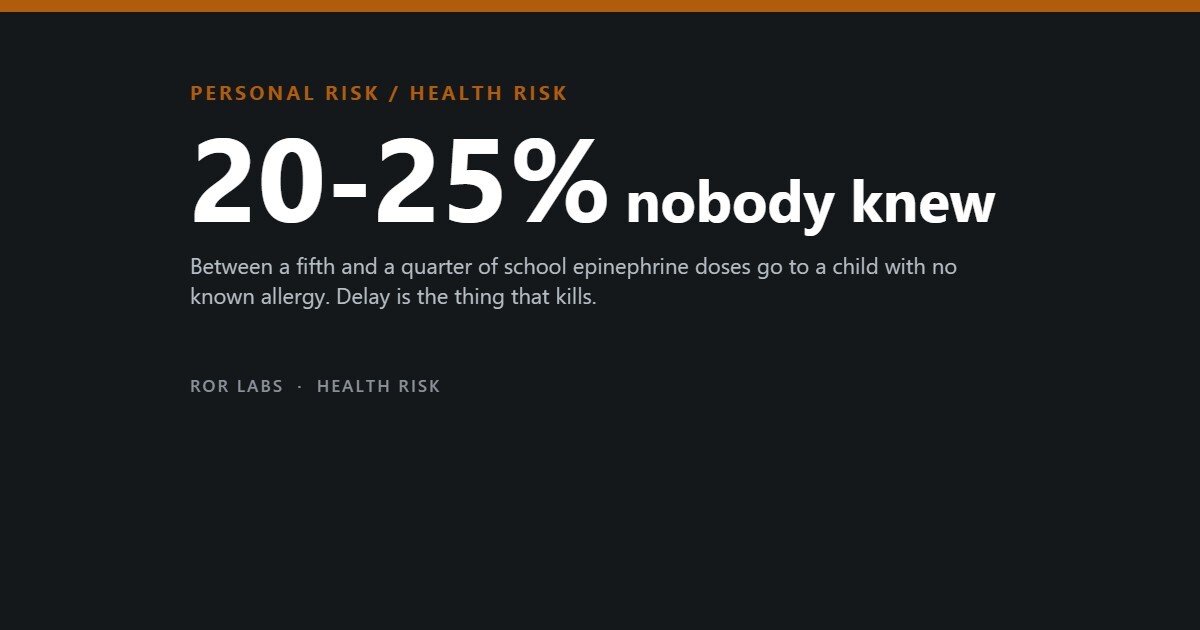
- 20–25% of school epinephrine administrations are to children with no previously known allergy.
- Which is why stock undesignated epinephrine matters more than any individual care plan.
- Delay is the lethal variable, and the commonest delay is reaching for an antihistamine first.
Most school food allergy policy is built around the children who are known to have allergies — the care plan in the office, the labelled lunch, the teacher who knows. That is sensible, and it misses the group that generates a large share of the emergencies.
Between a fifth and a quarter of the times epinephrine is given in a school, it is given to someone nobody knew was allergic. In one large district, more than half the children treated with emergency epinephrine in a single year were having their first severe reaction.

The numbers behind the classroom
Food allergy in the United States
FARE (Food Allergy Research & Education) compiled statistics.
Source: Food Allergy Research & Education (FARE), food allergy facts and statistics.
Who the school epinephrine is actually used on
The finding that should shape policy, and usually does not.
Source: FARE statistics on school epinephrine administration.
Delay is the thing that kills
Fatal food anaphylaxis is rare. When it does happen, the recurring feature in case reviews is not that epinephrine was unavailable — it is that it was given late, or after other things were tried first.
The reasons are understandable and they repeat. Antihistamines get reached for first because they are familiar and feel proportionate. An inhaler gets used because the breathing looks like asthma. Somebody waits to see whether it settles. Somebody worries about giving an injection unnecessarily. Every one of those is a delay, and delay is the variable that separates a frightening afternoon from a fatal one.
What each medicine actually does
This is the misunderstanding behind most delays.
Sources: AAAAI anaphylaxis practice parameter (2020 update); state guidelines for the care of students with anaphylaxis.
Recognising it: the two-system rule
Anaphylaxis is likely when two or more body systems are involved, or when blood pressure drops after a known trigger.
Source: AAAAI anaphylaxis practice parameter (2020 update); NIAID diagnostic criteria for anaphylaxis.
Questions worth asking your school
Five specific questions, not one general one
“Are you allergy aware?” gets a yes from everyone. These do not.
Sources: FARE school guidance; state guidelines for the care of students with anaphylaxis.
What helps at home (paid link)
The auto-injector itself is prescription-only and comes from a doctor. These are the things around it.
Browse on Amazon →
Browse on Amazon →
Browse on Amazon →
We are not linking allergen home test kits or at-home IgE panels. Broad untargeted allergy panels produce a great many positive results in people who eat those foods without any problem, and the usual outcome is unnecessary food avoidance in a child — which carries its own nutritional and social cost, and in some cases raises the risk of developing a real allergy later. Allergy testing belongs with an allergist who interprets it against an actual history.
Questions people ask
What if I give epinephrine and it was not anaphylaxis?
This is the fear that produces the delay, so it is worth answering plainly. In a healthy child, an unnecessary dose of epinephrine typically causes a racing heart, shakiness and pallor for a short period. It is unpleasant and it is not dangerous. Every guideline treats giving it unnecessarily as a far smaller problem than giving it late.
Why does the advice say carry two?
Because a meaningful proportion of reactions need a second dose before help arrives, and because devices misfire or get dropped. Two is the standard recommendation, and the second one is not a spare — it is part of the plan.
Do we still need an ambulance if the epinephrine worked?
Yes. Symptoms can return after the epinephrine wears off, sometimes hours later and without any further exposure — a biphasic reaction. Anyone who has needed epinephrine needs to be assessed and observed, however well they look twenty minutes afterwards.
Should the whole school ban peanuts?
Blanket bans are less effective than they feel. They are hard to enforce, they can create false confidence, and they do nothing for the many other allergens or for the child whose allergy nobody knows about. The measures with better support are practical ones: handwashing before and after eating, no food sharing, cleaned surfaces, trained staff, and rapid access to epinephrine.
The short version
- 5.6 million U.S. children have a food allergy — about two per classroom.
- 20–25% of school epinephrine administrations are to children with no previously known allergy.
- Which is why stock undesignated epinephrine matters more than any individual care plan.
- Delay is the lethal variable, and the commonest delay is reaching for an antihistamine first.
- Antihistamines do nothing for airway swelling or blood pressure. Epinephrine is the treatment.
- Two body systems, or any circulation sign, means give it. Hives are not required — many fatal reactions had no rash.
- Giving it unnecessarily is far safer than giving it late.
- Always call emergency services afterwards — symptoms can return hours later.
Anaphylaxis is a medical emergency. If you suspect it, use epinephrine immediately and call emergency services. This article summarises published guidance and is not a substitute for an allergy action plan written by your doctor.
On the links above: some are affiliate links, marked (paid link). If you buy through one we may earn a commission at no additional cost to you. As an Amazon Associate I earn from qualifying purchases. We link to product searches rather than specific items so recommendations do not break as models change, and we say plainly when we are choosing not to link something. Full policy: Affiliate Disclosure.
Sources
- Food Allergy Research & Education (FARE). Food allergy facts and statistics; school and epinephrine access guidance.
- American Academy of Allergy, Asthma & Immunology. Anaphylaxis — a 2020 practice parameter update, systematic review and GRADE analysis.
- Washington Office of Superintendent of Public Instruction. Guidelines for the Care of Students with Anaphylaxis (2021).