School Shootings: What the Evidence Shows
Key takeaways · 13 min read
- How many US school shootings there are depends on the definition: for 2025, trackers counted 233, 159 or 18, depending on whether any gunfire on school property counts.
- For one child the risk is very small: in most years about 1% of US youth homicides happen at school.
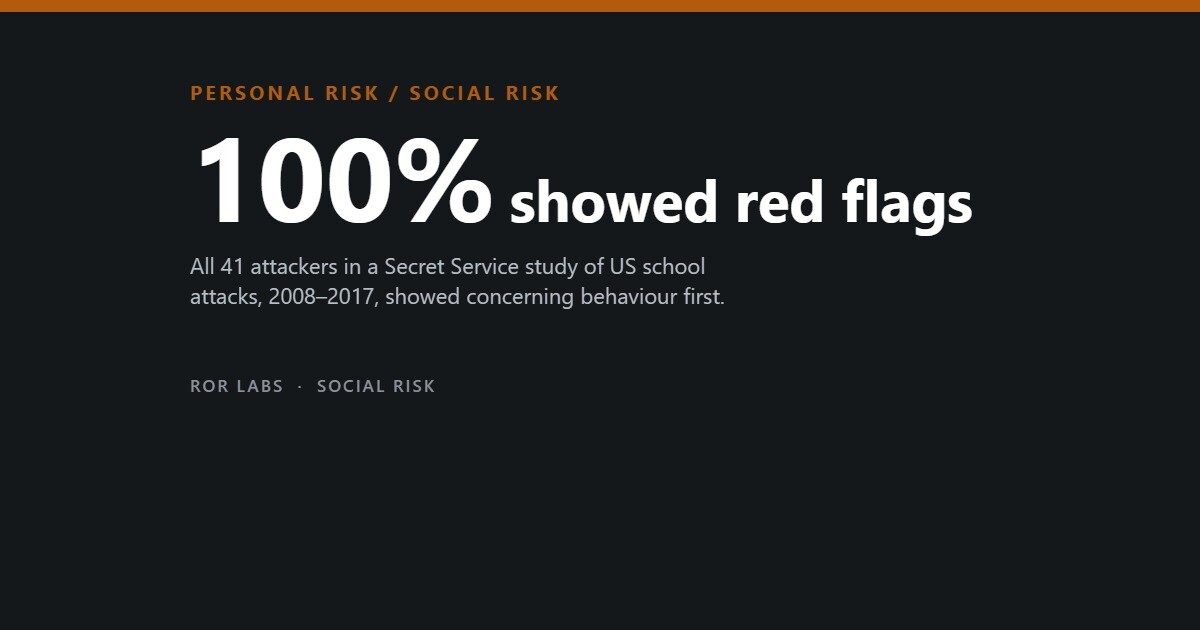
- In a Secret Service study of 41 attacks, every attacker had shown concerning behaviour beforehand, and three in four firearm attacks used a gun from a relative’s home.
- Evidence on armed officers, metal detectors and drills is thin and contested; one study linked an armed officer to a higher death rate.
In this article
- How many school shootings are there?
- How big is the risk to one child?
- What attackers have in common
- Does threat assessment work?
- Armed officers, metal detectors and locks
- Lockdown and active-shooter drills
- Harm beyond those killed
- Guns at home, and other countries
- What the evidence suggests
- Questions people ask
- The short version
- Sources
Few risks frighten parents more than a shooting at their child’s school, and few are harder to see clearly. In the United States, lockdown drills, armed officers and locked entrances are now part of normal school life. Whether they make children safer is a separate question, and the research answer is less settled than the debate suggests.
This article looks at what researchers and public agencies have measured: how often school shootings happen, the risk to one child, what attackers had in common, and what is known about threat assessment, armed officers, security, drills and safe gun storage. It also covers harm to survivors and how the US compares with other countries.
Two notes on method. There is no official US count of school shootings, and the main trackers use very different definitions, so every number here is tied to its source. And out of respect for those affected, the article names places and years but not perpetrators, and leaves out detail about how attacks were carried out.

How many school shootings are there?
The answer depends on who is counting. The K-12 School Shooting Database, run by researcher David Riedman, records any time a gun is fired or brandished with intent on school property, or a bullet hits it, whatever the time, day or reason. It logged 233 incidents in 2025, down from a peak of 352 in 2023. Everytown for Gun Safety, a gun-control advocacy group, counts any live round fired on or into school grounds: at least 159 in 2025.
One year, four very different counts
US school shootings in 2025 by tracker. Each uses its own definition.
Sources: K-12 School Shooting Database and Everytown figures as reported by K-12 Dive (12 January 2026; Everytown to 13 December 2025); Education Week (31 December 2025), mass shootings by the Gun Violence Archive definition.
Education Week uses a much narrower rule: someone other than the shooter must be hurt by gunfire on school property during school hours or a school event. It counted 18 such shootings in 2025, with 7 deaths and 44 injuries, the fewest since 2020.
None of these counts is wrong; they answer different questions. The broad ones include disputes that end in gunfire and shots fired at night into empty buildings; the narrow ones capture the events most people picture. Headlines often pair the largest number with images of the rarest event, and that is how the gap between fear and risk opens.
How big is the risk to one child?
Schools are among the safer places for American children. The US National Center for Education Statistics (NCES) reports that from 1992–93 to 2020–21, homicides of school-age children at school were generally about 1% of all youth homicides, and never more than 2.4%. The latest year, 2020–21, was 11 out of 2,436, about 0.5%, but many schools were closed or teaching remotely during the pandemic that year.
A 2013 study by James Shultz and colleagues found that school shooting deaths from 1990 to 2011 were about 0.11% of US firearm homicides. Counting all students, college included, the worst year was 2007, at 6.1 deaths per 10 million students.
The chance at one school depends on the definition
Modelled yearly probability of a shooting at one specific US K-12 school. Bars on a log scale.
Source: Lei X, MacKenzie CA, Risk Analysis (2023), doi:10.1111/risa.14197. Model estimates from national counts, not measured school by school.
Xue Lei and Cameron MacKenzie estimated in Risk Analysis (2023) that the yearly chance of a mass shooting at one particular school lies between one in 10 million and one in 20,000. With the Gun Violence Archive’s broader definition of four or more people shot, the range rises to between one in 10,000 and one in 200. These are model outputs, not measurements.
What attackers have in common
The US Secret Service’s National Threat Assessment Center reviewed 41 targeted attacks on K-12 schools from 2008 to 2017 in its 2019 report Protecting America’s Schools. It found no profile of a typical attacker or a typical target school. What the attackers shared was a pattern of behaviour that others could see.
Warning signs were nearly universal
Share of attackers in 41 targeted attacks on US K-12 schools, 2008–2017, %.
Source: US Secret Service National Threat Assessment Center, Protecting America’s Schools (2019); percentages as summarised for the Virginia Department of Criminal Justice Services.
Every attacker had shown concerning behaviour, most had made someone worried, and most had told others about their intent. Most were current students. Where a firearm was used, about three in four came from the home of a parent or close relative. Most had been bullied, and most had a history of school discipline.
A separate study by Jillian Peterson, James Densley and Gina Erickson, covering 133 shootings from 1980 to 2019, found that 70% of perpetrators were current students and another 15% former students. Both findings point to two places to act: warning signs, and guns at home.
Does threat assessment work?
In behavioural threat assessment, when a student makes a threat or worries others, a school team, usually an administrator, a psychologist or counsellor and often a police officer, looks into it, judges how serious it is and puts support or protective steps in place. In 2013 Virginia became the first state to require such teams in its public schools, and others have since followed.

The best-studied model, developed at the University of Virginia, has been tested in a randomised trial. In 40 schools, the 100 students who made threats in schools using the model were more likely to get counselling and a parent conference, and much less likely to be given a long-term suspension (odds ratio 0.35), than the 101 students in schools that carried on as usual. An earlier field test of 188 threats found none was carried out.
The balance point: these trials measured discipline and school climate, not shootings prevented, which are too rare to count, and most were led by the model’s own developer, Dewey Cornell. Real-world data are more sobering. A 2026 study of 14,126 threat assessment cases in Florida found 10.9% were followed by an attack of some kind, usually without serious harm; 38 caused a serious injury. About a third of threats judged serious were followed by one.
Armed officers, metal detectors and locks
Many states have paid for armed school resource officers since high-profile attacks. The most cited study of what happens during attacks is by Peterson, Densley and Erickson in JAMA Network Open (2021). An armed officer was on site in 29 of the 133 shootings. After adjusting for location and school characteristics, the death rate was 2.83 times higher where one was present.
That is an association, not proof that officers cause deaths. It is a short research letter built on public sources; it cannot count attacks that officers deterred, and the authors’ explanations, such as attackers who intend to die, are untested. A national study by Lucy Sorensen and colleagues (2023), using a regression discontinuity design based on federal grant scores, found that officers reduced some kinds of school violence but did not prevent gun-related incidents.
The same study found officers increased suspensions, expulsions, police referrals and arrests, most of all for Black students, boys and students with disabilities. Evidence on hardening is thinner still. A 2025 scoping review of efforts to stop students carrying weapons into US schools found only two qualifying studies, on metal detector searches and an anonymous reporting system, both with limited results. A 2023 national study linked more security measures to lower feelings of safety among students of colour relative to white students.
Lockdown and active-shooter drills
Lockdown drills are now routine in US schools. They differ from active-shooter drills: a lockdown is a quiet routine of locking doors, turning off lights and staying out of sight, while some active-shooter exercises have used masked actors or simulated gunfire. Research on their effects points in two directions.
A 2021 study by Mai ElSherief and colleagues analysed 54 million social media posts around drills at 114 schools in 33 states, and estimated that expressions of anxiety, stress and depression rose by 39% to 42% after them. Drill dates came from volunteers of a gun-violence prevention organisation, and posts were linked to schools by location and followers, not by asking students.
Surveys inside schools often find the opposite. Jaclyn Schildkraut and Amanda Nickerson surveyed more than 10,000 students in one urban district at three points and found less fear and lower perceived risk after lockdown drills and training, although avoidance behaviour rose. A survey of university students, by contrast, linked active-shooter drills in high school to more fear.
How drills are run matters. RAND surveys of teachers and principals, published in 2025, found most drills avoid realistic effects, but only 46% of students and 45% of parents were told in advance, against 83% of teachers, and only 16% of schools offered every student an opt-out. Nearly a third of staff knew of students with trauma or heightened anxiety afterwards.
Who is told before a drill
Practices reported in US school drills, %, from national RAND surveys of teachers and principals.
Source: Moore P, Diliberti MK, Jackson BA, RAND RR-A3930-7 (2025); teachers surveyed in 2023, principals in 2024.
Harm beyond those killed
Maya Rossin-Slater, Molly Schnell, Hannes Schwandt, Sam Trejo and Lindsey Uniat studied 44 school shootings and prescription data from 2006 to 2015 (PNAS, 2020). In the two years after a fatal shooting, youth antidepressant use within five miles of the school rose 21.4% compared with areas 10 to 15 miles away.
Using linked Texas school and earnings records, Marika Cabral and colleagues compared students at schools with shootings with those at similar schools elsewhere. Exposed students missed more school and were more likely to repeat a grade; years later they were less likely to finish high school or college and earned less at ages 24 to 26. The long-run estimates rest on only eight high-school shootings, and the figures here are from the 2020 working-paper version.
What exposure to a shooting cost Texas students
Change for students at schools with a shooting compared with matched schools, relative to the baseline, %.
Source: Cabral M, Kim B, Rossin-Slater M, Schnell M, Schwandt H, IZA Discussion Paper 13998 (2020). Grade repetition starts from a low base.
Other studies agree. In survey data from 24 US school districts, high school shootings were associated with 20% higher odds of students avoiding school because they felt unsafe. Following survivors of the deadliest attacks, Phillip Levine and Robin McKnight found lower attendance and test scores, and higher mortality by age 30 among students who were at the high school in Littleton, Colorado, in 1999.
Guns at home, and other countries
If most school attackers take a gun from home, safe storage is an obvious lever. Child-access-prevention laws make adults liable when a child gets hold of a carelessly stored gun. RAND’s review of gun policy research, updated in January 2026, rates the evidence that these laws reduce youth firearm suicides, unintentional child firearm deaths and youth firearm homicides as “supportive”, its strongest rating.
For mass and school shootings in particular, RAND calls the evidence inconclusive: two studies found uncertain effects, and the one that reported fewer school shooting injuries had serious weaknesses. Safe storage may well matter for school attacks, but that case rests on studies of attackers, not on measured drops in school shootings.
Internationally, the US is an outlier. A 2018 CNN analysis of shootings at schools and colleges since 2009 found at least 288 in the US, 57 times as many as in the other six G7 countries combined. A fact-check that adjusted for population put the US rate at 9.1 per 10 million against an average of 0.1 elsewhere, noting the broad definition.
Attacks still happen elsewhere. In Graz, Austria, in June 2025, ten people were killed at a school, and Austria’s parliament then voted to raise minimum ages and extend the waiting period for some gun purchases. In February 2026 a secondary school in Tumbler Ridge, British Columbia, was attacked.
What the evidence suggests
For one child, the risk of being killed in a school shooting is very small, and how large it looks depends on the definition. The harm is wider than the death toll: survivors show effects on mental health, learning and earnings for years.
The firmest evidence points upstream. Attackers are usually students who showed worrying behaviour and took guns from home, which supports threat assessment and safe storage, although neither has been shown to cut school shootings directly. Armed officers, hardening and realistic drills have the weakest evidence, and may carry costs of their own.
What to do
Steps sorted by when they matter. Each one says how strong the evidence is: Measured Official advice Untested
Before
- If a student makes a threat or worries you, tell the school so that its threat assessment team can look into it. Every attacker in the Secret Service study had shown concerning behaviour that others could see. Measured see Sources
- If there is a gun at home, keep it locked and out of children’s reach. Where a firearm was used, about three in four school attackers took it from the home of a parent or close relative. Measured see Sources
- Ask the school how drills are run: whether students and parents are told in advance, and whether there is an opt-out. In RAND surveys only 46% of students were told in advance. Measured see Sources
If it happens
- If you know of an immediate threat, call US 911 · UK 999 · Australia 000 · elsewhere, your local emergency number. Official advice see Sources
Afterwards
- After a shooting at or near a school, watch children for signs of distress for months, and ask a doctor or counsellor for support. Youth antidepressant use near schools with fatal shootings rose 21.4% over two years. Measured see Sources
What not to do
- Do not treat one worrying remark as proof of danger. In Florida, about nine in ten threat assessment cases were not followed by any attack. Measured see Sources
General information, not a school safety plan, security advice or legal advice.
Questions people ask
How many school shootings are there in the US each year?
It depends on the definition. For 2025, counts ranged from 18 shootings that injured or killed someone during school time to 233 incidents of any gunfire on school property.
How likely is a child to be killed at school?
Very unlikely. In most years about 1% of US youth homicides happen at school, and school shooting deaths are a tiny share of firearm deaths.
Do armed officers stop school shootings?
There is no good evidence that they do. One study linked an armed officer to a higher death rate; another found officers did not prevent gun incidents.
Are lockdown drills harmful to children?
Studies disagree. School surveys often find less fear after quiet lockdown drills, while a social media study found more anxiety; evidence on realistic active-shooter drills is less consistent.
What is a school threat assessment?
A team reviews a student’s threat or worrying behaviour, judges how serious it is and arranges support or protection, rather than relying on punishment alone.
The short version
- How many US school shootings there are depends on the definition: for 2025, trackers counted 233, 159 or 18, depending on whether any gunfire on school property counts.
- For one child the risk is very small: in most years about 1% of US youth homicides happen at school.
- In a Secret Service study of 41 attacks, every attacker had shown concerning behaviour beforehand, and three in four firearm attacks used a gun from a relative’s home.
- Evidence on armed officers, metal detectors and drills is thin and contested; one study linked an armed officer to a higher death rate.
- The harm reaches beyond those killed: youth antidepressant use near schools with fatal shootings rose 21.4%.
This article summarises research and official data for general information. It is not a school safety plan, security advice or legal advice. If you know of an immediate threat, call your local emergency number. Anyone affected by violence at school can ask a doctor, counsellor or mental-health professional for support.
Further reading: US Secret Service National Threat Assessment Center, Protecting America’s Schools (2019), for what attackers had in common. Rossin-Slater et al., PNAS 117(38) (2020), for effects on surviving youth. RAND, The Science of Gun Policy, child-access prevention laws (updated 2026), for the evidence on safe storage.
- The Violence Project, Jillian Peterson and James Densley (2021). Two researchers behind a database of mass shooters argue for prevention by spotting people in crisis. Practical; it covers all mass shootings, not only schools.
- Children Under Fire, John Woodrow Cox (2021). A journalist follows children whose lives were changed by gunfire, including at school. Powerful on the hidden toll; reporting with a point of view, not a neutral review.
- Parkland: Birth of a Movement, Dave Cullen (2019). A journalist follows students who became activists after Parkland in 2018. Strong on the aftermath; about activism, not prevention evidence.
Sources
- US Secret Service National Threat Assessment Center. Protecting America’s Schools: A U.S. Secret Service Analysis of Targeted School Violence (2019); summary for Virginia DCJS.
- Peterson J, Densley J, Erickson G. JAMA Netw Open 4(2) (2021), doi:10.1001/jamanetworkopen.2020.37394.
- Sorensen LC, Avila-Acosta M, Engberg J, Bushway SD. J Policy Anal Manage (2023), doi:10.1002/pam.22498.
- Stilwell SM et al. (2025), doi:10.1080/28324765.2025.2603596.
- Rauk L et al. J School Violence (2023), doi:10.1080/15388220.2023.2211768.
- Cornell DG, Allen K, Fan X. School Psych Rev (2012), doi:10.1080/02796015.2012.12087378.
- Cornell DG et al. School Psych Rev (2004), doi:10.1080/02796015.2004.12086266.
- Cornell DG, Maeng JL. Contemp School Psychol (2017), doi:10.1007/s40688-017-0146-x.
- Kerere J, Maeng J, Huang F. J Threat Assess Manag 13(1):100 (2026), doi:10.1037/tam0000249.
- ElSherief M et al. Humanit Soc Sci Commun (2021), doi:10.1057/s41599-021-00993-6.
- Schildkraut J, Nickerson AB. Crim Justice Policy Rev (2022), doi:10.1177/08874034221089867.
- Huskey MG, Connell NM. Crim Justice Policy Rev (2020), doi:10.1177/0887403419900316.
- Moore P, Diliberti MK, Jackson BA. RAND RR-A3930-7 (2025).
- Rossin-Slater M, Schnell M, Schwandt H, Trejo S, Uniat L. PNAS 117(38):23484 (2020), doi:10.1073/pnas.2000804117.
- Cabral M, Kim B, Rossin-Slater M, Schnell M, Schwandt H. IZA Discussion Paper 13998 (2020).
- Hodges JC et al. Am J Public Health (2023), PMC10003482.
- Levine PB, McKnight R. J Policy Anal Manage (2024), doi:10.1002/pam.22579.
- Lei X, MacKenzie CA. Risk Analysis (2023), doi:10.1111/risa.14197.
- Shultz JM et al. Disaster Health (2013), doi:10.4161/dish.26897.
- National Center for Education Statistics. Condition of Education indicator on violent deaths at school (updated July 2024).
- RAND. The Science of Gun Policy: child-access prevention laws (updated 29 January 2026); press release (10 January 2023).
- Education Week (31 December 2025).
- K-12 Dive (12 January 2026).
- CNN (May 2018); Snopes fact check of the CNN comparison.
- dpa via Aletihad (24 September 2025).
- Associated Press via WTOP (February 2026).
- Michigan Advance (15 October 2026).