Pickleball noise, and why one fence cut the pop by 20 decibels
Key takeaways · 10 min read
- Pickleball’s pop comes from the paddle face ringing at about 1,000 to 1,500 hertz, where human hearing is especially sensitive, and it starts and stops abruptly.
- In one case study at about 75 feet, its loudest moments were 15 decibels above tennis, and one home counted up to 2,800 pops an hour from four courts.
- Many conflicts involve converted tennis courts close to homes. Boise closed two sites in 2025 to settle a lawsuit, and Martinez voted in 2026 to shut eight courts.
- A tall acoustic barrier cut the loudest moments by 20 decibels at one home; quieter paddles and court orientation help at the source.
On 2 September 2025 the city of Boise, Idaho, closed the pickleball courts at two of its parks and began turning them back into tennis courts. It did so to settle a claim by a couple living beside the Willow Lane complex, who had asked for an injunction and $1.6 million for distress, describing the paddle noise as a “continuous, random auditory assault”. The six courts there had been converted from a single tennis court in 2017 and 2018.
The sound behind such fights has now been measured. In one case study at a shared park, the loudest moments of pickleball play were about 15 decibels louder than tennis on the same courts, heard from 75 feet away. An acoustic study of one neighbour’s home counted up to 2,800 pops an hour from four courts, and 21,208 in a single day.
This article covers what the pop actually is and why it annoys more than its decibels suggest, where the conflict concentrates, what has been measured to quieten it, from fences to paddles, and what noise guidance says about annoyance, sleep and hearing. The answer it reaches is not to ban the game. It is to site courts sensibly and play considerately.
What the pickleball pop actually is
A pickleball is a hard plastic ball with holes, struck by a solid paddle. The impact lasts a fraction of a second and makes the paddle face ring like a drum skin. Laser and modal tests on 13 paddles from ten brands traced most of the sound to this first “membrane mode”, between about 980 and 1,480 hertz. A tennis racket, by contrast, rings low.
That frequency matters because it falls where human hearing is especially sensitive. Each hit also rises from silence almost instantly and stops just as fast, the signature of what acousticians call impulsive noise. International standards add a penalty to impulsive sound because people find it more annoying than steady sound of the same average energy: 5 decibels for regular impulses such as ball games, 12 for highly impulsive sources such as hammering or gunfire.
Pickleball against tennis, measured
Differences at about 75 feet from the same park courts, from one case study, and maximum sound power used in German prediction methods.
Sources: Greene, Leech and Burke, Noise-Con 2023, doi:10.3397/nc_2023_0117; Notario Tévar and Geltinger, Noise-Con 2026, doi:10.3397/nc_2026_0107. Single site; differences in decibels, not percentages.
Which penalty applies to pickleball is a live argument. Some consultants class it as highly impulsive, which adds 7 decibels to any assessment and makes compliance much harder; others call it an ordinary outdoor ball game. A 2025 study compared paddle hits with ping-pong, basketball dribbles, hammer blows and small-arms fire to test the question. Meanwhile, as two consultants have pointed out, most local noise ordinances were not written for short, random impacts, so courts can measure as compliant and still draw complaints.
Where the conflict concentrates
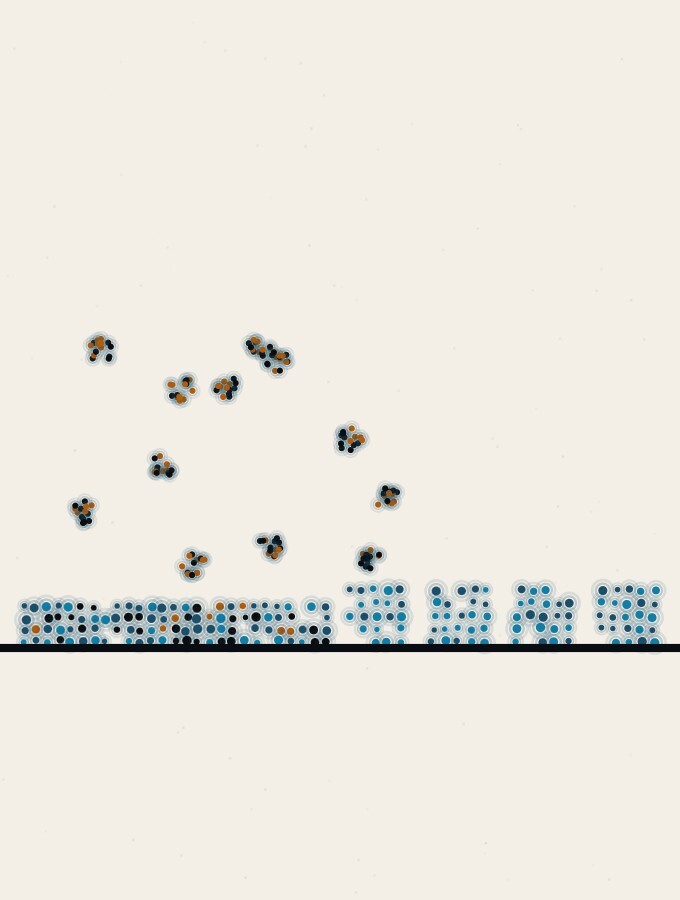
The conflict concentrates where courts sit close to homes, and most of those courts were not built for pickleball. Boren, an acoustician, estimates that more than 26,000 outdoor courts have been built or converted in the US since 2018, many of them old tennis courts painted with four pickleball courts each. That quadruples the number of games and moves the noise into frequencies the ear picks out easily. In Martinez, California, some homes stood 50 to 100 feet from eight new courts.
The legal results so far point both ways. Boise settled rather than defend its case. In Lone Tree, Colorado, five neighbours sued in June 2024 over six courts that had opened in 2023 cut into a hillside and surrounded with sound-absorbing materials. They said noise levels reached 62 decibels. In October 2025 the state appeals court said they were likely barred from suing, because the courts are government-owned.
The residents’ side now has survey numbers. In a 2025 survey of 440 people from 264 communities living within 1,000 feet of courts, about three in four said they heard play inside their homes, and more than half had moved or were considering it. Nine in ten described repetitive popping, but only six in ten called it loud, which suggests that the repetition, not the volume, is what wears people down.
What 440 residents near courts reported
Share of respondents living within 1,000 feet of pickleball courts, 264 communities. Self-selected online survey, not yet peer reviewed.
Source: Romito and Banks, Quiet Communities, 189th Meeting of the Acoustical Society of America (November 2025), popular version. Proportions as reported (“nine in ten”, “eight in ten”).
Those figures need careful handling. The respondents chose to take part, presumably because they were bothered, so the survey shows how badly affected people feel, not how common that is. It was presented by Quiet Communities, a group that campaigns for quieter neighbourhoods; it has not yet been peer reviewed. Annoyance also depends on more than sound: in a German airport study, noise level explained 16.5% of the variation in annoyance, rising to 54.8% once attitudes, noise sensitivity and home insulation were added.
What has been measured to quieten it
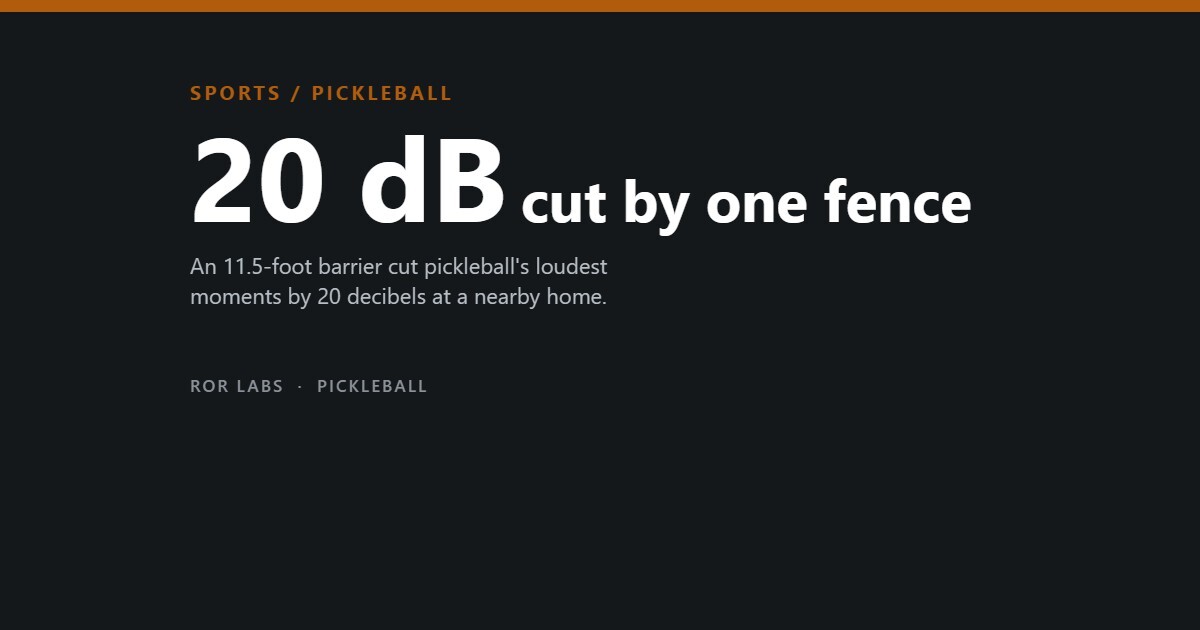
The pop’s high pitch, which makes it so noticeable, also makes it easier to block. Short wavelengths do not bend round barriers as readily as the low thump of traffic, and the air absorbs them faster. The case study that compared pickleball with tennis also measured a three-sided barrier of mass-loaded vinyl about 11.5 feet high, fixed to the fencing on the side facing a house 65 feet away. The fence cut pickleball’s loudest moments by 20 decibels and tennis’s by only about 5. Modelling suggested that screened pickleball would be about 10 decibels quieter on average at the house than unscreened tennis had been. A 10-decibel drop is usually heard as roughly half as loud. Results vary by site: for padel courts in Abu Dhabi, a model predicted that 4-metre barriers would lower levels at the most shielded homes by only 4 to 5 decibels.
One acoustic fence, two sports
Measured reduction at a home about 65 feet from the courts after an 11.5-foot, three-sided mass-loaded vinyl barrier was added. Higher is better.
Source: Greene, Leech and Burke, Noise-Con 2023, doi:10.3397/nc_2023_0117. One site, measurements of about 30 minutes each; not a controlled trial.
Quieter equipment attacks the source. USA Pickleball, the governing body, has created a Quiet Category for paddles and balls with targets of about 80 decibels and frequencies below 600 hertz, against roughly 90 decibels and 1,100 to 1,200 hertz for typical paddles; the article did not state the measurement distance. Independent laboratory work agrees that materials matter. In anechoic tests of six paddles and five balls, a wooden paddle was significantly quieter than composite ones, and the ball also changed the sound. Another engineering team cut the peak level by more than 10 decibels by perforating a paddle, though perforated paddles are not legal for play.
Quieter paddles: targets and test results
Governing-body targets, and laboratory findings. Measurement distances differ, so rows are not directly comparable.
Sources: USA Pickleball, “How USA Pickleball officials are working to make the sport quieter”; Stiles et al., Noise-Con 2026, doi:10.3397/nc_2026_0178; Moore, Noise-Con 2024, doi:10.3397/nc_2024_0039.
Layout is the cheapest lever. Moore found that a paddle radiates like a dipole, at least 10 decibels quieter in the plane of its face, so play may be quieter in the direction along the nets, and the orientation of courts relative to homes may matter. Distance helps less than people assume. A 2026 conference paper argued that fixed setbacks, such as a rule of so many feet, predict neither sound levels nor annoyance well, because ground, topography and screening matter as much as the figure on the plan.
Why the answer is to play considerately, not to ban the game
It helps to separate three different harms, because they are often blurred. Hearing damage depends on intensity and dose. Engineers testing paddles report peaks at the player’s ear of up to about 120 decibels, below the 140-decibel peak that the World Health Organization uses as a ceiling for impulsive sounds. A small laboratory experiment with 16 volunteers found that the standard 5-decibel impulse penalty overestimated short-term effects on the ears of low-level impacts. We found no study of long-term hearing in regular players, but there is little sign that neighbours face any hearing risk at all.
Annoyance and lost sleep are the real issues, and they occur far below damaging levels. WHO’s 1999 community guidelines advise that steady daytime noise in outdoor living areas should stay below 55 decibels to avoid serious annoyance, 50 for moderate annoyance, and below 45 outside at night. Those limits were written for steady, continuous sound, so a pop that is brief but repeated thousands of times fits awkwardly. WHO’s 2018 European guidelines did not cover noise from neighbours, and treated leisure noise as loud music, not ball games.
The numbers in the noise argument
Guideline values and an engineering measurement. Average levels (LAeq) and peaks are different measures and cannot be compared directly.
Sources: WHO Guidelines for Community Noise (1999); Stiles et al., Noise-Con 2026, doi:10.3397/nc_2026_0178.
None of this argues for banning a sport that gets millions of people moving, many of them in later life; its injury side is covered in our article on pickleball injuries and the fall that breaks a wrist. It argues for planning before pouring concrete and for courtesy afterwards. Players can pick quiet-rated paddles and balls, keep to posted hours, especially early mornings, and keep shouting down. Councils can screen courts, orient them, measure peaks rather than averages, and talk to neighbours before a conversion rather than after a lawsuit.
Questions people ask
How loud is pickleball?
It depends on distance, paddles and the measure used. In one case study at about 75 feet, the loudest moments were roughly 15 decibels above tennis on the same courts. Typical paddles produce about 90 decibels at impact, according to USA Pickleball.
Why does pickleball annoy people more than tennis?
The hard paddle rings at around 1,000 to 1,500 hertz, where hearing is sensitive, and each hit starts and stops abruptly. Four pickleball courts on one tennis court also means far more hits an hour.
Can pickleball noise damage hearing?
For neighbours, there is no evidence that it can. Measured peaks at a player’s ear stay below the WHO impulse ceiling, although we found no study of long-term hearing in regular players.
Do sound barriers and quiet paddles work?
In one measured case, an 11.5-foot acoustic barrier cut pickleball’s loudest moments by 20 decibels at a nearby home. Quieter paddles target about 10 decibels less, but how much they help in real play is less well measured.
The short version
- Pickleball’s pop comes from the paddle face ringing at about 1,000 to 1,500 hertz, where human hearing is especially sensitive, and it starts and stops abruptly.
- In one case study at about 75 feet, its loudest moments were 15 decibels above tennis, and one home counted up to 2,800 pops an hour from four courts.
- Many conflicts involve converted tennis courts close to homes. Boise closed two sites in 2025 to settle a lawsuit, and Martinez voted in 2026 to shut eight courts.
- A tall acoustic barrier cut the loudest moments by 20 decibels at one home; quieter paddles and court orientation help at the source.
- The main risk to neighbours is annoyance and lost sleep, not hearing damage. Site courts with care, use quieter gear and play considerately.
This is a summary of published research, not medical or legal advice. If you notice ringing in the ears or hearing changes after playing, see a doctor or an audiologist; if noise is affecting your sleep or health, talk to your doctor, and raise disputes with your local council or a qualified acoustician.
Further reading: Greene, Leech and Burke, Noise-Con 2023, for measured pickleball and tennis levels and a barrier test. Bacon et al., Proceedings of the IMechE, Part P (2025), for why paddles ring. WHO, Guidelines for Community Noise (1999), for the annoyance and impulse values still widely used.
- Golden: The Power of Silence in a World of Noise, Justin Zorn and Leigh Marz (2022). Two policy advisers on why quiet matters to health and attention; useful context for neighbours, though it is not about sport.
- The Data Detective, Tim Harford (2021). Ten rules for reading statistics, handy when a self-selected survey or a single case study is offered as proof.
- The Art of Uncertainty, David Spiegelhalter (2024). A Cambridge statistician on judging risk when evidence is thin, as it still is for pickleball noise.
Sources
- Boise settles anti-pickleball lawsuit; will shut down courts in two parks. Boise State Public Radio, 29 August 2025.
- ‘Relentless’: Couple files suit against City of Boise over pickleball noise. BoiseDev, 30 June 2025.
- Greene M, Leech J, Burke C. Case study: measurements and modeling of noise from pickleball versus tennis play, and estimation of proposed noise reduction measures. Noise-Con 2023 Proceedings, doi:10.3397/nc_2023_0117.
- Romito KM, Fink D. Pickleball noise raises health concerns for neighbors living near courts. Acoustical Society of America, popular version, 188th meeting, 5 May 2025; and Romito KM, Journal of the Acoustical Society of America (2025), doi:10.1121/10.0038039 (meeting abstract).
- Bacon IC, Dobbs CE, Allen MS, Patchett BD. Characterizing the vibroacoustic response of pickleball paddles through impact testing and laser Doppler vibrometry. Proceedings of the IMechE, Part P (2025), doi:10.1177/17543371251393306.
- Russell DA. Understanding pickleball noise at the source: the vibroacoustics of the pickleball paddle and ball. Journal of the Acoustical Society of America (2024), doi:10.1121/10.0027696 (meeting abstract).
- Storm M. The pickleball seven decibel challenge. Noise-Con 2024 Proceedings, doi:10.3397/nc_2024_0099.
- Jensen NM, Hord SK, Irarrazabal F, Wu B. Is pickle ball noise highly impulsive? Noise-Con 2025 Proceedings, doi:10.3397/nc_2025_0071.
- Notario Tévar A, Geltinger A. Prediction and assessment of racket sport noise from tennis, pickleball and padel. Noise-Con 2026 Proceedings, doi:10.3397/nc_2026_0107.
- Wyerman BR, Unetich R. Pickleball Sound 101: the statistics of pickleball sound and a recommended noise standard for pickleball play. Noise-Con 2023 Proceedings, doi:10.3397/nc_2023_0001.
- Boren BB. Psychoacoustic noise metrics for pickleball sound. Journal of the Acoustical Society of America (2026), doi:10.1121/10.0045537 (meeting abstract); Boren BB, doi:10.1121/10.0034949 (2024).
- Martinez council votes to permanently close pickleball courts after neighbor complaints. Local News Matters (Bay City News), 19 March 2026; and report of 16 March 2026.
- Colorado appeals court parses a pickle of a noise complaint. Courthouse News Service, 30 September 2025.
- Lone Tree neighbors likely can’t close noisy pickleball courts, judges say. BusinessDen, 31 October 2025.
- Romito K, Banks J. The noise nobody planned for: a community perspective on pickleball noise. Acoustical Society of America, popular version, 189th meeting, 13 November 2025.
- Bartels S, Müller U, Vogt J. Predictors of aircraft noise annoyance: results of a telephone study (2013), DLR elib 84453.
- Romito KM, Leahy CE. Reevaluating pickleball noise assessment: the case for integrating non-acoustic annoyance factors. Journal of the Acoustical Society of America (2025), doi:10.1121/10.0040125 (meeting abstract).
- Núñez-Naranjo AF, Vasquez JG, García M. Acoustic characterization and modeling of padel courts in urban residential environments (2026), doi:10.59400/sv4407.
- USA Pickleball. How USA Pickleball officials are working to make the sport quieter. usapickleball.org, accessed October 2026; Kingson JA. Inside the quest for quieter pickleball. Axios, 21 November 2023.
- Stiles J, Herrin DW. Pickleball paddle and ball impact noise. Noise-Con 2025 Proceedings, doi:10.3397/nc_2025_0188.
- Stiles J, Smither M, Rodger K, Herrin DW. Reducing pickleball impact noise by perforating the paddle. Noise-Con 2026 Proceedings, doi:10.3397/nc_2026_0178.
- Moore JA. Pickleball sounds: impact induced vibration and radiated sound. Noise-Con 2024 Proceedings, doi:10.3397/nc_2024_0039.
- Van Scoyk D, Wyerman BR. The distance myth for pickleball noise. Journal of the Acoustical Society of America (2026), doi:10.1121/10.0045535 (meeting abstract).
- Aranda de Toro MA, Ordoñez R, Reuter K, Hammershøi D. Is it necessary to penalize impulsive noise +5 dB due to higher risk of hearing damage? Journal of the Acoustical Society of America (2011), doi:10.1121/1.3573981.
- World Health Organization. Guidelines for Community Noise (1999), Berglund B, Lindvall T, Schwela DH, eds.
- Jarosíńska D, Héroux M-È, Wilkhu P, et al. Development of the WHO Environmental Noise Guidelines for the European Region: an introduction. International Journal of Environmental Research and Public Health 15(4):813 (2018); WHO, Compendium of WHO and other UN guidance on health and environment, chapter 11: environmental noise (2022).