Nurse Staffing and Patient Deaths: What the Evidence Shows
Key takeaways · 13 min read
- In large hospital comparisons in the US and Europe, each extra patient per nurse is linked to roughly 7% to 16% higher odds of dying within 30 days.
- Studies that follow individual patients shift by shift point the same way: each understaffed shift or day raises the risk of death by a few per cent.
- Queensland’s 2016 ratio law is the best natural experiment: staffing improved and deaths fell in covered hospitals, but hospitals were not randomly assigned.
- California’s older ratio law cut nurses’ patient loads, but one economic evaluation found no evidence that it improved patient safety.
When a hospital ward is short of nurses, the work does not disappear. Observations are taken later, pain relief waits, and a patient who is quietly getting worse is noticed an hour later than they might have been. For more than two decades researchers have tried to measure what that costs in lives. The answer that keeps coming back is that patients are more likely to die where each nurse looks after more people.
That finding now sits behind ratio laws in California and Queensland and behind nurses’ strikes in many countries. But almost all of it comes from observational studies. Hospitals with more nurses may differ in other ways, and sicker wards may attract extra staff. Whether more nurses cause fewer deaths, and by how much, is a harder question than the headlines suggest.
This article looks at the landmark hospital comparisons, the studies that follow patients shift by shift, the ratio laws that have been formally evaluated and the arguments about causation. It ends with what patients and families can and cannot do. It covers registered nurses in general hospitals; nursing homes and emergency department crowding are separate topics.
The study that started it
In 2002 Linda Aiken and colleagues at the University of Pennsylvania linked a survey of 10,184 nurses with the records of 232,342 surgical patients in 168 Pennsylvania hospitals. After adjusting for patient and hospital characteristics, each additional patient per nurse was associated with 7% higher odds of dying within 30 days of admission. Patients where nurses had eight patients each had an estimated 31% higher risk of death than where nurses had four.
Each extra patient was also linked to 23% higher odds of nurse burnout and 15% higher odds of job dissatisfaction. The paper appeared while California was drafting the first statewide ratio rules, and a US National Institute of Nursing Research release put the national toll at about 20,000 deaths a year. That was a projection from the model, not a count of deaths.
The design was cross-sectional: a single snapshot comparing hospitals. Staffing came from nurses’ own reports of their last shift, averaged by hospital. Better-staffed hospitals may also have better doctors, equipment or management, and statistical adjustment can only remove differences that were measured.
The same pattern in Europe
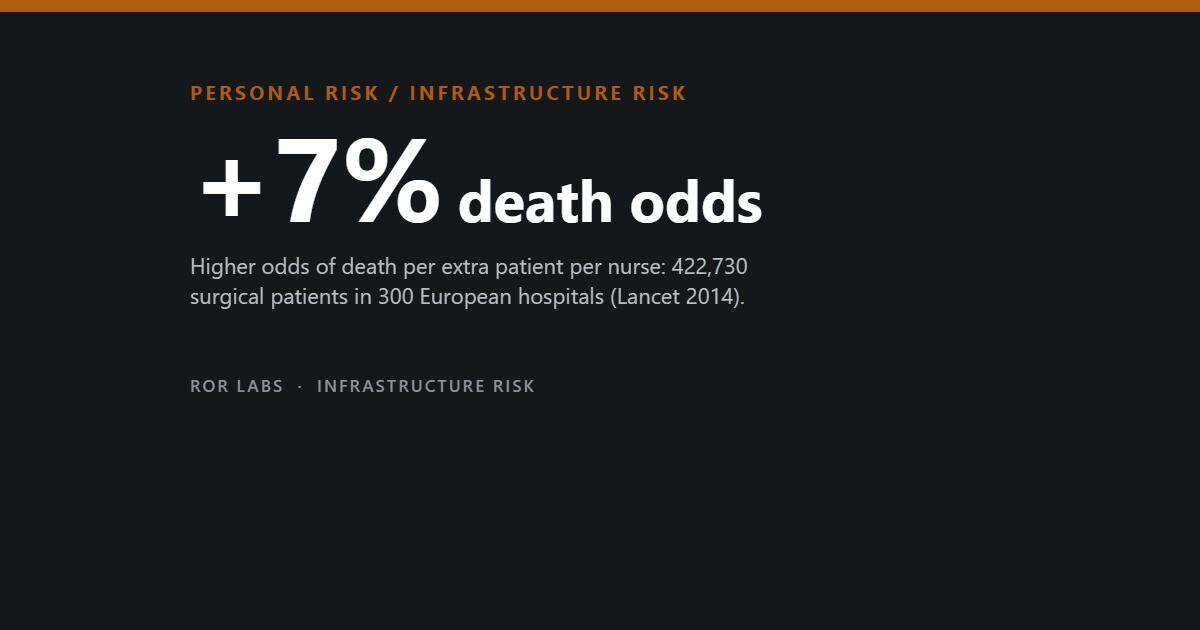
The comparison has since been repeated in many places. In England, Anne Marie Rafferty and colleagues studied 118,752 surgical patients in 30 hospital trusts and found 26% higher mortality in the quarter of hospitals where nurses had the most patients. The European RN4CAST study, published in The Lancet in 2014, covered 422,730 surgical patients aged 50 or over in 300 hospitals in nine countries, and again found 7% higher odds of death for each extra patient per nurse.
One more patient per nurse
Increase in the odds of death within 30 days for each additional patient per nurse, in hospital comparisons, %.
Sources: Lasater KB et al., BMJ Open (2021); Muir KJ et al., Med Care (2026); Aiken LH et al., JAMA (2002); Aiken LH et al., Lancet (2014). All cross-sectional; staffing measured by nurse surveys.
Recent US studies, designed to inform state staffing bills, find the same direction. In 87 Illinois hospitals, each extra patient per nurse on medical-surgical wards was associated with 16% higher odds of death among Medicare patients. A 2026 study of 547,689 patients in 132 Pennsylvania hospitals, where staffing ranged from three to nine patients per nurse, found 8%.
England’s National Institute for Health and Care Excellence (NICE) drew on this kind of evidence in 2014. Its safe staffing guideline says that when registered nurses on a day shift are caring for more than eight patients each, senior managers should act, because the risk of harm rises. It is a trigger for review, not a legal limit.
Following patients shift by shift
The obvious objection to hospital comparisons is that good hospitals may simply be good at everything. A stronger design looks inside one hospital and asks whether the same ward does worse on days when it is short. Jack Needleman and colleagues did this at a large US academic medical centre, tracking 197,961 admissions and 176,696 eight-hour nursing shifts across 43 units.

Staffing was within eight hours of target on 84% of shifts, so shortfalls were the exception. Even so, each shift a patient spent on a unit running eight or more registered-nurse hours below target was associated with a 2% higher hazard of death. Each shift with unusually high patient turnover, from admissions, transfers and discharges, carried a 4% higher hazard. Over a stay, several bad shifts add up.
Peter Griffiths and colleagues repeated the approach in an English hospital trust, with 138,133 patients on 32 general wards. Each day of registered-nurse staffing below the ward’s usual level raised the hazard of death by 3%, and days with admissions per nurse more than 25% above normal by 5%. Extra nursing assistants did not make up the gap: risk was higher both below and above their usual level.
Short shifts, higher risk
Increase in the risk of death with each exposure, in studies that track individual patients over time, %.
Sources: Musy SN et al., Int J Nurs Stud (2021); Griffiths P et al., BMJ Qual Saf (2019); Needleman J et al., NEJM (2011). Hazard or odds ratios from different designs; not directly comparable.
Other single-site studies agree. Across three NHS hospitals in 2017, Ben Zaranko and colleagues estimated that one extra 12-hour registered-nurse shift was linked to 9.6% lower odds of a patient death on that ward that day; agency nurses and support workers showed no clear effect. These designs remove the “good hospital” explanation, but they are still observational.
When a law changed the numbers
In July 2016 Queensland, Australia, required average ratios of at least one nurse to four patients on morning and afternoon shifts, and one to seven at night, on adult medical-surgical wards in 27 public hospitals. It also paid for an independent evaluation. Matthew McHugh and colleagues compared those hospitals with 28 that treated similar patients but were not covered, before the law and two years after.
Covered hospitals went from 4.84 to 4.37 patients per nurse, while comparison hospitals barely moved. The study included 231,902 patients at baseline and 257,253 afterwards. Odds of death within 30 days fell by 11% in covered hospitals and rose slightly, but not significantly, in the others. The authors estimated that without the law there would have been 145 more deaths, 255 more readmissions and 29,222 more hospital days.
Queensland before and after ratios
Adult medical-surgical wards, 2016 (before) and 2018 (two years after the law).
| Measure | Covered hospitals (27) | Comparison hospitals (28) |
|---|---|---|
| Patients per nurse, before | 4.84 | 6.13 |
| Patients per nurse, after | 4.37 | 5.96 |
| Odds of 30-day death, after vs before | 0.89 (11% lower) | 1.07 (not significant) |
| Deaths avoided, modelled | 145 | – |
Source: McHugh MD et al., Lancet (2021), doi:10.1016/S0140-6736(21)00768-6. Staffing from nurse surveys in the 36 hospitals with reliable data.
This is the closest the field has to an experiment, and the paper is open about its limits. Hospitals were chosen by the government, not at random, and were not matched. Staffing was measured through nurse surveys, reliable for only 36 of the 55 hospitals. The 145 deaths are a modelled counterfactual, and the estimate of extra nurses needed came from the nurses’ union. The study was funded by Queensland Health and the US National Institutes of Health; the authors declared no competing interests.
One detail is easy to miss. Covered hospitals were already better staffed at baseline, yet their patients had 34% higher odds of death, probably because these were larger hospitals with sicker patients. The before-and-after comparison is meant to cancel such fixed differences, but not ones that changed over the same two years.
California’s mixed record
California went first. Its regulations, in force since 2004, set limits that apply at all times: no more than two patients per nurse in intensive care, four in the emergency department and, from January 2005, five on medical-surgical wards. A 2006 survey of 22,336 nurses found that California nurses cared for one fewer patient on average than nurses in New Jersey and Pennsylvania, and two fewer on medical-surgical units.
Aiken’s team modelled that if hospitals in those two states had matched California’s ratios, surgical deaths would have been 13.9% lower in New Jersey and 10.6% lower in Pennsylvania. That is a prediction from a cross-sectional comparison. Economists Andrew Cook, Martin Gaynor and colleagues instead asked what happened when the law forced understaffed hospitals to change. Ratios did fall there, but outcomes did not improve faster than elsewhere: they found no evidence of a causal effect on patient safety.
What ratio laws did to deaths
Evaluations of mandatory nurse-to-patient ratios, by design.
| Law | Design | Finding on deaths or safety |
|---|---|---|
| California, 2004 | Hospitals forced to add staff vs others (Cook 2010) | No evidence of a causal effect |
| California, 2004 | Comparison with two states, 2006 (Aiken 2010) | Model predicts 10.6–13.9% fewer surgical deaths |
| Massachusetts ICUs, 2014 | Difference-in-differences (Law 2018) | No change in hospital mortality |
| Queensland, 2016 | Before and after with comparison hospitals (McHugh 2021) | Deaths fell; 145 avoided (modelled) |
Sources: Cook A et al., NBER Working Paper 16077 (2010); Aiken LH et al., Health Serv Res 45(4) (2010); Law AC et al., Crit Care Med (2018); McHugh MD et al., Lancet (2021).
Other evaluations were also muted. Joanne Spetz and colleagues found that higher registered-nurse staffing in California improved only one of six patient safety indicators. When Massachusetts capped intensive care at two patients per nurse in 2014, ICU staffing improved about as much in other states, and hospital mortality did not change. Many of these hospitals were already close to the limits, which leaves little room for a law to make a difference.
Why causation is still argued
No one has randomly assigned nurses to wards and counted deaths, and probably no one will. A 2013 review by Paul Shekelle judged the strongest support for a causal link to be the Needleman shift-level study and a dose-response pattern across observational studies, but noted that no intervention to raise staffing had been evaluated. Queensland has partly filled that gap since.
In 2022 Chiara Dall’Ora and colleagues reviewed 28 longitudinal studies. Twelve were at serious and six at critical risk of bias, and only three at low risk, yet the overall picture was consistent with fewer deaths when registered-nurse staffing is higher. The authors judged that the most biased studies were the most likely to underestimate the benefit of more nurses, not to exaggerate it.
Measurement is another weak point. Many hospital studies rely on nurses’ reports of how many patients they had on their last shift. In the 2020 Illinois survey of 1,391 nurses, half said their last assignment exceeded what they could safely manage. The same researchers projected 1,595 fewer deaths a year among Medicare patients at a four-to-one ratio, while stating in the paper that the cross-sectional design precludes causal statements.
How nurses rate their own workload
Medical-surgical nurses in 87 Illinois hospitals who judged their last shift’s assignment unsafe, %.
Source: Lasater KB et al., BMJ Open 11(12):e052899 (2021). Survey of 1,391 nurses in 2020; self-reported.
Much of this research comes from one group at the University of Pennsylvania, often timed to inform specific bills, and nurses’ unions cite it widely. That does not make it wrong, and independent teams in England and Switzerland find the same direction. It does mean that the size of the effect, more than its direction, is where honest doubt remains.
What patients and families can do
Very little about staffing is in a patient’s control. In an emergency you go to the nearest hospital, and in most places there is no published, enforceable ratio to check. Asking how many patients your nurse has is reasonable, but the answer changes by the hour. Nurses on a short-staffed ward are usually working flat out; the problem is the system, not the person at the bedside.
What families can do is notice and speak up. NICE lists “red flag” events that should prompt the nurse in charge to escalate, including a delay of more than 30 minutes in giving pain relief and vital signs not checked as planned. A relative who sees these, or sees a patient getting worse, should tell the nurse in charge and ask for a doctor to review.
In England, Martha’s Rule, named after Martha Mills, who died of sepsis in 2021 aged 13, lets patients and families call for an urgent review by a separate team. From September 2024 to May 2026 there were 16,160 calls, 72% through the family route, and 664 led to transfer to high-dependency or intensive care. NHS England says most calls about deterioration would not have been flagged by the usual early-warning score.

What the evidence suggests
Across countries and designs, patients are more likely to die when registered nurses have more patients each, and when individual shifts fall short. The size of the effect varies, from 2% per short shift to 7% to 16% per extra patient in hospital comparisons, and nearly all of it is observational. Queensland gives the best evidence that a law can improve both staffing and outcomes; California and Massachusetts show that ratios alone do not guarantee measurable gains.
What to do
Steps sorted by when they matter. Each one says how strong the evidence is: Measured Official advice Untested
If it happens
- Notice and speak up. If pain relief is more than 30 minutes late, vital signs are not checked as planned, or the patient seems worse, tell the nurse in charge and ask for a doctor to review. Official advice see Sources
- In England, use Martha’s Rule to call for an urgent review by a separate team. Of 16,160 calls, 664 led to transfer to high-dependency or intensive care. Measured see Sources
What not to do
- Do not blame the nurse at the bedside. On a short-staffed ward the problem is the system. Untested see Sources
Questions people ask
Does nurse staffing affect patient deaths?
Studies consistently link fewer patients per nurse to lower death rates. The exact size of the effect is uncertain because most studies are observational.
What is a safe nurse-to-patient ratio?
There is no single figure. California sets five patients per nurse on medical-surgical wards and two in intensive care; Queensland four by day; NICE flags more than eight on day shifts.
Do nurse ratio laws save lives?
Queensland’s law was followed by fewer deaths in covered hospitals. Evaluations in California and Massachusetts found no clear improvement.
Can nursing assistants replace registered nurses?
English studies suggest not: extra assistants or support workers did not offset shortages of registered nurses.
What can I do if a ward seems understaffed?
Tell the nurse in charge, ask for a doctor’s review if someone is getting worse and, in England, use Martha’s Rule.
The short version
- In large hospital comparisons in the US and Europe, each extra patient per nurse is linked to roughly 7% to 16% higher odds of dying within 30 days.
- Studies that follow individual patients shift by shift point the same way: each understaffed shift or day raises the risk of death by a few per cent.
- Queensland’s 2016 ratio law is the best natural experiment: staffing improved and deaths fell in covered hospitals, but hospitals were not randomly assigned.
- California’s older ratio law cut nurses’ patient loads, but one economic evaluation found no evidence that it improved patient safety.
- Nearly all the evidence is observational. Patients cannot choose staffing, but families can raise concerns and, in England, ask for an urgent review under Martha’s Rule.
This article summarises research and official guidance for general information. It is not medical or legal advice and cannot assess anyone’s care. If you are worried that someone in hospital is getting worse, tell the nurse in charge or ask for an urgent medical review; in an emergency, call your local emergency number. For questions about treatment, speak to a doctor or nurse.
Further reading: Needleman et al., NEJM 364(11) (2011), for the shift-level design. McHugh et al., The Lancet (2021), for the Queensland evaluation. Dall’Ora et al., Int J Nurs Stud (2022), for a critical review of the longitudinal evidence.
- Healing: When a Nurse Becomes a Patient, Theresa Brown (2022). An oncology nurse, diagnosed with cancer, sees hospital care from the bed and notices how much depends on nurses having time. Honest and humane; a memoir, not a study of staffing.
- The Courage to Care, Christie Watson (2020). A former NHS nurse draws on her career to argue that care needs time, support and enough people. Warm and vivid; anecdotal rather than evidence-based.
- How to Treat People, Molly Case (2019). A nurse describes her training and working life on NHS wards. Good on what a shift actually involves; a personal account rather than an analysis.
Sources
- Aiken LH, Clarke SP, Sloane DM, Sochalski J, Silber JH. JAMA 288(16):1987 (2002), doi:10.1001/jama.288.16.1987; National Institute of Nursing Research news release (2002).
- Rafferty AM, Clarke SP, Coles J et al. Int J Nurs Stud (2007), doi:10.1016/j.ijnurstu.2006.08.003.
- Aiken LH, Sloane DM, Bruyneel L et al. Lancet 383:1824 (2014), doi:10.1016/S0140-6736(13)62631-8.
- Lasater KB, Aiken LH, Sloane DM et al. BMJ Open 11(12):e052899 (2021).
- Muir KJ, Aiken LH, Brom HM et al. Med Care (2026), doi:10.1097/MLR.0000000000002332.
- Needleman J, Buerhaus P, Pankratz VS et al. N Engl J Med 364(11):1037 (2011), doi:10.1056/NEJMsa1001025.
- Griffiths P, Maruotti A, Recio-Saucedo A et al. BMJ Qual Saf 28(8):609 (2019).
- Zaranko B, Sanford N, Kelly EA et al. BMJ Qual Saf (2022), doi:10.1136/bmjqs-2022-015291.
- Musy SN, Endrich O, Leichtle AB et al. Int J Nurs Stud (2021), shift-level retrospective longitudinal study.
- McHugh MD, Aiken LH, Sloane DM, Windsor C, Douglas C, Yates P. Lancet (2021), doi:10.1016/S0140-6736(21)00768-6.
- Aiken LH, Sloane DM, Cimiotti JP et al. Health Serv Res 45(4):904 (2010), doi:10.1111/j.1475-6773.2010.01114.x.
- Cook A, Gaynor M, Stephens M, Taylor L. NBER Working Paper 16077 (2010), doi:10.3386/w16077.
- Spetz J, Harless DW, Herrera CN, Mark BA. Med Care Res Rev (2013), doi:10.1177/1077558713475715.
- Law AC, Stevens JP, Hohmann SF, Walkey AJ. Crit Care Med (2018), doi:10.1097/CCM.0000000000003286.
- Shekelle PG. Ann Intern Med (2013), doi:10.7326/0003-4819-158-5-201303051-00007.
- Dall’Ora C, Saville C, Rubbo B, Turner L, Jones J, Griffiths P. Int J Nurs Stud (2022), doi:10.1016/j.ijnurstu.2022.104311.
- California Code of Regulations, Title 22, § 70217.
- NICE. Safe staffing for nursing in adult inpatient wards in acute hospitals, guideline SG1 (2014).
- NHS England. Martha’s Rule (accessed October 2026).
- WBUR (14 September 2026; 2 October 2026).