How much water you need, and the eight glasses nobody measured
Key takeaways · 10 min read
- “Eight glasses a day” traces to a 1945 recommendation that also said most of the water comes from food. A 2002 review found no studies supporting it.
- Measured water turnover ranges from about one to six litres a day; a typical 20-year-old man turns over about 3.2 litres and a woman 2.7, including water from food.
- By the tablespoon, watery vegetables tie at just over 14 grams. By the serving, a cup of cooked rice carries more water than a cup of lettuce.
- About a quarter of older adults have low-intake dehydration, and bedside signs such as dry mouth or urine colour do not reliably detect it.
In this article
In 1945 the US Food and Nutrition Board suggested that adults take in about 2.5 litres of water a day, roughly one millilitre for every calorie burned. The same recommendation added that most of this quantity is contained in prepared foods. The first half survived as “eight glasses a day”. The second half was forgotten. In 2002 a kidney physiologist, Heinz Valtin, went looking for the evidence behind eight glasses of plain water and found no scientific studies at all.
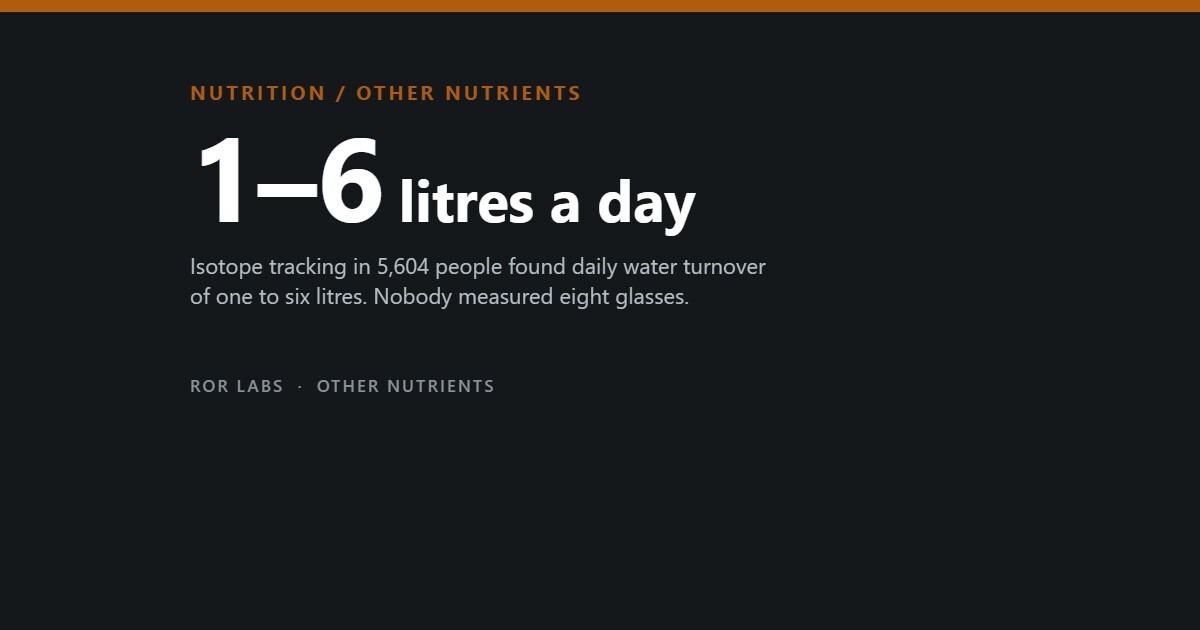
The largest direct measurement came in 2022. An international team tracked labelled water through the bodies of 5,604 people in 23 countries and found daily water turnover ranging from about one litre to six. A 20-year-old, 70-kilogram man at sea level in a temperate climate turned over about 3.2 litres; a 60-kilogram woman about 2.7. Turnover includes the water in food and the water the body makes itself, so it is more than anyone needs to drink.
This article covers what water does, why food matters, who runs short, how drinking too much can kill, what trials of drinking more found, and who pays for the research. This year electrolyte powders went mainstream, and most of the experts quoted about them said plain water does the job for most people.
What water does, and why no upper limit was set
Water is 40% to 62% of body mass, depending on age and body fat. The body makes only a quarter to a third of a litre a day from burning food and stores little, so losses through urine, breath, skin and faeces have to be replaced every day. Large differences in how much people drink barely move the concentration of their blood.
The US National Academies set Adequate Intakes in 2004: 3.7 litres of total water a day for men and 2.7 for women, from drinks and food together. These are not requirements. They describe what healthy people typically consume, and the panel expected about a fifth of it to come from food. The European Food Safety Authority settled lower, at 2.5 and 2.0 litres. Neither set an upper limit: healthy kidneys excrete a great deal of water, but not unlimited amounts, and not quickly.
The reference numbers for water
Litres a day of total water, from drinks and food combined, unless stated. Adequate Intakes describe typical intakes of healthy people; they are not minimums.
Sources: National Academies, Dietary Reference Intakes for water (2004); EFSA Scientific Opinion on water (2010); Yamada et al., Science 378:909 (2022), predictions for sea level, temperate climate, non-athlete.
Three foods by the spoonful
The series ranks foods by what one level tablespoon, 15 grams, delivers, using USDA FoodData Central values per 100 grams. For water the ranking collapses into a tie. Iceberg lettuce, celery and cucumber are all about 95% water, so a tablespoon of any of them carries a little over 14 grams.
Water in one level tablespoon (15 g)
USDA FoodData Central, SR Legacy, nutrient 255 (water). FDC identifiers given so the figures can be checked. A tablespoon of plain water is 15 g.
Source: USDA FoodData Central. Even the leaders reach the 2.7-litre women’s Adequate Intake only after about 190 tablespoons.
The spoon misleads in another way: people eat foods by the bowl, and dense foods that are only partly water still deliver a lot of it. A cup of cooked white rice, 186 grams at 68.6% water, carries about 128 grams. A cup of shredded iceberg lettuce weighs only 72 grams and carries about 69. This is what the 1945 sentence about prepared foods meant.
Water in a typical serving
Grams of water, from USDA FoodData Central values per 100 g multiplied by the serving weight shown.
Source: USDA FoodData Central, SR Legacy. Serving weights are stated so the arithmetic can be repeated.
Who actually runs short
Healthy adults rarely run short, because thirst is a sensitive alarm. Older people are the exception: thirst blunts with age, kidneys conserve water less well, and people who depend on others for drinks, or worry about reaching a toilet, drink less. Researchers call the result low-intake dehydration, and the reliable way to detect it is a blood test: serum osmolality above 300 milliosmoles per kilogram.
A 2023 meta-analysis of 61 studies and 22,398 people aged 65 and over, living outside hospital, estimated that 24% had low-intake dehydration on that test. A 2026 review of 19 studies and 14,398 older patients put the share at hospital admission at 23%, adding that a quarter to a third was the likely range. The intervals are wide because studies differ, but the direction is not in doubt.
Older adults with low-intake dehydration
Share with directly measured serum osmolality above 300 mOsm/kg, from two systematic reviews. Ranges are 95% confidence intervals.
Sources: Parkinson et al., Clinical Nutrition 42(8):1510 (2023); Hooper et al., BMJ Public Health 4(2):e002985 (2026).
The familiar bedside signs do not find it. A Cochrane diagnostic review analysed 24 studies and 67 signs and simple tests against blood measurements in people aged 65 and over, and no test was consistently useful in more than one study. It found enough evidence to say that urine colour, urine specific gravity, dry mouth and even feeling thirsty should not be relied on to judge whether an older person is dehydrated. One of the few promising signals was simpler: missing drinks between meals.
When drinking more becomes the danger
The opposite problem is rarer and faster. Drinking far more than the kidneys can clear dilutes the sodium in the blood, a condition called hyponatraemia, and water moves into the brain. At the 2002 Boston Marathon, 13% of 488 runners who gave a finish-line blood sample had low sodium, and 0.6% had critically low levels. The strongest predictor was gaining weight during the race, a sign of drinking more than was sweated out: it carried 4.2 times the odds, and finishing in more than four hours 7.4 times.
An analysis of 2,135 weighed endurance athletes found the same relationship: the more weight gained, the lower the sodium. Its senior author, Tim Noakes, later argued that a 1996 guideline urging athletes to drink as much as tolerable helped cause a wave of cases, and that commercial influence delayed acceptance of the evidence. The 2015 international consensus on exercise-associated hyponatraemia now advises athletes to use thirst as their guide.
What happened when trials asked people to drink more
People who drink more water differ in many other ways, so randomised trials are the cleaner test, and there are few. A 2024 systematic review in JAMA Network Open found 18; ten reported at least one benefit and eight reported none.
The clearest benefit is for kidney stones. In a 1996 Italian trial, 199 people who had passed a first calcium stone were randomised to drink enough water to produce at least two litres of urine a day, or given no advice. Over five years, 12.1% of the high-water group had another stone, against 27% of the others. Guidelines for stone formers still rest largely on that one trial.
Kidney function was a disappointment. The CKD WIT trial coached 631 Canadians with moderate chronic kidney disease to drink 1 to 1.5 litres more a day, or to carry on as usual. After a year the hydration group’s urine was 0.6 litres a day higher, but kidney function declined by 2.2 units against 1.9 — a difference of −0.3, with a confidence interval from −1.8 to 1.2. In polycystic kidney disease, where water was expected to slow cyst growth, the three-year PREVENT-ADPKD trial of 184 patients found kidneys growing 6.8% a year on prescribed water and 7.8% without it, a difference that could be chance.
Weight loss is the other repeated signal. In a 2010 trial of 48 adults on a calorie-controlled diet, those who drank 500 millilitres of water before each meal lost about two kilograms more over 12 weeks. A 2015 British trial of 84 adults found 1.3 kilograms, which lost statistical significance after adjustment.
Randomised trials of drinking more water
Main results. Kidney function is the change in estimated glomerular filtration rate (mL/min/1.73 m²) over one year.
Sources: Borghi et al., Journal of Urology 155(3):839 (1996); Clark et al., JAMA 319(18):1870 (2018); Rangan et al., NEJM Evidence 1(1) (2022).
Who pays for hydration science
Much of the research on everyday hydration is paid for by companies that sell drinks. A narrative review published in 2020 and arguing that drinking more water benefits health listed 18 authors: nine were or had been employed by Danone Research, the arm of a major bottled-water company, and the other nine had received fees or grants from it. PREVENT-ADPKD was part-funded by Danone too, and Noakes’s complaint was aimed at the sports-drink industry.
Funding does not make a finding wrong: PREVENT-ADPKD, with Danone money, published a null result. But it is a reason to notice where advice to drink more comes from, and to weight the modest randomised trials above confident marketing.
Keeping water where it should be
For healthy adults in ordinary conditions, drinking when thirsty and with meals is enough, and tea, coffee and milk count; the old warning that caffeinated drinks do not was not supported in Valtin’s review. Needs rise in heat, at altitude and with long, hard exercise, and the measured differences are large: in the 2022 study athletes turned over about a litre a day more than non-athletes.
Some groups should plan rather than wait for thirst. Older adults, especially in care, benefit from being offered drinks regularly; in a UK study of care-home residents, those who drank well were the ones offered drinks more often and who drank with their medicines. People who have had a calcium kidney stone are usually advised to drink enough to make two to two and a half litres of urine. People told by a doctor to restrict fluids, for heart failure, advanced kidney disease or some causes of low sodium, should follow that advice rather than general guidance.
For endurance events, drink to thirst and do not gain weight during the race. For most other exercise, the experts interviewed by the AP said water is enough; electrolyte products differ several-fold in sodium, and potassium in large amounts is dangerous.
Questions people ask
How much water should I drink a day?
There is no single figure. US reference intakes are 3.7 litres of total water for men and 2.7 for women, including food, which typically supplies about a fifth. For healthy adults, thirst is a reliable guide.
Can you drink too much water?
Yes. Drinking much more than the kidneys can clear lowers blood sodium and can be fatal. In marathon studies the main warning sign was gaining weight during the race.
Is urine colour a good guide?
It is a rough guide for young, healthy people, but a Cochrane review found it should not be relied on to judge hydration in older adults.
The short version
- “Eight glasses a day” traces to a 1945 recommendation that also said most of the water comes from food. A 2002 review found no studies supporting it.
- Measured water turnover ranges from about one to six litres a day; a typical 20-year-old man turns over about 3.2 litres and a woman 2.7, including water from food.
- By the tablespoon, watery vegetables tie at just over 14 grams. By the serving, a cup of cooked rice carries more water than a cup of lettuce.
- About a quarter of older adults have low-intake dehydration, and bedside signs such as dry mouth or urine colour do not reliably detect it.
- Drinking more prevented kidney stone recurrence in a trial, but did not slow kidney disease. Overdrinking during endurance events can be fatal.
This is a summary of published research, not medical advice. If you have kidney, heart or liver disease, have been told to restrict fluids, care for an older person who drinks little, or are preparing for an endurance event, talk to your doctor or a registered dietitian.
Further reading: Valtin, American Journal of Physiology 283(5):R993 (2002), for the origin of eight glasses. Yamada et al., Science 378:909 (2022), for measured water turnover across 23 countries. Hooper et al., BMJ Public Health (2026), for dehydration in older patients.
- Burn, Herman Pontzer (2021). An evolutionary anthropologist on how the body really spends energy, by a co-author of the 2022 water turnover study. Strong on measurement with labelled water; it is about calories more than water.
- Exercised, Daniel E. Lieberman (2021). A Harvard biologist tests common beliefs about exercise against evolution and evidence. Useful context for advice that sounds obvious and is not; hydration is a small part of it.
- Water: A Biography, Giulio Boccaletti (2021). A history of how societies have organised themselves around water. A wider frame than the body; read it for perspective, not for health advice.
Sources
- Valtin H. “Drink at least eight glasses of water a day.” Really? American Journal of Physiology – Regulatory, Integrative and Comparative Physiology 283(5):R993–R1004 (2002).
- Food and Nutrition Board, National Research Council. Recommended Dietary Allowances (1945), as described by Stookey and Kavouras, Nutrients 12(11):3359 (2020).
- Yamada Y, Zhang X, Henderson MET, et al. Science 378(6622):909–915 (2022); Phys.org report, November 2022.
- Institute of Medicine. Dietary Reference Intakes for Water, Potassium, Sodium, Chloride, and Sulfate (2004/2005).
- EFSA Panel on Dietetic Products, Nutrition and Allergies. Scientific Opinion on Dietary Reference Values for water. EFSA Journal 8(3):1459 (2010).
- Perrier ET, Armstrong LE, Bottin JH, et al. European Journal of Nutrition 60(3):1167–1180 (2021), conflict of interest statement.
- Jimoh OF, Brown TJ, Bunn D, Hooper L. Nutrients 11(2):447 (2019).
- USDA FoodData Central, SR Legacy, nutrient 255; FDC identifiers are printed in the figures.
- Parkinson EG, Hooper L, Fynn JF, et al. Clinical Nutrition 42(8):1510–1520 (2023).
- Hooper L, Parkinson EG, Abdelhamid AS, et al. BMJ Public Health 4(2):e002985 (2026).
- Hooper L, Abdelhamid A, Attreed NJ, et al. Cochrane Database of Systematic Reviews (2015), CD009647, doi:10.1002/14651858.CD009647.pub2.
- Almond CSD, Shin AY, Fortescue EB, et al. New England Journal of Medicine 352(15):1550–1556 (2005).
- Noakes TD, Sharwood K, Speedy D, et al. PNAS 102(51):18550 (2005); Noakes TD, British Journal of Sports Medicine 45(6):475–477 (2011).
- Hew-Butler T, Rosner MH, Fowkes-Godek S, et al. Clinical Journal of Sport Medicine 25(4):303–320 (2015).
- Hakam N, Guzman Fuentes JL, Nabavizadeh B, et al. JAMA Network Open 7(11):e2447621 (2024).
- Borghi L, Meschi T, Amato F, et al. Journal of Urology 155(3):839–843 (1996).
- Clark WF, Sontrop JM, Huang SH, et al. JAMA 319(18):1870–1879 (2018).
- Rangan GK, Wong ATY, Munt A, et al. NEJM Evidence 1(1):EVIDoa2100021 (2022).
- Dennis EA, Dengo AL, Comber DL, et al. Obesity 18(2):300–307 (2010); Parretti HM, Aveyard P, Blannin A, et al. Obesity 23(9):1785–1791 (2015).
- Loller T. Electrolyte supplements are everywhere. Who benefits from them and when? Associated Press, 27 February 2026.