School Smartphone Bans: What the Evidence Shows
Key takeaways · 13 min read
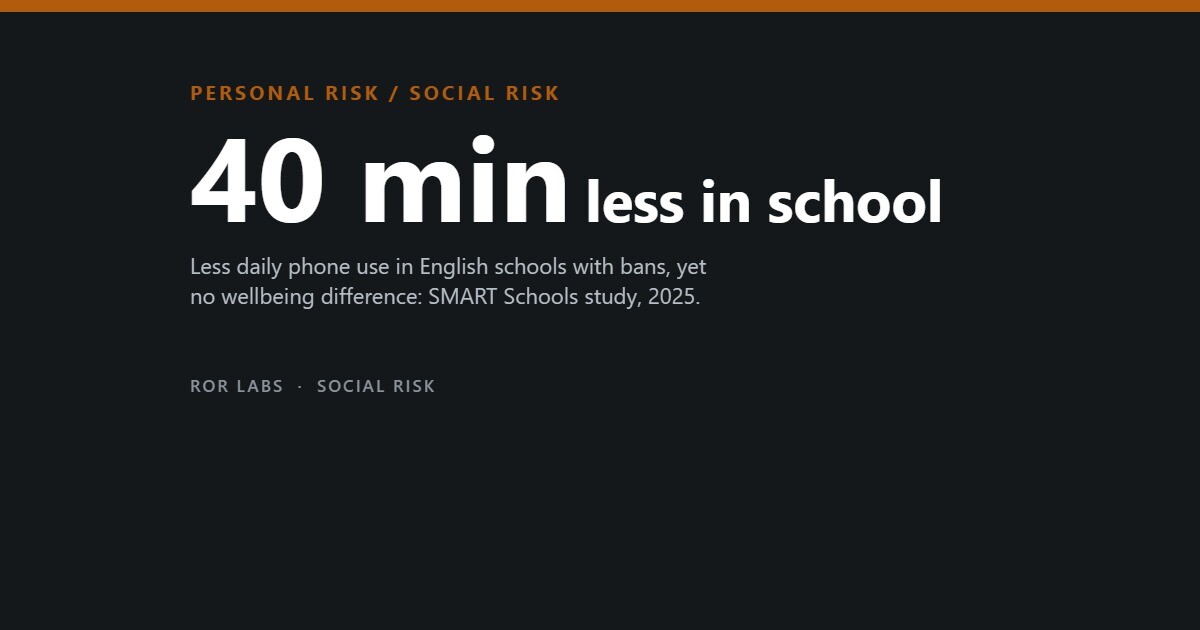
- In an English study of 1,227 pupils, restrictive schools cut phone use during the school day by about 40 minutes, but mental wellbeing scores were no different from schools that allowed phones.
- The study that launched the debate found test scores rose by 6.41% of a standard deviation after bans in four English cities, and by 14.23% for the lowest achievers.
- The largest US study, of schools using lockable pouches, found test-score effects close to zero, a dip in wellbeing in the first year and a rise by the second.
- Enforcement fades: in one US survey, phone use in class rose from 28% to 42% of teens over a single school year.
Few education policies have spread as fast as the school phone ban. In a few years it has gone from the choice of individual head teachers to national law in the Netherlands and to state law across much of the United States. The case for it is intuitive: phones distract, social media unsettles teenagers, and a classroom without notifications should be calmer and more focused.
The evidence is thinner than the policy. There are no large randomised trials. Most studies compare schools that chose bans with schools that did not, or track outcomes before and after a ban, and the schools that choose bans may differ in other ways. The results that exist point in different directions depending on what is measured: grades, wellbeing, bullying or simply how much pupils use their phones.
This article sets out what the main studies found, from the English research that started the debate to a 2026 analysis of thousands of American schools using lockable pouches. It looks at what bans change and what they do not, why enforcement matters as much as the rule, and why a ban covering six hours of the school day leaves the rest of a teenager’s screen time largely untouched.
How far the bans have spread
UNESCO’s Global Education Monitoring Report tracks national rules through its country profiles. By the end of 2024, it counted 79 education systems, 40% of those it monitors, that banned smartphones in schools, up from 30% a year earlier. Its 2023 report on technology in education had already found little solid evidence that digital technology adds value in classrooms.
A policy that spread fast
Share of education systems worldwide with a smartphone ban in schools, as tracked by UNESCO.
Source: UNESCO Global Education Monitoring Report, PEER country profiles, as reported by the GEM Report (September 2025). Rules range from classroom-only limits to whole-day bans.
The rules vary widely. Some ban phones only during lessons, others for the whole day, including breaks and lunch. Some ask pupils to keep phones switched off in bags; others collect them or lock them in magnetic pouches. In the United States, 26 states had full-day, so-called bell-to-bell, bans by January 2026, according to a Ballotpedia count. These differences make it hard to talk about the effect of a ban, singular.
The study that started it
The most quoted study was published in Labour Economics in 2016 by Louis-Philippe Beland and Richard Murphy. They surveyed 91 secondary schools in Birmingham, Leicester, London and Manchester about when, if ever, they had banned phones, and linked the answers to national exam results. Because schools introduced bans in different years, they could compare pupils’ results before and after a ban with those in schools that had not yet changed.
Exam gains after a ban, by prior attainment
Change in high-stakes exam scores after a school banned phones, in standard deviations. Four English cities.
Source: Beland L-P, Murphy R, Labour Economics 41:61–76 (2016). Based on 91 schools that answered a survey, a 21% response rate.
Scores rose by 6.41% of a standard deviation on average after a ban, and by 14.23% for pupils in the lowest fifth of prior attainment; the top fifth were unaffected. The authors likened the average gain to an extra hour of school a week. It is a careful study, but it tracks policies adopted from 2001 onwards, before smartphones and social media were universal among teenagers, and only about one school in five answered the survey.
The English wellbeing study

The study most often cited against bans is SMART Schools, led by Victoria Goodyear at the University of Birmingham and published in The Lancet Regional Health – Europe in 2025. It recruited 1,227 pupils aged 12 to 15 from 30 English secondary schools: 20 that did not allow recreational phone use during the day and 10 that did. Pupils reported their screen time from their phones’ own tracking apps and completed a standard wellbeing questionnaire.
The bans worked on their own terms. Pupils in restrictive schools spent about 40 minutes less on their phones during the school day and about half an hour less on social media. But wellbeing scores were essentially the same: after adjustment, the difference on a 14-to-70 scale was 0.48 points, well within chance. Total phone time on school days and at weekends did not differ between the two groups either; the minutes saved at school seemed to be made up elsewhere.
Less phone time at school, same wellbeing
SMART Schools: pupils in restrictive versus permissive English schools, adjusted differences.
Phone time during school: −0.67 hours
Social media during school: −0.54 hours
Both statistically significant
Wellbeing score, 14–70 scale: −0.48 (range −2.05 to 1.06)
Total phone time, school days and weekends: no difference
More phone time overall went with worse sleep, mood and grades
Source: Goodyear VA et al., Lancet Regional Health – Europe 51:101211 (2025), doi:10.1016/j.lanepe.2025.101211. Cross-sectional: 1,227 pupils, 30 schools.
The same study found that the amount of time pupils spent on phones and social media overall did matter. More time was linked to lower wellbeing, more symptoms of anxiety and depression, less physical activity, poorer sleep, lower attainment and more disruptive behaviour in class. The authors’ reading was that school rules alone are not enough. The study is a snapshot, so it cannot show cause and effect, and the schools that agreed to take part may not be typical.
Norway, girls and bullying
Norway offers a longer view. Sara Abrahamsson, an economist at the Norwegian School of Economics, combined a survey of middle schools’ phone rules with national registers of grades and health-care use, exploiting the fact that schools banned phones in different years. Her study, published in the Journal of Human Resources in 2026, found no average effect on education or mental health. Underneath that average were differences by sex.
After a ban, girls made fewer visits to health services for psychological symptoms, their grades improved and they were more likely to enter an academic upper-secondary track, with larger effects for girls from poorer backgrounds. Bullying fell for both boys and girls. A 2024 rapid review by Tobias Böttger and Klaus Zierer pooled the few studies with usable numbers and found the same shape: a modest effect on social outcomes such as bullying, and almost none on attainment.
Bigger on bullying than on grades
Pooled effect size of school smartphone bans (Cohen’s d) by type of outcome. Higher is better.
Source: Böttger T, Zierer K, Education Sciences 14(8):906 (2024). Five studies only; some effect sizes were read from published graphs.
A d of 0.22 is small by most conventions. The review rested on only five studies, some of whose effects had to be read off charts, and the authors themselves warned that the evidence was short-term and uneven. A 2024 scoping review of 22 studies by Marilyn Campbell and colleagues found no randomised trials at all, and concluded that differing designs and definitions of a ban made the findings hard to reconcile.
The largest US study
The biggest study so far came in April 2026, as a National Bureau of Economic Research working paper by economists including Hunt Allcott, Thomas Dee and Matthew Gentzkow, with the psychologist Angela Duckworth. They studied schools that adopted lockable phone pouches, using sales records from the largest pouch provider, phone location data, teacher surveys, test scores and discipline records. Nearly 5,000 schools used pouches by 2026; the test-score analysis covered 1,778 of them.
Lockable pouches in US schools
Estimated effects after schools adopted lockable phone pouches. SD = standard deviation.
| Outcome | Finding |
|---|---|
| Pupils using phones in class for personal reasons (teacher reports) | 61% to 13% |
| Phone location pings at school, by third year | About 30% fewer |
| Test scores, pooled | −0.006 SD, close to zero |
| Student wellbeing, adoption year | Down about 0.2 SD |
| Student wellbeing, second year after | Up 0.16 SD |
| Suspensions, adoption year | About 15% higher, then fading |
Source: Allcott H, Baron EJ, Dee TS, Duckworth A, Gentzkow M, Jacob B, NBER Working Paper 35132 (2026), doi:10.3386/w35132. Not yet peer reviewed; wellbeing data came from a small subset of schools.
The pouches clearly cut phone use. Teachers reported that the share of pupils using phones in class for personal reasons fell from 61% to 13%. Yet average test-score effects were close to zero: modest gains in high-school maths were offset by small losses in middle schools. Suspensions rose by about 15% in the first year, and pupils’ reported wellbeing dipped before improving by the second year, a pattern the authors read as disruption followed by adjustment.
Two caveats apply. The paper is a working paper, not yet peer reviewed, and the wellbeing results come from a much smaller set of schools than the test scores. The researchers also worked with sales data from the pouch company, which they disclose. Even so, a large, careful study finding no average gain in test scores is a useful check on claims that bans transform learning.
What schools report
Teachers and heads often describe the change in warmer terms than the data. The Netherlands banned phones in secondary classrooms from 1 January 2024. A government-commissioned evaluation of 317 secondary schools, published in July 2025, found that 75% reported better concentration among pupils, nearly two-thirds a better social climate and about a third improved academic performance. These are staff impressions, collected by asking schools, rather than measured outcomes.
Studies that measured pupils directly found less. A 2026 study of 1,398 Dutch pupils in 24 schools, published in the Journal of Youth and Adolescence, found no differences in wellbeing or bullying between schools with classroom-only bans and those with whole-school bans; whole-school bans were linked to weaker bonds between pupils and teachers and, for girls, a lower sense of belonging. In South Australia, five schools phasing in a ban showed no significant differences from comparison schools one month on.
Enforcement and the rest of the day
A rule is only as strong as its enforcement. In the OECD’s PISA 2022 survey of 15-year-olds, 65% of students across member countries said they were distracted by using digital devices in at least some maths lessons, and 59% by other students’ devices; those distracted by classmates’ devices scored about 15 points lower in maths. Yet in schools that banned phones, 29% of students said they used a smartphone several times a day at school, and another 21% every day or almost.
Bans erode over a school year
Share of US teens saying they used a phone in class, October 2025 and May 2026.
Source: University of Southern California survey of a nationally representative sample of teens, reported by Education Week (30 September 2026).
The 2026 American survey in the news card shows the same drift over time. Phone use in class rose over a single year in every kind of school, though less where bans covered the whole day, and 44% of teens said teachers had become more lenient while only 13% of adults noticed. The SMART Schools finding adds the other limit: a ban governs six or seven hours on weekdays. Evenings, nights and weekends, when most social media use happens, are outside a school’s reach.
What the evidence suggests
School phone bans reliably do one thing: they reduce phone use during the school day. Beyond that the evidence is mixed and mostly observational. Gains in test scores appear in some studies, especially for weaker pupils, and vanish in the largest recent one. Effects on bullying look more consistent than effects on grades. The best study of wellbeing found no difference, while finding that total screen time mattered. A ban is a reasonable classroom rule; it is not, on present evidence, a treatment for adolescent mental health.
Questions people ask
Do phone bans improve grades?
Sometimes. An English study found gains concentrated among lower-achieving pupils, but the largest US study, of schools using pouches, found average effects close to zero.
Do bans improve mental health?
The evidence is weak. The main English study found no wellbeing difference; a Norwegian study found benefits for girls only. Neither was a randomised trial.
Do bans reduce bullying?
Several studies, including the Norwegian one and a 2024 review, found small reductions. A Dutch study found no difference between partial and whole-school bans.
Are whole-day bans better than classroom-only rules?
Not clearly. All-day bans held up better in one US survey, but a Dutch study found no wellbeing benefit and weaker pupil–teacher bonds.
Does a school ban cut total screen time?
Not in the English SMART Schools study. Pupils used phones less at school, but total use on school days and weekends was no different.
The short version
- In an English study of 1,227 pupils, restrictive schools cut phone use during the school day by about 40 minutes, but mental wellbeing scores were no different from schools that allowed phones.
- The study that launched the debate found test scores rose by 6.41% of a standard deviation after bans in four English cities, and by 14.23% for the lowest achievers.
- The largest US study, of schools using lockable pouches, found test-score effects close to zero, a dip in wellbeing in the first year and a rise by the second.
- Enforcement fades: in one US survey, phone use in class rose from 28% to 42% of teens over a single school year.
- Effects on bullying look more consistent than effects on grades, and a school ban does not reach evenings and weekends.
This article summarises published research for general information. It is not a guide to any individual child’s needs. If you are worried about a young person’s phone use, mood, sleep or experience of bullying, talk to their school through its usual pastoral channels, or to a family doctor. If a young person is in emotional crisis, contact local emergency services or a local crisis line.
Further reading: Goodyear et al., The Lancet Regional Health – Europe (2025), for the SMART Schools study of wellbeing. Beland and Murphy, Labour Economics 41 (2016), for the original exam-score study. Allcott et al., NBER Working Paper 35132 (2026), for the national study of lockable pouches.
- The Anxious Generation, Jonathan Haidt (2024). The book that did most to popularise phone-free schools, arguing that smartphones drove a rise in teenage anxiety. Readable and influential; several researchers dispute how strongly its evidence supports cause and effect.
- Behind Their Screens, Emily Weinstein and Carrie James (2022). Draws on thousands of American teenagers’ own accounts of life online. Good on what teens actually experience; it is not about school bans and was written before most of them.
- Stolen Focus, Johann Hari (2022). A journalist’s tour of the forces eroding attention, from technology design to sleep. Lively and wide-ranging; it leans on interviews and sometimes simplifies contested research.
Sources
Goodyear VA, Randhawa A, Adab P et al. School phone policies and their association with mental wellbeing, phone use, and social media use (SMART Schools): a cross-sectional observational study. Lancet Reg Health Eur 51:101211 (2025), doi:10.1016/j.lanepe.2025.101211. — Wood G et al. SMART Schools study protocol. BMJ Open 13:e075832 (2023). — Beland L-P, Murphy R. Ill Communication: technology, distraction & student performance. Labour Economics 41:61–76 (2016), doi:10.1016/j.labeco.2016.04.004. — Beland L-P, Murphy R. Phone home: should mobiles be banned in schools? CentrePiece, Centre for Economic Performance (2015). — Abrahamsson S. Smartphone bans, student outcomes and mental health. Journal of Human Resources (2026), doi:10.3368/jhr.0224-13403R2. — Böttger T, Zierer K. To ban or not to ban? Education Sciences 14(8):906 (2024). — Campbell M et al. Evidence for and against banning mobile phones in schools: a scoping review (2024), doi:10.1177/20556365241270394. — Allcott H, Baron EJ, Dee TS, Duckworth A, Gentzkow M, Jacob B. The effects of school phone bans: national evidence from lockable pouches. NBER Working Paper 35132 (2026), doi:10.3386/w35132. — King DL et al. “Phones off while school’s on”. J Behav Addict (2024), doi:10.1556/2006.2024.00058. — Vanluydt E et al. Disconnect to reconnect. J Youth Adolesc (2026), doi:10.1007/s10964-025-02313-6. — UNESCO Global Education Monitoring Report, PEER profiles on smartphone bans (2025); GEM Report 2023, Technology in education. — OECD. PISA 2022 Results, Volume II (2023), as reported by Education Week (December 2023) and Teacher magazine. — Dutch government-commissioned evaluation of the classroom phone ban, reported by AFP via The Daily Star (July 2025). — Ballotpedia count of state bans, reported by Newsweek (9 January 2026). — Prothero A. Are teens starting to accept cellphone bans? Education Week (30 September 2026).