Financial Exploitation of Older People by Family and Carers: What the Evidence Shows
Key takeaways · 14 min read
- In a US national survey, 5.2% of people aged 60 and over reported financial abuse by a family member in the past year.
- Estimates range from 0.6% to 6.8% depending on the country, the questions asked and who was left out, so no single figure is reliable.
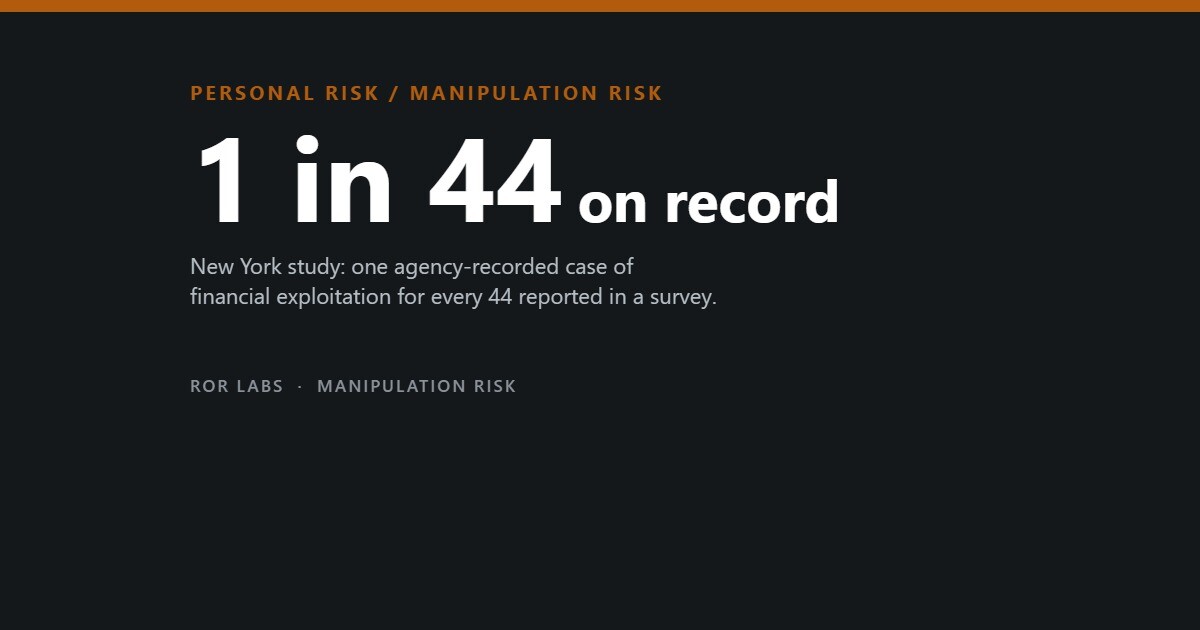
- In New York, for every case of financial exploitation known to agencies, about 44 were reported by older people in a survey.
- In bank reports of theft from older customers by people they knew, adult children were the most frequently named suspects.
When people picture an older person losing their savings, they usually picture a stranger: a phone call from a fake bank, an email from a fake grandson. Those scams are real and common. But a separate kind of loss happens inside relationships of trust, at the hands of a son who has the bank card, a carer who runs errands, or a friend who holds a power of attorney. It is harder to see, harder to count and much less often reported.
Researchers agree that this kind of exploitation is common. They disagree, sometimes by a factor of ten, about how common. The figures depend heavily on how exploitation is defined, which questions are asked, and whether people with dementia or living in care are included at all. The cases that reach the police or social services are a small fraction of any estimate.
This article sets out what prevalence surveys, bank reports and agency data show, who the perpetrators tend to be, why powers of attorney matter, and what is known about prevention. That last part is short, because very little has been shown to work. This is general information, not a screening tool.

What counts as exploitation
The World Health Organization defines elder abuse as harm or distress caused to an older person within a relationship where there is an expectation of trust. Financial exploitation within that frame covers taking money or property, using a bank card or account without permission, pressuring someone to sign over assets or change a will, and misusing legal authority such as a power of attorney. Some researchers also count relatives who live in the home and contribute nothing towards bills.
That is distinct from fraud by strangers, which researchers usually measure separately. The distinction matters because the two need different responses. A scam victim can be warned about a script. A parent being drained by a child they love may not want the child punished, may depend on them for daily care, and may not call what is happening abuse at all.
How common is it
The best-known US figure comes from the National Elder Mistreatment Study, published in 2010. Researchers telephoned a random national sample of 5,777 people aged 60 and over. In the past year, 5.2% reported current financial abuse by a family member, a higher figure than for emotional abuse at 4.6% or physical abuse at 1.6%. A companion survey of 902 people in South Carolina found that 6.6% had been financially exploited by a family member since turning 60.
Other countries report very different numbers. The first UK national prevalence study, based on interviews in 2006 with 2,111 people, found financial abuse by family, close friends or care workers in 0.6% of respondents. A 2017 global meta-analysis in the Lancet Global Health, pooling 52 studies from 28 countries, put past-year financial abuse at 6.8%, with a confidence interval from 5.0% to 9.2%.
One question, many answers
Financial abuse or exploitation of older people living at home, mostly past-year rates.
Sources: Biggs S et al., J Elder Abuse Negl (2009); Peterson JC et al., J Gen Intern Med (2014); Under the Radar, New York State Elder Abuse Prevalence Study (2011), 42.1 per 1,000; Acierno R et al., Am J Public Health 100(2) (2010); Yon Y et al., Lancet Glob Health (2017).
For comparison, a 2017 meta-analysis of 12 US studies covering 41,711 people estimated that 5.4% of older adults fall victim to fraud or scams by strangers each year. Exploitation by people they know and fraud by people they do not are of roughly similar orders of magnitude, though the surveys behind them are not directly comparable.
Why the estimates disagree
The clearest illustration comes from New York. In 2011 a state study called Under the Radar interviewed 4,156 older residents and found a one-year rate of financial exploitation of 42.1 per 1,000, or about 4.2%. A later analysis of the same interviews, using a purpose-built set of questions in five domains, put one-year prevalence at 2.7%. Same people, same year, different definitions, and the estimate falls by more than a third.
A 2018 systematic review of how prevalence studies measure financial exploitation concluded that the measures were considerably more variable than for other forms of elder abuse. Studies differ on whether a single incident counts, how much money must be involved, whether a relative failing to share costs is included, and whether the period is one year, five years or a lifetime.
Just as important is who is left out. Most surveys use telephone interviews with people living at home who are able to answer for themselves. The New York prevalence analysis was limited to cognitively intact adults. People with dementia, those in care homes and those too ill to take part are among the most exposed to exploitation and the least likely to be counted, so the published figures probably understate the problem.
Why the numbers move
Design choices that change financial exploitation estimates.
| Choice | Example | Likely effect |
|---|---|---|
| Definition | Counting relatives who pay nothing towards bills | Raises estimate |
| Time window | Past year against since age 60 | Lifetime figures higher |
| Who answers | Only people able to answer themselves | Misses people with dementia |
| Setting | Private homes only | Misses care homes |
| Relationship | Family only, or all trusted people | Wider net, higher figure |
Based on Jackson SL, J Appl Gerontol (2018); Peterson JC et al., J Gen Intern Med (2014); Under the Radar (2011). Directions are general tendencies, not measured effects.
Who does it
Different sources point the same way. Of 818 contacts to the US National Center on Elder Abuse resource line that alleged abuse between 2014 and 2017, financial abuse was the most common type, in 449 cases or 54.9%. Family members were the most frequently named perpetrators, in 46.8%. In the South Carolina survey, people who had been mistreated were more likely to name someone they knew than a stranger, and abusers often had substance use or legal problems.
Dependence keeps appearing. A small study of 60 families, presented as a conference abstract, compared families where a power of attorney worked well with families where the attorney exploited the older person. Most exploiting agents were financially dependent on the older adult. Other risk factors described were the older person’s physical and cognitive decline, an attorney’s sense of entitlement, and poor family relationships.
Not every case is deliberate theft. A solicitor quoted in coverage of the October 2026 STEP research noted that a relative dipping into a parent’s money to cover their own bills, or a grandchild’s school fees, during a hard month can be a form of financial abuse. In the same research, 9% of UK adults thought caring for a relative earned them a bigger inheritance. The older person may have agreed, may have felt unable to refuse, or may no longer have been able to understand. Those differences matter legally, and they are rarely visible from outside.
What bank reports show
Banks in the United States must file suspicious activity reports with the Financial Crimes Enforcement Network, and some flag elder exploitation. FinCEN’s April 2024 analysis covered 155,415 such reports from 4,472 institutions filed between June 2022 and June 2023, describing more than $27 billion in suspicious activity. The total may include attempted as well as completed transactions.
About 80% of the reports described scams by strangers. About 20% described theft by someone the older person knew. In those theft reports, adult children were the most frequently identified perpetrators, followed by professional carers such as nurses, aides and home-care workers. The average reported theft was $98,863 and the median $23,762, a gap that shows a minority of very large cases pulling up the average.
Bank reports of elder financial exploitation
US suspicious activity reports, June 2022 to June 2023. Amounts may include attempted transactions.
Source: FinCEN, Financial Trend Analysis: Elder Financial Exploitation (18 April 2024). 155,415 reports from 4,472 institutions.
An earlier analysis by the Consumer Financial Protection Bureau, of 180,000 reports filed from 2013 to 2017, found an average loss of about $50,000 when the older person knew the suspect. Fewer than one-third of those reports said the bank had also told adult protective services, the police or another authority. Bank reports measure what staff noticed and chose to report, not how much exploitation exists.
Powers of attorney
A power of attorney lets someone act on another person’s behalf, and a lasting or durable power continues if that person loses mental capacity. It is usually the sensible thing to arrange, and it is also the most powerful legal tool an exploiter can hold. In England and Wales, the Office of the Public Guardian had 10.6 million lasting and enduring powers of attorney on its register by March 2026, with almost 1.6 million new applications that year.
The same office received 13,183 safeguarding concerns in 2025–26, up 17% on the year before, and opened 3,645 investigations. Investigations took 198 days on average against a target of 70. Police data quoted in the STEP research suggested that in 2025–26, one in five reports of fraud by people in a position of trust involved misuse of a power of attorney. Most attorneys act honestly; the point is that oversight mostly begins after someone complains.
Powers of attorney in England and Wales
Office of the Public Guardian, year to 31 March 2026.
| Measure | Figure |
|---|---|
| Powers of attorney on the register | 10,620,245 |
| New applications in the year | 1,589,500 |
| Safeguarding concerns received | 13,183 |
| Investigations opened | 3,645 |
| Average time to complete an investigation | 198 days (target 70) |
Source: Office of the Public Guardian, Annual Report and Accounts 2025 to 2026 (15 July 2026).
The reporting gap

Under the Radar did something unusual: alongside its survey, it collected documented cases from 292 agencies that serve older people. Older people reported financial exploitation at 42.1 per 1,000 a year. The agencies had documented 0.96 per 1,000. That is roughly 44 cases reported in the survey for every one in agency records, a wider gap than for elder abuse as a whole, where the ratio was about 24 to one.
Reported by older people, known to agencies
Yearly rate per 1,000 people aged 60 and over, New York State.
Source: Lifespan of Greater Rochester, Weill Cornell Medical Center and New York City Department for the Aging, Under the Radar: New York State Elder Abuse Prevalence Study (2011). 4,156 interviews; 292 agencies.
The reasons are easy to imagine and hard to fix. Victims may feel ashamed, fear losing the relative who helps them, or worry about being moved into care. Some do not recognise what is happening. Others cannot report because of dementia. The survey itself depends on people being willing and able to answer, so even the larger figure is likely to miss cases.
What is known to help
Very little, in the sense of proven by good studies. A 2009 systematic review found only eight studies that met its standards. The interventions that measured repeat abuse did not reduce it, and may even have increased it, perhaps because closer contact uncovered more. A 2016 Cochrane review rated the quality of evidence for elder abuse interventions as very low, with only tentative signs that teaching coping skills to family carers of people with dementia might help.
A 2024 World Health Organization-led review identified 89 promising interventions across 101 evaluations or descriptions. Only 28 of those evaluations used a randomised design, and the authors described evidence-based interventions as insufficient. Promising is not the same as proven.
Interventions: what exists and what is tested
The gap between recommended practice and evaluated results.
Transaction holds and delays
Trusted contact persons
Staff training, reports to authorities
Seven regulators; offered as examples
Systematic review, 2009: 8 studies
Randomised evaluations, 2024: 28 of 101
Evidence quality rated very low
Sources: Interagency Statement on Elder Financial Exploitation (December 2024); Ploeg J et al., J Elder Abuse Negl (2009); Baker PRA et al., Cochrane Database Syst Rev (2016); Campo-Tena L et al., Lancet Healthy Longev (2024).
Banks have been urged to act. In December 2024 seven US financial regulators issued a joint statement describing practices such as temporarily holding suspicious transactions, asking customers to name a trusted contact, training staff and reporting to adult protective services and the police. The statement offers these as examples to consider and presents no evidence on how well they work. I could not find a published outcome evaluation of these measures.
What the evidence suggests
Financial exploitation by family and trusted people is one of the most common forms of elder abuse in every survey that measures it, and adult children appear at the top of perpetrator lists from very different sources. Beyond that, honesty requires vagueness. Plausible past-year figures run from under 1% to about 7%, depending on definition and method, and agencies see perhaps one case in 44. There is no well-tested way to prevent it. Treat any precise national total with caution, including the ones above.
Questions people ask
Who most often financially exploits older people?
In US bank reports of theft by known people, adult children were named most often, followed by professional carers. Helpline data and surveys also point to family members.
How common is elder financial abuse?
Past-year estimates range from 0.6% to 6.8% of older people, depending on country and method. A US national survey found 5.2% by family members.
Why is it so rarely reported?
Victims may depend on the person exploiting them, feel ashamed, fear losing independence, or lack the capacity to report. In New York, about one case in 44 reached agencies.
Is a power of attorney risky?
It is usually a sensible safeguard, and most attorneys act honestly. But it gives wide control, and official oversight mostly starts only after someone raises a concern.
Do prevention programmes work?
There is little good evidence either way. Reviews rate the evidence as very low quality, and only a minority of evaluations are randomised trials.
The short version
- In a US national survey, 5.2% of people aged 60 and over reported financial abuse by a family member in the past year.
- Estimates range from 0.6% to 6.8% depending on the country, the questions asked and who was left out, so no single figure is reliable.
- In New York, for every case of financial exploitation known to agencies, about 44 were reported by older people in a survey.
- In bank reports of theft from older customers by people they knew, adult children were the most frequently named suspects.
- No prevention approach has strong evidence behind it. If you are worried about someone, contact adult protective services or the police where you live.
This article summarises published research for general information. It is not a screening tool, and it is not legal or financial advice. If you think an older person is being financially exploited, or is in danger, contact your local adult protective services or adult social care safeguarding team, or the police; in an emergency call the emergency number where you live. Their bank can also be told of concerns.
Further reading: Acierno et al., American Journal of Public Health (2010), for the US national prevalence study. Under the Radar (2011), for the gap between what older people report and what agencies see. FinCEN’s 2024 Financial Trend Analysis, for what bank reports reveal about who takes the money.
- Mom and Dad, We Need to Talk, Cameron Huddleston (2019). A personal-finance journalist on starting money conversations with ageing parents, including powers of attorney. Practical and humane; written for the US system and for families where relations are good.
- Elderhood, Louise Aronson (2019). A geriatrician on how society and medicine treat old age, and how dependence makes people vulnerable. Thoughtful background; it says little about financial abuse specifically.
- Scam Me If You Can, Frank Abagnale (2019). A guide to common frauds and how they target older people. Readable, but it deals mainly with strangers, not with exploitation by family or carers, and the author’s own life story has been disputed.
Sources
- Acierno R et al. The National Elder Mistreatment Study. Am J Public Health 100(2):292–297 (2010), doi:10.2105/AJPH.2009.163089.
- Amstadter AB et al. The South Carolina Elder Mistreatment Study. J Interpers Violence (2011), doi:10.1177/0886260510390959.
- Peterson JC et al. Financial exploitation of older adults: a population-based prevalence study. J Gen Intern Med (2014), doi:10.1007/s11606-014-2946-2.
- Lifespan of Greater Rochester, Weill Cornell Medical Center, New York City Department for the Aging. Under the Radar: New York State Elder Abuse Prevalence Study (2011).
- Biggs S et al. J Elder Abuse Negl (2009), doi:10.1080/08946560802571870.
- Yon Y, Mikton CR, Gassoumis ZD, Wilber KH. Lancet Glob Health (2017), doi:10.1016/S2214-109X(17)30006-2.
- Burnes D et al. Am J Public Health (2017), doi:10.2105/AJPH.2017.303821.
- Jackson SL. J Appl Gerontol (2018), doi:10.1177/0733464816650801.
- Weissberger GH et al. J Appl Gerontol (2020), doi:10.1177/0733464819865685.
- Steinman BA et al. Risk and protective factors for elder financial exploitation by family power of attorney agents (conference abstract). Innovation in Aging (2017).
- FinCEN. Financial Trend Analysis: Elder Financial Exploitation (18 April 2024).
- Consumer Financial Protection Bureau. Suspicious Activity Reports on Elder Financial Exploitation (2019).
- Office of the Public Guardian. Annual Report and Accounts 2025 to 2026 (15 July 2026).
- Ploeg J et al. J Elder Abuse Negl (2009), doi:10.1080/08946560902997181.
- Baker PRA et al. Cochrane Database Syst Rev (2016), doi:10.1002/14651858.CD010321.pub2.
- Campo-Tena L et al. Lancet Healthy Longev (2024), doi:10.1016/j.lanhl.2024.100647.
- Federal Reserve, CFPB, FDIC, FinCEN, NCUA, OCC and state regulators. Interagency Statement on Elder Financial Exploitation (December 2024).
- World Health Organization, definition of elder abuse.
- Today’s Wills & Probate, 2 October 2026; IFA Magazine, 4 October 2026 (STEP research).