Volleyball injuries, ankles at the net and the second sprain
Key takeaways · 9 min read
- Ankle sprains are the commonest volleyball injury; most happen at the net on landing.
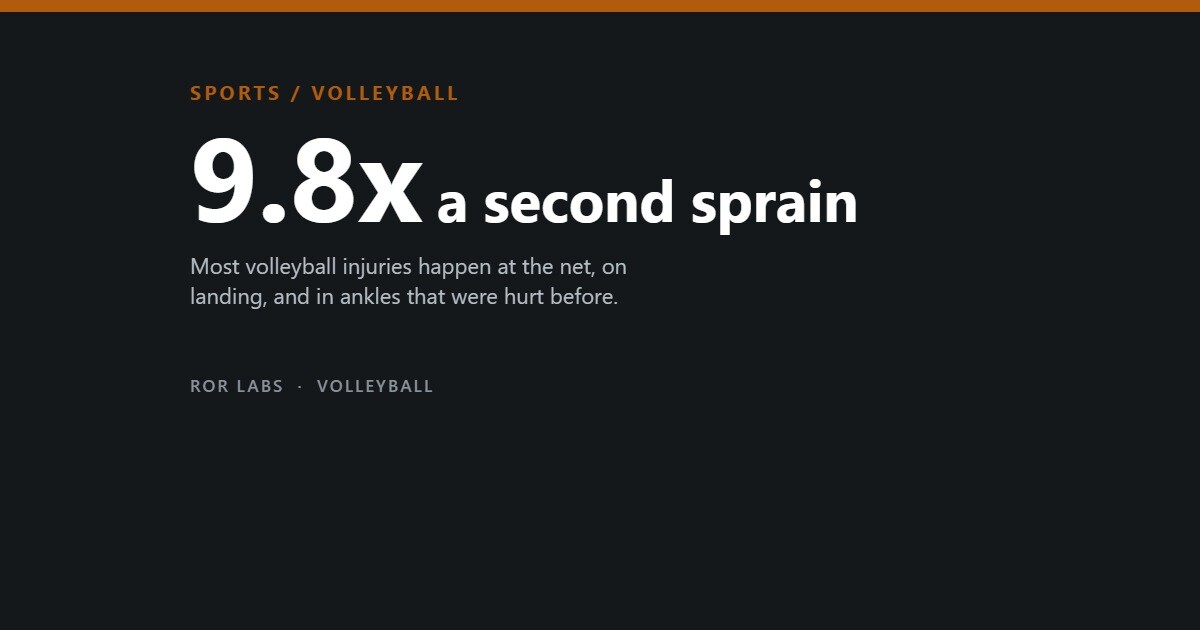
- An ankle sprained in the past six months was 9.8 times as likely to be sprained again in one elite study.
- Balance training reduced sprains mainly in players who had sprained before.
- Women’s college volleyball sits near the all-sport injury average, well below soccer and football.
In the Norwegian top divisions of the 1990s, an ankle that had been sprained in the previous six months was sprained again 42% of the time during a season. Against an ankle that had never been injured, that was a risk ratio of 9.8. Nearly four out of five ankle sprains in the study were repeats.
That single number explains most of what is known about volleyball injuries. The sport is not especially dangerous — by most measures it sits at or below the average for college sport — and its injuries cluster in one place and one moment: under the net, on landing, often on someone else’s foot. And the most effective prevention found so far worked mainly for players who had already been hurt once.
This article follows the series format: what volleyball players actually injure, where the risk concentrates, what has been measured to reduce it, and why the answer is not to stop playing.
What actually gets injured
The ankle, above all. In the Norwegian study of 272 players over 51,588 player-hours, the ankle took 54% of acute injuries, followed by the lower back at 11%, the knee and shoulder at 8% each and the fingers at 7%. The overall rate was 1.7 injuries per 1,000 hours. A Dutch cohort of 486 players in the second and third divisions found 2.6 per 1,000 hours, with ankle sprains again the largest group of acute injuries.
At the elite end, the FIVB’s own surveillance of 32 international tournaments from 2010 to 2014 recorded 440 injuries, a match rate of 10.7 per 1,000 player-hours. Ankle sprain was the single commonest diagnosis, at 19.8%. Most injuries were minor: only ten were expected to keep a player out for more than four weeks, and the authors described the injury risk as substantially lower than in football, handball or ice hockey. Men and women were injured at the same rate.
Where elite volleyball players get hurt
Share of 440 match injuries in FIVB international tournaments, 2010–2014.
Source: Bere et al., British Journal of Sports Medicine 49:1132–1137 (2015).
Two injuries are specific to the jumping. Patellar tendinopathy, or jumper’s knee, is pain in the tendon below the kneecap. Reported prevalence in volleyball ranges from 30% to 51%, against 25% to 32% in basketball and none in cycling or wrestling. In one study of elite men, 45% had current symptoms. It rarely stops players, which is part of the problem: in female college players the time-loss rate was only about 0.2 to 0.26 per 1,000 exposures, even though ultrasound found tendon changes in 22 of 106 players before their season began. Shoulder problems, from thousands of overhead swings, make up 8% to 20% of injuries and caused the longest average absence in the Dutch cohort, 6.5 weeks. ACL tears, the great fear of jumping sports, are rare: pooled estimates for female players run around 0.02 per 1,000 exposures.
When the risk concentrates
The net. In the original Norwegian study of ankle sprains, 86% happened at the net, mostly on landing after a block, at 63%, or an attack, at 29%. Players who had been blocking landed on the foot of an attacker who had come down across the centre line, or on a teammate’s foot during a two- or three-player block. A later video analysis of 24 ankle injuries in world-class matches found 15 happened while blocking — 11 on an opponent’s foot and four on a teammate’s — and six while attacking. In 11 of the 12 opponent-landing cases, the attacker had landed in the opponent’s court without breaking the centre-line rule.
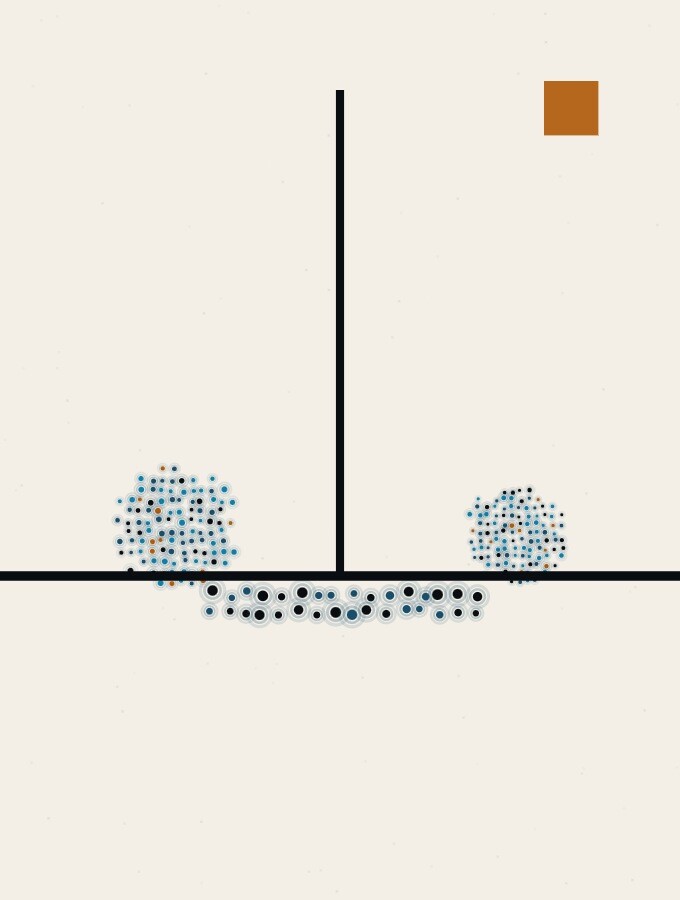
That matters for who carries the risk. Middle blockers and outside attackers, who spend the most time jumping at the net, are hurt most often; setters and defensive specialists much less. In the FIVB data, 47.4% of ankle injuries involved contact with another player, centre players had the highest exposure-adjusted rate and liberos the lowest. In US college volleyball and basketball combined, player contact caused 52.6% of ankle injuries.
Then there is the previous sprain. In the Norwegian season, 79% of ankle injuries were recurrences, and an ankle sprained within the previous six months had a 9.8-fold risk of going again. In the Dutch cohort, 75% of players with a sprain had sprained before. Jumper’s knee has its own load curve: in young elite players, each extra hour of training per week raised the odds by 1.72 and each extra set played per week by 3.88. The better jumpers were at higher risk, an irony the researchers called the jumper’s knee paradox.
The ankle that has been here before
Risk of a new ankle sprain in Norwegian elite volleyball, compared with an uninjured ankle.
Source: Bahr and Bahr, Scandinavian Journal of Medicine & Science in Sports 7:166–171 (1997).
One old assumption does not hold in recent US data. In Norway, measured by hours, matches were three to four times as risky as training. In the CDC’s summary of NCAA injuries from 2009 to 2014, volleyball was one of only three women’s sports where competition was not significantly riskier than practice, and a later five-year window found practice slightly ahead. The two systems measure risk differently — per hour against per session — so they are not in conflict, but they point the same way: the sport’s risk sits in a mechanism, not in the scoreboard.
What has been measured to work
Roald Bahr’s Norwegian group tried the first programme in the 1990s: teaching players about the mechanism, coaching take-off and landing technique, and putting players with recurrent sprains on a balance board. Over three seasons ankle injuries fell from 0.9 to 0.7 to 0.5 per 1,000 hours, 48 then 38 then 24 injuries. That was a before-and-after comparison, not a randomised trial, so it cannot rule out other changes over those years.
Two prevention studies
The Dutch trial was randomised by region; the recreational trial by team.
1,127 players, one season
Ankle sprains: 0.4 fewer per 1,000 h
Benefit only in players with a previous sprain
More knee overuse in players with old knee injuries
Recreational players
Acute injuries: 8.9 vs 11.3 per 1,000 h
Adjusted hazard ratio 0.85 (0.71–1.02)
Not statistically significant
Source: Verhagen et al., American Journal of Sports Medicine 32(6) (2004); Gouttebarge et al., Journal of Sports Sciences (2020).

The Dutch balance-board trial came next, with 116 teams randomised by region. Ankle sprains were lower in the intervention group by 0.4 per 1,000 hours, but only in players who had sprained before — the same group the Norwegian numbers had singled out. Players with a previous knee injury had more knee overuse problems on the programme, a reminder that no training comes free. A recreational trial of a structured warm-up in 672 adults found fewer acute injuries, 8.9 against 11.3 per 1,000 hours, but after adjustment the result was not statistically significant. A 2026 review of six randomised trials in volleyball found no pooled preventive effect overall and rated the evidence as low quality. The fair summary is that prevention works best, and perhaps only, where the risk is highest: in ankles that have already gone once.
The Norwegian programme, season by season
Acute ankle sprains in Norwegian elite volleyball after an awareness, technique and balance programme began.
Source: Bahr, Lian and Bahr, Scandinavian Journal of Medicine & Science in Sports (1997). Before-and-after comparison, not randomised.
Two other ideas have less support than their popularity suggests. There is no volleyball-specific trial showing that ankle braces or tape prevent sprains; the evidence comes from basketball and soccer. A small randomised comparison in 52 female players who had already sprained found technique training, balance training and a brace all helped, with technique slightly ahead. And rules have not been the answer that they were in American football. Norway once tested making any contact with the centre line a fault; whistles rose nearly twentyfold and the idea was dropped. When the NCAA later allowed players to cross the line fully, ankle sprains did not rise significantly. For jumper’s knee, heavy slow resistance training and eccentric exercise both outlasted a steroid injection at six months in one small trial, but eccentric training done during the competitive season had no effect.
Why the answer is not to stop
Volleyball sits in the middle of the injury table. In the CDC’s NCAA data, women’s volleyball recorded 6.4 injuries per 1,000 athlete-exposures, alongside women’s basketball at 6.5 and the all-sport average of 6.0, and well below women’s soccer at 8.4, men’s football at 9.2 and men’s wrestling at 13.1. US emergency departments treated an estimated 65,440 volleyball injuries in 2024, against 385,777 for basketball and 265,761 for soccer.
Volleyball among college sports
Injuries per 1,000 athlete-exposures, NCAA, 2009–10 to 2013–14.
Source: Kerr et al., MMWR 64(48):1330–1336 (2015).
The benefits are measurable too. A 2026 meta-analysis of 12 randomised trials of volleyball training, with 656 participants, found improvements in muscular endurance, cardiovascular endurance and strength. The trials were small and varied, but they are trials, and they show the game does what exercise is supposed to do. Add the social structure of a team sport and a low rate of severe injury, and the case for playing is strong.
The injury picture also points to what to change. The risk sits at the net, on landing, and in ankles that have been sprained before. That gives players and coaches something concrete: finish rehabilitation properly after a first sprain, including balance work, before going back to full blocking; train controlled landings; build jumping volume gradually, especially for young players with tender knees; and treat a sore patellar tendon as a load problem rather than a nuisance. A recent case at a US men’s club tournament in 2025, where two players crossed under the net at once and left a third with nowhere safe to land, shows why officiating the centre line matters even in amateur games. None of this means giving up the sport. It means taking the one mechanism that causes most of the harm seriously.
Questions people ask
What is the most common volleyball injury?
Ankle sprains, mostly from landing on another player’s foot at the net after a block or attack.
Is volleyball a dangerous sport?
No more than most. College women’s volleyball records about 6.4 injuries per 1,000 exposures, close to the all-sport average, and severe injuries are uncommon.
Does an ankle brace prevent volleyball sprains?
There is no volleyball-specific trial proving it. Balance training after a first sprain has the best evidence for preventing a second.
What is jumper’s knee?
Pain in the tendon below the kneecap, linked to jumping volume. It is common in volleyball and usually managed by adjusting training load and strengthening.
Is beach volleyball safer than indoor?
Beach volleyball has no centre line and fewer ankle sprains, but more shoulder and back overuse. Overall rates are similar.
The short version
- Ankle sprains are the commonest volleyball injury; most happen at the net on landing.
- An ankle sprained in the past six months was 9.8 times as likely to be sprained again in one elite study.
- Balance training reduced sprains mainly in players who had sprained before.
- Women’s college volleyball sits near the all-sport injury average, well below soccer and football.
- Finish rehabilitation after a first sprain, train landings, and build jumping volume gradually.
This is a summary of published research, not medical advice. Have a persistent or recurrent injury assessed by a doctor or physiotherapist, and follow professional guidance on returning to play after a sprain.
Further reading: Bere et al., British Journal of Sports Medicine 49:1132–1137 (2015), for elite injury surveillance. Verhagen et al., American Journal of Sports Medicine 32(6) (2004), for the balance-board trial. Our article on basketball injuries covers the brace trial in another jumping sport.
- Hidden Potential, Adam Grant (2023). An organisational psychologist on how skills are built through practice and structure rather than talent alone — useful on why landing technique can be taught.
- Next Level, Stacy Sims and Selene Yeager (2022). A physiologist’s guide to training for women in midlife, relevant to the many adults who play recreational volleyball.
- Tiny Habits, BJ Fogg (2019). On building small routines that stick. The hard part of balance training is not knowing it helps but doing it every week.
Sources
Bahr R, Bahr IA. Scandinavian Journal of Medicine & Science in Sports 7:166–171 (1997), doi:10.1111/j.1600-0838.1997.tb00134.x. — Verhagen EALM, et al. British Journal of Sports Medicine 38(4):477–481 (2004). — Bere T, Kruczyński J, Veintimilla N, Hamu Y, Bahr R. British Journal of Sports Medicine 49:1132–1137 (2015), doi:10.1136/bjsports-2015-094959. — Reeser JC, Verhagen E, Briner WW, Askeland TI, Bahr R. British Journal of Sports Medicine 40:594–600 (2006), doi:10.1136/bjsm.2005.018234. — Tiemessen IJ, et al. BMC Research Notes 2:127 (2009). — Hutchison MK, et al. Research in Sports Medicine (2020), doi:10.1080/15438627.2019.1683559. — Martínez-Calderón J, et al. Journal of Functional Morphology and Kinesiology 10(2):174 (2025). — Bahr R, Karlsen R, Lian Ø, Øvrebø RV. American Journal of Sports Medicine 22(5) (1994), doi:10.1177/036354659402200505. — Skazalski C, et al. British Journal of Sports Medicine (2018), doi:10.1136/bjsports-2016-097155. — Lytle JB, et al. Orthopaedic Journal of Sports Medicine (2021), doi:10.1177/2325967121998052. — Visnes H, Bahr R. Scandinavian Journal of Medicine & Science in Sports (2013), doi:10.1111/j.1600-0838.2011.01430.x. — Visnes H, Aandahl HÅ, Bahr R. British Journal of Sports Medicine (2013), doi:10.1136/bjsports-2012-091385. — Kerr ZY, Marshall SW, Dompier TP, et al. MMWR 64(48):1330–1336 (2015). — Chandran A, et al. Journal of Athletic Training 56(7):666–673 (2021). — Bahr R, Lian Ø, Bahr IA. Scandinavian Journal of Medicine & Science in Sports (1997), doi:10.1111/j.1600-0838.1997.tb00135.x. — Verhagen E, van der Beek A, Twisk J, Bouter L, Bahr R, van Mechelen W. American Journal of Sports Medicine 32(6) (2004), doi:10.1177/0363546503262177. — Gouttebarge V, Barboza SD, Zwerver J, Verhagen E. Journal of Sports Sciences (2020), doi:10.1080/02640414.2020.1721255. — Corrêa FG, et al. Fisioterapia e Pesquisa (2026), doi:10.1590/1809-2950/e24001426en. — Stasinopoulos D. British Journal of Sports Medicine 38(2):182–185 (2004). — Kongsgaard M, et al. Scandinavian Journal of Medicine & Science in Sports (2009), doi:10.1111/j.1600-0838.2009.00949.x. — Visnes H, Hoksrud A, Cook J, Bahr R. Clinical Journal of Sport Medicine 15(4):227–234 (2005). — Mao Y, et al. Frontiers in Sports and Active Living (2026), doi:10.3389/fspor.2026.1800110. — US Consumer Product Safety Commission. 2024 NEISS Data Highlights. — The Mirror, University of Northern Colorado, 13 November 2025. — Bahr R, Reeser JC. American Journal of Sports Medicine 31:119–125 (2003).