Eyewitness Identification: What the Evidence Shows
Key takeaways · 10 min read
- Mistaken eyewitnesses played a role in 76% of the first 250 US DNA exonerations.
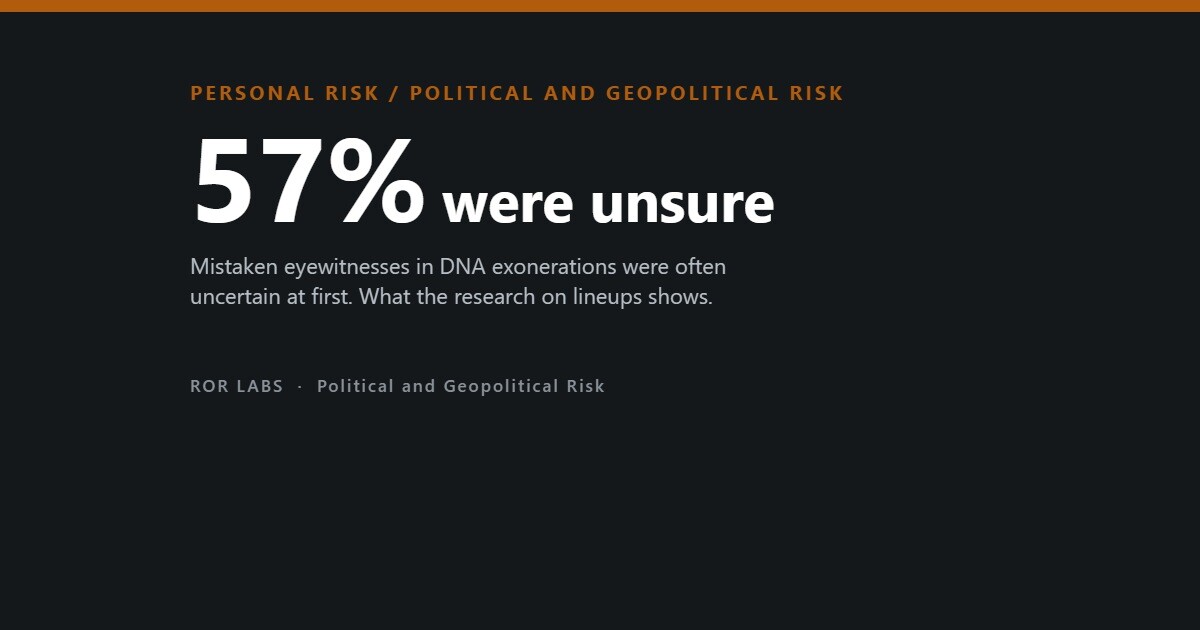
- In 57% of those cases the witness had not been certain at the first identification.
- Confidence at a first, fair, double-blind identification is a useful signal; confidence at trial is not.
- Some researchers still find about one in eight high-confidence field identifications are known errors.
Few things persuade a jury like a witness who points across the courtroom and says: that is the man. It is direct, human and confident. It has also sent many innocent people to prison, some of them for decades, before DNA or a confession proved them innocent.
Eyewitness misidentification is one of the most common factors in wrongful convictions in the United States. But the research on eyewitness memory has changed in the last decade. Many psychologists now argue that eyewitnesses are not hopelessly unreliable. The problem, they say, is that the legal system has often ignored what witnesses said the first time and relied on what they said later.
This article looks at what the evidence shows about eyewitness identification, how confidence changes between the police station and the courtroom, which lineup methods reduce errors, and where researchers still disagree. The figure at the centre of it: in 57% of the DNA exoneration cases involving a mistaken eyewitness, the witness had not been certain at the first identification.
How often eyewitnesses are wrong
The clearest cases come from DNA exonerations, where later testing proved that the convicted person could not have committed the crime.
Brandon Garrett, a law professor, studied the first 250 people exonerated by DNA testing in the United States. In 190 of those cases, 76%, at least one eyewitness had misidentified the defendant. Many involved more than one witness. The Innocence Project, which has worked on hundreds of such cases, reports that eyewitness misidentification played a role in 62% of the DNA exonerations it has secured.
DNA cases are not typical, because they mostly involve rapes and murders with biological evidence. The National Registry of Exonerations tracks all known exonerations, whatever the evidence. It has recorded 3,792 since 1989. Mistaken witness identification was a factor in 27% of those in 2024 and 23% of the 97 recorded in 2025. In 2025 alone, exonerees had lost a combined 1,373 years in prison, 14.2 years each on average.
These are cases where errors were discovered. How many mistaken identifications lead to convictions that are never overturned is unknown.
Eyewitness error in known wrongful convictions
Share of exonerations where mistaken identification was a factor.
Garrett BL, Convicting the Innocent, 2011; Innocence Project; National Registry of Exonerations, 2024 and 2025 annual reports.
Why faces are hard to remember
Psychologists divide the factors that affect eyewitness accuracy into two groups. Estimator variables are the conditions of the crime itself, which nobody can change afterwards. System variables are the procedures police use, which can be controlled.
Some estimator variables have strong evidence behind them. Christian Meissner and John Brigham, in a 2001 meta-analysis of nearly 5,000 participants, found a consistent own-race bias. People were about 1.4 times more likely to correctly identify a face of their own race, and about 1.56 times more likely to mistakenly identify a face of another race.
Nancy Steblay’s 1992 meta-analysis found a weapon-focus effect: when a weapon is visible, witnesses are somewhat less accurate at identifying the person holding it, probably because their attention is drawn to the weapon. Distance, lighting, stress and the time between the crime and the lineup all matter too.
These factors cannot be undone. That is why much of the reform effort has focused on the other group: how lineups are built, who runs them, and what is recorded.
The confidence that grows
Garrett read the trial transcripts in his cases closely. By the time of trial, the witnesses who had picked the wrong person were almost always certain. Many said they would never forget the face.
But in 57% of the transcripts he could examine, 92 of 161 cases, the witnesses had not been certain at the time of their earlier identification. Some had hesitated, picked someone else first, or said the suspect only looked similar. Somewhere between the police station and the courtroom, doubt had turned into certainty.
Psychologists have documented how this happens. In a well-known 1998 experiment, Gary Wells and Amy Bradfield showed that simple feedback after an identification, such as ‘Good, you identified the suspect’, made witnesses far more confident. It also made them remember having had a better view and paying more attention than they actually had.
Repeated identification procedures add to the problem. If a witness sees a suspect’s face in a mugshot and then again in a lineup, the suspect is often the only familiar face in both. The second identification may reflect the first viewing rather than the crime.
From first identification to trial
DNA exoneration cases involving eyewitness misidentification.
Garrett BL, Convicting the Innocent, 2011, as analysed in Wixted and colleagues, American Psychologist, 2015.
The first test is different
This led to a change in thinking. John Wixted, Gary Wells and colleagues argued in a 2017 review in Psychological Science in the Public Interest that confidence at the first, uncontaminated identification is a strong indicator of accuracy, provided the lineup is fair and the officer running it does not know who the suspect is.
Field data support this. In a study of 349 real lineups in Houston, 80% of the identifications made with high confidence picked the police suspect rather than a filler, one of the known-innocent people included for comparison. For low-confidence identifications, the figure was about 40%. A filler pick is a known error, so this means high-confidence identifications were much less likely to be demonstrably wrong.
On this view, many wrongful convictions did not happen because eyewitness memory is inherently unreliable. They happened because the system discounted a hesitant first answer and believed a confident later one. In a 2025 paper, Laura Mickes and Wixted argued that in many DNA exoneration cases, the witness’s initial decision actually pointed towards innocence.
Confidence at the first identification, in real cases
Police lineups in Houston. Share of identifications that picked the suspect rather than a filler.
Houston Police Department field study, as reported in Wixted and colleagues, American Psychologist, 2015.
The case against trusting confidence
Not all researchers accept this. The disagreement matters because it affects how courts treat a confident witness.
Ryan Fitzgerald, Ira Hyman and Kimberley Wade, in a 2025 meta-analysis of real criminal investigations, found that when lineups were run by an officer who did not know the suspect, about one in eight high-confidence identifications were known errors, picks of innocent fillers. In laboratory studies, they noted, the error rate for high-confidence identifications ranged from 0 to 40% depending on how strongly the lineup was biased against the suspect.
James Sauer, Matthew Palmer and Neil Brewer argued in 2019 that even if confidence and accuracy are closely linked on average, that does not tell a court whether a particular confident witness is right. A suspect who happens to resemble the real offender closely may be picked confidently and wrongly.
Shari Berkowitz, Brandon Garrett, Kimberly Fenn and Elizabeth Loftus, in a 2021 reply to Wixted and colleagues, argued that confidence is not ready to be relied on in court and that field data make it risky to assume a confident initial witness is accurate.
Which lineup is better?
For years, reformers recommended the sequential lineup, where a witness sees faces one at a time and must decide on each before seeing the next, over the traditional simultaneous lineup, where all faces are shown together. Laboratory studies suggested sequential lineups reduced false identifications.
Real-world tests have been contradictory. An Illinois pilot programme in 2006 reported that sequential double-blind lineups had a higher rate of filler identifications, 9.2%, than the traditional lineups used as comparison, 2.7%. Critics pointed out that the two procedures differed in more than one way, making the comparison hard to interpret.
A cleaner test came from Gary Wells, Nancy Steblay and Jennifer Dysart, who randomly assigned 494 eyewitnesses to real crimes in four police jurisdictions to see either kind of lineup on a laptop, run double-blind. Suspect identification rates were similar, about 25%. The sequential procedure produced fewer filler identifications, 11% against 18%.
But Karen Amendola and Wixted, reanalysing the same field trial with different measures of which suspects were likely guilty, concluded that innocent suspects were, if anything, less likely to be picked from simultaneous lineups. More recent laboratory work by Wixted and Mickes also favours simultaneous lineups. The question remains unsettled, and US guidance generally allows either.
Sequential versus simultaneous lineups in real cases
Studies using actual eyewitnesses.
| Study | Design | Finding |
|---|---|---|
| Illinois pilot, 2006 | Sequential double-blind vs traditional | Filler picks 9.2% vs 2.7% |
| Wells, Steblay and Dysart, 2015 | 494 witnesses, randomised | Suspect IDs similar; filler picks 11% vs 18% |
| Amendola and Wixted, 2015 | Reanalysis of the same trial | Simultaneous at least as accurate |
Law and Human Behavior, 2008 and 2015; Journal of Experimental Criminology, 2015.
What reforms have been adopted
Researchers have agreed on more than they disagree on. As early as 1995, Wells and Eric Seelau proposed four simple rules: tell witnesses the offender may not be in the lineup; make sure the suspect does not stand out; have the lineup run by someone who does not know which person is the suspect; and record the witness’s confidence immediately, before anything else can influence it.
In 2014 the US National Academy of Sciences endorsed similar steps in its report Identifying the Culprit. In January 2017 the US Department of Justice issued procedures for federal agents that included double-blind administration and recording confidence at the time of identification. Many states and police departments have adopted similar rules.
Courts have moved more slowly. In 2011 the New Jersey Supreme Court, in State v. Henderson, revised how its courts assess eyewitness evidence in light of the research. The following year, in Perry v. New Hampshire, the US Supreme Court declined to require extra scrutiny of eyewitness identifications unless police had arranged suggestive circumstances.
Cases continue to surface. Among the exonerations recorded in 2025 was Sherman Townsend, convicted of a 1998 burglary in Minnesota on the strength of a witness who said he was certain, with no physical evidence. The registry’s account records that the witness later confessed to having falsely named him.
Wrongful convictions discovered in 2025
National Registry of Exonerations.
National Registry of Exonerations, 2025 Annual Report. Mistaken witness identification was a factor in 23%.
What the evidence does not show
It does not show that eyewitnesses are always unreliable. Under good conditions, a confident first identification is often accurate.
It does not show that confidence at trial means anything. Confidence can grow after feedback and repeated viewing, and many mistaken witnesses were certain by the time they testified.
It does not settle which lineup format is best. Field studies of sequential and simultaneous lineups point in different directions.
And it does not tell us how many wrongful convictions remain undiscovered. Exoneration data only capture errors that someone later proved, usually after years of effort by lawyers and campaigners, and most convictions are never re-examined at all.
Questions people ask
How often does eyewitness error cause wrongful convictions?
It was a factor in 76% of the first 250 US DNA exonerations, and in 23% of all exonerations recorded in 2025.
Is a confident eyewitness more likely to be right?
At the first, properly run identification, often yes. Confidence expressed later, at trial, is much less informative.
Why do witnesses become more certain over time?
Feedback from police, seeing the suspect again, and repeated questioning can all inflate confidence without improving memory.
Are sequential lineups better than simultaneous ones?
The evidence is mixed. One field trial found fewer filler picks with sequential lineups; reanalyses and later lab work favour simultaneous ones.
What makes a lineup fairer?
Telling the witness the offender may not be present, using fillers who match the description, running it double-blind, and recording confidence immediately.
The short version
- Mistaken eyewitnesses played a role in 76% of the first 250 US DNA exonerations.
- In 57% of those cases the witness had not been certain at the first identification.
- Confidence at a first, fair, double-blind identification is a useful signal; confidence at trial is not.
- Some researchers still find about one in eight high-confidence field identifications are known errors.
- Double-blind lineups and immediate confidence records are widely recommended; lineup format is still debated.
This article summarises published research on eyewitness identification. It is not legal advice. Anyone involved in a criminal case should speak to a qualified lawyer about how eyewitness evidence applies to their situation.
Further reading. Wixted and Wells, ‘The Relationship Between Eyewitness Confidence and Identification Accuracy: A New Synthesis’, Psychological Science in the Public Interest, 2017, sets out the new view. Garrett’s Convicting the Innocent remains the best account of what went wrong in the DNA cases.
- Noise, Daniel Kahneman, Olivier Sibony and Cass Sunstein (2021). On variability in human judgment, including in courts and criminal justice.
- Remember, Lisa Genova (2021). A neuroscientist’s accessible guide to how memory is formed, how it fails, and why confidence is not the same as accuracy.
- Why We Remember, Charan Ranganath (2024). A memory scientist on how remembering works, and why memories change each time they are recalled.
Sources
- Garrett BL. Convicting the Innocent: Where Criminal Prosecutions Go Wrong. Harvard University Press, 2011.
- Innocence Project. Exonerations data. Accessed September 2026.
- National Registry of Exonerations. 2024 Annual Report; 2025 Annual Report.
- Wells GL, Bradfield AL. “Good, you identified the suspect”: feedback to eyewitnesses distorts their reports of the witnessing experience. Journal of Applied Psychology, 1998;83(3):360–376. doi:10.1037/0021-9010.83.3.360.
- Meissner CA, Brigham JC. Thirty years of investigating the own-race bias in memory for faces: a meta-analytic review. Psychology, Public Policy, and Law, 2001;7(1):3–35. doi:10.1037/1076-8971.7.1.3.
- Steblay NM. A meta-analytic review of the weapon focus effect. Law and Human Behavior, 1992;16(4):413–424. doi:10.1007/BF02352267.
- Lin W, Strube MJ, Roediger HL. The effects of repeated lineups and delay on eyewitness identification. Cognitive Research: Principles and Implications, 2019;4:16.
- Wixted JT, Mickes L, Clark SE, Gronlund SD, Roediger HL. Initial eyewitness confidence reliably predicts eyewitness identification accuracy. American Psychologist, 2015;70(6):515–526. doi:10.1037/a0039510.
- Wixted JT, Wells GL. The relationship between eyewitness confidence and identification accuracy: a new synthesis. Psychological Science in the Public Interest, 2017;18(1):10–65. doi:10.1177/1529100616686966.
- Mickes L, Wixted JT. When eyewitness memory reliably exonerates the wrongfully convicted. Memory, 2025. doi:10.1080/09658211.2025.2546905.
- Fitzgerald RJ, Hyman IE, Wade KA. Error rates for high confidence eyewitness identifications. Memory, 2025. doi:10.1080/09658211.2025.2546919.
- Sauer JD, Palmer MA, Brewer N. Pitfalls in using eyewitness confidence to diagnose the accuracy of an individual identification decision. Psychology, Public Policy, and Law, 2019;25(3):147–165. doi:10.1037/law0000203.
- Berkowitz SR, Garrett BL, Fenn KM, Loftus EF. Eyewitness confidence may not be ready for the courts: a reply to Wixted et al. Memory, 2022;30(1):75–76. doi:10.1080/09658211.2021.1952271.
- Mecklenburg SH, Bailey PJ, Larson MR. The Illinois field study: a significant contribution to understanding real world eyewitness identification issues. Law and Human Behavior, 2008;32(1):22–27. doi:10.1007/s10979-007-9108-6.
- Wells GL, Steblay NK, Dysart JE. Double-blind photo lineups using actual eyewitnesses: an experimental test of a sequential versus simultaneous lineup procedure. Law and Human Behavior, 2015;39(1):1–14. doi:10.1037/lhb0000096.
- Amendola KL, Wixted JT. Comparing the diagnostic accuracy of suspect identifications made by actual eyewitnesses from simultaneous and sequential lineups in a randomized field trial. Journal of Experimental Criminology, 2015;11(2):263–284. doi:10.1007/s11292-014-9219-2.
- Wells GL, Seelau EP. Eyewitness identification: psychological research and legal policy on lineups. Psychology, Public Policy, and Law, 1995;1(4):765–791. doi:10.1037/1076-8971.1.4.765.
- National Research Council. Identifying the Culprit: Assessing Eyewitness Identification. National Academies Press, 2014.
- US Department of Justice. Eyewitness identification: procedures for conducting photo arrays. January 2017.
- State v. Henderson, 208 N.J. 208 (2011); Perry v. New Hampshire, 565 U.S. 228 (2012).