Iron food sources, and why a daily dose absorbs less
Key takeaways · 10 min read
- Iron has no excretion route, so intake is the only control point and hepcidin is the valve.
- A dose of 60 mg or more raises hepcidin for about 24 hours and cuts absorption of the next dose by 35 to 45%.
- The same 100 mg dose absorbed 23.5% on day one, 17.0% on a second consecutive day, 25.0% after a day off.
- At equal total dose over months, a blinded trial of 150 women found identical ferritin — but 56% more gastrointestinal side effects on the daily schedule.
In this article
- What iron is doing, and why the body hoards it
- The tablespoon table, and what it hides
- Haem and non-haem, and why the two numbers do not mean the same thing
- Yesterday’s tablet is the reason today’s works less well
- What the clinical trials found when they asked the harder question
- The trial that showed iron is not free
- Keeping it in range without guessing
- Questions people ask
- The short version
- Sources
Iron is the nutrient people are most likely to have been told they are short of, and the one where the advice they were given is most likely to be out of date. The prescription for a low ferritin result has been the same for decades: a ferrous sulfate tablet every day, often split into two or three doses, on the reasonable-sounding theory that more chances to absorb means more absorbed.
Stable-isotope work over the past ten years has shown the theory is wrong in a measurable way. A dose of iron large enough to matter raises a hormone called hepcidin for about a day, and hepcidin closes the gut to iron. This morning’s dose is the reason tomorrow morning’s is absorbed less well.
That is the interesting part. The useful part is more awkward, because when the same question was put to a long blinded trial with iron stores as the outcome, the two schedules came out level. This article works through both.
What iron is doing, and why the body hoards it
Most of the body’s iron is not in storage. It is in haemoglobin carrying oxygen, in myoglobin doing the same job inside muscle, and in the enzymes that run the last step of energy production. Iron is useful for the same reason it is dangerous: it moves easily between two charge states, which lets it hand electrons around — and lets it generate free radicals when it is loose.
Because free iron is hazardous, the body has no route for getting rid of a surplus. There is no regulated excretion of iron the way there is for sodium or water. Losses happen through bleeding and through shed intestinal cells and skin, and that is essentially it. With no exit valve the only control point is the entrance, and hepcidin is the valve on it. That one fact explains the rest: why the recommended intake is 18 mg for women aged 19 to 50 against 8 mg for men, why the upper limit for adults is 45 mg, and why a nutrient half the world is short of is also one you can be harmed by taking.
The tablespoon table, and what it hides
Ranking foods by iron per tablespoon produces a table that is arithmetically correct and practically useless, which is why it is worth printing. The top is dried herbs and spices, because drying concentrates everything and 15 g of a dried leaf is an enormous quantity of leaf.
Iron per level tablespoon (15 g)
USDA FoodData Central, SR Legacy. Values are per 100 g, converted arithmetically to 15 g.
| Food (FDC ID) | mg per 100 g | mg per 15 g | Share of an 18 mg RDA |
|---|---|---|---|
| Dried thyme (170938) | 124 | 18.6 | 103% |
| Dried basil (171317) | 89.8 | 13.5 | 75% |
| Cumin seed (170923) | 66.4 | 9.96 | 55% |
| Dried spirulina (170495) | 28.5 | 4.28 | 24% |
| Crude rice bran (169713) | 18.5 | 2.78 | 15% |
Source: USDA FoodData Central, SR Legacy entries as listed.
A level tablespoon of dried thyme carries a woman’s entire daily requirement. Nobody eats one. A generous pinch in a pot of stew is about 1 g, which delivers 1.2 mg — and that is before absorption, which is poor, because leaf iron arrives alongside the polyphenols that make herbs taste like herbs, and polyphenols bind it.
The foods that actually supply iron to a population look nothing like that table. In the United States they are enriched grains and meat, and the enriched part is not incidental. Enriched long-grain white rice holds 4.31 mg per 100 g against 0.80 unenriched; enriched white flour 4.64 against 1.17. Between three-quarters and four-fifths of the iron in those staples was put there at the mill.
What enrichment adds, per 100 g
Source: USDA FoodData Central, SR Legacy. Milligrams of iron per 100 g.
Haem and non-haem, and why the two numbers do not mean the same thing
Iron arrives in food in two chemically different forms, absorbed by different routes at different rates. The NIH Office of Dietary Supplements puts bioavailability at roughly 14 to 18 per cent from mixed diets containing meat, seafood and vitamin C, and 5 to 12 per cent from vegetarian diets. That gap is why the reference intakes set the requirement for vegetarians at 1.8 times the general figure — not because plants hold less iron, but because it arrives in the harder form, usually alongside phytate.
The modifiers are unglamorous and well established. Ascorbic acid helps, and so does meat itself. Phytate in whole grains and legumes hinders, polyphenols in tea and coffee hinder, and calcium appears to hinder both forms. None of them turns a deficient diet into an adequate one, but together they make the milligram figure on a label a weak guide to what reaches the blood.
Yesterday’s tablet is the reason today’s works less well
In 2015 a group at ETH Zurich gave 54 iron-depleted young women labelled iron in doses from 40 to 240 mg and tracked plasma hepcidin alongside isotopic absorption. Twenty-four hours after any dose of 60 mg or more, hepcidin was still raised and fractional absorption of the next dose was down by 35 to 45 per cent. A sixfold increase in a single dose, 40 mg to 240 mg, produced only a threefold increase in iron actually absorbed.
A later cross-over study in 19 women with iron-deficiency anaemia — median haemoglobin 11.5 g/dL, mean ferritin 10 µg/L — measured the effect directly. The identical 100 mg dose absorbed 23.5 per cent on the first day, 17.0 on a second consecutive day, and 25.0 when the second day was skipped. At 200 mg: 17.3, 11.9 and 16.8.
Fractional absorption of the same 100 mg iron dose
Nineteen women with iron-deficiency anaemia, stable-isotope cross-over. Day 3 follows a dose on day 2; day 5 follows a rest day.
Source: Stoffel et al., Haematologica 105(5):1232–1239, 2020.
The measurement is about as direct as nutrition science gets: labelled iron, counted where it ends up. Splitting a dose across the day makes things worse for the same reason. This is why recent expert reviews recommend a single morning dose on alternate days — and why guidelines written before 2015 say the opposite.
What the clinical trials found when they asked the harder question
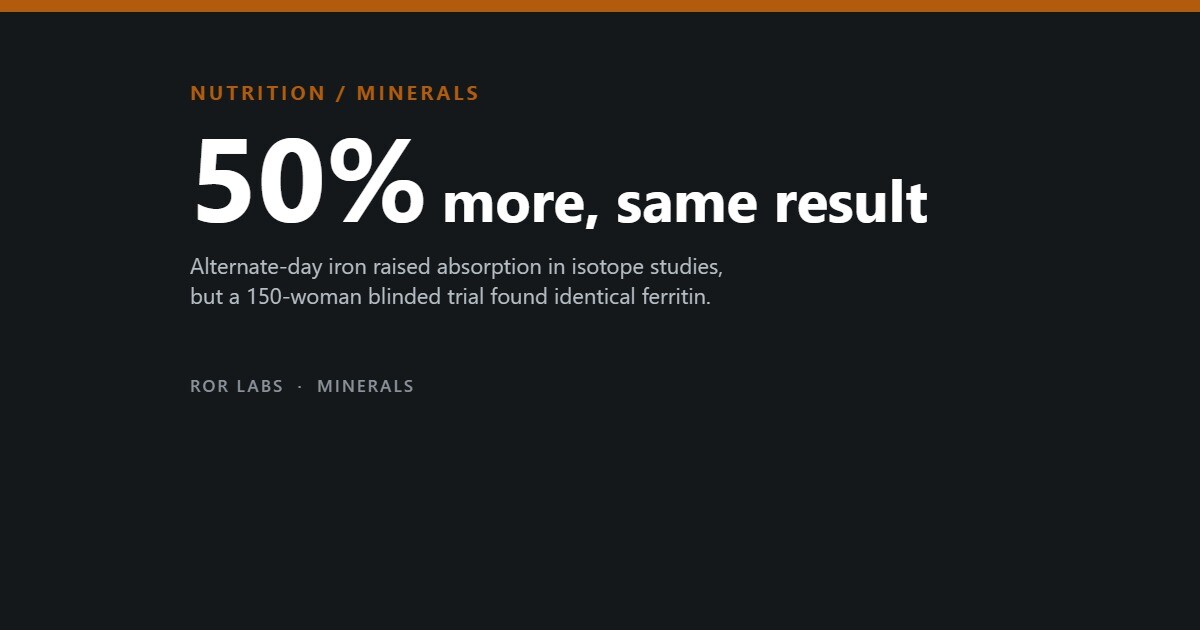
Absorbing a larger fraction of a dose and ending up with more iron in the body are different claims, and the second has to be tested separately. The largest attempt randomised 150 Swiss women with ferritin of 30 µg/L or less, double-blind, to 100 mg of iron daily for 90 days or the same dose on alternate days for 180 days — an identical total either way.
At equal total dose the two arms were indistinguishable on iron stores: median ferritin 43.8 µg/L daily against 44.8 alternate-day, P = 0.98. What differed was tolerance. Gastrointestinal side effects on days iron was taken were far more common on the daily schedule, longitudinal prevalence ratio 1.56 (95% CI 1.38 to 1.77, P < 0.0001). Hepcidin behaved as the isotope work predicted, 3.0 nM against 1.9 nM (P < 0.0001), and at six months iron deficiency was present in 11.4 per cent of the daily arm against 3.0 per cent (P = 0.049).
Three randomised trials, three different answers
Alternate-day against daily oral iron. Positive numbers favour the schedule named.
Sources: eClinicalMedicine 65 (2023); Scientific Reports 13 (2023); Indian Journal of Hematology and Blood Transfusion (2024).
A fourth, smaller trial published in 2026 ran the other way again, finding larger rises in red cell indices on the daily schedule — but it enrolled 60 women for a fortnight, short enough to be measuring the speed of the initial response rather than the endpoint anyone cares about.
Read together they say something specific. The physiology is real and repeatable. Its consequence for iron stores at an equal total dose is small or absent. Its consequence for whether a person keeps taking the tablets is not small at all — and since the usual reason iron treatment fails is that people stop, that may be the outcome that matters.
The trial that showed iron is not free
Between 2002 and 2003 a community trial on Pemba, Zanzibar, randomised preschool children to daily iron and folic acid, to iron with folic acid and zinc, or to placebo, in an area of intense malaria transmission. Of 32,155 randomised, 24,076 fell into the three groups analysed. The iron-containing groups were stopped early, on 19 August 2003, on the recommendation of the data and safety monitoring board.
The reason was a signal in the wrong direction. Children receiving iron and folic acid were 11 per cent more likely to be admitted to hospital (RR 1.11, 95% CI 1.01 to 1.23, P = 0.03), and deaths were 15 per cent higher, an estimate that did not reach significance (RR 1.15, 95% CI 0.93 to 1.41). A nested substudy found the opposite among children who were genuinely iron-deficient and anaemic: those were protected, relative risk 0.51. Iron-deficient children without anaemia showed no effect either way.
That contrast is the sentence worth keeping. Universal supplementation did harm on average; the same supplement given to children whose iron was actually low did good. Current WHO guidance pairs iron with malaria control rather than withholding it — a policy answer to a trial result, not a contradiction of it.
Keeping it in range without guessing
Serum ferritin below 30 µg/L suggests iron deficiency and below 10 µg/L suggests iron deficiency anaemia — but ferritin rises with inflammation, which is why the Swiss trial excluded anyone with a C-reactive protein of 5 mg/L or more. Taken during or after an infection, it can read normal on genuinely empty stores.
Groups where the base rate makes testing sensible rather than reflexive: pregnancy, infancy and early childhood, heavy menstrual bleeding, frequent blood donation — 25 to 35 per cent of regular donors develop iron deficiency — coeliac and inflammatory bowel disease, and long-term proton pump inhibitor use, which reduces non-haem absorption.
Two interactions are common and avoidable: iron alongside levothyroxine causes clinically significant reductions in its effect and the two should be four hours apart, and iron reduces absorption of levodopa. Doses of 45 mg a day or more are where gastric upset, constipation, nausea and diarrhoea start appearing in numbers — the ordinary reason most courses of iron are abandoned.
Questions people ask
Should I take iron every other day instead of every day?
A question for whoever ordered the test, since it depends on how fast the deficit needs correcting. The evidence supports alternate-day dosing being absorbed better per dose and tolerated better. It does not support it putting more iron in you over a course of treatment at the same total dose.
Does taking iron with orange juice help?
Ascorbic acid is a genuine enhancer of non-haem absorption. The effect is real but modest, and it does not override hepcidin — vitamin C will not rescue a dose given 24 hours after the last one.
Is cast-iron cookware a meaningful source?
It transfers measurable non-haem iron into acidic foods cooked for a long time. That is a marginal contribution rather than a strategy, and not something to count on if a blood test has come back low.
Why is spinach still treated as an iron food?
Raw spinach holds 2.71 mg per 100 g, which is unremarkable, and it arrives with oxalate. The reputation is older than the measurement. Spinach is a good food for other reasons.
Why does the upper limit sit so much higher than the RDA?
Because the endpoint that sets it is gastrointestinal upset rather than organ damage, and because absorption falls as doses rise. The body’s own gate does much of the work an upper limit would otherwise have to do. For people without haemochromatosis, food alone does not get near it.
The short version
- Iron has no excretion route, so intake is the only control point and hepcidin is the valve.
- A dose of 60 mg or more raises hepcidin for about 24 hours and cuts absorption of the next dose by 35 to 45%.
- The same 100 mg dose absorbed 23.5% on day one, 17.0% on a second consecutive day, 25.0% after a day off.
- At equal total dose over months, a blinded trial of 150 women found identical ferritin — but 56% more gastrointestinal side effects on the daily schedule.
- Ranked per tablespoon the top iron foods are dried herbs nobody eats by the spoon; enrichment supplies most of the iron in white rice and flour.
- On Pemba, universal iron raised hospital admissions 11%, while the iron-deficient anaemic children in the same trial were protected.
This describes what published research has reported. It is not medical advice and not a reason to start or stop a supplement. Iron deficiency and iron overload both need a blood test and a clinician to read it, and iron supplements are a leading cause of poisoning in young children — they belong in a closed cupboard.
Further reading: Moretti et al., Blood 126(17):1981–1989 (2015), on the hepcidin response to oral iron. Stoffel et al., Haematologica 105(5):1232–1239 (2020), for the isotope measurements above. Von Siebenthal et al., eClinicalMedicine 65:102286 (2023), for the blinded 180-day comparison. Sazawal et al., Lancet 367(9505):133–143 (2006), for the Pemba trial.
- Sickening, John Abramson (2022). On how industry-funded trials and regulatory gaps shape what supplements get sold on what evidence.
- The Age of Diagnosis, Suzanne O’Sullivan (2025). On overdiagnosis and medicalization — relevant to who actually benefits from testing and supplementing.
- How to Read Numbers, Tom Chivers & David Chivers (2021). Common statistical traps explained through news examples.
Sources
NIH Office of Dietary Supplements, Iron — Health Professional Fact Sheet (RDAs, ULs, bioavailability 14–18% and 5–12%, the 1.8× vegetarian factor, ferritin thresholds, donor and risk-group figures, drug interactions).
USDA FoodData Central, SR Legacy: 170938, 171317, 170923, 170495, 169713, 170150, 168877, 169756, 168894, 169761, 168462.
Moretti D et al. Oral iron supplements increase hepcidin and decrease iron absorption from daily or twice-daily doses in iron-depleted young women. Blood 2015;126(17):1981–1989.
Stoffel NU et al. Iron absorption from supplements is greater with alternate day than with consecutive day dosing in iron-deficient anemic women. Haematologica 2020;105(5):1232–1239.
Stoffel NU et al. Iron absorption from oral iron supplements given on consecutive versus alternate days. Lancet Haematology 2017;4(11):e524–e533.
Von Siebenthal HK et al. Alternate day versus consecutive day oral iron supplementation in iron-depleted women. eClinicalMedicine 2023;65:102286.
Pasupathy E et al. Alternate day versus daily oral iron for treatment of iron deficiency anemia: a randomized controlled trial. Scientific Reports 2023;13. doi:10.1038/s41598-023-29034-9.
Dhanush M et al. Daily versus alternate day oral iron replacement for women with iron deficiency anaemia. Indian J Hematol Blood Transfus 41(2):245–251.
Pilot double-blind randomised trial of daily versus alternate-day oral iron in 60 iron-deficient young women. Clinical Nutrition 2026.
Sazawal S et al. Effects of routine prophylactic supplementation with iron and folic acid on admission to hospital and mortality in preschool children in a high malaria transmission setting. Lancet 2006;367(9505):133–143.