Calcium: Food Sources, Bone Density, and What the Trials Found
In This Series: Nutrients
- Which Nutrients Are You Actually Short Of?
- How Nutrients Are Classified — and What the Reference Numbers Mean
- Vitamin A: Food Sources, Deficiency, and Safe Limits
- Vitamin C: Food Sources, Scurvy, and the Ceiling the Body Sets
- Vitamin D: Food Sources, Sunlight, and What the Trials Found
- Vitamin D2 vs D3: What the Head-to-Head Trials Found
- Riboflavin: Food Sources, Deficiency, and the Migraine Trials
- Thiamin: Food Sources, Beriberi, and Why There Is No Upper Limit
Key takeaways · 10 min read
- About 98 per cent of the body’s calcium is in bone, as hydroxyapatite — roughly 1,200 g in women and 1,400 in men. Blood calcium is defended by taking bone apart, so it does not report intake.
- Per tablespoon: poppy seed 216 mg, hard parmesan 177, whole sesame 146. Milk is last at 17, and milk is where most people get theirs.
- Whole sesame seeds carry 975 mg per 100 g; hulled ones, 60. The calcium is in the hull.
- Absorption falls as the dose rises — 36 per cent at 300 mg, 28 at 1,000, highest at 500 mg or less.
Calcium has the widest gap in this series between how confidently it is recommended and what the trials of recommending it actually found. Two systematic reviews published in the same journal on the same day in 2015 pooled essentially the same evidence and concluded that increasing calcium intake does not prevent fractures. A meta-analysis from a major osteoporosis foundation, published the same year, reported hip fractures cut by 31 per cent.
Both are real papers. Neither is fringe. This page is mostly about how that happened, because the mechanism underneath explains the disagreement better than either side does.
This is the first mineral entry in this appendix: what it does, which foods carry it per measured spoonful, what running short does, and what the reference numbers are.
What it does
Calcium is structural before it is anything else. Roughly 98 per cent of the body’s calcium is stored in bone, and more than 99 per cent of it is present as calcium hydroxyapatite, an inorganic matrix. An adult carries about 1,200 grams of it if female and 1,400 if male — more than a kilogram of mineral, held in a tissue that is continuously dismantled and rebuilt.
The remaining fraction, well under 2 per cent, does the signalling work: muscle contraction, nerve transmission, clotting. That fraction is regulated tightly, and the skeleton is the buffer that keeps it steady. Which is the first thing to understand about dietary calcium: a blood calcium test tells you almost nothing about intake, because the body will take bone apart to keep blood calcium where it belongs.
The three foods that carry the most per spoonful
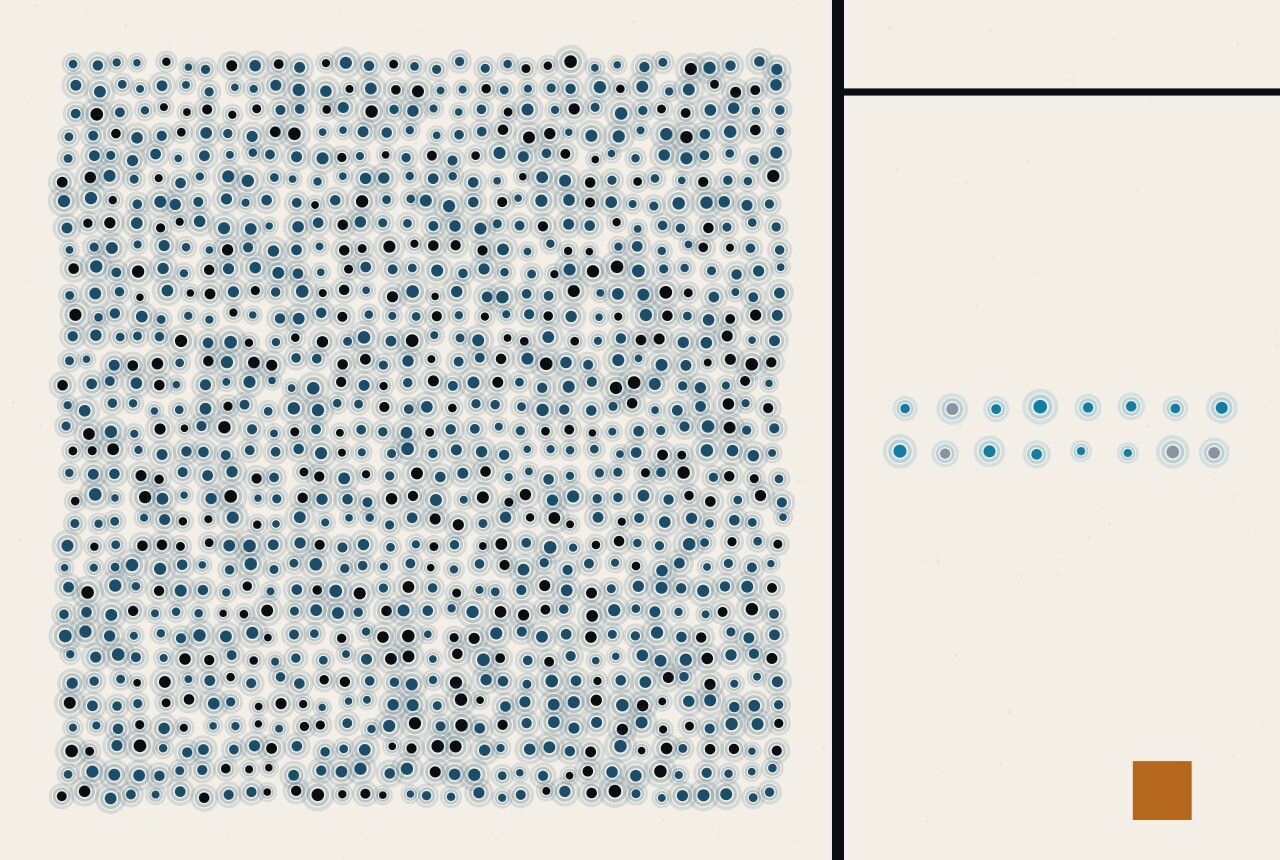
Ranked by what fits on a level tablespoon, using USDA composition values:
Calcium per level tablespoon
USDA SR Legacy values per 100 g, converted at 15 g. Share is of the 1,000 mg adult RDA.
| Food (USDA FDC ID) | Per 100 g | Per tablespoon | Share of RDA |
|---|---|---|---|
| Poppy seed (171330) | 1,440 mg | 216 mg | 22% |
| Parmesan, hard (170848) | 1,180 mg | 177 mg | 18% |
| Sesame seeds, whole, dried (170150) | 975 mg | 146 mg | 15% |
| Tofu, firm, with calcium sulfate (172475) | 683 mg | 102 mg | 10% |
| Chia seeds, dried (170554) | 631 mg | 94.7 mg | 9% |
| Sardines, canned in oil, with bones (175139) | 382 mg | 57.3 mg | 6% |
| Milk, whole, with added vitamin D (171265) | 113 mg | 17 mg | 2% |
Source: USDA FoodData Central, SR Legacy. Tablespoon figures are conversions at 15 g.
Milk is last, at 17 mg a spoonful, and milk is the food everyone names. It earns its reputation by volume: a cup is 276 to 299 mg depending on fat content, and people drink cups. A tablespoon of poppy seed carries thirteen times as much calcium as a tablespoon of milk and supplies almost nobody’s calcium.
One line in that table is worth its own sentence. Whole sesame seeds carry 975 mg per 100 g. Hulled sesame seeds — the decorticated kernels, FDC 169412 — carry 60. The calcium is in the hull, and hulling removes about 94 per cent of it. As with thiamin and rice bran, the nutrient sits in the fraction that processing takes off.
How much of it gets in
Calcium is unusual in this series for having a well-characterised and steep absorption curve, and the shape of it matters more than any food table.
Fraction absorbed, by dose and by age
NIH Office of Dietary Supplements.
Two practical consequences follow without needing any trial. The first is that a single large tablet is the least efficient way to take calcium: the fraction absorbed falls as the dose rises, and the guidance to split doses at 500 mg is a statement about the transporter, not a marketing convention. The second is that the body already compensates for low intake by absorbing a larger share of it — which is part of why adding more to an adequate diet does so little.
What a supplement does to bone
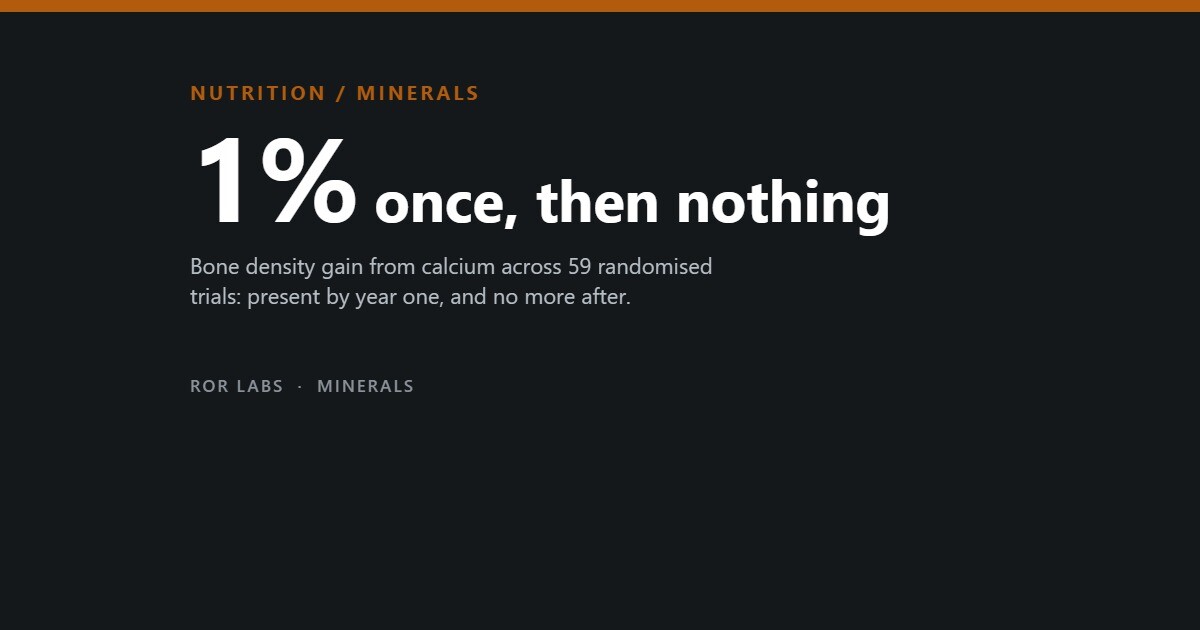
This is the number that makes sense of everything else. A 2015 systematic review pooled 59 randomised trials of calcium intake with bone mineral density as the outcome.
Bone mineral density, pooled across 59 randomised trials
Percentage increase over one to more than two and a half years.
Source: Tai, V. et al., BMJ 351, 2015, h4183.
The increase arrives in year one and then stops. It is not cumulative, and there is no dose-response: trials using 1,000 mg a day or more did not do better than trials using less, and people with the lowest baseline intakes did not gain more than people with the highest. That pattern is the opposite of what correcting a deficiency looks like.
Now put a number beside it. The average rate of bone density loss in older postmenopausal women is about 1 per cent a year. So the entire effect of increasing calcium intake is to buy back roughly one to two years of ordinary loss, once, and then to slow that loss without stopping it. The reviewers’ own conclusion is that increases of this size are unlikely to translate into clinically meaningful reductions in fractures.
And what it does to fractures
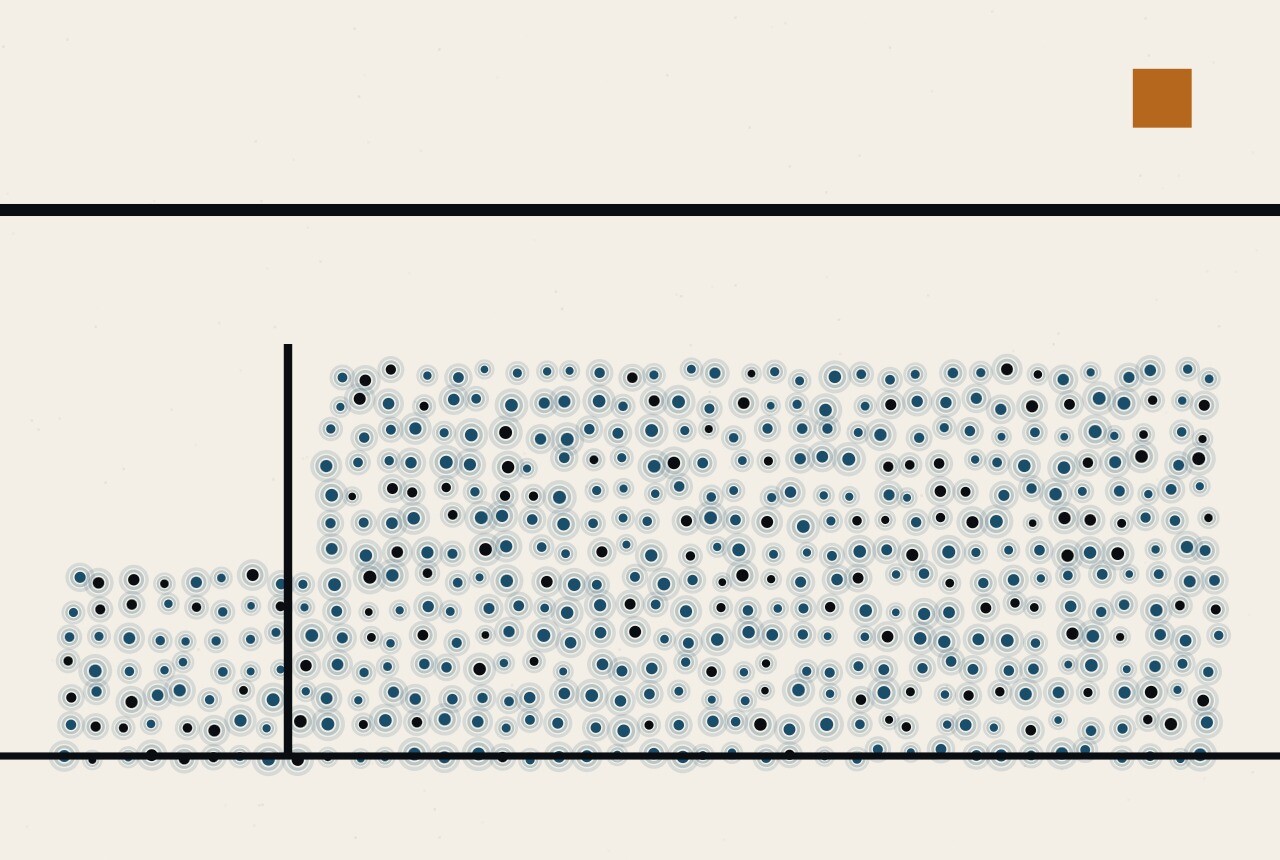
The companion review, published the same day, took fracture as the outcome: 26 randomised trials, 69,107 participants.
Calcium supplements and fracture, pooled randomised trials
Relative risk. Below 1.00 favours supplementation.
Source: Bolland, M.J. et al., BMJ 351, 2015, h4580. Total fracture 95% CI 0.81 to 0.96; vertebral 0.74 to 1.00. Full bar = 25 per cent.
An 11 per cent reduction in total fracture and 14 per cent in vertebral, nothing at the hip or forearm — and, critically, no reduction at any site once the analysis was restricted to the trials at lowest risk of bias, with evidence of publication bias among the small and moderate-sized studies. On dietary calcium the same review found 42 cohort studies of which at least three quarters reported no association at all, and the two randomised trials of dietary sources between them enrolled 262 people.
The authors’ conclusion was blunt: clinicians, advocacy organisations and health policymakers should not recommend increasing calcium intake for fracture prevention, by supplement or by diet.
The same evidence, read the other way
In the same year, a meta-analysis from the National Osteoporosis Foundation pooled 11 trials of calcium plus vitamin D, 52,915 participants, and reported total fractures down 16 per cent and hip fractures down 31 per cent, both statistically significant. The US Preventive Services Task Force, reviewing the field in 2018, landed in between: daily doses below 1,000 mg of calcium with less than 400 IU of vitamin D do not prevent fractures in postmenopausal women, and the evidence on larger doses is inadequate.
The disagreement is not really about arithmetic. It is about which trials belong in the pool — calcium alone or calcium with vitamin D, community-dwelling or institutionalised, replete or deficient at baseline — and about how much weight to give the small positive studies that the funnel plots flag. Three groups made three defensible choices and got three answers, and none of them is hiding what they did.
The harm question, which has the same shape
The cardiovascular argument ran the same way and is still running.
Calcium supplements and cardiovascular risk: three readings
Each from randomised trial data.
The 2023 pooling does not refute the 2013 one so much as show how thin the data underneath both are: 219 myocardial infarctions spread across seven comparisons, and an interval running from a 12 per cent reduction to a 51 per cent increase. That is not a null result. It is an absence of resolution.
The kidney stone finding has a similar history. In the Women’s Health Initiative, 1,000 mg a day of supplemental calcium for seven years was linked to a greater risk of kidney stones; two later systematic reviews of osteoporosis studies found no such association.
The numbers
The RDA is 1,000 mg a day for adults aged 19 to 50, rising to 1,200 for women over 50 and everyone over 70, and 1,300 for ages 9 to 18. The tolerable upper level is 2,500 mg for adults up to 70 and 2,000 mg above that.
Measured intakes sit close to those figures without a supplement: men over 20 average 1,083 mg a day from food and drink, women 842. About 22 per cent of men and 32 per cent of women take a calcium supplement anyway. The shortfall is real but uneven — 39 per cent of everyone aged 4 and over takes in less than the estimated average requirement, and among children aged 4 to 18 it is 49 per cent.
Questions people ask
How much calcium is in a tablespoon?
Poppy seed about 216 mg, hard parmesan 177, whole sesame seeds 146, calcium-set firm tofu 102, chia 94.7, sardines with bones 57.3, milk 17. Per serving the order inverts: a cup of low-fat yogurt is 415 mg, calcium-fortified orange juice 349, a cup of nonfat milk 299.
Should I take a calcium supplement?
If your intake is low, food is the better route, and the trial evidence for supplements preventing fractures is contested by serious people on both sides. If you take one anyway, the absorption data says to split it: doses of 500 mg or less are absorbed most efficiently. Anyone with a history of kidney stones, or taking it alongside other treatment for bone, should be having this conversation with a doctor rather than a label.
Is dairy necessary?
No. Calcium-set tofu is 683 mg per 100 g, whole sesame 975, and fortified plant milks are matched to dairy by design — fortified soymilk is 299 mg a cup, the same as nonfat milk. The pooled review found dietary and supplemental calcium raised bone density by the same small amount, so the source matters less than the total.
Why do the studies disagree so much?
Because most of them enrolled people who already had enough. A supplement is a treatment for a shortage; tested in the replete it produces the small, non-cumulative, non-dose-responsive bump the bone density review describes. Add publication bias among the small trials and different inclusion rules between review teams, and you get 31 per cent and zero from the same literature.
The short version
- About 98 per cent of the body’s calcium is in bone, as hydroxyapatite — roughly 1,200 g in women and 1,400 in men. Blood calcium is defended by taking bone apart, so it does not report intake.
- Per tablespoon: poppy seed 216 mg, hard parmesan 177, whole sesame 146. Milk is last at 17, and milk is where most people get theirs.
- Whole sesame seeds carry 975 mg per 100 g; hulled ones, 60. The calcium is in the hull.
- Absorption falls as the dose rises — 36 per cent at 300 mg, 28 at 1,000, highest at 500 mg or less.
- Across 59 trials, raising calcium intake lifts bone density 1 to 2 per cent, in the first year only, with no further gain. Ordinary loss after menopause is about 1 per cent a year.
- On fractures: 0.89 for total and 0.86 for vertebral across 26 trials, nothing at the hip, and nothing at all in the trials at lowest risk of bias — against a foundation meta-analysis reporting hip fractures down 31 per cent. Both published in 2015.
This is a reference page, not clinical guidance. Calcium interacts with several common medications and with treatment for osteoporosis, and decisions about supplementing belong with a doctor or pharmacist.
Further reading: The two 2015 BMJ reviews are a matched pair and are best read together — the bone density one explains why the fracture one came out the way it did. Both are open access.
- The Age of Diagnosis, Suzanne O’Sullivan (2025). A neurologist on overdiagnosis and medicalization — directly relevant to bone-density screening thresholds.
- Spoon-Fed, Tim Spector (2022). An epidemiologist on why nutrition science is so unreliable — confounding, industry funding, weak designs.
- How to Read Numbers, Tom Chivers & David Chivers (2021). Common statistical traps explained through news examples.
Sources
- NIH Office of Dietary Supplements, “Calcium”, fact sheet for health professionals. (RDA and UL tables; 98% of body calcium in bone; absorption 45% at 200 mg/day falling to 15% above 2,000, and 36% at a 300 mg supplement dose against 28% at 1,000; mean intakes 1,083 and 842 mg/day, with 39% of adults below the EAR; the cited cardiovascular and kidney stone findings; per-serving food figures.)
- USDA FoodData Central, SR Legacy, calcium per 100 g. (Poppy seed 171330, 1,440 mg; parmesan hard 170848, 1,180; sesame whole 170150, 975 against decorticated kernels 169412, 60; tofu with calcium sulfate 172475, 683; chia 170554, 631; sardines with bones 175139, 382; kale 168421, 254; whole milk 171265, 113.)
- Tai, V., Leung, W., Grey, A., Reid, I.R. and Bolland, M.J., “Calcium intake and bone mineral density”, BMJ 351, 2015, h4183. (59 randomised trials; dietary sources 0.6–1.8% and supplements 0.7–1.8%; present by one year with no further increase; no dose-response and no interaction with baseline intake.)
- Bolland, M.J., Leung, W., Tai, V., Bastin, S., Gamble, G. and Grey, A., “Calcium intake and risk of fracture”, BMJ 351, 2015, h4580. (26 trials, 69,107 participants; total fracture RR 0.89, 95% CI 0.81–0.96; vertebral 0.86, 0.74–1.00; hip 0.95, not significant; no reduction at any site in the trials at lowest risk of bias; publication bias among smaller trials.)
- Wallace, T.C. et al., National Osteoporosis Foundation meta-analysis, 2015. (11 studies, 52,915 participants; total fractures 0.84, 95% CI 0.73–0.96; hip 0.69, 0.56–0.86.)
- Kahwati, L.C. et al., evidence report for the US Preventive Services Task Force, JAMA, 2018, and the USPSTF conclusion on daily doses below 1,000 mg with under 400 IU vitamin D.
- Reid, I.R., “Cardiovascular effects of calcium supplements”, Nutrients 5(7), 2013. (Myocardial infarction up 27–31% and stroke 12–20% in pre-specified analyses of placebo-controlled trials.)
- Huo, X. et al., “Calcium supplements and risk of CVD”, Current Developments in Nutrition, 2023. (11 trials; calcium alone: MI RR 1.15, 95% CI 0.88–1.51 on 219 events; stroke 1.15, 0.90–1.46.)