Badminton shoulder pain, the smash and what prevention trials actually show
Key takeaways · 10 min read
- The fastest recorded badminton hit is 565 km/h in a controlled attempt; elite smashes in the lab average about 349 km/h, driven largely by shoulder internal rotation.
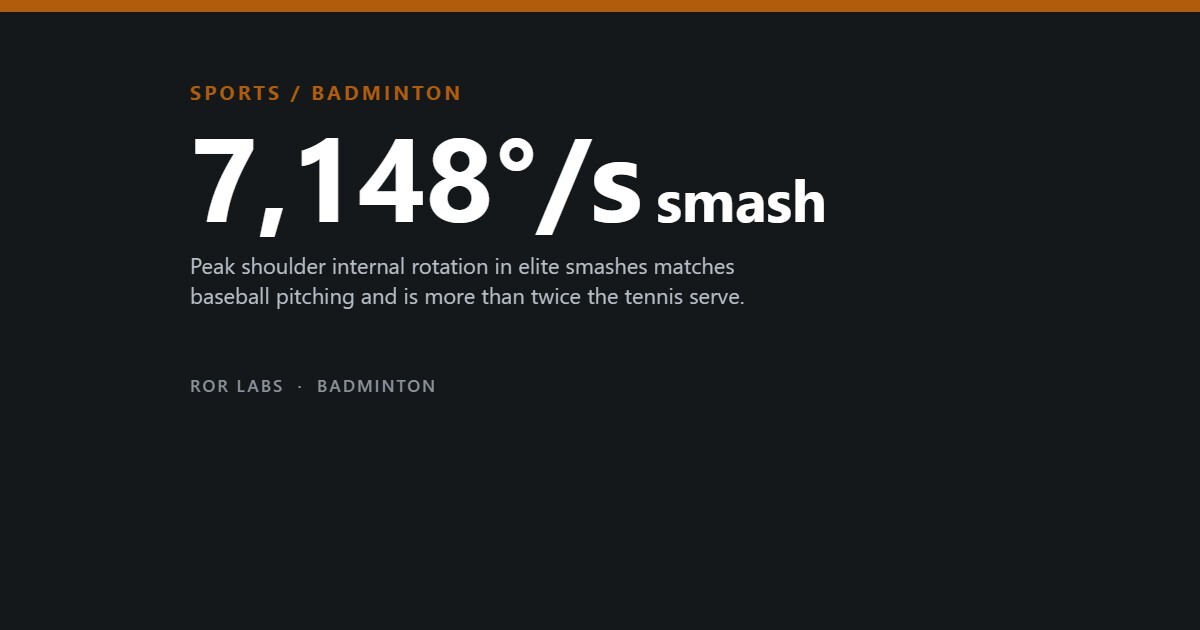
- Peak shoulder rotation in an elite smash reaches about 7,000 degrees a second, similar to baseball pitching and more than twice the tennis serve.
- About half of players report shoulder pain at some point, but far fewer have it now: 5% to 20% in surveys that asked about ongoing pain.
- Lost internal rotation in the hitting arm and uneven shoulder-blade movement go with later pain; handball programmes targeting them had mixed but mostly favourable results.
Satwiksairaj Rankireddy holds the Guinness World Record for the fastest badminton hit: 565 km/h, measured with a high-speed camera in a racket maker’s factory gym in Saitama, Japan, in April 2023. In July 2026 he and his doubles partner Chirag Shetty retired from their opening match at the Japan Open, a game down, because of his recurring shoulder injury. It was their first event since he aggravated the same shoulder at the Indonesia Open in June.
His coach, Tan Kim Her, said the trouble went back to a tear several years earlier and came and went. A shoulder that is neither quite injured nor quite well is exactly what surveys of badminton players keep finding. In a questionnaire of 188 international players at the World Mixed Team Championships, 52% reported previous or present pain in the dominant shoulder, and 20% were playing with it at the time.
This article covers what the smash asks of the shoulder and elbow, as measured in the laboratory; who reports pain and which measurable traits go with it; what shoulder prevention programmes have achieved in other overhead sports, since badminton has no trial of its own; and what is known about getting back on court. The aim is to keep smashing, with a shoulder that lasts.
What the smash asks of the shoulder
A smash is a throw with a racket on the end. The arm cocks back, raised and turned outwards, then the upper arm whips into internal rotation as the elbow straightens and the forearm turns over. In 19 elite Malaysian men filmed with motion capture, the fastest smash per player averaged 97 metres a second, about 349 km/h. Faster smashes went with a more internally rotated shoulder at contact.
How fast a smashed shuttle leaves the racket
Shuttle speed just after impact, in km/h. Record attempts are measured in controlled conditions; laboratory and match values are lower.
Sources: Guinness World Records and Yonex (2023; the attempt was run at the racket maker’s factory); Ramasamy et al., Sports Biomechanics (2021); Ceylan et al., Journal of Coaching and Sports Science (2026).
The rotation itself is the startling number. Peak internal rotation speeds in the Malaysian players ran from 3,773 to 7,148 degrees a second. The authors noted that this matches published values for baseball pitching and is more than twice those reported for the tennis serve. Once the shuttle has gone, the small external rotator muscles of the rotator cuff and the muscles around the shoulder blade have to brake that spin in a fraction of a second.
Peak shoulder internal rotation speed
Degrees per second, upper end of the reported range. Badminton values measured in 19 elite players; baseball and tennis values are those the authors cited from earlier studies.
Source: Ramasamy et al., Sports Biomechanics (2021), doi:10.1080/14763141.2021.1877336.
Most badminton shoulder pain starts gradually. In recreational players the diagnosis was usually never made, but history and tests resembled subacromial impingement, irritation of the rotator cuff tendons under the shoulder’s bony roof. The elbow is affected less often than in tennis. A 1979 survey of 231 players found surprisingly little tennis elbow, and in 124 male players in Tehran, 17.7% recalled an inner-elbow injury and 9.7% an outer-elbow one. Leg and eye injuries are covered in our earlier article on the Achilles tendon and eye injuries in badminton.
Where the risk concentrates
Shoulder pain is not confined to the elite. Fahlström and Söderman questioned 99 recreational players: 52% reported previous or present pain in the dominant shoulder and 16% had ongoing pain linked to badminton, yet they kept playing. Painful shoulders scored lower on a standard function test and had less pain-free range when the arm was lifted sideways, although measured strength was no different from that of pain-free shoulders.
Young players report it too. A Japanese questionnaire of middle-school, high-school and university players found that 461 of 1,002 had had shoulder pain in the previous year, and earlier shoulder pain was the clearest predictor. Among 52 university players at national level, 30.8% had shoulder pain at a medical check, and it went with less trunk rotation towards the racket side and poorer balance on the other leg.
Badminton players reporting shoulder pain
Percentages of players, from questionnaires; definitions and time windows differ, so the studies are not directly comparable.
Sources: Fahlström et al., Scand J Med Sci Sports (2006); Fahlström and Söderman (2006); Cejudo, IJERPH (2022); Warashina et al. (2018); Zhou et al., Asian J Sports Med (2022); Sundström et al. (2024).
The “over half” figure needs a second look. It counts pain at any point in a career, gathered from players who chose to answer, and the two surveys behind it come from the same research group. Asked what hurt now, the numbers fall: 20% of world-class players, 16% of recreational ones, and only three of 63 players, 5%, in a 2024 study that compared them with wrestlers, of whom 32% had ongoing pain.
Two measurable traits keep turning up. One is lost internal rotation in the hitting arm, often called GIRD. In one cross-sectional study it fell from about 98 degrees at ages 7 to 12 to about 78 in university players. In 38 Spanish under-17 players followed for a year, 18 developed shoulder pain, and internal rotation of 55 degrees or less was the best predictor. A 2026 review of prospective studies named the same threshold.
The other is scapular dyskinesis, a shoulder blade that moves unevenly. Pooling five prospective studies of 419 athletes from several sports, a meta-analysis found that 35% of those with it developed shoulder pain, against 25% without it, a 43% higher risk. In 48 university players at national level, attacking players were 7.33 times as likely as defensive ones to have current shoulder pain, although the confidence interval ran from 1.55 to 34.7.
What has been measured to work
No randomised trial has tested a shoulder programme in badminton. The nearest evidence comes from handball, another sport built on repeated overhead throwing. In Norway, 45 elite teams with 660 players were randomised by team. Half added the Oslo Sports Trauma Research Center shoulder programme to their warm-up three times a week: internal rotation stretching, external rotation and shoulder-blade strength, trunk and thoracic mobility. Over a seven-month season, shoulder problems averaged 17% against 23% in the control teams.
A Swedish trial in handball-profiled secondary schools went further. It randomised 18 schools and 709 players aged 15 to 19 to a shoulder programme, a knee programme or usual training. New shoulder injuries ran at 0.8 per 1,000 handball hours in the shoulder group against 1.8 in the controls, a 56% lower rate; about nine players had to do the programme to prevent one injury. Players completed it only 1.3 times a week on average.
Shoulder prevention trials in handball
Main results of three cluster-randomised trials. Prevalence is the average share of players reporting shoulder problems during the season; rates are per 1,000 handball hours.
Sources: Andersson et al., BJSM 51:1073 (2017); Asker et al., Sports Medicine – Open (2022); Achenbach et al., BMJ Open Sport & Exercise Medicine 8(1):e001270 (2022).
Not every trial agreed. In Germany, 61 teams with 579 players used a stretching and elastic-band programme, and overuse shoulder injuries were no less common; only 61% of questionnaires came back, and the season was cut short by the pandemic. When a 2025 meta-analysis pooled three handball trials, the odds ratio was 0.73 with a confidence interval from 0.45 to 1.17, and the authors concluded effectiveness had not been shown.
For badminton, that leaves borrowed evidence. A 2026 narrative review argued for the Thrower’s Ten exercises used in baseball, but it tested nothing. Stretching does change range: in a trial of 37 overhead athletes with an internal rotation deficit of 15 degrees or more, a daily “sleeper stretch” for eight weeks improved internal rotation against no stretching. Whether that prevents pain was not measured.
Why the answer is to play carefully, not to stop
A month after the Japan Open, Rankireddy was preparing to return at the World Championships in India. He described the shoulder as “on and off all the time” and said the pair had to “respect the body as well,” while keeping the same attacking style. Surveys find that most players with shoulder pain keep playing, and the published exercise programmes in other overhead sports are cheap, quick and part of a warm-up.
For the club players most likely to read this, surgery is not usually the end either. Of 375 recreational athletes over 40 who answered a survey after arthroscopic repair of a full-thickness rotator cuff tear, 91.9% returned to some sport and 89% to their chosen one, with no significant difference between overhead and other sports. Most were back between six and nine months. Only a third of eligible patients replied, so the true rate may be lower.
Getting back to sport after shoulder surgery
Percentages of patients. Rotator cuff figures come from one survey of recreational athletes over 40 (mean age about 59); stabilisation figures pool 23 studies of overhead athletes.
Sources: Sonnier et al., JSES International (2022), doi:10.1016/j.jseint.2022.12.006; Hurley et al., Shoulder & Elbow (2023).
The practical steps follow the measurements. Warm up the shoulder, not just the legs: a few minutes of band work for the external rotators and shoulder blade, plus internal rotation stretching if your hitting side is stiff. Build smash volume gradually after a break, and train the trunk and legs that feed the stroke. Pain that wakes you at night, weakness lifting the arm, or pain lasting more than a few weeks deserves a physiotherapist’s look.
Questions people ask
Is smashing bad for your shoulder?
Smashing loads the shoulder heavily, with rotation speeds similar to baseball pitching. Shoulder pain is common in surveys, but most players keep playing, and pain is linked to measurable, trainable traits such as lost internal rotation and uneven shoulder-blade movement.
What is GIRD?
Glenohumeral internal rotation deficit: the hitting arm rotates inwards less than the other one. Some loss is a normal adaptation in overhead athletes; in young badminton players, internal rotation of 55 degrees or less predicted shoulder pain in one small study.
Do badminton players get tennis elbow?
They can, but surveys find elbow problems less common than in tennis, and inner-elbow pain was reported more often than outer-elbow pain in one survey of male players. Grip, technique and training volume are the usual suspects.
Can I play badminton after rotator cuff surgery?
Most recreational athletes over 40 in one large survey returned to sport, usually within six to nine months, with similar rates for overhead and other sports. Follow your surgeon’s and physiotherapist’s timetable.
The short version
- The fastest recorded badminton hit is 565 km/h in a controlled attempt; elite smashes in the lab average about 349 km/h, driven largely by shoulder internal rotation.
- Peak shoulder rotation in an elite smash reaches about 7,000 degrees a second, similar to baseball pitching and more than twice the tennis serve.
- About half of players report shoulder pain at some point, but far fewer have it now: 5% to 20% in surveys that asked about ongoing pain.
- Lost internal rotation in the hitting arm and uneven shoulder-blade movement go with later pain; handball programmes targeting them had mixed but mostly favourable results.
- Most recreational athletes over 40 return to sport after rotator cuff repair, overhead sports included, usually within six to nine months.
This is a summary of published research, not medical advice. If you have shoulder or elbow pain that lasts, wakes you at night, or comes with weakness, numbness or a sudden loss of movement, see a doctor or physiotherapist, and follow their advice on when to return to play.
Further reading: Ramasamy et al., Sports Biomechanics (2021), for how the smash is generated. Fahlström et al., Scandinavian Journal of Medicine & Science in Sports (2006), for shoulder pain in world-class players. Asker et al., Sports Medicine – Open (2022), for the strongest shoulder prevention trial in an overhead sport.
- Rehab Science, Tom Walters and Glen Cordoza (2023). A physical therapist’s guide to pain and graded rehabilitation, with programmes for the shoulder and elbow. Practical; it is general, not badminton-specific.
- Built from Broken, Scott H. Hogan (2021). A guide to rebuilding painful joints and tendons with progressive loading. Close to the shoulder-strength advice here; its claims go beyond the trials.
- Built to Move, Kelly Starrett and Juliet Starrett (2023). Ten everyday physical habits, including shoulder and hip mobility, from two physiotherapy-minded coaches. Useful for club players; not a sports-injury text.
Sources
- Guinness World Records. Fastest badminton hit (male): Satwiksairaj Rankireddy, 565 km/h, 14 April 2023; Yonex press release, 17 July 2023 (women’s record, Tan Pearly, 438 km/h; previous men’s record 493 km/h).
- The Statesman. Japan Open: Satwik-Chirag retire hurt again as recurring shoulder injury returns. 14 July 2026.
- PTI via DT Next. Satwik’s shoulder injury remains biggest concern ahead of Worlds: Tan. 6 August 2026.
- PTI via The Bridge. Shoulder injury ‘frustrating’, Satwik-Chirag vow to stay aggressive at home Worlds. 15 August 2026.
- Fahlström M, Yeap JS, Alfredson H, Söderman K. Shoulder pain – a common problem in world-class badminton players. Scandinavian Journal of Medicine & Science in Sports (2006), doi:10.1111/j.1600-0838.2004.00427.x.
- Fahlström M, Söderman K. Decreased shoulder function and pain common in recreational badminton players. Scandinavian Journal of Medicine & Science in Sports (2006), doi:10.1111/j.1600-0838.2006.00562.x.
- Ramasamy Y, Usman J, Sundar V, Towler H, King MA. Kinetic and kinematic determinants of shuttlecock speed in the forehand jump smash performed by elite male Malaysian badminton players. Sports Biomechanics (2021), doi:10.1080/14763141.2021.1877336.
- Ceylan T, Arslan Y, García-Ramos A, Ceylan L. Associations of shoulder rotational range of motion and isokinetic peak torque with shuttlecock velocity during the forehand jump smash in trained male badminton players. Journal of Coaching and Sports Science (2026).
- Hensley LD, Paup DC. A survey of badminton injuries. British Journal of Sports Medicine 13(4):156 (1979).
- Azarbal M, Adybeik D, Ettehad H, Kia MA. A survey of elbow injuries in badminton players (2003), doi:10.5580/1de4.
- Warashina Y, Ogaki R, Sawai A, et al. Risk factors for shoulder pain in Japanese badminton players: a quantitative-research survey (2018), doi:10.17265/2332-7839/2018.02.003.
- Zhou X, Imai K, Liu X, Chen Z, Watanabe E. Assessing the association of shoulder pain risk with physical fitness in badminton players at national tournament level. Asian Journal of Sports Medicine (2022).
- Sundström A, Tärnklev C, Fahlström M. Shoulder pain in badminton players and wrestlers. International Journal of Racket Sports Science (2024).
- Zhou X, Imai K, Chen Z, Liu X, Watanabe E. Differences in shoulder function among badminton players broken down by age and sex. Journal of Bodywork and Movement Therapies (2024), doi:10.1016/j.jbmt.2024.05.020.
- Cejudo A. Risk factors for, and prediction of, shoulder pain in young badminton players: a prospective cohort study. International Journal of Environmental Research and Public Health 19(20):13095 (2022).
- Xiao D, Duan Y, Weng H. Biomechanical risk factors for badminton injuries: a systematic review. Research in Sports Medicine (2026), doi:10.1080/15438627.2026.2680707.
- Hickey D, Solvig V, Cavalheri V, Harrold M, McKenna L. Scapular dyskinesis increases the risk of future shoulder pain by 43% in asymptomatic athletes: a systematic review and meta-analysis. British Journal of Sports Medicine 52(2):102 (2018).
- Imai K, Zhou X, Chen Z, et al. Mechanism for shoulder pain and injury in elite badminton players (2022), eSciPub IJSMR.
- Andersson SH, Bahr R, Clarsen B, Myklebust G. Preventing overuse shoulder injuries among throwing athletes: a cluster-randomised controlled trial in 660 elite handball players. British Journal of Sports Medicine 51:1073–1080 (2017), doi:10.1136/bjsports-2016-096226.
- Asker M, Hägglund M, Waldén M, Källberg H, Skillgate E. The effect of shoulder and knee exercise programmes on the risk of shoulder and knee injuries in adolescent elite handball players: a three-armed cluster randomised controlled trial. Sports Medicine – Open (2022), PMC9283550.
- Achenbach L, Huppertz G, Zeman F, et al. Multicomponent stretching and rubber band strengthening exercises do not reduce overuse shoulder injuries: a cluster randomised controlled trial with 579 handball athletes. BMJ Open Sport & Exercise Medicine 8(1):e001270 (2022).
- Yonneau J, Lefèvre-Colau MM, Compagnat M, et al. Shoulder injuries prevention programmes in handball: a systematic review with meta-analysis. BMJ Open Sport & Exercise Medicine 11(3):e002416 (2025).
- Kumari M, Sidiq M, Gupta S. Efficacy of Advanced Throwers Ten Exercise Program for overuse shoulder injury prevention in badminton players: a narrative review. Research in Sports Medicine (2026), doi:10.1080/15438627.2026.2729034.
- Chepeha JC, Magee DJ, Bouliane M, Sheps D, Beaupré L. Effectiveness of a posterior shoulder stretching program on university-level overhead athletes: randomized controlled trial. Clinical Journal of Sport Medicine (2017), doi:10.1097/jsm.0000000000000434.
- Sonnier JH, Connors GM, Campbell M, et al. Return to recreational sports participation following rotator cuff repair in adults over 40 years of age. JSES International (2022), doi:10.1016/j.jseint.2022.12.006.
- Hurley ET, Lunn KN, Bethell MA, et al. Return to play following operative management of anterior shoulder instability in overhead athletes – a systematic review. Shoulder & Elbow (2023), PMC10902415.