Rugby scrum injuries, the 16.5-kilonewton hit and the bind that softened it
Key takeaways · 10 min read
- Elite forward packs hit a scrum machine with a peak of 16.5 kilonewtons; most modern scrum spinal cord injuries happen at engagement rather than collapse.
- Hookers, one player in fifteen, suffered 46% of permanent spinal cord injuries in South Africa from 2008 to 2011, and adult amateurs far more than juniors.
- Scrum spinal cord injuries are less common than tackle ones overall but more often permanent: 82% against 50% in South African data.
- Pre-binding (crouch-bind-set, 2013) cut peak front-row forces by 14% to 25%; New Zealand recorded one disabling scrum injury in 2001–05 against nine predicted.
In February 2025 Steven Kitshoff, a 33-year-old prop with 83 Tests and two World Cup winner’s medals for South Africa, retired from all rugby. He had hurt his neck in a domestic match the year before. “It was just another scrum,” he told the newspaper Rapport, describing three cracking noises; he played on. Surgeons later fused his neck vertebrae with bone from his hip, and he said he had been “two millimetres away from catastrophe”.
The forces are large. When University of Bath researchers measured 34 forward packs driving into an instrumented scrum machine, international and elite packs hit it with a peak of 16.5 kilonewtons, roughly the weight of 1.7 tonnes. That first impact, the engagement, is where most modern scrum spinal cord injuries start: in South Africa from 2008 to 2011, 56% of scrum cases happened on engagement and 39% when the scrum collapsed.
This article covers what a mistimed engagement or a collapse does to a front-row neck, who carries the risk, what has been measured to work, from the 2013 crouch-bind-set law to New Zealand’s RugbySmart and South Africa’s BokSmart, why some of those successes are less certain than they look, and why the answer is trained front rows and a controlled engagement rather than giving up the scrum.
What a collapsing scrum does to a neck
In a scrum the two front rows meet head to head, each player’s head wedged between two opponents. Decades of case series describe the same catastrophic injury: a fracture-dislocation in the middle of the neck, most often around the C4 to C6 vertebrae, damaging the spinal cord. The classic explanation is hyperflexion. A player engages with the neck slightly bent, its normal curve straightens, and when the engagement is mistimed or the scrum goes down, the load lands on the flexed spine instead of the shoulders.
Biomechanists have challenged that picture. A systematic review by Kuster and colleagues argued that the commonest injury, dislocation of both facet joints, is better explained by buckling: the neck is compressed along its length, like a ruler pushed from both ends, and fails within milliseconds, before it reaches the end of its range. Others replied that cadaver tests cannot settle it. Both camps agree on what to avoid: sudden loads that combine compression with bending.
Peak force when a pack hits the scrum machine
Peak compression force at engagement, in kilonewtons, for forward packs of different levels pushing against an instrumented scrum machine. 34 packs in total.
Sources: Preatoni et al., IRCOBI conference (2012); Trewartha et al., British Journal of Sports Medicine (2015), table 2. One pack against a machine; live scrums differ.
The forces have grown. Packs in a 1990 study engaged at about two metres a second; international packs in the Bath study, at about three. During engagement the downward force reached 3.9 kilonewtons, the component that drives a scrum towards the ground. Repetition may leave its own mark: a South African radiologist found more cervical spine degeneration in 150 club players than in 150 matched controls, most marked in front-row forwards.
Where the risk concentrates
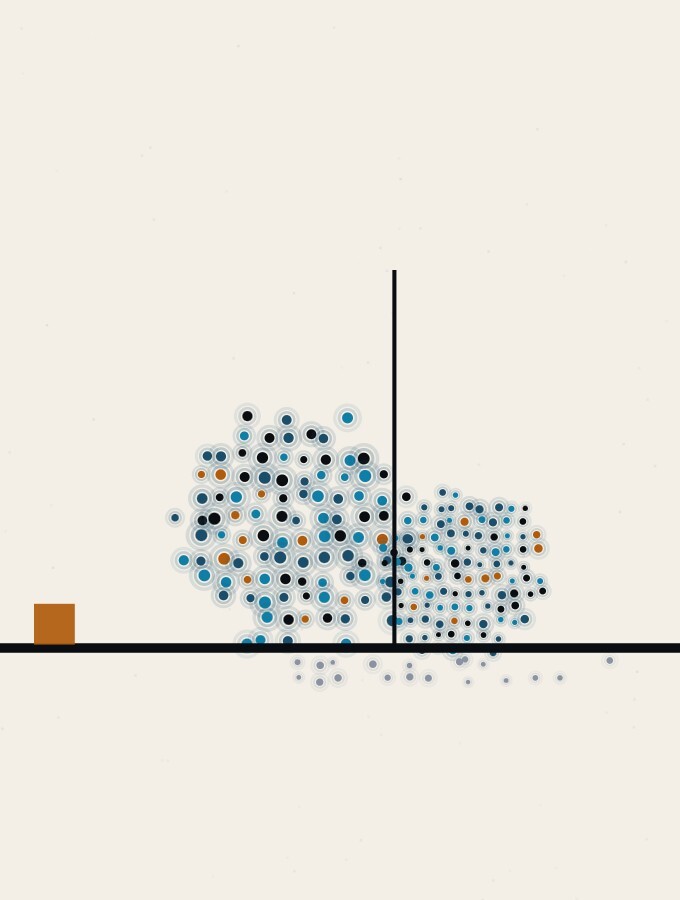
The hooker carries most of it. South Africa’s BokSmart registry recorded 45 acute spinal cord injuries from 2008 to 2011. Hookers, one player in fifteen, accounted for 12 of the 26 that left permanent damage, and ten of those twelve happened in scrums. In the United States from 1970 to 1996, hookers were 78% of the players who hurt their cervical spines in a scrum. With both arms bound around his props, a hooker cannot brace or adjust when an engagement goes wrong.
Level matters too. In the South African data, permanent spinal cord injuries ran at 4.52 per 100,000 senior players a year against 0.24 for juniors, and 85% of senior cases were permanent against 26% of junior ones. The authors pointed to stricter under-19 scrum laws, which cap the push at 1.5 metres and ban wheeling, and suggested that poorly conditioned weekend players and small squads forcing players into unfamiliar positions may add to the adult risk.
The hooker’s share of serious neck injuries
Share of injured players who were hookers, from three registries and case series, compared with the hooker’s share of a starting XV.
Sources: Wetzler et al., American Journal of Sports Medicine (1998); Brown et al., BMJ Open 3(2):e002475 (2013); Bohu et al., American Journal of Sports Medicine (2009).
The scrum is not the only route to a broken neck. Across reports from 1956 to 2004, scrums were blamed for 42% of catastrophic spinal injuries, tackles for 34% and rucks and mauls for 20%; in South Africa from 1980 to 2007, the tackle led with 45% against 37%. The tackle and its height laws are covered in our earlier article on rugby injuries and the tackle. What sets the scrum apart is how often the damage is permanent.
How often a spinal cord injury is permanent
Share of acute spinal cord injuries leaving permanent damage (or, for the UK, complete neurological loss), by phase of play.
Sources: Brown et al., BMJ Open (2013); under-19 spinal unit data as summarised by Trewartha et al., British Journal of Sports Medicine (2015).
Two situations recur. One is a mismatch: in a New Zealand review of rugby neck fractures at two hospitals from 1992 to 1997, in four of the five scrum cases the injured player judged the opposing scrum to be stronger. The other is collapse. In the 2011–12 English Premiership, 31% of scrums collapsed, and collapsed scrums produced 8.6 injuries per 1,000 against 4.1 for scrums that stayed up.
What has been measured to work
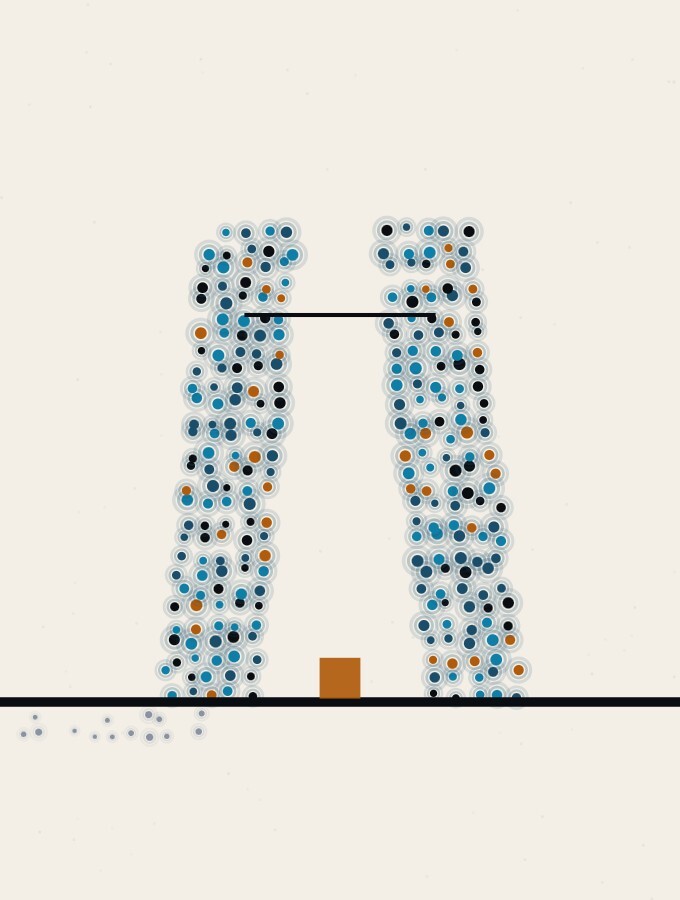
The engagement call has changed several times. Referees used crouch-touch-pause-engage from 2007 and crouch-touch-set from 2012. The Bath group then tested a third version in live scrums: props take a bind on their opponents before the call to set, so the packs start closer and cannot charge. In 11 professional teams, peak force across the front row at engagement fell by about a quarter, from roughly 8.8 to 6.3 kilonewtons, without weakening the sustained push.
Across 27 teams from five levels, pre-binding cut the gap between the packs by 27%, the speed of contact by more than 20% and peak stresses on the front row by 14% to 25%. It became law as crouch-bind-set in 2013. In the Six Nations, collapses, resets and early engagements fell afterwards, and scrums lasted longer as impact gave way to pushing. Since 2022 hookers have also had to keep a brake foot forward during crouch and bind, meant to reduce axial loading; it became full law from 1 July 2026.
What a softer engagement changes
Top: peak force across the front row in live elite scrums under two engagement sequences, in kilonewtons. Bottom: injuries per 1,000 scrums in the 2011–12 English Premiership.
Sources: Cazzola et al., British Journal of Sports Medicine (2015), doi:10.1136/bjsports-2013-092904, as summarised by Trewartha et al. (2015); Taylor et al., British Journal of Sports Medicine (2014).
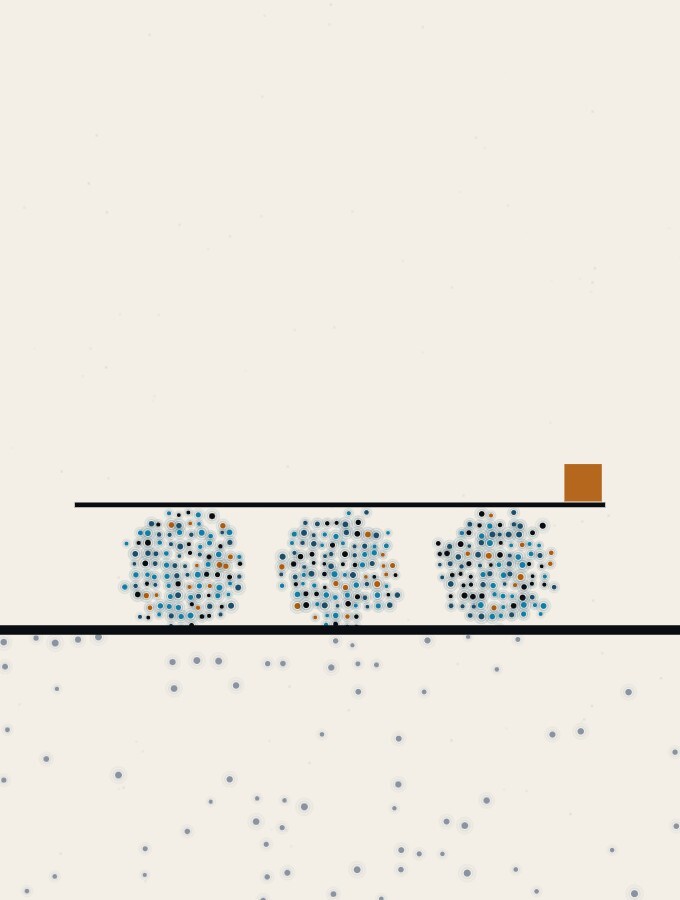
Education seems to have mattered as much as law. Since 2001 every New Zealand coach and referee has had to complete RugbySmart each year, covering conditioning, injury management and safe contact technique. In 2001–05 the country recorded one permanently disabling scrum spinal injury against 9.0 predicted from earlier years, a relative rate of 0.11. Injuries from other phases barely moved. After South Africa launched BokSmart in 2009, junior serious injuries fell by 40%, but seniors showed no significant change.
New Zealand before and after RugbySmart
Permanently disabling spinal injuries in New Zealand rugby union, 2001–05: number observed against the number predicted from 1976–2000 trends.
Source: Quarrie et al., BMJ 334(7604):1150 (2007), an ecological study without a control group. Relative rate for scrums 0.11 (95% CI 0.02 to 0.74).
These numbers are smaller and shakier than they look. The New Zealand study had no control group, could not adjust for player numbers before 1998, and estimated that 8% to 10% of the scrum decline came from fewer scrums: in internationals the average fell from 31 a match in the early 1980s to 19. An earlier survey had already found no serious scrum spinal injuries in the 18 months after compulsory safety education began in the mid-1990s, years before RugbySmart. The BokSmart evaluation assumed player numbers never changed.
Neck strengthening is widely recommended but less proven. Isometric programmes reliably make necks stronger, but a 2021 systematic review found no rugby union studies testing whether that means fewer concussions, and a retrospective analysis of 27 players in one professional squad found no significant difference in the number of neck injuries after a 26-week programme. It is sensible preparation, not a demonstrated shield.
Why the answer is to scrum carefully, not to stop
Calls to ban the contested scrum surface regularly, and rugby league offers a precedent: an Australian survey reported that scrum spinal cord injuries disappeared from league after it adopted non-contested scrums in 1996. Union has kept the contest but built in a safety valve. Law 3.12 makes each team responsible for ensuring its front-row players and replacements are suitably trained and experienced, and Law 3.13 makes scrums uncontested if either side cannot field such a front row.
The absolute risk is small: in South Africa, permanent scrum spinal cord injuries ran at about 0.54 per 100,000 players a year from 2008 to 2011. Most of that risk sits in places that can be identified, namely the engagement, the collapse, the hooker, the adult amateur game and the mismatch, and each has a lever. Pre-binding takes momentum out of the hit, under-19 laws cap the push, and competent front rows and referees keep scrums up.
France, which already required a certificate for front-row players, changed its scrum rules in 2010 and recorded significantly fewer scrum injuries afterwards. In practice: learn to scrum from someone qualified before scrummaging live, and build up in preseason. Do not fill in at hooker or prop as a favour; ask for uncontested scrums. Referees should reset a scrum that is going down. If a neck injury is suspected, do not move the player.
Questions people ask
Which rugby position is most at risk of a serious neck injury?
The hooker. In South African data hookers, one player in fifteen, suffered 46% of permanent spinal cord injuries, most of them in scrums. Props come next among scrum injuries.
Did crouch-bind-set make scrums safer?
It made them gentler. Measurements in live scrums found peak forces on the front row fell by 14% to 25%, and collapses fell in international rugby. Catastrophic injuries are too rare to show a direct effect yet.
Are uncontested scrums safer?
They remove the push, and union law requires them when a team has no suitably trained front row. Rugby league reported no scrum spinal cord injuries after switching to non-contested scrums in 1996.
Does neck strengthening prevent neck injuries?
It reliably increases neck strength, but studies have not yet shown that it prevents catastrophic or concussion injuries in rugby union. Treat it as good preparation alongside technique.
The short version
- Elite forward packs hit a scrum machine with a peak of 16.5 kilonewtons; most modern scrum spinal cord injuries happen at engagement rather than collapse.
- Hookers, one player in fifteen, suffered 46% of permanent spinal cord injuries in South Africa from 2008 to 2011, and adult amateurs far more than juniors.
- Scrum spinal cord injuries are less common than tackle ones overall but more often permanent: 82% against 50% in South African data.
- Pre-binding (crouch-bind-set, 2013) cut peak front-row forces by 14% to 25%; New Zealand recorded one disabling scrum injury in 2001–05 against nine predicted.
- The evidence is small and partly confounded, but it points the same way: trained front rows, a controlled engagement and uncontested scrums when in doubt.
This is a summary of published research, not medical advice. If you have neck pain, numbness, tingling or weakness after a scrum or tackle, stop playing and see a doctor; coaches with questions about a player’s neck should involve a doctor or physiotherapist. If a spinal injury is suspected on the pitch, do not move the player and call emergency services.
Further reading: Trewartha et al., British Journal of Sports Medicine (2015), for a review of scrum injuries and biomechanics. Quarrie et al., BMJ 334:1150 (2007), for RugbySmart and spinal injuries. Brown et al., BMJ Open 3:e002475 (2013), for South Africa’s catastrophic injury registry.
- Unforgettable, Steve Thompson (2022). A World Cup-winning hooker’s memoir of a front-row career and its long-term cost; personal rather than statistical.
- The Data Detective, Tim Harford (2021). Ten rules for reading statistics, useful when a dramatic fall rests on a handful of cases.
- The Art of Uncertainty, David Spiegelhalter (2024). A Cambridge statistician on rare risks and acting on imperfect evidence, as rugby has with scrum laws.
Sources
- Kitshoff retirement: Associated Press, “South Africa prop Steven Kitshoff retires from all rugby because of a serious neck injury,” 25 February 2025 (via Africanews and Castanet), quoting Rapport.
- Preatoni E, Stokes KA, England ME, Trewartha G. Forces generated in rugby union machine scrummaging at various playing levels. IRCOBI Conference (2012).
- Trewartha G, Preatoni E, England ME, Stokes KA. Injury and biomechanical perspectives on the rugby scrum: a review of the literature. British Journal of Sports Medicine 49:425–433 (2015), doi:10.1136/bjsports-2013-092972.
- Quarrie KL, Cantu RC, Chalmers DJ. Rugby union injuries to the cervical spine and spinal cord. Sports Medicine 32(10) (2002), doi:10.2165/00007256-200232100-00003.
- Dennison CR, Macri EM, Cripton PA. Mechanisms of cervical spine injury in rugby union: is it premature to abandon hyperflexion as the main mechanism underpinning injury? British Journal of Sports Medicine (2012), doi:10.1136/bjsports-2012-091257.
- Brown JC, Lambert MI, Verhagen E, Readhead C, van Mechelen W, Viljoen W. The incidence of rugby-related catastrophic injuries (including cardiac events) in South Africa from 2008 to 2011: a cohort study. BMJ Open 3(2):e002475 (2013).
- Wetzler MJ, Akpata T, Laughlin W, Levy AS. Occurrence of cervical spine injuries during the rugby scrum. American Journal of Sports Medicine (1998), doi:10.1177/03635465980260020501.
- Bohu Y, Julià M, Bagate C, et al. Declining incidence of catastrophic cervical spine injuries in French rugby: 1996–2006. American Journal of Sports Medicine (2009), doi:10.1177/0363546508325926.
- Galley LJ, Otto BK. A retrospective review of all cervical spine fractures and dislocations from rugby, at Middlemore and Tauranga Hospitals, New Zealand, 1992–1997. Journal of Science and Medicine in Sport (1999), conference abstract.
- Taylor AE, Kemp SPT, Trewartha G, Stokes KA. Scrum injury risk in English professional rugby union. British Journal of Sports Medicine (2014), doi:10.1136/bjsports-2013-092873.
- Cazzola D, Preatoni E, Stokes KA, England ME, Trewartha G. A modified prebind engagement process reduces biomechanical loading on front row players during scrummaging: a cross-sectional study of 11 elite teams. British Journal of Sports Medicine (2015), doi:10.1136/bjsports-2013-092904.
- Preatoni E, Cazzola D, Stokes KA, England ME, Trewartha G. Pre-binding prior to full engagement improves loading conditions for front-row players in contested rugby union scrums. Scandinavian Journal of Medicine & Science in Sports (2016), doi:10.1111/sms.12592.
- Bradley E, Hogg B, Archer DT. Effect of the PreBind engagement process on scrum timing and stability in the 2013–16 Six Nations. International Journal of Sports Physiology and Performance (2017).
- World Rugby. Law changes summary, July 2022 (brake foot global law trial); 2026-07 Law updates; Laws of the Game, Law 3 (3.12–3.17). passport.world.rugby.
- Quarrie KL, Gianotti SM, Hopkins WG, Hume PA. Effect of nationwide injury prevention programme on serious spinal injuries in New Zealand rugby union: ecological study. BMJ 334(7604):1150 (2007).
- Armour KS, Clatworthy BJ, Bean AR, Wells JE, Clarke A. Spinal injuries in New Zealand rugby and rugby league: a twenty year survey. (1997), PMID 9451410.
- Brown JC, Verhagen E, Knol D, van Mechelen W, Lambert MI. The effectiveness of the nationwide BokSmart rugby injury prevention program on catastrophic injury rates. Scandinavian Journal of Medicine & Science in Sports 26(2):221–225 (2016).
- Reboursière E, Bohu Y, Retière D, et al. Impact of the national prevention policy and scrum law changes on the incidence of rugby-related catastrophic cervical spine injuries in French rugby union. British Journal of Sports Medicine (2016), doi:10.1136/bjsports-2016-096122.
- Chavarro-Nieto C, Beaven CM, Gill N, Hébert-Losier K. Neck strength in rugby union players: a systematic review of the literature. The Physician and Sportsmedicine (2021), doi:10.1080/00913847.2021.1886574.
- Naish R, Burnett A, Burrows S, et al. Can a specific neck strengthening program decrease cervical spine injuries in a men’s professional rugby union team? A retrospective analysis. Journal of Sports Science and Medicine (2013).