Night Shift Work and Health: What the Evidence Shows
Key takeaways · 14 min read
- The World Health Organization’s cancer agency classes night shift work as probably carcinogenic, but its evidence in humans was rated only limited.
- Large prospective studies of breast cancer mostly find little or no extra risk; the clearest positive results come from case-control studies.
- The heart evidence is more consistent: a meta-analysis of 34 studies linked shift work with a 23% higher risk of heart attack.
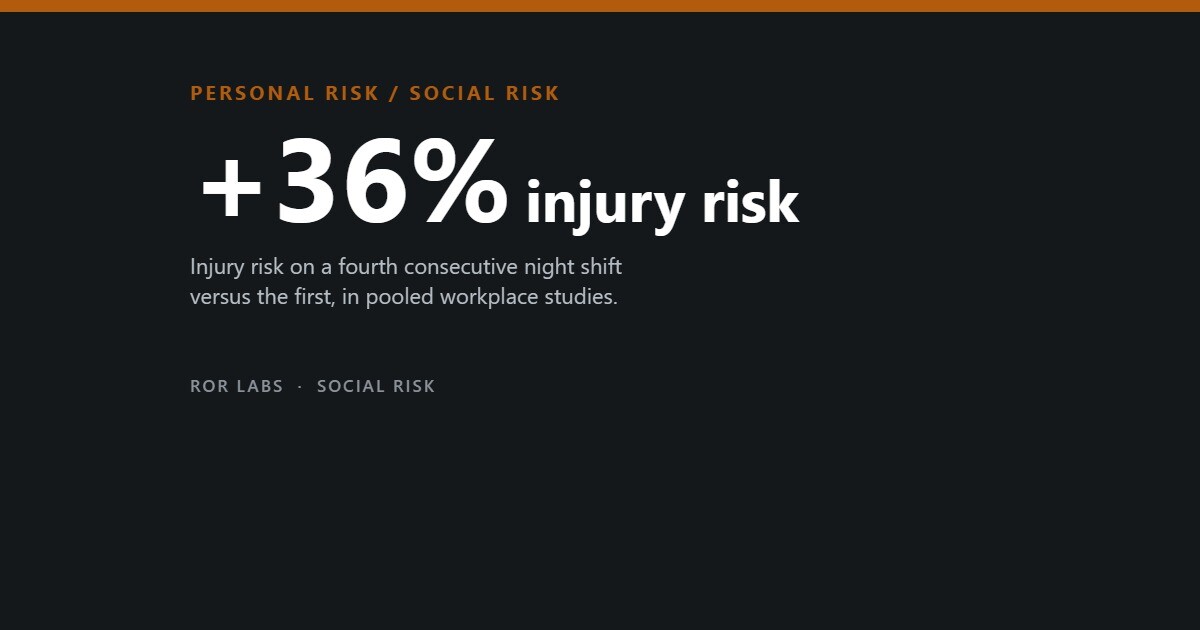
- Workplace injury risk rises across a run of nights, reaching about 36% higher on the fourth consecutive night shift than on the first.
Hospitals, power stations, warehouses, police forces and care homes do not close at night, so somebody has to be awake. The human body is built the other way. A master clock in the brain, set mainly by light, tells it to sleep in the dark and to digest, repair and secrete hormones on a daily schedule. Working through the night asks the body to do things at the wrong time, and sleeping in daylight is rarely as deep or as long.
That mismatch has been blamed for almost everything, from breast cancer to heart attacks, diabetes and car crashes on the drive home. Some of those links are well supported, some are mixed, and some have faded as better studies arrived. A widely quoted 2018 meta-analysis on night work and cancer in women was later retracted.
This article sets out what the main studies found for cancer, heart disease, diabetes and injuries, why night work is unusually hard to study, and what the evidence says about schedule design, rest breaks, naps and light. The numbers are averages across large groups of workers, not predictions for any one person.
Who works at night
Night work is common but not the norm. The US Bureau of Labor Statistics reported in September 2026 that 15% of workers usually worked a schedule other than daytime in 2024–2025, including 5% on evenings and 3% on nights. The rest of that 15% worked rotating, split or irregular shifts, many of which include nights.
“Night shift” means different things in different studies. It may be permanent nights, a rotation of days, evenings and nights, or as few as three nights a month, the definition used in the American Nurses’ Health Studies. That variety is one reason results disagree. A nurse doing a few nights a month and a factory worker on permanent nights are both night workers in the data, but their body clocks are living very different lives.
The cancer label
In 2007 the International Agency for Research on Cancer, part of the World Health Organization, classified shift work involving circadian disruption as probably carcinogenic to humans, Group 2A. A new working group reviewed the evidence in June 2019 and kept night shift work in Group 2A; the full assessment was published as IARC Monograph 124 in 2020.
The label is easy to misread. It rested on sufficient evidence of cancer in experimental animals exposed to disrupted light-dark cycles and strong mechanistic evidence, but only limited evidence in humans. IARC classes describe how confident the agency is that something can cause cancer, not how large the risk is. Red meat sits in the same group. Group 2A tells you the question is serious, not that night workers face a known extra risk.
Breast cancer and the cohort problem
Breast cancer is the most studied outcome, and the evidence splits by study design. A 2013 meta-analysis by Sharea Ijaz and colleagues found a 9% higher risk per five years of night work in case-control studies, which ask women with and without cancer to recall their working lives. In prospective cohort studies, which record work before anyone is diagnosed, the figure was 1.01, essentially no difference.
Night work and breast cancer: it depends on the design
Relative risk of breast cancer in night workers compared with day workers. 1.00 means no difference.
| Study | Design | Exposure | Relative risk |
|---|---|---|---|
| Ijaz 2013, meta-analysis | Case-control studies | Per 5 years of nights | 1.09 |
| Ijaz 2013, meta-analysis | Cohort studies | Per 5 years of nights | 1.01 |
| Travis 2016, 10 prospective studies | Cohort | Any night work | 0.99 |
| Travis 2016, 10 prospective studies | Cohort | 20 years or more | 1.01 |
| Jones 2019, Generations Study, 102,869 women | Cohort | Nights in last 10 years | 1.00 |
| Esposito 2025, health-care workers | Mixed | Ever worked nights | 1.05 |
Sources: Ijaz S et al., Scand J Work Environ Health (2013); Travis RC et al., J Natl Cancer Inst (2016) and authors’ response, doi:10.1093/jnci/djx008; Jones ME et al., Br J Cancer (2019), doi:10.1038/s41416-019-0485-7; Esposito G et al., Occup Med (2025), doi:10.1093/occmed/kqaf040.
The largest prospective analysis, by Ruth Travis and colleagues at Oxford in 2016, combined three UK cohorts with seven others, including the two Nurses’ Health Studies. The combined relative risk was 0.99 for any night work and 1.01 for 20 or more years of it. The Generations Study of 102,869 British women, published in 2019, found a hazard ratio of exactly 1.00. Recall bias in case-control studies is a plausible explanation for the gap.
The question is not closed. A 2025 meta-analysis of health-care workers by Giovanna Esposito and colleagues found no significant link for ever working nights, but a 25% higher risk after 20 or more years. That result was fragile: it lost significance when single studies were removed and moved close to no effect after correcting for publication bias. If there is a breast cancer risk, the better studies suggest it is small and limited to very long exposure.
Heart disease and stroke
The cardiovascular evidence is more consistent. A 2012 meta-analysis in the BMJ by Manav Vyas and colleagues pooled 34 studies of more than two million people. Shift work was linked to a 23% higher risk of heart attack and a 5% higher risk of ischaemic stroke. For coronary events in general the increase was 24%, and in the subgroup of studies of night work specifically it was 41%.
Shift work and the heart
Pooled relative risk in shift or night workers compared with day workers.
Sources: Vyas MV et al., BMJ 345:e4800 (2012); Torquati L et al., Scand J Work Environ Health (2018); Xi J et al., Front Public Health (2025), doi:10.3389/fpubh.2025.1668848; Su F et al., Sleep Med (2021), doi:10.1016/j.sleep.2021.08.017. Bar lengths show the excess above 1.00.
Later reviews found similar sizes and a dose-response pattern. Luciana Torquati and colleagues reported in 2018 that cardiovascular risk rose by 7.1% for every five years of shift work after the first five. A 2025 analysis of 23 cohort studies by Jiayu Xi and colleagues put the overall increase in cardiovascular events at 13%, and 7% for each additional five years. A rising risk with longer exposure is one of the signs epidemiologists look for when judging cause.
The Nurses’ Health Studies, which followed 189,158 American women for up to 24 years, add a hopeful detail. In the older cohort, women with fewer than five years of rotating nights had no clear extra risk of coronary heart disease, while those with ten years or more had an 18% higher risk. In the analysis by Céline Vetter and colleagues, the excess risk faded in the years after women stopped night work.
Years of nights and heart disease in nurses
Hazard ratio for coronary heart disease by years of rotating night shifts, Nurses’ Health Study, compared with never.
Source: Vetter C et al., JAMA (2016), as reported in Strohmaier S et al., Curr Diab Rep (2018), doi:10.1007/s11892-018-1102-5. The younger cohort, NHS2, found a hazard ratio of 1.15 for 10 years or more.
Type 2 diabetes
Disrupted sleep and meals eaten at the wrong body-clock time are the suspected route to diabetes, which makes a link plausible. The population studies agree in direction but not in size. A 2015 meta-analysis by Yong Gan and colleagues pooled 12 studies with 226,652 participants and found 9% higher odds of diabetes in shift workers. A 2020 review of 21 studies put the increase at 10%.
A 2024 meta-analysis limited to cohort studies of night work, by Fei Xie and colleagues, found a larger figure: 30% higher incidence across ten cohorts. The association was clear in women but not statistically significant in men, the reverse of what Gan’s review had suggested. A letter responding to Gan pointed out that the larger effect in men came mainly from small studies, which tend to report bigger effects.
Some of the extra diabetes risk may run through weight. Night workers often eat at irregular times, sleep less and have fewer chances to exercise, and studies adjust for body weight in different ways. If night work causes weight gain, which then raises diabetes risk, adjusting for weight can hide part of the real effect. If heavier people are more likely to take night jobs, failing to adjust exaggerates it. Either way the honest summary is a modest, fairly consistent excess.
Shift work and type 2 diabetes
Pooled risk in shift or night workers compared with day workers, by review.
Sources: Xie F et al., BMC Endocr Disord (2024), doi:10.1186/s12902-024-01808-w; Gao Y et al., Chronobiol Int (2020), doi:10.1080/07420528.2019.1683570; Gan Y et al., Occup Environ Med 72(1):72–78 (2015). Bar lengths show the excess above 1.00.
Injuries and mistakes
The most immediate risk of night work is not a disease but a mistake. Simon Folkard and David Lombardi built a “Risk Index” from studies of real workplace injuries and incidents. In their original analysis, risk was about 30% higher on night shifts than morning shifts. It climbed across a run of nights: 6% higher on the second night than the first, 17% on the third and 36% on the fourth. Twelve-hour shifts carried 27% more risk than eight-hour ones.
Injury risk climbs across a run of nights
Relative risk of a workplace injury or incident, from pooled workplace studies.
Sources: Folkard S and Lombardi DA’s original Risk Index, as summarised in Fischer D et al., Chronobiol Int (2017), doi:10.1080/07420528.2017.1367305, which also reports the rest-break estimate (relative risk 0.35, two studies).
An update by Dorothee Fischer and colleagues in 2017, using 29 studies, broadly confirmed the pattern. The night-shift excess was 33%, though the confidence interval crossed no effect until the most extreme studies were set aside, when it became 35%. The jump on a fourth consecutive night remained significant at 36%, and shifts longer than 12 hours carried 34% more risk. Rest breaks cut the risk sharply in the two studies that measured them.
Why the numbers are hard
Night workers are not a random slice of the population. On average they differ from day workers in income, education, smoking, diet and the kinds of jobs they do, and studies vary in how well they adjust for these. The Working Time Society’s 2019 consensus statements noted that earlier reviews could not rule out inadequate control of confounding, selection bias and misclassification caused by very crude measures of night work.
Selection cuts the other way too. People who cope badly with nights tend to leave night work, and those who stay may be unusually robust, a version of what epidemiologists call the healthy worker effect. That would make night work look safer than it is. Death rates show the difficulty: a 2021 meta-analysis of 16 cohorts by Fuxiang Su and colleagues found no significant rise in death from any cause, while a Swedish twin study found 15% higher mortality after more than five years of nights.
What schedules can change
If night work cannot be avoided, how it is arranged matters. A 2010 review by Mikael Sallinen and Göran Kecklund found that night shifts, early starts and quick returns between shifts were linked to short sleep and sleepiness across all types of rota. The few controlled studies suggested that switching from slowly backward-rotating shifts to rapidly forward-rotating ones, moving from mornings to evenings to nights, was better for alertness.
Evidence for individual remedies is weaker than their popularity suggests. A 2025 review of systematic reviews by Rhiannon Hawkes and colleagues found 28 reviews of measures such as light therapy, napping and exercise, and rated 23 of them critically low in quality. The higher-quality reviews found the evidence inconclusive. In one small randomised trial on a North Sea oil rig, melatonin added 15 to 20 minutes of sleep a day.
What the evidence says about fixes
Schedule design and personal measures for night workers, by strength of evidence.
Fewer consecutive nights: injury risk rises to +36% by the fourth
Shifts of 12 hours or less: longer shifts +34%
Regular rest breaks of 30 minutes or more
Forward rotation: mornings, then evenings, then nights
Light therapy and planned naps: high-quality reviews inconclusive
Melatonin: 15–20 minutes more sleep in one small trial
23 of 28 reviews of personal measures were rated critically low quality
Sources: Fischer D et al., Chronobiol Int (2017); Sallinen M, Kecklund G, Scand J Work Environ Health (2010); Hawkes RE et al., Sleep Med Rev (2025), doi:10.1016/j.smrv.2025.102110; Bjorvatn B et al., Scand J Work Environ Health (2007).
Much of what helps is in the employer’s hands rather than the worker’s: how many nights in a row, how long each shift is, how often breaks are allowed, and how much rest falls between the last night and the next day shift. Those are also the factors with the most direct evidence, because they link to injuries that can be counted within weeks rather than diseases that take decades.
What the evidence suggests
Night work carries real, measurable risks, but they are not the ones the headlines usually lead with. The cancer classification reflects animal and mechanistic evidence more than human data, and the best prospective studies of breast cancer find little or no excess. Heart disease and diabetes show modest, fairly consistent increases that grow with years of exposure, with some signs of reversal after stopping. The clearest and most fixable harm is fatigue: injuries rise across a run of nights and long shifts, and schedule design can reduce them.
Questions people ask
Does night shift work cause cancer?
It is classed as probably carcinogenic, mainly on animal and mechanistic evidence. Large prospective studies of breast cancer in women have mostly found little or no extra risk.
Is permanent nights better than rotating shifts?
The evidence does not settle it. Studies differ in definitions, and few compare the two directly with health outcomes.
How many nights in a row is too many?
There is no fixed limit, but pooled workplace data show injury risk rising each night, to about 36% higher on the fourth night than the first.
Does the risk go away if I stop?
For heart disease, the Nurses’ Health Studies found the excess risk faded in the years after women stopped night work. For other outcomes the data are thinner.
Do naps or bright light help?
Possibly, but high-quality reviews have found the evidence inconclusive so far, partly because most studies are small and short.
The short version
- The World Health Organization’s cancer agency classes night shift work as probably carcinogenic, but its evidence in humans was rated only limited.
- Large prospective studies of breast cancer mostly find little or no extra risk; the clearest positive results come from case-control studies.
- The heart evidence is more consistent: a meta-analysis of 34 studies linked shift work with a 23% higher risk of heart attack.
- Workplace injury risk rises across a run of nights, reaching about 36% higher on the fourth consecutive night shift than on the first.
- Shorter runs of nights, shifts of 12 hours or less and proper breaks have better support than most personal remedies.
This article summarises published research for general information. It is not medical advice and is not a screening tool. If you work nights and are worried about your sleep, heart health, blood sugar or other symptoms, talk to a doctor, and where your employer has one, an occupational health service. If you feel too sleepy to drive after a shift, do not drive.
Further reading: Vyas et al., BMJ 345:e4800 (2012), for the main meta-analysis of shift work and vascular events. Travis et al., Journal of the National Cancer Institute (2016), for the largest prospective analysis of breast cancer. Fischer et al., Chronobiology International (2017), for how schedules shape injury risk.
- Life Time, Russell Foster (2022). An Oxford circadian neuroscientist explains the body clock, light and shift work. Clear and authoritative; its practical advice is general rather than tailored to particular jobs.
- The Nocturnal Brain, Guy Leschziner (2019). A sleep neurologist tells the stories of patients with unusual sleep disorders. Vivid on how sleep goes wrong; shift work is a minor theme.
- Hello Sleep, Jade Wu (2023). A behavioural sleep specialist sets out cognitive and behavioural approaches to insomnia without medication. Practical; written mainly for people with regular daytime schedules.
Sources
US Bureau of Labor Statistics. Job Flexibilities and Work Schedules, 2024–2025 (24 September 2026). — IARC Monographs Volume 124: Night Shift Work (2020). — Erren TC et al. J Occup Med Toxicol (2019), doi:10.1186/s12995-019-0249-6. — Ijaz S et al. Night-shift work and breast cancer. Scand J Work Environ Health (2013). — Travis RC et al. J Natl Cancer Inst (2016); authors’ response (2017), doi:10.1093/jnci/djx008. — Jones ME et al. Br J Cancer (2019), doi:10.1038/s41416-019-0485-7. — Esposito G et al. Occup Med (2025), doi:10.1093/occmed/kqaf040. — Yuan X et al. Cancer Epidemiol Biomarkers Prev (2018), retracted (2019), doi:10.1158/1055-9965.epi-18-1085. — Vyas MV et al. BMJ 345:e4800 (2012). — Torquati L et al. Scand J Work Environ Health (2018). — Xi J et al. Front Public Health (2025), doi:10.3389/fpubh.2025.1668848. — Vetter C et al. JAMA (2016). — Strohmaier S et al. Curr Diab Rep (2018), doi:10.1007/s11892-018-1102-5. — Gan Y et al. Occup Environ Med 72(1):72–78 (2015). — Gao Y et al. Chronobiol Int (2020), doi:10.1080/07420528.2019.1683570. — Xie F et al. BMC Endocr Disord (2024), doi:10.1186/s12902-024-01808-w. — Fischer D et al. Chronobiol Int (2017), doi:10.1080/07420528.2017.1367305. — Moreno CRC et al. Working Time Society consensus statements. Ind Health 57(2) (2019). — Su F et al. Sleep Med (2021), doi:10.1016/j.sleep.2021.08.017. — Åkerstedt T, Narusyte J, Svedberg P. Scand J Work Environ Health (2020). — Sallinen M, Kecklund G. Scand J Work Environ Health (2010). — Hawkes RE et al. Sleep Med Rev (2025), doi:10.1016/j.smrv.2025.102110. — Bjorvatn B et al. Scand J Work Environ Health (2007). — Vivarelli S et al. Front Endocrinol (2026), reported by News-Medical, 5 October 2026.