Payday Loans: What the Evidence Shows
Key takeaways · 11 min read
- About 12 million Americans used payday loans a year, averaging eight loans and $520 in interest.
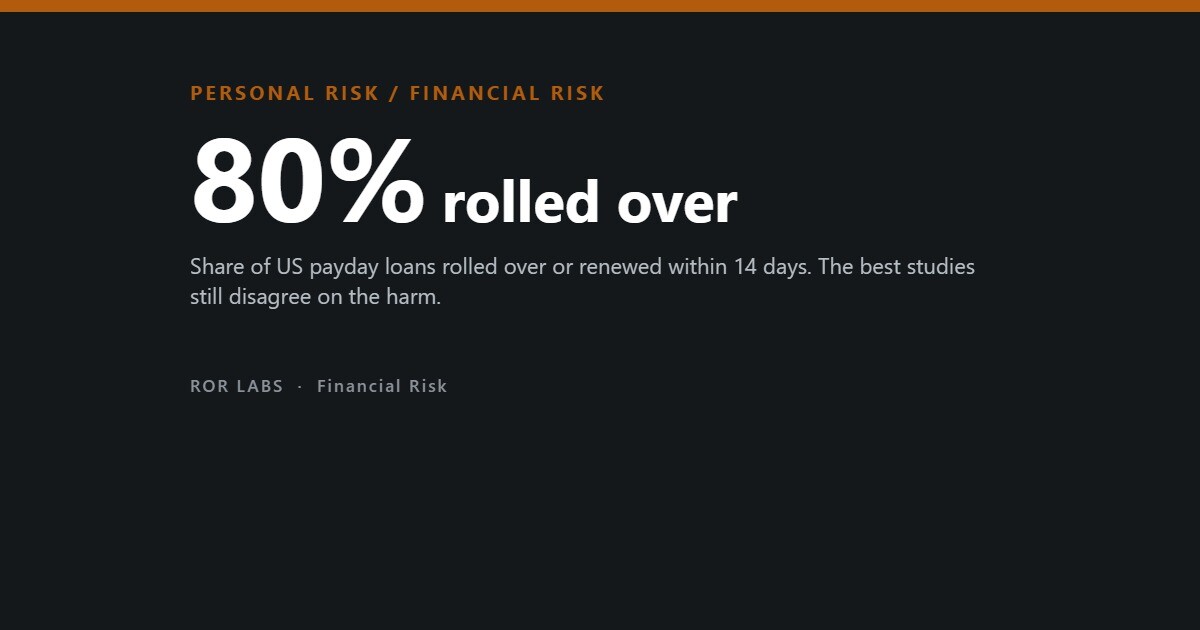
- More than 80% of payday loans are rolled over or renewed within 14 days.
- Rigorous studies disagree: one found bankruptcy doubled, another found almost no effect on credit scores.
- Restricting access pushed borrowers to overdrafts, late bills and pawnshops rather than removing the need.
A payday loan is simple to describe. You borrow a few hundred dollars until your next pay day, and repay it with a fee, typically $10 to $30 for every $100 borrowed. Over two weeks that sounds manageable. As an annual rate, it is several hundred percent.
Almost everyone who writes about payday loans condemns them, and several US states ban them. But the research on what they actually do to borrowers is more divided than that consensus suggests. Some careful studies find serious harm. Others, using similar methods, find almost none. Some find that taking them away makes people worse off.
This is what the evidence shows about payday lending, who uses it, what happens to them, and what happens when it is restricted. The number the regulators chose to lead with is 80%: the share of US payday loans rolled over or renewed within 14 days.
Who borrows, and for what
The largest descriptive study is the Pew Charitable Trusts survey of 2012. It estimated that 12 million Americans used payday loans each year, spending more than $7 billion. The average borrower took out eight loans of $375 over the year and paid $520 in interest, spending about five months of the year in debt.
The reason people gave for their first loan was not usually an emergency. 69% said they used it for recurring expenses such as utilities, rent, credit card bills or food. Only 16% said it was for something unexpected, such as a car repair or medical bill.
Pew also asked what borrowers would do if payday loans were not available. 81% said they would cut back on essentials such as food and clothing. Majorities said they would delay paying bills, borrow from family or friends, or sell possessions. Only 44% said they would take a loan from a bank or credit union, and 37% would use a credit card.
Neil Bhutta, Paige Marta Skiba and Jeremy Tobacman, matching payday applications to national credit files, found that people apply for payday loans when they have little access to mainstream credit, and that the weakness of their credit histories is severe and long-standing. By the time someone reaches a payday lender, most of the alternatives have already gone.
If payday loans were not available
What US payday borrowers said they would do.
Pew Charitable Trusts, 2012. Respondents could choose more than one option.
The average US payday borrower
Pew Charitable Trusts national survey, 2012.
Pew Charitable Trusts, Payday Lending in America: Who Borrows, Where They Borrow, and Why, July 2012.

The rollover pattern
The core concern about payday loans is not the first loan. It is the ones that follow. In 2014 the US Consumer Financial Protection Bureau analysed more than 12 million storefront payday loans made over a year.
More than 80% were rolled over or followed by another loan within 14 days. Roughly half of all loans were made to borrowers in sequences of ten or more loans in a row. One in five borrowers receiving monthly benefits, such as Social Security, stayed in debt for the entire year.
That pattern is consistent with earlier academic work. Skiba and Tobacman, studying a large payday and pawn lender, found that applicants who were approved for their first loan went on to apply for 8.8 more payday loans on average within the following 12 months, amounting to about $2,400 of payday debt and $350 in finance charges. The authors concluded that behaviour this frequent was unlikely to be driven only by one-off shocks.
The industry’s defenders argue that repeated borrowing is not necessarily a trap. Robert DeYoung, Ronald Mann, Donald Morgan and Michael Strain, in a 2015 review for the Federal Reserve Bank of New York, argued that many criticisms of payday lending did not hold up, and that the right question is whether borrowers who roll over are systematically over-optimistic about how quickly they will repay. On that point, they found the evidence limited and mixed.
How payday loans are actually used
Analysis of more than 12 million US storefront payday loans over 12 months.
Consumer Financial Protection Bureau, CFPB Data Point: Payday Lending, March 2014.
What happens to borrowers: the studies disagree
The strongest studies use a regression discontinuity design. Lenders approve applicants above a credit score threshold and reject those just below it. Applicants on either side are almost identical, so comparing what happens to them afterwards comes close to a randomised experiment.
Using this design with US data, Skiba and Tobacman found in a 2019 paper in the Journal of Law and Economics that payday loans roughly doubled personal bankruptcy rates, apparently by worsening households’ cash flow. Bhutta, Skiba and Tobacman, in a 2015 paper in the Journal of Money, Credit and Banking using a similar design and national credit files, found effects on credit scores and other measures of financial well-being that were close to zero.

The largest study comes from the United Kingdom. John Gathergood, Benedict Guttman-Kenney and Stefan Hunt, then at the Financial Conduct Authority, used data on almost all UK payday applications in 2012 and 2013, matched to credit files. Payday loans provided short-lived liquidity, and borrowers took on more credit in the following months. But over the next six to twelve months, the loans caused persistent increases in defaults and in the likelihood of exceeding bank overdraft limits.
Brian Melzer used a different approach, comparing households close to state borders where payday loans were or were not available nearby. In a 2011 paper in the Quarterly Journal of Economics, he found no evidence that access alleviated hardship. Instead, it was associated with greater difficulty paying mortgage, rent and utility bills.
Same question, different answers
Quasi-experimental studies of the effect of getting a payday loan.
| Study | Setting | Main finding |
|---|---|---|
| Skiba and Tobacman, 2019 | US, one large lender | Bankruptcy roughly doubled |
| Bhutta, Skiba and Tobacman, 2015 | US, national credit files | Effect on credit scores close to zero |
| Gathergood and colleagues, 2019 | UK, almost all loans | Short-lived help, then more defaults |
| Melzer, 2011 | US, border areas | More difficulty paying bills |
Journal of Law and Economics; Journal of Money, Credit and Banking; Review of Financial Studies; Quarterly Journal of Economics.
Why careful studies disagree
It is tempting to pick the study that fits one’s view. The more useful question is why good designs reach different answers.
Part of the answer is who they study. A regression discontinuity compares applicants just above and just below a lender’s cut-off, so it describes borrowers at that margin, not payday borrowers in general. Gathergood and colleagues noted that most UK applicants had credit scores well away from the threshold, and that the negative effects they found were smaller for applicants with better scores.
Part is what they measure. Bankruptcy, credit scores, missed bills and overdraft use are different outcomes, and a loan can plausibly help with one while hurting another. A borrower who avoids a bounced rent payment this month may default on a card six months later.
And part is the loan itself. Will Dobbie and Paige Marta Skiba found that a $50 larger payday loan reduced the probability of default by 17 to 33%, which suggests that the size and terms of the loan, not only its existence, shape the outcome. That is one reason regulators have focused on price and repayment terms rather than on bans alone.
What happens when payday loans are taken away
If payday loans were simply harmful, restricting them should help. Several studies suggest it is not that simple.
When Oregon capped payday loan terms in 2007, Jonathan Zinman compared borrowers there with those in neighbouring Washington. Borrowing fell in Oregon, but former payday borrowers shifted partly into bank overdrafts and paying bills late, and there was evidence that their overall financial condition got worse. His conclusion was that restricting access harmed rather than helped consumers on average.
Adair Morse, in the Journal of Financial Economics, used natural disasters in California as an unexpected shock. Foreclosures rose by 4.5 per 1,000 homes in the year after a disaster, but where payday lenders were present, 1.0 to 1.3 of those foreclosures were avoided. Payday lenders also appeared to reduce larcenies. The effect did not appear for disasters covered by home insurance.
Kabir Dasgupta and Brenden Mason studied four US states that banned payday lending more recently. Across the states, bankruptcies were largely unaffected. In survey data, former borrowers substituted towards paying credit card bills late and using pawnshops.
The picture that emerges is of a product that helps some borrowers through a real shock and harms others who borrow repeatedly, with bans shifting people into other expensive options rather than removing their need to borrow.
Payday lenders after a natural disaster
California, year after a disaster, per 1,000 homes.
Morse, Journal of Financial Economics, 2011. No such effect for disasters covered by home insurance.
A price cap, not a ban: the UK experiment
The United Kingdom took a different route. From 2 January 2015 the Financial Conduct Authority capped high-cost short-term credit: interest and fees at 0.8% per day of the amount borrowed, default fees at £15, and total cost at 100% of the loan, so no one could repay more than double what they borrowed.
The regulator expected some borrowers to lose access and estimated about 7%, around 70,000 people. The market shrank sharply: from roughly 10 million loans a year before 2013 to about 5.4 million by 2018. The FCA’s own review in 2017 estimated that about 760,000 borrowers were saving a combined £150 million a year, and debt charities reported fewer clients with payday-related problems. Wonga, the largest lender, collapsed in 2018 under compensation claims for unaffordable lending.
The cap also changed the product. Because the total cost can never exceed the amount borrowed, the long chains of rollovers that the CFPB documented in the United States became far less profitable, and lenders had a stronger reason to check whether a borrower could repay before lending at all.
That is a regulator reviewing its own policy, and it is not a randomised trial. But it is the largest natural experiment in capping payday loan prices, and it suggests that a price cap can reduce the harm without removing short-term credit altogether.
What the evidence does not show
It does not show that payday loans always harm borrowers. The best-designed studies disagree, and some find benefits after genuine shocks such as natural disasters.
It does not show that banning them helps on its own. Studies of state restrictions found borrowers moving to overdrafts, late payments and pawnshops, and no clear fall in bankruptcies.
It does not settle whether repeat borrowers understand what they are getting into. That question, which reviewers on both sides identify as central, has only limited and mixed evidence.
And much of the data is now old. The major US studies use loans from the 2000s and early 2010s, before online lending and newer products such as earned-wage access and buy now, pay later changed the market.
Questions people ask
How much does a payday loan cost?
Fees typically run $10 to $30 per $100 borrowed for about two weeks. In Pew’s survey, the average borrower took eight loans of $375 in a year and paid $520 in interest.
Do most people roll payday loans over?
Yes. The CFPB found more than 80% of payday loans were rolled over or followed by another loan within 14 days, and about half were in sequences of ten or more.
Do payday loans hurt your credit?
Studies disagree. One US study found effects on credit scores close to zero; a large UK study found more defaults and overdraft problems in the following year.
Are bans better than caps?
Studies of US bans found borrowers shifting to other costly options. The UK’s price cap shrank the market and, by the regulator’s estimate, saved borrowers about £150 million a year.
What do borrowers use them for?
Mostly recurring bills. In the Pew survey, 69% used their first loan for regular expenses and 16% for something unexpected.
The short version
- About 12 million Americans used payday loans a year, averaging eight loans and $520 in interest.
- More than 80% of payday loans are rolled over or renewed within 14 days.
- Rigorous studies disagree: one found bankruptcy doubled, another found almost no effect on credit scores.
- Restricting access pushed borrowers to overdrafts, late bills and pawnshops rather than removing the need.
- The UK’s 2015 price cap shrank the market and, by the regulator’s estimate, saved borrowers £150 million a year.
This article summarises published research on payday lending. It is not financial or legal advice, and it does not recommend any lender or credit product. If you are struggling with debt, a non-profit credit counselling service or a local debt advice charity can help you look at your options.
Further reading. Gathergood, Guttman-Kenney and Hunt, ‘How Do Payday Loans Affect Borrowers? Evidence from the U.K. Market’, Review of Financial Studies, 2019, is the largest causal study and is open access. DeYoung, Mann, Morgan and Strain, ‘Reframing the Debate about Payday Lending’, Federal Reserve Bank of New York, 2015, is the clearest statement of the other side.
- Poverty, by America, Matthew Desmond (2023). A sociologist on the costs of being poor in the United States, including high-cost credit and overdraft fees.
- Broke in America, Joanne Samuel Goldblum and Colleen Shaddox (2021). A survey of the basic needs that go unmet when money runs short, which is where payday borrowing starts.
- Invisible Child, Andrea Elliott (2021). A Pulitzer Prize-winning account of one family’s life in poverty in New York, and of how short-term decisions follow from long-term scarcity.
Sources
- Pew Charitable Trusts. Payday lending in America: who borrows, where they borrow, and why. July 2012.
- Consumer Financial Protection Bureau. CFPB Data Point: Payday Lending. March 2014.
- Skiba PM, Tobacman J. Do payday loans cause bankruptcy? Journal of Law and Economics, 2019;62(3):485–519. doi:10.1086/706201.
- Skiba PM, Tobacman J. Payday loans, uncertainty, and discounting: explaining patterns of borrowing, repayment, and default. Working paper, 2008.
- Bhutta N, Skiba PM, Tobacman J. Payday loan choices and consequences. Journal of Money, Credit and Banking, 2015;47(2–3):223–260. doi:10.1111/jmcb.12175.
- Gathergood J, Guttman-Kenney B, Hunt S. How do payday loans affect borrowers? Evidence from the U.K. market. Review of Financial Studies, 2019;32(2):496–523. doi:10.1093/rfs/hhy090.
- Dobbie W, Skiba PM. Information asymmetries in consumer credit markets: evidence from payday lending. American Economic Journal: Applied Economics, 2013;5(4):256–282. doi:10.1257/app.5.4.256.
- Melzer BT. The real costs of credit access: evidence from the payday lending market. Quarterly Journal of Economics, 2011;126(1):517–555. doi:10.1093/qje/qjq009.
- Zinman J. Restricting consumer credit access: household survey evidence on effects around the Oregon rate cap. Journal of Banking and Finance, 2010. Working paper version: Federal Reserve Bank of Philadelphia, 2008.
- Morse A. Payday lenders: heroes or villains? Journal of Financial Economics, 2011;102(1):28–44.
- Dasgupta K, Mason BJ. The effect of interest rate caps on bankruptcy: synthetic control evidence from recent payday lending bans. Working paper 2019-04, Auckland University of Technology.
- DeYoung R, Mann RJ, Morgan DP, Strain MR. Reframing the debate about payday lending. Federal Reserve Bank of New York, Liberty Street Economics, 2015.
- Financial Conduct Authority. FCA confirms price cap rules for payday lenders. Press release, November 2014.
- Financial Conduct Authority. High-cost credit review. 2017 (as summarised in Wikipedia, ‘Payday loans in the United Kingdom’).