Potassium food sources and the 99 mg you can buy
Key takeaways · 10 min read
- The adequate intake is 3,400 mg a day for men, 2,600 for women. It was 4,700 until 2019, and it was lowered because the committee set it at observed intake rather than at a requirement.
- There is no upper limit, and supplements stop at 99 mg — about 3% of a day. You cannot buy your way to this one.
- One tablespoon of cream of tartar is 2,475 mg. It is a baking acid, and in 2025 it caused a hyperkalaemic cardiac arrest.
- A banana is 422 mg. Dried apricots, lentils, squash and a baked potato all beat it per serving.
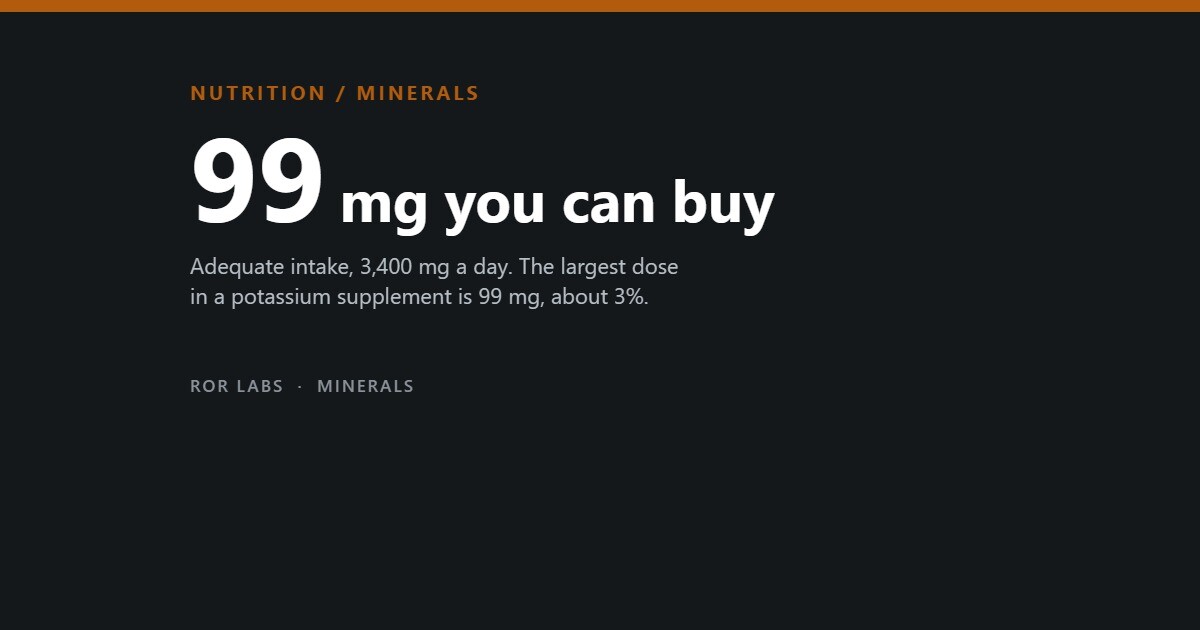
The adequate intake for potassium is 3,400 mg a day for an adult man. The largest dose you will find in a potassium supplement on a shop shelf is 99 mg — about three per cent of it.
That gap is not an oversight, and it is not because potassium is unimportant. It is the most interesting thing about this mineral: the one nutrient with a large randomised trial showing fewer strokes is also the one you cannot meaningfully buy in a pill.
This article covers what potassium does, which foods actually carry it, why the official number was lowered in 2019, what the salt-substitute trial found, and who should not go anywhere near any of it without a doctor.
The three numbers, and what the first one actually is
Potassium is the main positively charged ion inside cells, and the body uses the gradient across the cell membrane for nerve conduction, muscle contraction and fluid balance. Low intake is associated with higher blood pressure and with stroke. None of that is in dispute.
The three numbers for potassium
US dietary reference intakes for adults, in milligrams per day, alongside the practical limit on what a supplement contains.
Source: NIH Office of Dietary Supplements, potassium fact sheet, from the 2019 Institute of Medicine review.
The first number deserves a second look, because it is not what most people assume. In 2019 the committee found the data insufficient to derive an estimated average requirement — the figure that would say how much a body actually needs. So it set an adequate intake instead, and it set it at the highest median intake observed in healthy people.
That is a description of what people eat, not a target derived from health outcomes. And it went down: the 2005 figure was 4,700 mg. Nothing about potassium changed between those two dates. The method for picking the number did.
There is no tolerable upper limit either. The committee noted that very large doses of potassium supplements have caused heart abnormalities and death, but judged the case reports insufficient to set a limit, and found no evidence that high intakes cause hyperkalaemia in adults with normal kidney function. Hold on to that last clause. The whole second half of this article is about the people it excludes.
Three foods by the spoonful
The series convention is to rank foods by what one level 15-gram tablespoon delivers, using USDA per-100-gram values. Potassium produces the most extreme result the series has seen, and the winner is not a food in any ordinary sense.
Potassium in one level tablespoon (15 g)
USDA FoodData Central, SR Legacy. Per-100-gram values converted arithmetically; FDC identifiers given so the figures can be checked.
Source: USDA FoodData Central. Cream of tartar is potassium bitartrate — a baking acid, not a food in the usual sense.
One tablespoon of cream of tartar carries 2,475 mg of potassium: 73 per cent of a man’s adequate intake and 95 per cent of a woman’s, in a single spoon of white powder sold in the baking aisle. Nobody uses a tablespoon of it — a recipe calls for a teaspoon, about 3 g, which is still 495 mg, more than a banana.
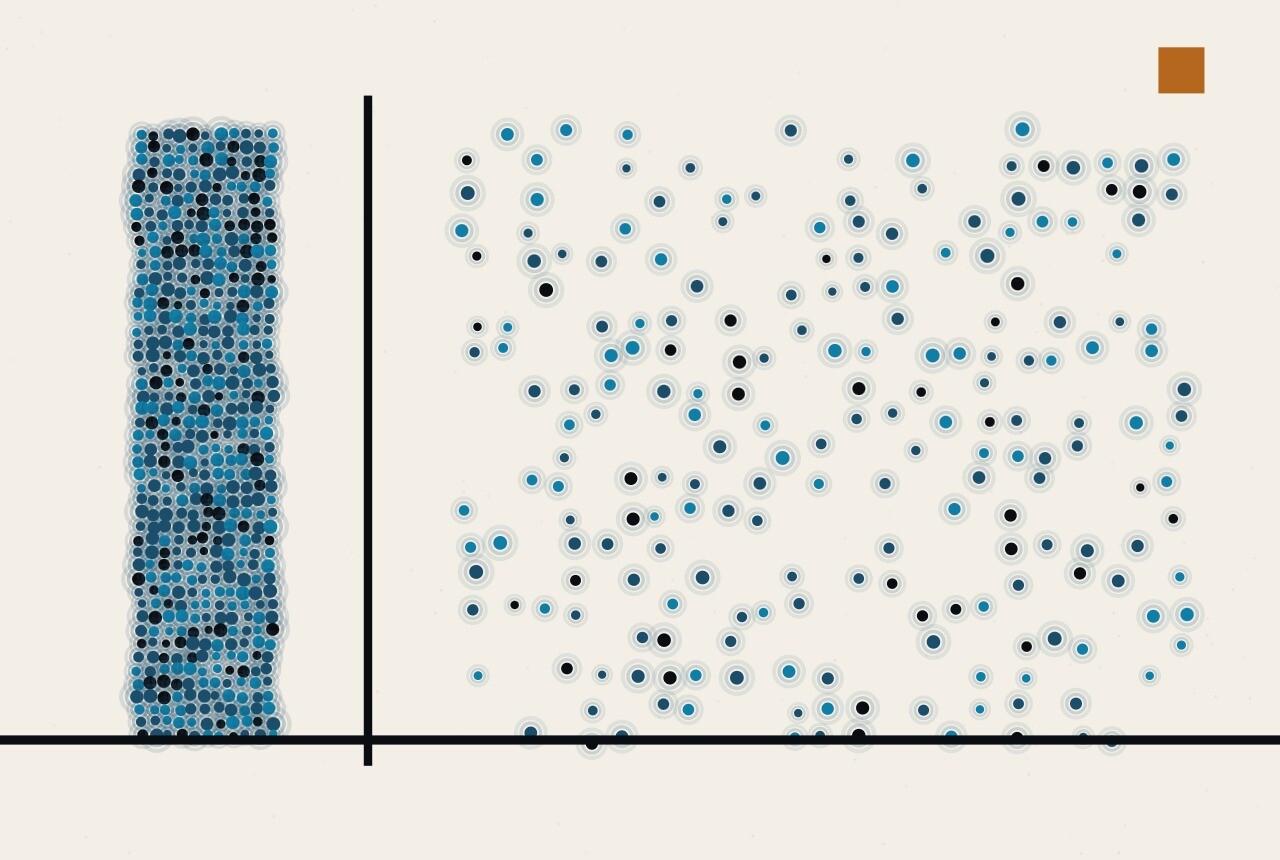
That is not a curiosity. In May 2025 the Medical Journal of Australia published a case of hyperkalaemic cardiac arrest caused by swallowing cream of tartar. The most potassium-dense thing in the food database is a substance people take by the spoonful as a folk remedy, and it has put someone into cardiac arrest.
Ranked by an actual serving rather than a spoon, the table becomes ordinary again — and that is the real lesson.
Potassium per standard serving
Milligrams per serving as listed by the NIH Office of Dietary Supplements.
Source: NIH Office of Dietary Supplements, potassium fact sheet.
The banana is the emblem of dietary potassium and it is a middling source: 422 mg, about an eighth of a man’s day. Dried apricots, lentils and a plain baked potato all beat it. Potassium is not concentrated in one hero food — it is spread thinly across unprocessed plants, which is why the total tracks how much of your diet is made of them.
What the intakes actually are
American men average 3,016 mg a day from food and women 2,320. Both are below their own adequate intakes, and both are far below the 4,700 mg figure that was in force until 2019 — which almost nobody ever reached. That is precisely why the number was changed.
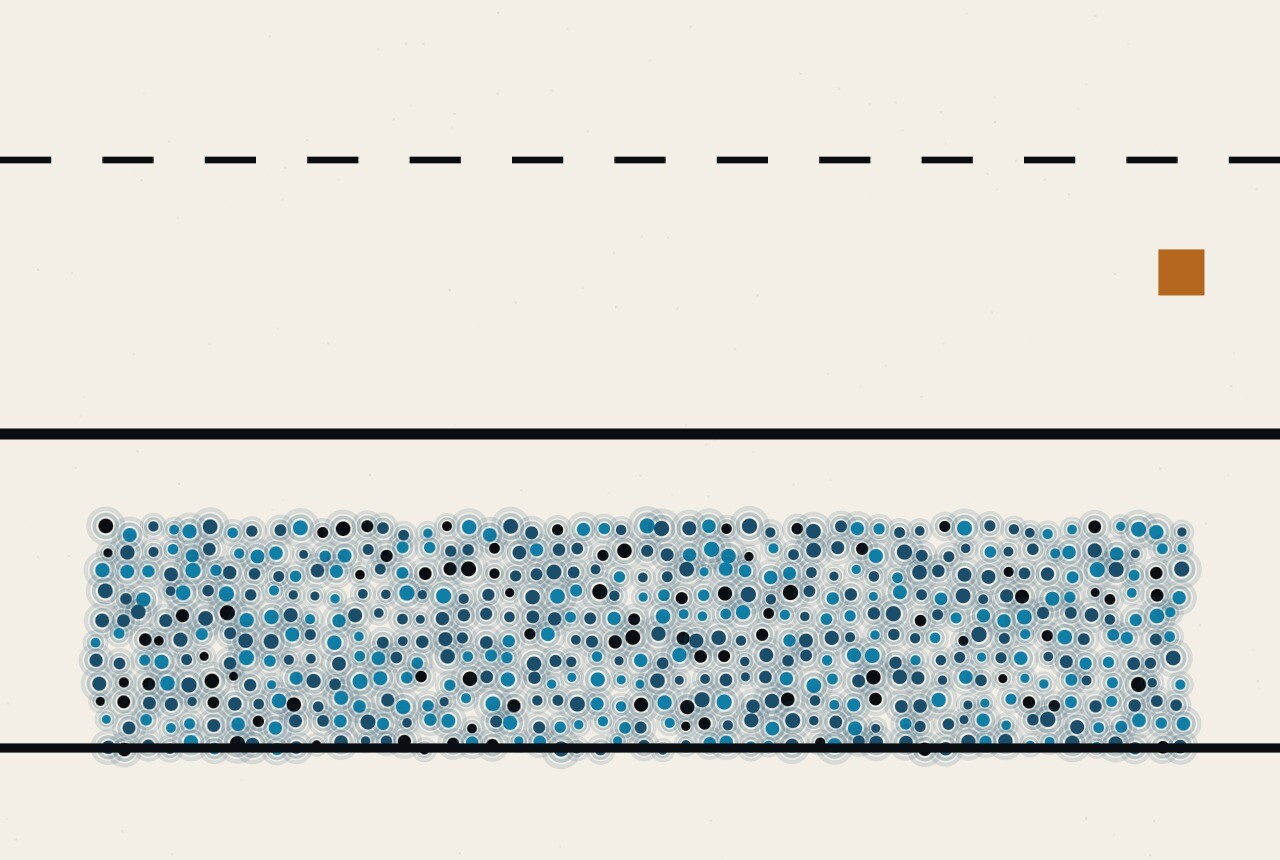
Supplements do not close the gap and are not designed to. Twelve per cent of Americans take something containing potassium, and among those who do it adds a mean of 87 mg a day. Manufacturers hold the dose at 99 mg because the US Food and Drug Administration requires certain potassium salts above that amount to carry a warning about small-bowel lesions.
Frank potassium deficiency from diet alone is uncommon in people who eat normally. Low blood potassium usually comes from losing it — vomiting, diarrhoea, or diuretics — rather than from not eating enough. The dietary question is not about deficiency disease. It is about blood pressure.
The one large trial is about salt, not supplements
The Salt Substitute and Stroke Study randomised 600 villages in rural China. The 20,995 participants had all either had a stroke or were over 60 with poorly controlled blood pressure. Intervention villages received a substitute that was 75 per cent sodium chloride and 25 per cent potassium chloride; control villages carried on with ordinary salt. Mean follow-up was 4.74 years.
What replacing the salt did
Rate ratios against regular salt, 20,995 adults in 600 Chinese villages, mean follow-up 4.74 years. Below 1.00 favours the substitute.
Source: Neal et al., New England Journal of Medicine 385(12):1067–1077 (2021). Stroke 0.86 (0.77–0.96); events 0.87 (0.80–0.94); death 0.88 (0.82–0.95); hyperkalaemia 1.04 (0.80–1.37).
Those are real reductions in hard outcomes from changing one ingredient in a kitchen, and the safety signal was flat. It is the strongest result in this series so far. Three things should be said about it before anyone reaches for the salt substitute.
The first is that nobody can say how much of it was the potassium. Two things changed together: 24-hour urinary sodium fell by 15.2 mmol and potassium rose by 20.6 mmol, and systolic blood pressure fell by 3.34 mmHg. A 2024 modelling paper tried to apportion that between the two and produced estimates ranging from −1.67 to −5.33 mmHg. This trial is evidence for the substitution, not for potassium on its own.
The second is the population. These were older Chinese villagers with high blood pressure, most with a previous stroke, eating a very high-salt diet and cooking at home. A 2022 meta-analysis of 21 trials and 31,949 participants found a consistent blood-pressure effect of −4.61 mmHg, and a 2026 network meta-analysis of 34 trials across 15 countries supports the direction. But the hard-outcome evidence still rests largely on one place.
The third is that the guidelines have not settled. A 2024 review searched 32 hypertension guidelines and 14 kidney guidelines and found the advice on potassium-enriched salt substitutes incomplete and inconsistent. The World Health Organization did issue a guideline in 2025 recommending replacing regular salt with a potassium-containing substitute. Most national bodies have not followed.
Who this is dangerous for
Here is the part the salt-substitute coverage tends to bury. The trial that produced the reassuring hyperkalaemia figure excluded the people most likely to be harmed: anyone using a potassium-sparing diuretic, anyone taking a potassium supplement, and anyone with known serious kidney disease. No routine blood test of kidney function was done. Participants were filtered by question, not by measurement.
The list of people at risk is long and ordinary. Chronic kidney disease. ACE inhibitors and angiotensin receptor blockers, which are among the most prescribed drugs in the world. Potassium-sparing diuretics such as spironolactone and amiloride. Type 1 diabetes, heart failure, adrenal insufficiency, liver disease. In these people, the fact sheet is explicit: even dietary potassium intakes below the adequate intake can cause hyperkalaemia.
Hyperkalaemia from what people ate or drank
Review of published case reports of hyperkalaemia caused by oral intake.
44 incidents of oral-intake hyperkalaemia
17 patients had no kidney dysfunction
Mean serum potassium 8.2 mEq/L
Fruit and vegetables: 17
Salt substitutes: 12
In people with normal kidneys, substitutes and supplements were the main cause
Source: Te Dorsthorst et al., European Journal of Clinical Nutrition 73(1):38–45 (2019).
Salt substitutes are not standardised. The potassium in them ranges from about 440 mg to 2,800 mg per teaspoon — a more than sixfold difference between products sitting on the same shelf, with no way to tell from the front of the packet. If you are going to use one, the number on the back is the number that matters.
None of this makes the SSaSS result wrong. It makes it conditional. The finding is that in people whose kidneys handle potassium normally, swapping a quarter of the salt for potassium chloride lowered stroke risk. For anyone on the list above, the same swap is the mechanism by which people end up in an emergency department.
Questions people ask
Should I switch to a potassium salt substitute?
If your kidneys are healthy and you take none of the drugs listed above, the randomised evidence is better than for almost anything else in this series. If you have kidney disease, or take an ACE inhibitor, an ARB or a potassium-sparing diuretic, ask a doctor first — those were the people the trial excluded.
Why can I only buy 99 mg tablets?
Because the FDA requires certain potassium salts above 99 mg per tablet to carry a warning about small-bowel lesions, and manufacturers stay under the line. It means a supplement adds about 3 per cent of a day’s intake. Food is not the convenient option here; it is the only one.
Is a banana enough?
One medium banana is 422 mg, roughly an eighth of a man’s adequate intake. Dried apricots, lentils, squash and a plain baked potato all carry more per serving. There is no single food that solves potassium.
Should I get my potassium tested?
Serum potassium is a real clinical test, not a wellness metric, and it is ordered when there is a reason — kidney disease, certain drugs, symptoms. It does not tell you much about your diet. Do not order it to optimise anything.
Did the recommendation really go down?
Yes. The adequate intake fell from 4,700 mg to 3,400 for men and 2,600 for women in 2019, because the committee could not derive a requirement from the evidence and instead set the figure at the highest median intake observed in healthy people.
The short version
- The adequate intake is 3,400 mg a day for men, 2,600 for women. It was 4,700 until 2019, and it was lowered because the committee set it at observed intake rather than at a requirement.
- There is no upper limit, and supplements stop at 99 mg — about 3% of a day. You cannot buy your way to this one.
- One tablespoon of cream of tartar is 2,475 mg. It is a baking acid, and in 2025 it caused a hyperkalaemic cardiac arrest.
- A banana is 422 mg. Dried apricots, lentils, squash and a baked potato all beat it per serving.
- Replacing a quarter of the salt with potassium chloride cut stroke by 14% in 20,995 Chinese villagers — with no excess hyperkalaemia.
- But that trial excluded people on potassium-sparing diuretics or with known kidney disease, and did no blood screening. For them the same swap is a hazard.
- Salt substitutes range from about 440 to 2,800 mg of potassium per teaspoon. Read the back of the packet.
This is a summary of published research, not medical advice. Potassium is one of the few nutrients where getting it wrong can be immediately dangerous: if you have chronic kidney disease, heart failure, type 1 diabetes, adrenal insufficiency or liver disease, or you take an ACE inhibitor, an angiotensin receptor blocker, or a potassium-sparing diuretic such as spironolactone or amiloride, do not start a potassium supplement or a potassium salt substitute without asking your doctor or a registered dietitian first.
Further reading: Neal et al., New England Journal of Medicine 385(12):1067–1077 (2021), for the trial itself, including the exclusion criteria that define who it does not apply to. Huang et al., Journal of Human Hypertension 38(4):298–306 (2024), for the attempt to separate the sodium effect from the potassium effect. Te Dorsthorst et al., European Journal of Clinical Nutrition 73(1):38–45 (2019), for what oral potassium has actually done to people.
- Hooked, Michael Moss (2021). On how the food industry engineers what people reach for, which is the background to why sodium is everywhere and potassium is not. Reported, and hostile to its subject.
- The Age of Diagnosis, Suzanne O’Sullivan (2025). On what happens when a threshold is drawn and people fall either side of it — the problem this article opens with. A clinician’s argument, and a contested one.
- Noise, Daniel Kahneman, Olivier Sibony and Cass Sunstein (2021). Useful here for the 46 guidelines that read the same evidence and gave different advice.
Sources
NIH Office of Dietary Supplements, potassium fact sheet for health professionals: the 2019 adequate intakes of 3,400 mg for men and 2,600 mg for women, the earlier 2005 figure of 4,700 mg, the committee’s finding that the data were insufficient to derive an estimated average requirement, the absence of a tolerable upper intake level, the serving-size table, US average intakes of 3,016 and 2,320 mg, the 12% supplement-use figure and the mean 87 mg it adds, the 99 mg practical limit and the FDA small-bowel-lesion warning, the medication interactions, the list of people at risk of hyperkalaemia, and the 440–2,800 mg per teaspoon range for salt substitutes. — USDA FoodData Central, SR Legacy, nutrient 306 (potassium), for the per-100-gram values behind the tablespoon table; FDC identifiers are printed in the figure. — Neal B, Wu Y, Feng X, et al. Effect of salt substitution on cardiovascular events and death. New England Journal of Medicine 385(12):1067–1077 (2021). — Huang L, Li Q, Wu J, et al. Journal of Human Hypertension 38(4):298–306 (2024). — Yin X, Rodgers A, Perkovic A, et al. Effects of salt substitutes on clinical outcomes. Heart 108(20):1608–1615 (2022). — Lai H, Nesrallah G, Guyatt GH, et al. BMC Medicine 24(1) (2026). — Xu X, Zeng L, Jha V, et al. Potassium-enriched salt substitutes: a review of recommendations in clinical management guidelines. Hypertension 81(3):400–414 (2024). — Te Dorsthorst RPM, Hendrikse J, Vervoorn MT, et al. European Journal of Clinical Nutrition 73(1):38–45 (2019). — Ng D, Govindasamy L, Hughes A, Lee HM. Hyperkalaemic cardiac arrest due to cream of tartar ingestion. Medical Journal of Australia 222(11):542–544 (2025).