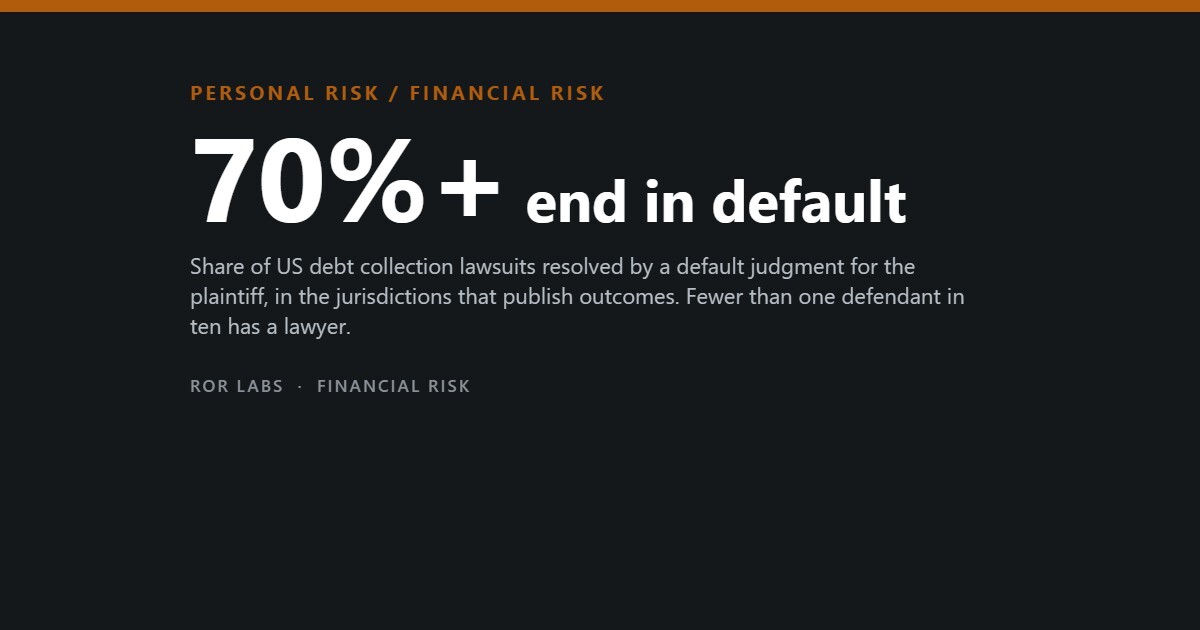
Courts Resolve More Than Seventy Per Cent of Debt Suits Without a Defence. Fewer Than One Defendant in Ten Has a Lawyer.
In This Series: Personal Finance & Investing
- Why Most Stock Investors Lose Money: What the Evidence Actually Shows
- Options and Futures: Where Retail Money Actually Goes
- Two Retirees, the Same Returns, Only One Runs Out. The Difference Is the Order.
- Deposit Insurance Stops at $250,000. Since 2008, Uninsured Depositors Have Actually Lost Money in Six Per Cent of Failures.
- Your Home Insurance Almost Certainly Does Not Cover Flooding
- The Median Forfeiture Is $1,678. A Lawyer to Contest It Costs About Twice That.
Key takeaways · 10 min read
- Debt claims went from about one in nine state civil cases in 1993 to about one in four in 2013, and filings roughly doubled to around 4 million.
- In the jurisdictions that publish outcomes, more than 70 per cent of debt suits end in a default judgment for the plaintiff. New York City 80 per cent, Washington over 80, Colorado 71.
- Fewer than one in ten defendants has a lawyer; nearly every plaintiff does. In 4,400 Maryland cases, 98 per cent of defendants had none.
- In many court systems, ten private filers account for one fifth to one third of all civil litigation.
In the jurisdictions that publish enough data to check, courts have resolved more than seventy per cent of debt collection lawsuits with a default judgment for the plaintiff. A default judgment is what happens when the defendant does not respond. The plaintiff wins because nobody argued.
That is not a description of a rare procedural mishap. It is the ordinary outcome of the single largest category of civil case in the United States. Debt claims went from about one in nine civil cases to about one in four in twenty years, and the number of suits filed roughly doubled while the courts they were filed in did not change at all.
This article is about what the published court data show, which is a great deal about volume and very little about people. The most important number in the subject — how many defendants had a real defence and lost it by not answering — has never been measured anywhere.
How a quarter of the civil docket became debt
The Pew Charitable Trusts assembled what state court systems publish and found the shape of the change. In 1993, debt claims were roughly one in nine of 14.6 million civil cases. By 2013 they were about one in four of 16.9 million. The total civil caseload grew by 16 per cent; the debt share more than doubled. In raw filings, debt suits went from fewer than 1.7 million to around 4 million. By 2018, debt claims were 30 per cent of the entire civil caseload in Texas.
Debt claims as a share of state civil caseloads
Pew Charitable Trusts, How Debt Collectors Are Transforming the Business of State Courts, 2020.
The institutions absorbing that volume were built for something else. A civil court is designed around two represented parties who each file papers and argue. What arrived instead was one repeat institutional plaintiff, filing in bulk, against an individual who mostly does not appear.
The default rate
Pew’s central finding is a single sentence: “Over the past decade in the jurisdictions for which data are available, courts have resolved more than 70 percent of debt collection lawsuits with default judgments for the plaintiff.” The individual jurisdictions behind that average are worse than it. In New York City between 2006 and 2008, 80 per cent. In Colorado between 2013 and 2015, 71 per cent. In Washington superior courts between 2012 and 2016, over 80 per cent.
Share of debt collection suits ending in default judgment
Pew 2020 for the first three; Richman, Greene, Chen & Havlak, Duke University, 2023 for North Carolina.
A default judgment is enforceable. It supports wage garnishment, bank account attachment and a lien, and in most states it accrues interest until paid. It is a final determination of liability produced without either side presenting evidence.

Who shows up with a lawyer
The representation figures explain most of the default rate. Across the jurisdictions Pew examined, fewer than ten per cent of debt defendants had an attorney. Nearly all plaintiffs did. A study of 4,400 debt-buyer suits in Maryland found consumers had no lawyer in 98 per cent of cases, that most lost by default, and — the part that matters — that the subset who did respond, by filing a notice of intent to defend themselves without counsel, still fared poorly.
Representation in debt collection cases
Pew 2020; Holland, P., “Junk Justice”, 2014.
That last detail is the one usually left out. The obvious remedy for a default problem is to get people to answer. Maryland suggests answering is not sufficient on its own, because the substantive questions in these cases — whether the debt is the defendant’s, whether the chain of assignment is documented, whether the limitation period has run — are not questions an unrepresented person knows to raise.
The repeat players
A study in the Harvard Law Review examined who is actually filing. Drawing on a sample of 1,000 recent dockets and filing data back to 2004, it reported that “in many court systems just the top ten private filers account for between one fifth and one third of all civil litigation”.
Not one fifth of debt cases. One fifth to one third of all civil litigation, from ten plaintiffs. The author’s term for them is assembly-line plaintiffs, and the description is procedural rather than pejorative: these are entities for which filing is a standardised, high-volume operation with a predictable unit cost, facing opponents for whom the case is a once-in-a-lifetime event.
Who files, and who answers
Wilf-Townsend, D., “Assembly-Line Plaintiffs”, Harvard Law Review 135, 2022; Richman et al., Duke, 2023.

What happens after the judgment
The best case-level accounting of what a judgment actually costs comes from a Duke study of hospital suits in North Carolina between January 2017 and June 2022. Five thousand nine hundred and twenty-two lawsuits were brought against 7,517 patients and family members. They produced 3,449 judgments totalling $57.3 million — an average of $16,623.
Of that $57.3 million, $20.3 million was interest and fees. Not principal: 35.4 per cent of the total judgment value was the cost of the judgment itself. Four hundred and sixty-three families owed more than $10,000 in interest alone. In the state district courts, 59.8 per cent of the judgments were defaults. Five hospital systems filed 96.5 per cent of the suits, and 90.6 per cent came from nonprofit hospitals.
Five and a half years of hospital debt suits in one state
Richman, B.D., Greene, S.S., Chen, R. and Havlak, J., Duke University, 2023.
The interest figure is the one worth sitting with, because it is the mechanism by which a debt someone could not pay becomes a debt nobody could pay. Post-judgment interest accrues by statute regardless of whether the defendant ever knew the case existed.
Does fixing the paperwork fix the outcome?
California tried the most obvious reform. A 2014 statute required plaintiffs in consumer debt cases to attach specified documentation before a default judgment could be entered. An evaluation found it worked in the narrow sense: default judgments fell, and the time to judgment lengthened by about ten weeks.
A much larger follow-up on 535,766 Los Angeles County cases found the effects modest and the default rate still high. Documentation requirements make bulk filing slightly more expensive and slightly slower. They do not put a lawyer on the other side of the table, and the evidence so far is that this is the binding constraint.
What the evidence does not show
The default-judgment literature has a serious data problem, and it runs in the direction that makes the headline number look worse than it may be.

Start with Pew’s own qualifier: “in the jurisdictions for which data are available”. As of 2018, 38 states and the District of Columbia included no detail on debt cases in their court reporting at all. Only twelve states reported statewide debt-claim data. Texas was the only state reporting comprehensively. The 70 per cent figure is an average over the minority of jurisdictions that keep records, and jurisdictions that keep records are not a random sample of jurisdictions.
Two smaller studies that looked at complete dockets rather than reported aggregates found something quite different. A review of more than 500 Dallas cases concluded that consumer default was not the most common outcome, and that minimal effort by consumers often helped considerably. A study of 100 Discover Bank cases in Harris County, Texas found 39 per cent ended in plaintiff nonsuit and 21 per cent in dismissal for want of prosecution, with only 24 per cent default — roughly sixty per cent of cases ending with no judgment against anyone.
Two ways of counting the same thing
Pew 2020; Hirczy de Miño, W., Harris County docket review, 2019. Small samples of complete records and large samples of reported aggregates are not measuring the same population.
There is also a live challenge to the assumption that representation is what drives the gap. An analysis of 531,959 Los Angeles Superior Court cases found that raw default rates for unrepresented and represented defendants were nearly identical — 26.52 per cent against 25.72 per cent — and that matching on case characteristics cut the estimated representation effect from ten to thirteen percentage points down to 4.7. It also found matched represented defendants paid about $28 more. That work is an undergraduate thesis and has not been peer reviewed, and it should be read as a reason to hold the representation story loosely rather than as a finding that overturns it.
What nobody has measured, in any of this, is the thing that would settle the argument: among defendants who defaulted, how many had a defence that would have won. Without that number, a 70 per cent default rate is consistent with a system processing valid debts efficiently and with a system entering judgments against people who did not owe the money. The data cannot tell those apart.
The short version
- Debt claims went from about one in nine state civil cases in 1993 to about one in four in 2013, and filings roughly doubled to around 4 million.
- In the jurisdictions that publish outcomes, more than 70 per cent of debt suits end in a default judgment for the plaintiff. New York City 80 per cent, Washington over 80, Colorado 71.
- Fewer than one in ten defendants has a lawyer; nearly every plaintiff does. In 4,400 Maryland cases, 98 per cent of defendants had none.
- In many court systems, ten private filers account for one fifth to one third of all civil litigation.
- In 5,922 North Carolina hospital suits, interest and fees were 35.4 per cent of $57.3m in judgments; five systems filed 96.5 per cent of them and 90.6 per cent came from nonprofit hospitals.
- Documentation requirements reduce defaults and slow judgments, but the effects are modest and default rates stay high.
- Thirty-eight states and DC publish no detail on debt cases. The 70 per cent figure is an average over the minority that do.
- Two small studies of complete dockets found default was not the dominant outcome, and one large matched analysis found the representation effect much smaller than assumed. None of this is settled.
- Nobody has measured how many defaulting defendants had a defence that would have won. That is the number the whole argument turns on.
This describes what published court data and peer-reviewed research have found about debt collection lawsuits in the United States. It is not legal advice and not financial advice, and nothing here is a recommendation about any debt, creditor or course of action. Deadlines to respond to a lawsuit are short and vary by state; anyone who has been served should speak to a lawyer or a court self-help centre in their own jurisdiction rather than rely on anything written here. Several of the figures come from partial data that the sources themselves describe as incomplete, which is noted where it matters.
Further reading: the Pew report is about forty pages, written for a general reader, and its state-by-state data appendix is the clearest picture of how little is actually recorded. Assembly-Line Plaintiffs is a law review article but its first twenty pages are plain description. The Duke hospital study is short and its tables can be read without the text.
- Poverty, by America, Matthew Desmond (2023). How debt, exploitation, and collections practices interlock with poverty in the US.
- How to Read Numbers, Tom Chivers & David Chivers (2021). Common statistical traps explained through news examples.
- The Data Detective, Tim Harford (2020). Ten rules for reading numbers in the news skeptically.
Sources
- Pew Charitable Trusts, How Debt Collectors Are Transforming the Business of State Courts, 2020. (Debt claims rose from about 1 in 9 of 14.6 million civil cases in 1993 to about 1 in 4 of 16.9 million in 2013; filings from fewer than 1.7 million to about 4 million. Texas 30% of the civil caseload by 2018. “Over the past decade in the jurisdictions for which data are available, courts have resolved more than 70 percent of debt collection lawsuits with default judgments for the plaintiff.” New York City 2006–08, 80%; Colorado 2013–15, 71%; Washington superior courts 2012–16, over 80%. Fewer than 10% of defendants represented against near-universal plaintiff representation. As of 2018, 38 states and DC included no detail on debt cases; only 12 states reported statewide debt claims data; Texas was the only state reporting comprehensively.)
- Wilf-Townsend, D., “Assembly-Line Plaintiffs”, Harvard Law Review, vol. 135, 2022. (Sample of 1,000 recent dockets with filing data back to 2004. “In many court systems just the top ten private filers account for between one fifth and one third of all civil litigation.”)
- Holland, P.A., “Junk Justice: A Statistical Analysis of 4,400 Lawsuits Filed by Debt Buyers”, 2014. (Maryland. Consumers had no lawyer in 98% of cases; most lost by default; those filing a notice of intent to defend themselves without counsel nonetheless fared poorly.)
- Richman, B.D., Greene, S.S., Chen, R. and Havlak, J., study of North Carolina hospital debt litigation, Duke University, 2023. (January 2017 to June 2022: 5,922 lawsuits against 7,517 patients and family members; 3,449 judgments totalling $57.3m, average $16,623; interest and fees $20.3m, 35.4% of judgment value; 463 families owed more than $10,000 in interest alone; 59.8% of state district court judgments were defaults; five hospital systems filed 96.5% of the suits; 90.6% were filed by nonprofit hospitals.)
- Raba, A., evaluation of California’s 2014 consumer debt documentation requirement, Debt Collection Lab / University of California, Berkeley, 2024. (Default judgments reduced; time to judgment lengthened by about ten weeks.)
- Seever, K., analysis of 535,766 Los Angeles County debt cases, 2025. (Effects of the documentation requirement modest; default rates remained high.)
- Spector, M., study of more than 500 Dallas-area consumer debt cases, 2011. (Consumer default was not the most common outcome, and minimal effort by consumers often considerably improved the result. A small, single-jurisdiction sample of complete records.)
- Hirczy de Miño, W., docket review of 100 Discover Bank cases, Harris County, Texas, 2019. (39% plaintiff nonsuit, 21% dismissal for want of prosecution, 24% default — approximately 60% ending with no judgment. Very small sample; one plaintiff; one county.)
- Aspromonte, M., analysis of 531,959 Los Angeles Superior Court civil cases, 2026. (Raw default rates 26.52% for pro se defendants against 25.72% for represented defendants; matching on case characteristics reduces the estimated representation effect from 10–13 percentage points to 4.7; matched represented defendants pay approximately $28 more. This is an undergraduate thesis and has not been peer reviewed. Included because it is the largest matched analysis available and because it cuts against the rest of the literature, not because its conclusions are established.)