The Wrong Cuff Turns 125 Into 144. Most People Have Never Had This Measured Properly.
In This Series: Healthy Ageing & Everyday Myths
- Two of the 14 Dementia Risk Factors Are Your Ears and Your Eyes
- Every 3 Decibels Halves the Time. That Is the Whole Rule, and Almost Nobody Knows It.
- Sleep Regularity Beat Sleep Duration: What the Mortality Data Shows
- Sitting Is Not the New Smoking. The Standing Desk Did Not Help Either.
- Falls at Home: The Fixes With Evidence, and the One That Was Withdrawn
- Loneliness Raises the Risk of Dying by Fourteen Per Cent. The Fifteen-Cigarettes Line Came From Somewhere Else.
Disclosure: this article contains affiliate links, marked (paid link). If you buy through one we may earn a commission, at no extra cost to you. As an Amazon Associate I earn from qualifying purchases. It costs you nothing and it does not change what we recommend.
Key takeaways · 11 min read
- 1.4 billion adults aged 30–79 have hypertension. About 600 million do not know.
- Only about 23% of people with it have it controlled.
- In SPRINT, tighter control cut cardiovascular events 24% and all-cause death 27% — with real side effects, and excluding people with diabetes or prior stroke.
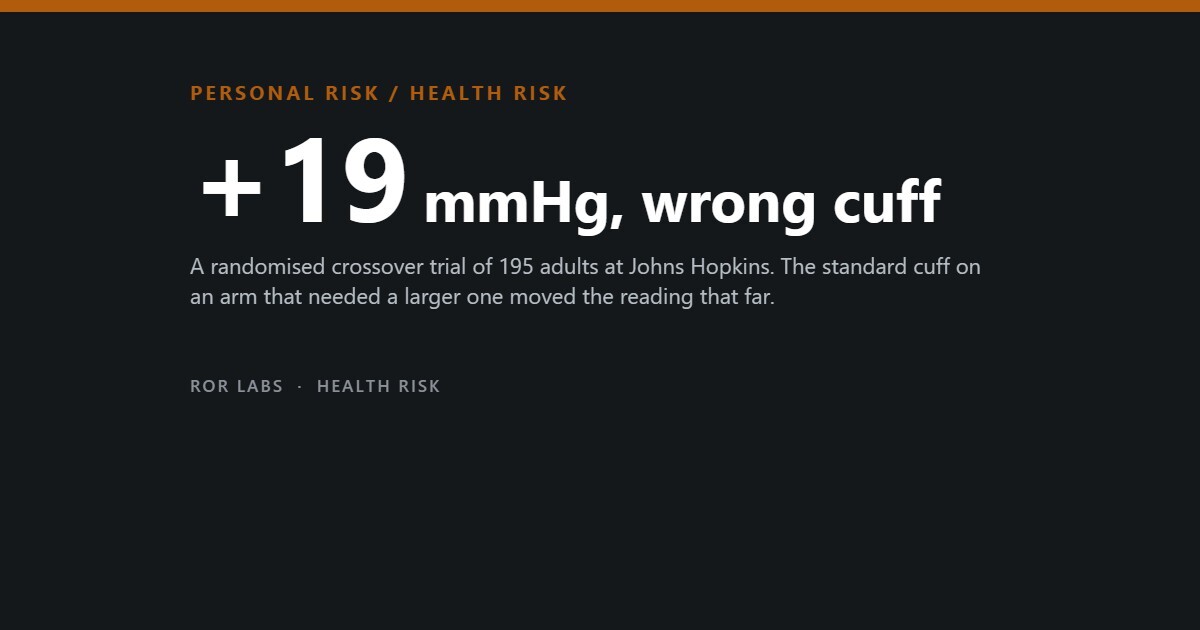
- The wrong cuff is the biggest measurement error: up to about 20 mmHg overestimate for people needing an extra-large.
High blood pressure is the largest modifiable contributor to death on earth, it produces no symptoms until something breaks, and it is measured with a device that is wrong more often than anyone admits. Those three facts together explain why this is the single most consequential number in preventive medicine and also the one most people have never seen measured properly.
The World Health Organization estimates that 1.4 billion adults aged 30 to 79 had hypertension in 2024 — a third of everyone in that age band. About 600 million of them do not know. And of those who do, fewer than a quarter have it under control.
The part almost nobody hears about is the measurement itself. In a 2023 randomised trial, using the wrong size cuff produced errors large enough to move a person from normal blood pressure to stage 2 hypertension — in the same arm, minutes apart. Here is what the evidence says, and how to get a number you can act on.

The cascade, and where it leaks
1.4 billion have it. 320 million have it controlled.
Adults aged 30–79 worldwide, 2024. Each step loses people.
Source: World Health Organization, hypertension fact sheet, 2024 estimates. Hypertension defined as 140/90 mmHg or higher on two separate occasions.
Why it matters is not in dispute, and the cleanest evidence comes from SPRINT, a trial that was stopped a year early because the difference was too large to keep running.
What tighter control bought, in a randomised trial
SPRINT: over 9,300 adults aged 50 and above with elevated cardiovascular risk and systolic pressure of 130 or more. Target under 120 versus target under 140.
The honest caveats. SPRINT excluded people with diabetes and people with a previous stroke, so it does not speak for them. Intensive treatment came with more hypotension, fainting and acute kidney abnormalities. And SPRINT measured blood pressure with an unusually careful automated protocol, which means its “under 120” is not the same number as a hurried reading in a busy clinic. This is a real result and it is not a licence to chase a number without a doctor.
Source: The SPRINT Research Group, “A Randomized Trial of Intensive versus Standard Blood-Pressure Control,” New England Journal of Medicine, 2015; final report, 2021.
The cuff is the error
In 2023 a team at Johns Hopkins ran a randomised crossover trial that should be far better known than it is. They took 195 adults, measured each person’s arm, and then measured their blood pressure twice — once with a correctly sized cuff and once with the regular adult cuff that comes in the box.
What the wrong cuff does to the number
Systolic error from using a regular adult cuff, by the size the person actually needed. Cuff(SZ) trial, 195 participants, triplicate measurements.
Source: Ishigami, J. et al., “Effects of Cuff Size on the Accuracy of Blood Pressure Readings: The Cuff(SZ) Randomized Crossover Trial,” JAMA Internal Medicine, 2023.
The fix takes two minutes and a tape measure. Measure the circumference of your upper arm at the midpoint between shoulder and elbow, then buy the cuff that matches — not the one that came with the machine. Most home monitors are sold with a single medium cuff, and a large or extra-large is usually available separately for the same model.
Getting a reading that means something
The protocol matters as much as the device. Each of these items is a known source of error.
| Step | Why it is on the list |
|---|---|
| Measure your arm and match the cuff | The largest single error available, worth up to about 20 mmHg. |
| Empty your bladder first | A full bladder raises readings measurably. |
| Sit quietly for five minutes | Not thirty seconds. Readings fall over the first few minutes of rest. |
| Back supported, feet flat, legs uncrossed | Unsupported back and crossed legs each add several mmHg. |
| Arm supported at heart level | An arm hanging low reads high; an arm raised reads low. |
| Cuff on bare skin, not over a sleeve | Fabric between cuff and skin changes the transmitted pressure. |
| Do not talk during the reading | Talking raises blood pressure while it is being measured. |
| Take two readings a minute apart, and average | Single readings are noisy. The first is usually the highest. |
| Morning and evening for seven days; discard day one | A week of paired readings is what clinicians want. One number in a doctor’s room is the least reliable version. |
Sources: American Heart Association home monitoring guidance; AHA/ACC hypertension guideline.
The categories are worth knowing, because the thresholds are lower than most people remember.
Where the lines are
AHA/ACC categories. Note that stage 1 begins at 130, not 140.
| Category | Systolic | Diastolic |
|---|---|---|
| Normal | under 120 | and under 80 |
| Elevated | 120–129 | and under 80 |
| Stage 1 hypertension | 130–139 | or 80–89 |
| Stage 2 hypertension | 140 or above | or 90 or above |
| Severe — seek care | above 180 | and/or above 120 |
Source: American Heart Association / American College of Cardiology high blood pressure guideline.
What actually helps, in order
Two honest framings before the list. First, lifestyle change and medication are not competitors — for most people with established hypertension the guideline expects both, and declining medication in favour of a diet plan is a decision with a body count. Second, the effect sizes of individual lifestyle changes are modest on their own and meaningful in combination, and they are largest in people who have the most room to move.
Ranked by strength of evidence and typical effect
Everything here is free except the last item.
Sources: AHA/ACC high blood pressure guideline; World Health Organization; SPRINT.
There is one more reason to take this seriously that sits outside the cardiovascular argument entirely. Blood pressure appears on the Lancet Commission’s list of modifiable dementia risk factors, which we went through in our piece on the fourteen risk factors. Whatever you make of the strength of that association, midlife blood pressure is one of the few things on that list you can measure at home for the price of a takeaway.
What to buy, and what to check before you do (paid link)
One purchase, two specifications.
Browse on Amazon →
Browse on Amazon →
Two things we are deliberately not linking. Wrist blood pressure monitors. They are popular, cheap and easier to put on, and they are also far more sensitive to position — the wrist must be held exactly at heart level or the reading is wrong, and the arteries there are smaller and less suited to the measurement. Clinical guidance consistently prefers upper-arm devices. Smartwatch and phone-based blood pressure features. Cuffless estimation is an active research field and a genuinely interesting one; it is not yet a substitute for a cuff, most implementations require periodic calibration against a real monitor, and a convenient number that is wrong is worse than no number at all in a condition defined entirely by a threshold.
Questions people ask
My reading is always high at the doctor and normal at home. Which is right?
Both are real measurements of different situations, and the pattern has a name: white coat hypertension. There is also a mirror image — masked hypertension, normal in the clinic and high everywhere else — which is the more dangerous of the two because it goes untreated. A week of properly taken home readings is what distinguishes them, and it is exactly why clinicians now ask for home logs.
Which number matters more, the top or the bottom?
Above roughly age 50, the systolic number — the top one — is the stronger predictor of cardiovascular events, because arteries stiffen with age and systolic pressure keeps climbing while diastolic often flattens or falls. Below that age both carry weight. Either one being above the threshold is enough to meet the definition.
Is one high reading a problem?
No. Blood pressure moves constantly — with the time of day, caffeine, stress, a full bladder, a conversation. The diagnosis rests on readings on separate occasions, which is why the seven-day home protocol exists. The exception is a reading above 180/120, especially with symptoms, which needs attention now rather than next week.
Can I get off medication if my lifestyle changes work?
Sometimes, and it is a decision to make with the doctor who prescribed it, using data rather than hope. What is not safe is stopping quietly because the numbers look good — the numbers look good because of the medication, and blood pressure climbs back without symptoms to warn you. Bring your home log to the appointment and ask the question directly.
Does salt actually matter, or is that contested?
There is genuine scientific argument at the edges — about how low is optimal, and about whether very low intakes carry risks of their own. There is much less argument about the direction, or about the fact that typical intakes in most countries sit well above every guideline. Individual responses vary considerably too, which is a good reason to test it on yourself with a monitor rather than to assume either way.
The short version
- 1.4 billion adults aged 30–79 have hypertension. About 600 million do not know.
- Only about 23% of people with it have it controlled.
- In SPRINT, tighter control cut cardiovascular events 24% and all-cause death 27% — with real side effects, and excluding people with diabetes or prior stroke.
- The wrong cuff is the biggest measurement error: up to about 20 mmHg overestimate for people needing an extra-large.
- That is enough to turn 125/79 into 144/87 on the same arm.
- Slim arms get the opposite error — the standard cuff underestimates, and hypertension gets missed.
- Measure your arm, then buy the cuff. Five minutes of rest, back supported, arm at heart level, no talking.
- Two readings, morning and evening, seven days. Discard day one.
- Stage 1 starts at 130, not 140.
- Buy an upper-arm, clinically validated device. Check the model on a validation registry — many popular ones are not listed.
This article is health information, not medical advice, and I am not a doctor. Decisions about diagnosing or treating high blood pressure — including starting, changing or stopping any medication — belong with a clinician who knows your history. A reading above 180/120, particularly with chest pain, breathlessness, weakness, difficulty speaking or vision change, is a medical emergency: seek care immediately rather than repeating the measurement.
On the links above: some are affiliate links, marked (paid link). If you buy through one we may earn a commission at no additional cost to you. As an Amazon Associate I earn from qualifying purchases. We link to product searches rather than specific items so that recommendations do not break as models change, and we say plainly when we are choosing not to link something. Full policy: Affiliate Disclosure.
Sources
- World Health Organization. Hypertension fact sheet, 2024 estimates. (1.4 billion adults aged 30–79, 33% of that age band; about 600 million unaware; about 630 million diagnosed and treated; about 320 million controlled; two thirds in low- and middle-income countries.)
- The SPRINT Research Group. “A Randomized Trial of Intensive versus Standard Blood-Pressure Control.” New England Journal of Medicine, 2015; and “Final Report of a Trial of Intensive versus Standard Blood-Pressure Control,” NEJM, 2021. (Over 9,300 participants; 24% reduction in cardiovascular events; 27% reduction in all-cause mortality; excluded diabetes and prior stroke; increased hypotension, syncope and acute kidney abnormalities.)
- Ishigami, J. et al. “Effects of Cuff Size on the Accuracy of Blood Pressure Readings: The Cuff(SZ) Randomized Crossover Trial.” JAMA Internal Medicine, 2023. (195 participants; regular cuff read about 3.6 mmHg low for those needing a small cuff, about 4.8 mmHg high for large, and about 19.5 mmHg high for extra-large; 144/87 versus 125/79 in the extra-large group.)
- American Heart Association / American College of Cardiology. High blood pressure guideline: categories, thresholds, home monitoring technique and lifestyle recommendations including a sodium target below 1,500 mg per day and approximately 5% weight loss.
- Livingston, G. et al. “Dementia prevention, intervention, and care: 2024 report of the Lancet standing Commission.” The Lancet, 2024.