Government and Bank Impersonation Scams: What the Evidence Shows
Key takeaways · 13 min read
- Americans reported losing over $3.5 billion to imposter scams in 2025; FBI complaints about fake officials nearly doubled to 32,424.
- Only about 4.8% of fraud victims tell an official body. The FTC puts real 2024 fraud losses at $31.3 billion to $195.9 billion, against $12.5 billion reported.
- When a fictitious government agency called, 16.4% of 644 older adults engaged without scepticism.
- Britain’s refund rules returned 88% of £316 million in claims and cut in-scope losses by about 21%, but scams via crypto exchanges and abroad grew.
In 2025 Americans told the Federal Trade Commission they had lost more than $3.5 billion to imposter scams, the most commonly reported type of fraud for the fifth year running. The FBI’s Internet Crime Complaint Center counted 32,424 complaints about people posing as government officials, almost double the 17,367 of a year earlier, with reported losses of $797.9 million. In South Korea, voice-phishing losses passed ₩1 trillion for the first time.
The pattern behind those numbers is old. Someone claiming to be from the tax office, the police, a regulator or your own bank’s fraud team says that your money or your identity is in danger and that you must act now. The fix they offer is nearly always the same: move the money somewhere “safe”, or hand it over for safekeeping. The safe place belongs to them.
This article sets out what research and official data show: how much the reported losses miss, why careful people comply, how “safe account” and courier scams work, what happened when Britain made banks refund victims, why South Korea’s losses rose so fast, and whether warnings help. Family-emergency calls using cloned voices are a separate scam and are not covered here.

The reported numbers
The FTC’s Consumer Sentinel database is the largest public record of fraud in the United States. For 2024 it logged reports from 2.6 million consumers and $12.5 billion in losses, 25% more than in 2023. Imposter scams accounted for $2.95 billion, and losses to government impersonators alone rose by $171 million to $789 million. In 2025 total reported losses reached $15.9 billion and imposter losses passed $3.5 billion across more than a million reports. The FTC said reports of government imposters rose 40%, helped by fake road-toll texts.
FBI data point the same way. Its 2025 report recorded 1,008,597 complaints and $20.9 billion in losses across all internet crime. Government impersonation complaints nearly doubled, and people aged 60 and over filed 8,628 of them, reporting $413.2 million in losses, more than half of the category’s total.
The FTC also says people reported losing more through bank transfers and cryptocurrency than through all other payment methods combined. A transfer the customer makes themselves is hard to reverse: the bank did what it was told.
What the counts miss
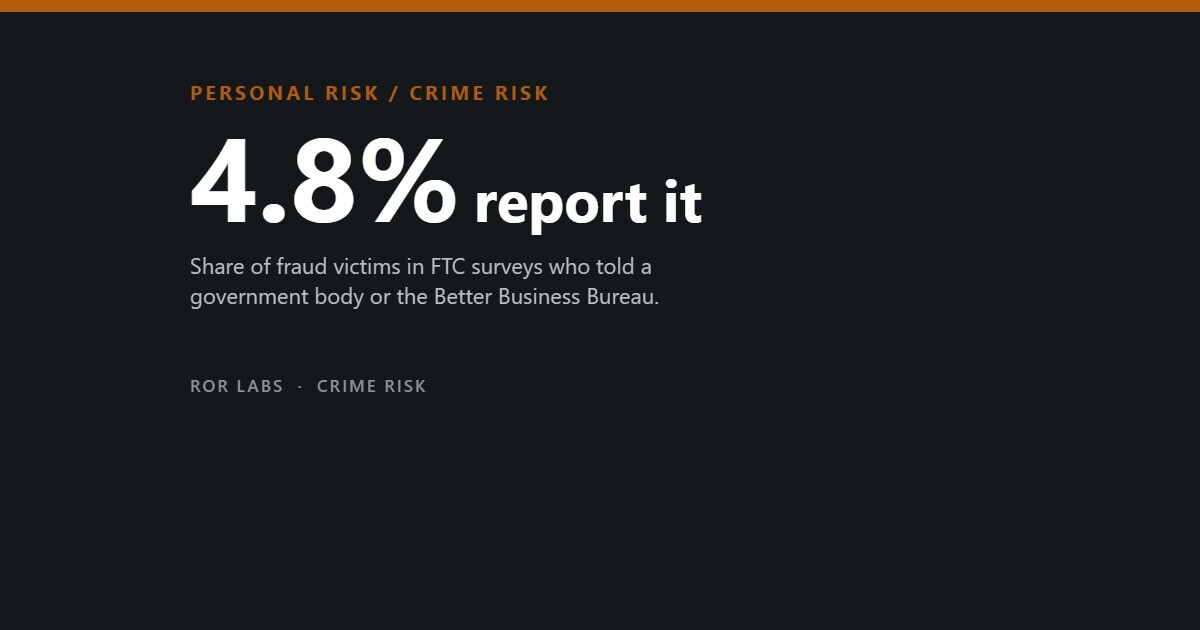
Every figure above is a count of reports, and most fraud is never reported. A 2021 analysis of several FTC consumer surveys found that just 4.8% of people who had experienced fraud said they had reported it to a government body or a Better Business Bureau. The rate was 2.0% when the loss was under $1,000 and 6.7% when it was $1,000 or more.
Using survey results like these, the FTC has tried to estimate the real total. For 2024 it put overall fraud losses somewhere between $31.3 billion and $195.9 billion, against $12.5 billion reported, and losses among adults aged 60 and over between $10.1 billion and $81.5 billion. The agency says the estimates reflect a “considerable degree of uncertainty” because the scale of underreporting, particularly when losses are high, is not well understood.
Reported fraud losses and what they may hide
United States, all fraud types, 2024. Reported losses compared with the FTC’s low and high estimates after adjusting for underreporting.
Sources: FTC press release (March 2025); FTC, Protecting Older Consumers 2024–2025 (December 2025).
Underreporting also distorts who appears to be at risk. Researchers who analysed Consumer Sentinel complaints found that older adults were less likely than people aged 30 and under to report having lost money, but older victims who did lose money lost more on average. Rising report counts can reflect more scams, more willingness to report or easier reporting tools, and the data alone cannot say which.
Why careful people comply
Victims are often called gullible. In a 2009 report for the UK Office of Fair Trading, Stephen Lea, Peter Fischer and Kath Evans described responding to a scam as an error of judgement that the scam is built to provoke. In two questionnaire studies published in 2013, the same group found that people who had complied with scams differed from those who had not in their response to large rewards, their self-confidence and their reliance on signs of official authority.
Impersonation scams lean on that last factor and add fear. A study of 600 complaint narratives about callers pretending to be from the US Social Security Administration found threats of arrest and of suspended bank accounts or Social Security numbers, with the “charges” removable if the target bought gift cards, wired money or fed cash into cryptocurrency machines. An earlier analysis of 100 phishing emails found that alerts about accounts were typically followed by an urgent, threatening tone.
The most direct measurement comes from an experiment. In late 2021 researchers at Rush University in Chicago, working with the investor-education foundation of the US brokerage regulator FINRA, contacted 644 older people in a long-running study of ageing on behalf of a fictitious “US Retirement Protection Task Force”, warning of unusual activity on a file linked to their benefits. Most never engaged. But about half of those who picked up the phone, 94 of 186, talked to the caller without scepticism or confirmed personal details.
How 644 older adults responded to a fake government agency
Responses to phone outreach from a fictitious agency in a 2021 experiment. The last two rows are subsets of those who engaged.
Source: Yu L et al., JAMA Network Open 6(9):e2335319 (2023). Average age about 85. Partly funded by the FINRA Investor Education Foundation, whose staff helped design the study.
The authors think real-world rates would be higher, because their caller used no high-pressure tactics and the agency name was invented. But the sample was mostly white, highly educated and very old, so it does not represent everyone. Those least aware of scams were the most likely to engage.
Safe accounts, couriers and gold

The most expensive impersonation scams now follow a script that regulators on both sides of the Atlantic describe in almost the same words. A message, pop-up or call warns of suspicious activity on a bank account, a computer or a Social Security number. A second “official”, perhaps from the bank’s fraud team, the police or a government agency, then explains that the money is at risk and must be moved to protect it. UK Finance describes criminals telling victims to transfer funds to a “safe account” that the criminal controls.
In the United States the FTC found that reports from older adults who lost $10,000 or more to such impersonators rose more than fourfold, from 1,790 in 2020 to 8,269 in 2024. Combined losses among those who lost more than $100,000 rose eightfold, from $55 million to $445 million. For losses of $10,000 or more, the most common first contact was a phone call, at 41%.
How older adults paid impersonators
Payment method in reports of losses of $10,000 or more to business and government impersonators, adults aged 60 and over, 2024.
Source: FTC Data Spotlight, “False alarm, real scam” (August 2025). For losses above $100,000, bank transfer was the most common method, at 32%. Reported cases only.
Cash and gold are the newest twist. Victims are told to withdraw savings, sometimes to buy gold, and to hand it to a courier who comes to the door. The FBI’s 2025 report counted about 725 complaints about gold courier scams, with $311.8 million in losses, an average of more than $400,000 per complaint. Handing over cash or gold leaves no payment to recall.
Britain makes the banks pay
Britain has run the largest test of a different idea: make the banks carry the loss. Since 7 October 2024, payment firms using Faster Payments and CHAPS must reimburse victims of authorised push payment (APP) scams, in which the victim is tricked into sending money themselves, up to £85,000 per claim. Firms can refuse when the victim fell short of a “consumer standard of caution”.
The early numbers are striking. From October 2024 to March 2026, the Payment Systems Regulator says firms returned 88% of the £316 million lost in reimbursable claims and closed 82% of claims within five business days. An independent evaluation by Frontier Economics, published in July 2026, estimated that APP scam losses over Faster Payments fell by around 21%, about £73 million a year. UK Finance counted £55.5 million lost to police and bank-staff impersonation in 2025, down 18%, though total APP losses rose 19%, to £576.4 million.
Britain’s reimbursement rules: what changed
Measures before and after mandatory reimbursement began in October 2024. Out-of-scope channels are not covered by the rules.
| Measure | Before | After | Source |
|---|---|---|---|
| In-scope APP losses reimbursed, by value | 54% | 65% | Frontier Economics |
| Reimbursable claims repaid, Oct 2024–Mar 2026 | – | 88% of £316m | PSR dashboard |
| Police and bank-staff impersonation losses | £67.9m (2024) | £55.5m (2025) | UK Finance |
| Scams via crypto exchanges (out of scope) | about £59m (2023) | £153m (2025) | Evaluation, as summarised |
| International APP scams (out of scope) | £21m (2023) | £60m (2025) | Evaluation, as summarised |
Sources: Frontier Economics for the PSR (July 2026); PSR APP scams reimbursement dashboard (30 July 2026); UK Finance Annual Fraud Report 2026; Grant Thornton and Bratby Law summaries of the evaluation (2026).
Reimbursement changes who pays; it does not recover the money. The evaluation estimated extra costs for payment firms of £44 million to £56 million a year, and outcomes remain uneven: one firm applied the consumer-caution exception to more than a quarter of cases by value, while others did not use it at all. Scams sent through channels outside the rules grew, and the evaluators called displacement plausible for international payments, though they did not attribute the rises directly to the policy. Even the headline rate depends on what is counted: 88% of reimbursable claims, 65% of in-scope losses by value, or 61% of all APP losses in UK Finance’s figures.
South Korea’s voice-phishing bill

South Korea shows how quickly losses can climb when the script works. Voice-phishing losses were ₩447.2 billion in 2023, ₩854.5 billion in 2024 and ₩1.258 trillion in 2025, according to police and Financial Supervisory Service data analysed by members of the National Assembly. The average loss per case in 2025 was ₩53.84 million.
Impersonation of the state dominates. Calls claiming to come from prosecutors, the police or financial authorities accounted for 78.6% of 2025 losses, about ₩988 billion. Between January and August 2026, 91.3% of identified cases began with a phone call. A 2022 study of 1,017 Korean voice-phishing apps found they could silently redirect a victim’s outgoing calls, so that ringing the bank or the police reached the fraudsters instead. In a user test, 87% of participants did not notice the switch.
South Korea: voice-phishing losses by year
Reported losses to voice phishing, and the part attributed to callers impersonating state agencies in 2025.
Sources: National Police Agency and Financial Supervisory Service data, as analysed by National Assembly members and reported by Seoul Times News (29 September 2026) and inews24 (September 2026).
Recovery is poor. Banks froze 102,307 suspect accounts in 2025, but only about 26% of losses were refunded to victims, down from 35.9% in 2021, as money moved quickly into crypto wallets or through chains of transfers. In August 2025 the government announced a package that included making financial companies compensate victims within set limits even when they were not at fault, and the bill was introduced in December 2025; we could not confirm whether it has since passed. The Financial Services Commission reported losses in November 2025 35.0% lower than a year earlier.
Do warnings work?
Awareness campaigns are the most common response to impersonation scams and among the least tested. A 2019 review of real-world fraud prevention projects by the criminologist Tim Prenzler found only two that met best-practice scientific standards. An Australian evaluation of a national fraud awareness month in 2007 concluded that it raised awareness and the number of scams reported, which is not the same as reducing losses.
The experiments that exist are mixed. In a US field study, older people who had been defrauded before received a mock scam call from a telemarketer two or four weeks after being warned. A warning about the same scam, and even one about a different scam, reduced outright acceptance; the specific warning produced more refusals but lost effectiveness over time. In an online experiment in Kenya, standard tips on spotting phone scams did not improve people’s overall ability to tell scams from genuine messages: they flagged more scams but also mislabelled more genuine ones.
Do scam warnings change behaviour?
What four studies measured, and what they found.
| Study | Design | Outcome measured | Result |
|---|---|---|---|
| Scheibe 2014 | Field experiment, past victims | Response to a mock telemarketing scam | Warnings reduced acceptance; the specific warning faded over time |
| Kubilay 2023 | Online experiment, Kenya | Telling scams from genuine messages | Tips did not improve accuracy; people grew more cautious |
| DeLiema 2022 | Survey, 1,375 people who reported a scam | Responding and losing money | Prior knowledge of the scam type protective |
| Prenzler 2019 | Review of real-world projects | Quality of evaluations | Only 2 met best-practice standards |
Sources: Scheibe S et al., Basic and Applied Social Psychology (2014), doi:10.1080/01973533.2014.903844; Kubilay E et al., Journal of Development Economics 165 (2023); DeLiema M, Li Y, Mottola GR, International Journal of Consumer Studies (2022), doi:10.1111/ijcs.12886; Prenzler T (2019), doi:10.1108/jcrpp-04-2019-0026.
In a survey of 1,375 North American consumers who had reported a scam, knowing about a type of fraud beforehand was protective across nearly all scam types. What the research cannot yet show is that a poster, an advert or a text-message campaign changes what a frightened person does while someone who sounds like the police is on the line.
What the evidence suggests
Three points are better supported than the rest. First, the reported numbers are a floor: fewer than one in twenty fraud victims tell an official body. Second, impersonation works by stacking authority, fear and a deadline, and in the one direct experiment about one in six older adults engaged with a made-up agency without scepticism. Third, the money now leaves through the routes hardest to reverse: transfers the customer authorises, crypto machines, cash and gold.
The policy picture is less settled. Britain’s reimbursement rules have moved most of the cost of in-scope scams from victims to banks and coincided with a fall in losses, but some fraud appears to have moved to channels the rules do not cover. South Korea is attempting a similar shift, and in September 2026 the FTC asked for public comment on whether its impersonation rule should reach search engines, social media and other platforms that carry scam adverts. The message every agency repeats is simple: the FBI says law enforcement and government authorities will never contact the public by telephone or text to demand payment, and the “safe account” a caller describes is, in UK Finance’s words, controlled by the criminal.
Questions people ask
How much do Americans lose to impersonation scams?
Reported losses to imposter scams passed $3.5 billion in 2025, according to the FTC. Because few victims report, the true figure is higher.
What is a safe account scam?
A caller posing as your bank, the police or a regulator says your money is at risk and must be moved to a new account to protect it. The account belongs to the criminal.
Will my bank refund me if I was tricked into sending money?
In the UK, most victims of scam payments made by Faster Payments or CHAPS since October 2024 are covered up to £85,000, with exceptions. Elsewhere, refunds for payments you authorised are far less certain; South Korea has proposed limited no-fault compensation.
Would a government agency call and demand payment?
No. The FBI says law enforcement and government authorities will never contact the public by phone or text to demand any form of payment.
Do scam awareness campaigns work?
The evidence is thin. A specific warning reduced acceptance of a mock scam in one experiment; general tips did not improve accuracy in another.
The short version
- Americans reported losing over $3.5 billion to imposter scams in 2025; FBI complaints about fake officials nearly doubled to 32,424.
- Only about 4.8% of fraud victims tell an official body. The FTC puts real 2024 fraud losses at $31.3 billion to $195.9 billion, against $12.5 billion reported.
- When a fictitious government agency called, 16.4% of 644 older adults engaged without scepticism.
- Britain’s refund rules returned 88% of £316 million in claims and cut in-scope losses by about 21%, but scams via crypto exchanges and abroad grew.
- South Korea’s voice-phishing losses reached ₩1.258 trillion in 2025, 78.6% of it to fake officials. Awareness campaigns are rarely rigorously tested.
This article summarises published research, regulatory reports and official statistics for general information. It is not financial or legal advice. If you think you have sent money or personal details to an impersonator, contact your bank straight away using the number on your card or statement, not one given by the caller, and report it to the police or your national fraud reporting service.
Further reading: Yu et al., JAMA Network Open (2023), for the government impersonation experiment. The FTC’s Protecting Older Consumers 2024–2025 report, for how it estimates underreported losses. Frontier Economics’ 2026 evaluation for the Payment Systems Regulator, for the first full assessment of mandatory reimbursement.
- Influence, New and Expanded, Robert B. Cialdini (2021). The classic account of persuasion, updated, including the pull of authority and scarcity that impersonators exploit. Useful for understanding why the script works; it is written mostly about marketing, not crime.
- The Psychology of Fraud, Persuasion and Scam Techniques, Martina Dove (2020). A fraud researcher explains why people fall for scams and why standard prevention advice often fails. Clear on the research; its practical checklists are less tested than its analysis.
- Fool Me Once, Kelly Richmond Pope (2023). A forensic accountant gathers the stories of victims, whistleblowers and fraudsters. Vivid on how fraud feels from the inside; it is anecdotal rather than statistical.
Sources
FTC, press release on 2024 fraud data (March 2025). — FTC, prepared statement to the Joint Economic Committee (March 2026). — FTC, “New trends in reports of imposter scams” (7 May 2026). — FTC, Protecting Older Consumers 2024–2025 (December 2025), citing Anderson KB (2021). — FTC, Data Spotlight “False alarm, real scam” and press release (7 August 2025). — FTC, Rule on Impersonation of Government and Businesses, advance notice of proposed rulemaking, Federal Register (1 October 2026). — FBI Internet Crime Complaint Center, 2025 IC3 Annual Report (2026). — FBI IC3, public service announcement I-091726-PSA (17 September 2026). — DeLiema M, Witt P. Innovation in Aging 6(Suppl 1):407 (2022). — Lea SEG, Fischer P, Evans KM. The Psychology of Scams, Office of Fair Trading (2009). — Fischer P, Lea SEG, Evans KM. Journal of Applied Social Psychology (2013), doi:10.1111/jasp.12158. — DeLiema M, Witt P. Michigan Retirement and Disability Research Center working paper 434 (2021). — Atkins B, Huang W. “A Study of Social Engineering in Online Frauds” (2013). — Yu L et al. JAMA Network Open 6(9):e2335319 (2023), doi:10.1001/jamanetworkopen.2023.35319. — UK Finance, Annual Fraud Report 2026. — Payment Systems Regulator, one-year update (2025) and reimbursement dashboard (30 July 2026). — Frontier Economics, evaluation of APP scam policies for the PSR (1 July 2026). — Grant Thornton, commentary on the evaluation (July 2026). — Bratby Law, commentary on the evaluation (2026). — Seoul Times News (29 September 2026). — inews24 (September 2026). — Financial Services Commission (Korea), press release (30 December 2025). — Kim J et al. HearMeOut, MobiSys (2022), doi:10.1145/3498361.3538939. — Prenzler T. Journal of Criminological Research, Policy and Practice (2019), doi:10.1108/jcrpp-04-2019-0026. — Smith R, Akman T. Australian Institute of Criminology (2008). — Scheibe S et al. Basic and Applied Social Psychology (2014), doi:10.1080/01973533.2014.903844. — Kubilay E et al. Journal of Development Economics 165 (2023). — DeLiema M, Li Y, Mottola GR. International Journal of Consumer Studies (2022), doi:10.1111/ijcs.12886.