Ladder Falls: What the Evidence Shows
Key takeaways · 13 min read
- US emergency departments treated an estimated 274,767 injuries involving ladders and stools in 2024. The rate in people aged 65 and over, 165.1 per 100,000, was about twice that of adults aged 25 to 64.
- Most injured people are men falling at home. In Australia, falls outside work produced 33,545 hospital admissions over ten years against 7,547 at work, and men over 60 had the highest rate.
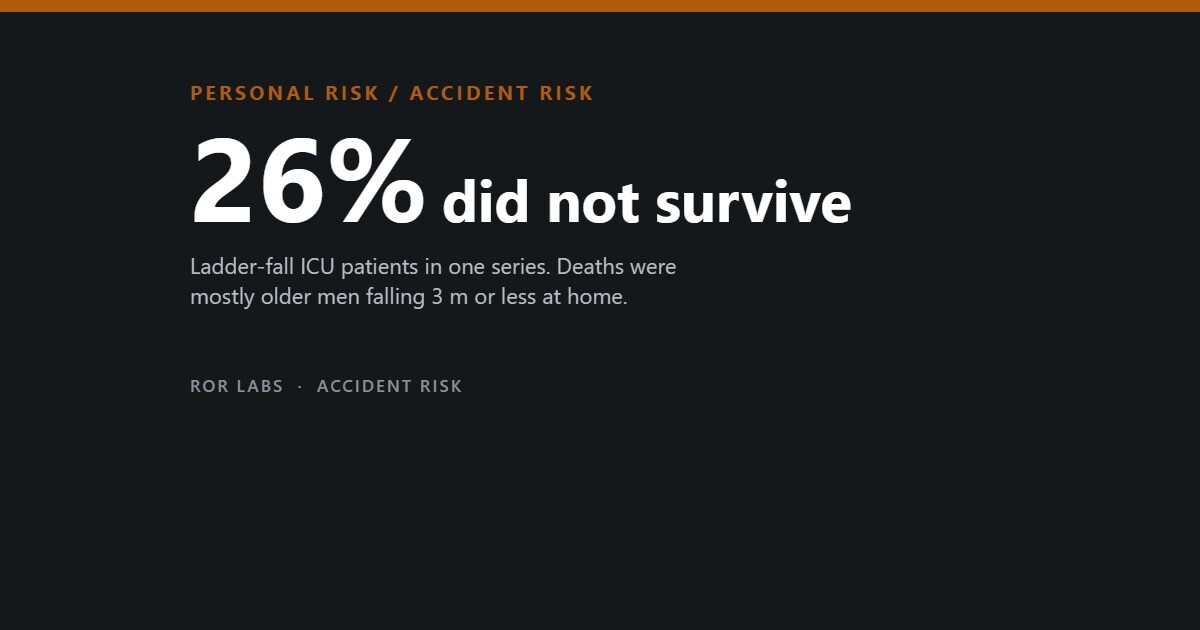
- Height is a poor guide to harm. In one intensive care series, 26% of ladder-fall patients died, almost all older men who fell 3 metres or less at home.
- The recommended angle of about 75.5 degrees is rarely reached: trained installers averaged 67.3 degrees, and in a laboratory study a 10-degree shallower angle raised the friction needed at the foot by 77%.
In 2024, emergency departments in the United States treated an estimated 274,767 injuries involving ladders and stools, according to the Consumer Product Safety Commission’s national injury sample. Just over 100,000 of them were in people aged 65 or over, and 53,761 people were admitted to hospital or were dead on arrival. Studies consistently find that most such falls happen away from work: at home, on the kind of ladder kept in a garage.
Those figures are real, but they answer a narrower question than it first appears. They count people who reached a hospital. They do not say how many times anyone climbed a ladder, so they cannot say how risky a single climb is, or whether one group is careless or simply climbs more. That gap runs through almost every study on the subject.
This article sets out what the research shows about who falls, why fall height is a poor guide to harm, what the data say about ladders at work, where the 75-degree angle comes from, and how little is known about whether training works. It draws mainly on American and Australian studies.
What the counts measure
The most cited national study, by Anjali D’Souza and colleagues, appeared in 2007. Using the National Electronic Injury Surveillance System, a national sample of hospital emergency departments, they estimated that 2,177,888 people were treated for ladder-related injuries between 1990 and 2005, an average of 136,118 a year, or 49.5 per 100,000 people. The number rose by more than 50% over the period, while the rate per head of population rose by nearly 27%. Fractures were the most common injury, at 31.5%, and the authors reported that 97.3% of injuries happened in non-occupational settings such as homes and farms.
The commission’s latest yearly summary groups ladders with stools, so its 2024 figure is not directly comparable with the 2007 study. The breakdown by age is still telling. The rate rises steeply in later life, and it is high again in children under five, a reminder that this category is not ladders alone.
Ladder and stool injuries in US emergency departments, 2024
Estimated injuries per 100,000 people, by age group.
Source: US Consumer Product Safety Commission, NEISS Data Highlights, calendar year 2024 (product group “Ladders, Stools”). Population rates, not rates per climb.
Australia shows the same pattern in hospital admissions rather than emergency visits. Kirsten Vallmuur and colleagues counted 41,092 admissions for ladder falls between July 2002 and June 2012, rising from 3,374 in the first year to 4,945 in the last. Only 7,547 were classed as occupational; 33,545 were not. The age-standardised rate rose significantly for men, and the increase was larger in people over 60.
Who falls, and from where
The largest study of serious ladder injuries used the US National Trauma Data Bank. Panagiotis Liasidis and colleagues found 168,227 patients treated in trauma centres after a fall from a ladder between 2007 and 2017. Their median age was 56 and 86.1% were men. One in six had major trauma, defined as an injury severity score above 15. Overall, 1.8% died; among those over 65, 3.6% did.
The Australian data point at the same group. In the Vallmuur study the highest rate of any group, 78.8 admissions per 100,000, was among men over 60. A Danish series of 131 patients admitted after falls outside work, published in 2001, found that 107 were men and that men typically fell from straight ladders outdoors while repairing, painting or clearing gutters, while women more often fell from stepladders indoors. In most cases the person had reached too far sideways and the ladder tipped or slipped.
Who gets hurt: four studies, one pattern
Different countries, data sources and levels of severity.
| Study | Data | Who fell | Key finding |
|---|---|---|---|
| D’Souza 2007 | US emergency visits, 1990–2005 | 76.5% male | 97.3% outside work |
| Vallmuur 2016 | Australian admissions, 2002–2012 | Highest rate in men over 60 | 33,545 non-work vs 7,547 work |
| Liasidis 2022 | US trauma centres, 2007–2017 | Median age 56; 86.1% male | Deaths 1.8%; 3.6% over 65 |
| Færgemann 2001 | Danish admissions | 107 of 131 men | Most reached too far sideways |
Sources: D’Souza AL et al., American Journal of Preventive Medicine (2007), doi:10.1016/j.amepre.2007.01.012; Vallmuur K et al., ANZJPH 40(6):559–563 (2016); Liasidis P et al., J Trauma Acute Care Surg (2022), doi:10.1097/TA.0000000000003696; Færgemann C, Larsen LB, J Safety Res (2001).
Why older men? An Australian study of 102 people aged 65 and over, published in 2021, found that older men commonly used straight ladders: 75% at least once a year, mostly outside the house, and most often for clearing gutters, a task 74% reported. The finding that complicates the usual advice was that unsafe ladder use was more common in men and in people with better strength, balance and stepping ability. The most physically capable were the ones taking the most chances.
Low ladders, serious heads
A common assumption is that a short fall is a safe one. The research does not support it. A community emergency department study from 1998 reviewed 59 people injured in ladder falls who had fallen an average of 7.2 feet, about 2.2 metres, and found no relationship between the distance fallen and whether a bone was broken. One of the 59 died.
Work-related falls tell a similar story. A follow-back study of 306 American workers treated in emergency departments found an average fall of 7.5 feet and a median of 6 feet. More than a third had fallen 4 feet or less.
How far injured workers fell
Fall height among 306 workers treated in US emergency departments after a ladder fall.
Source: Lombardi DA et al., Scandinavian Journal of Work, Environment & Health (2011). Interviewed cases from the occupational NEISS sample; 49.3% of workers contacted took part.
Age changes what a given fall does. In an Arizona trauma registry, 340 patients had fallen from ladders, from an average of 9.8 feet. Older patients fell from lower heights yet had more severe injuries, and those over 66 were more likely to have a traumatic brain injury, with an odds ratio of 3.4. The authors titled their paper “age matters more than height”.
The starkest numbers come from intensive care. Over five years, a Level 1 trauma service recorded 584 admissions after ladder falls; 58 people who had fallen more than a metre went to intensive care. Of these, 26% died in hospital, and the fatal cases were almost entirely older men in falls at home of 3 metres or less who died of traumatic brain injury. A Japanese series of 86 patients, with a mean age of 69 and a median fall of 2.55 metres, found that head injury and non-professional ladder use were independent predictors of a poor outcome, and that fall height was not statistically related to head injury. And when young volunteers were made to fall onto padding from ladders with their feet up to 1.8 metres high, 15 of 115 falls ended with the head striking the padding, every time on the back of the head.
Ladders at work
Work accounts for a minority of ladder injuries, but it is where deaths are counted most carefully. A CDC analysis of three surveillance systems found that in 2011 work-related ladder falls caused 113 deaths, an estimated 15,460 injuries reported by employers that involved at least a day off work, and about 34,000 injuries treated in emergency departments. Among construction workers, an estimated 81% of fall injuries treated in emergency departments involved a ladder. Construction accounted for 57% of the ladder-fall deaths.
The same report found fatality rates rising with age: 0.16 per 100,000 full-time workers aged 55 to 64, and 0.35 for those 65 and over. Self-employed workers died at a rate of 0.30, against 0.06 for employees. And height again misled: fatal falls from 6 to 10 feet were the most common band, yet that band accounted for only 28% of deaths.
More recent figures come from the construction research group CPWR. Fatal falls to a lower level in US construction rose from 260 in 2011 to 397 in 2022, and a third of those deaths, 33.6%, were from 15 feet or less. Deaths in which a ladder was involved fell from 103 in 2021 to 90 in 2022. Across all industries, the Bureau of Labor Statistics counted 844 fatal falls, slips and trips in 2024.
OSHA’s most-cited standards, fiscal year 2026
Preliminary violation counts for the top five, October 2025 to August 2026.
Source: OSHA preliminary figures presented at the NSC Safety Congress & Expo, reported by Safety+Health, 15 September 2026. Citations reflect where inspectors go, not where injuries happen.
The 75-degree rule
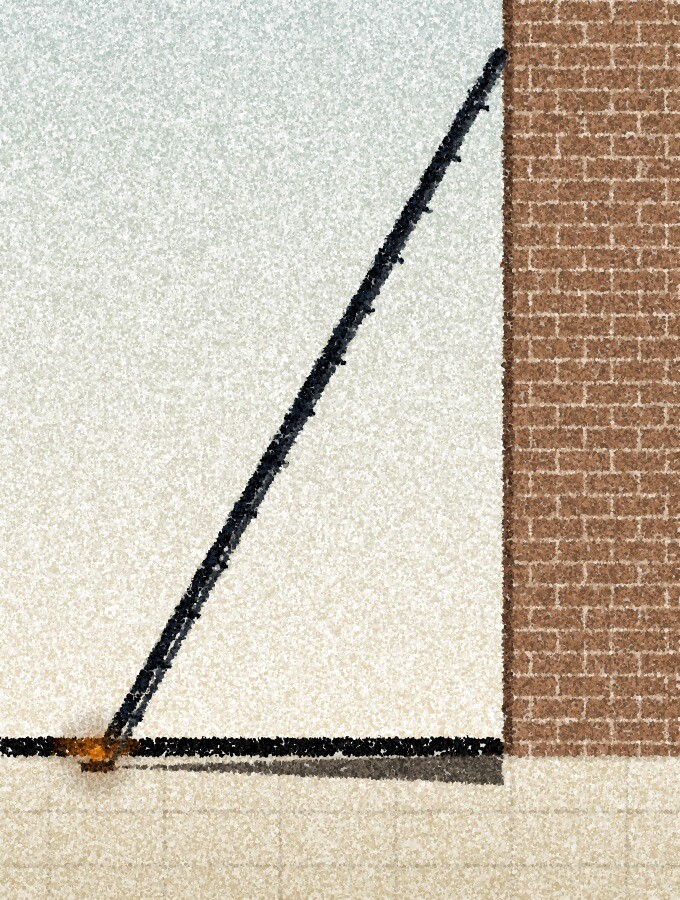
The rule most people half-remember is that a leaning ladder should stand at about 75 degrees. It comes from geometry rather than folklore. OSHA’s construction standard says the horizontal distance from the top support to the foot of the ladder should be approximately one quarter of the working length, and a ladder set that way stands at about 75.5 degrees. Set it steeper and it moves more from side to side; set it shallower and its feet are more likely to slide out.
Laboratory work shows how sensitive the base is to that angle. In a 2004 study of people climbing a straight ladder, the friction needed at the foot to stop it sliding increased by 77% on average when the angle was lowered from 75 to 65 degrees. The angle was the single most important factor tested, ahead of climbing speed. The trouble is that real ladders are not set at 75 degrees. In a field study of more than 120 ladder installations, the average angle was 67.7 degrees.
The recommended angle and the angles people actually use
Mean set-up angles recorded in field and laboratory studies.
| Study | Setting | Mean angle |
|---|---|---|
| Standard (one-quarter rule) | Target | 75.5° |
| Knox and Van Bree 2015 | Over 120 real installations | 67.7° |
| Chang 2016 | 265 set-ups by trained installers | 67.3° |
| Knox and Van Bree 2015 | Laboratory, following the standard label | 74.1° |
Sources: OSHA 29 CFR 1926.1053(b)(5)(i); Knox EH, Van Bree MP (2015), doi:10.1177/1541931215591317; Chang WR et al., Ergonomics (2016), doi:10.1080/00140139.2015.1115897; Chang WR et al., Safety Science (2004), doi:10.1016/j.ssci.2004.02.002.
Methods for getting the angle right do exist. In a NIOSH study of 40 people, the standard method of standing at the base with arms outstretched improved positioning, but it took 50% longer than no instruction and still varied a good deal. An earlier study of 68 lay people found a bubble level on the rail came closest to 75.5 degrees. In 2013 NIOSH released a free Ladder Safety app with an angle indicator that uses sound and visual signals; by December 2023 it had been downloaded more than 850,000 times. NIOSH now says the app is not receiving updates, and we found no study measuring whether its users fall less.
Does training work
Training is the default answer to ladder falls, and it is the part with the thinnest evidence. In the 2016 field study, all 67 cable TV installers observed had been trained in recommended set-up methods. Only 3 used one in their daily work, and even they did not reach 75.5 degrees. A preliminary 2026 study of five experienced construction workers found that explicit instruction produced the most accurate angles, but the benefit had gone by the retention trials. Ladders fitted with bubble levels were accurate too, though the workers felt less at ease and less confident using them.
Reviews of injury outcomes are no more encouraging. A 2000 review of programmes to prevent falls from height in construction found only three studies with a comparison group, and concluded there were few data to support current programmes. The 2018 Cochrane review of interventions to prevent injuries in construction workers found 17 studies, none randomised, most at high risk of bias. It rated the evidence as very low quality that regulations reduce fatal and non-fatal injuries, and very low quality that safety campaigns, training or inspections reduce non-fatal injuries.
What the evidence on training looks like
Two very different kinds of study, pointing the same way.
Installers trained in set-up methods: 67
Used a method on the job: 3
Mean angle 67.3° against a target of 75.5°
Studies found: 17
Randomised trials: 0
Evidence for training and campaigns rated very low quality
Sources: Chang WR et al., Ergonomics (2016), doi:10.1080/00140139.2015.1115897; van der Molen HF et al., Cochrane Database of Systematic Reviews (2018), doi:10.1002/14651858.CD006251.pub4.
None of this shows training is useless. It shows that it has rarely been tested against injuries, and that knowing a rule and following it on a busy day differ. OSHA’s own list makes the point: fall protection training requirements were cited 1,273 times in 2026, eighth on the list.
The missing denominator

The deepest weakness in the ladder literature is the denominator. Emergency and trauma data count injuries. They do not count climbs, hours on a ladder or households that own one. The CDC’s own 2014 analysis said its rates used all workers as the denominator, and that a better measure would be the number of workers who actually used ladders.
That matters for the most repeated conclusion, that older men are especially at risk. A 2024 Sydney study of 104 older and 20 younger adults found that older participants used stepladders monthly, against a few times a year for the younger group, and took 45.4 seconds longer to clear a simulated gutter. Younger adults reached and leaned further and reported more unsafe habits. The authors concluded that longer task times and more frequent use are likely part of why older people’s injury rates are higher. It was a small volunteer sample, but a higher injury count can clearly reflect more exposure as well as frailty.
Rising counts need the same care. In the US study, ladder injuries rose by more than 50% between 1990 and 2005, but the rate per person rose by nearly 27%, because the population grew. An older population that keeps doing its own maintenance would produce more ladder injuries even if each climb were no more dangerous than before.
What the evidence suggests
Several points stand up. Most ladder injuries happen at home rather than at work, and the most seriously hurt are disproportionately older men on straight ladders outside the house. A fall of 2 or 3 metres is enough to cause a fatal head injury, and in older people the height of the fall predicts little. The 75-degree angle has a sound basis in physics, and the evidence that people rarely achieve it is consistent. What is weak is the link from any intervention, whether training, apps or campaigns, to fewer injuries, and nearly every figure on the subject is a count of casualties rather than a measure of risk per climb.
Questions people ask
What is the right angle for a ladder?
About 75 degrees. The rule is that the foot should be out from the wall by about a quarter of the ladder’s working length, which gives roughly 75.5 degrees.
Is a fall from a stepladder really dangerous?
It can be. In one intensive care series, most deaths were older men who fell 3 metres or less at home, and studies find that fall height predicts injury poorly in older people.
Who is most likely to be hurt in a ladder fall?
Men, mostly at home, with the highest hospital rates in men over 60. Part of that may reflect how often they climb, which injury data do not measure.
Does ladder safety training prevent falls?
It has rarely been tested against injuries. A Cochrane review rated the evidence for training and campaigns in construction as very low quality.
Are ladder injuries becoming more common?
Counts rose in the US and Australia over the periods studied. Part of the US rise reflects population growth, and no data show whether each climb has become riskier.
The short version
- US emergency departments treated an estimated 274,767 injuries involving ladders and stools in 2024. The rate in people aged 65 and over, 165.1 per 100,000, was about twice that of adults aged 25 to 64.
- Most injured people are men falling at home. In Australia, falls outside work produced 33,545 hospital admissions over ten years against 7,547 at work, and men over 60 had the highest rate.
- Height is a poor guide to harm. In one intensive care series, 26% of ladder-fall patients died, almost all older men who fell 3 metres or less at home.
- The recommended angle of about 75.5 degrees is rarely reached: trained installers averaged 67.3 degrees, and in a laboratory study a 10-degree shallower angle raised the friction needed at the foot by 77%.
- Ladders were OSHA’s fifth most-cited standard in 2026, but evidence that training prevents falls is very low quality, and injury data rarely measure how often people climb.
This article summarises published research and official data for general information. It is not medical or professional safety advice. Anyone who hits their head in a fall, particularly an older person, should seek medical advice promptly, and employers should follow the regulations that apply where they work.
Further reading: D’Souza et al., American Journal of Preventive Medicine (2007), for the US emergency department picture. Socias-Morales et al., MMWR 63(16) (2014), for ladder falls at work. Chang et al., Ergonomics (2016), for how far real set-up angles fall from the standard.
- There Are No Accidents, Jessie Singer (2022). A journalist’s argument that most injuries come from predictable conditions rather than individual carelessness. A useful counterweight to “just be careful” advice; it is a polemic and says little about ladders specifically.
- The Art of Statistics, David Spiegelhalter (2019). A clear guide to reading numbers, including why counts without denominators mislead. Ideal for judging injury statistics; it is about data in general, not safety.
- Foundations of Safety Science, Sidney Dekker (2019). A history of how a century of researchers has explained accidents, from blaming workers to redesigning systems. Strong on why training alone rarely fixes hazards; written for professionals and dense in places.
Sources
US Consumer Product Safety Commission, NEISS Data Highlights, calendar year 2024. — D’Souza AL, Smith GA, Trifiletti LB. American Journal of Preventive Medicine (2007), doi:10.1016/j.amepre.2007.01.012. — Vallmuur K, Eley R, Watson A. Australian and New Zealand Journal of Public Health 40(6):559–563 (2016), doi:10.1111/1753-6405.12592. — Liasidis P et al. Journal of Trauma and Acute Care Surgery (2022), doi:10.1097/TA.0000000000003696. — Færgemann C, Larsen LB. Journal of Safety Research (2001), doi:10.1016/S0022-4375(01)00054-8. — Hicks CJ, Pliner EM, Lord SR, Sturnieks DL. International Journal of Environmental Research and Public Health 18(18):9799 (2021). — Partridge RA, Virk AS, Antosia RE. Academic Emergency Medicine (1998), doi:10.1111/j.1553-2712.1998.tb02571.x. — Lombardi DA et al. Scandinavian Journal of Work, Environment & Health (2011). — Con J et al. Journal of Surgical Research 191(2):262–267 (2014), doi:10.1016/j.jss.2014.05.072. — Ackland HM et al. Injury (2016), doi:10.1016/j.injury.2015.12.016. — Yoshitake H et al. Head injuries due to ladder-related falls (2018), PubMed 30572303. — Ferro G, Rowson S, Madigan ML. Head kinematics during laboratory-induced ladder falls (2024). — Socias-Morales C et al. MMWR 63(16) (2014). — Harris W et al. CPWR Data Bulletin, Fatal and Nonfatal Falls in the US Construction Industry, 2011–2022 (March 2024). — US Bureau of Labor Statistics, Census of Fatal Occupational Injuries 2024 (19 February 2026). — Safety+Health, OSHA Top 10 for fiscal year 2026 (15 September 2026). — OSHA, 29 CFR 1926.1053. — Häkkinen K, Pesonen J, Rajamäki E. Journal of Occupational Accidents (1988), doi:10.1016/0376-6349(88)90002-8. — Chang WR et al. Safety Science (2004), doi:10.1016/j.ssci.2004.02.002. — Knox EH, Van Bree MP (2015), doi:10.1177/1541931215591317. — Chang WR et al. Ergonomics (2016), doi:10.1080/00140139.2015.1115897. — Simeonov P et al. Human Factors (2012), doi:10.1177/0018720812445805. — Young SL, Wogalter MS (2000), doi:10.1177/154193120004402503. — NIOSH, Ladder Safety App (page reviewed March 2024). — Davis CA, Pliner EM (2026), doi:10.1177/10711813261475217. — Rivara FP, Thompson DC. American Journal of Preventive Medicine (2000), doi:10.1016/S0749-3797(00)00137-9. — van der Molen HF et al. Cochrane Database of Systematic Reviews (2018), doi:10.1002/14651858.CD006251.pub4. — Pliner EM, Sturnieks DL, Beschorner KE, Redfern MS, Lord SR. Geriatrics 9(3):61 (2024).