Hot Water and Scald Burns: What the Evidence Shows
Key takeaways · 13 min read
- In the classic 1947 experiments, water at 44°C took about six hours to destroy the outer layer of skin. At 49°C it took about nine minutes, at 55°C thirty seconds and at 60°C five seconds.
- Hot drinks cause most scalds in toddlers. Hot tap water causes fewer but larger ones: 52,088 US emergency visits and 110 hospital deaths in 2016–2018.
- After Washington State made new water heaters ship at 49°C in 1983, mean tap temperature fell from 61°C to 50°C and child admissions for tap water burns in the study hospitals fell from 5.5 to 2.4 a year.
- Lukewarm tanks that prevent scalds can grow Legionella. The usual compromise is to store water at 60°C and mix it down near the tap.
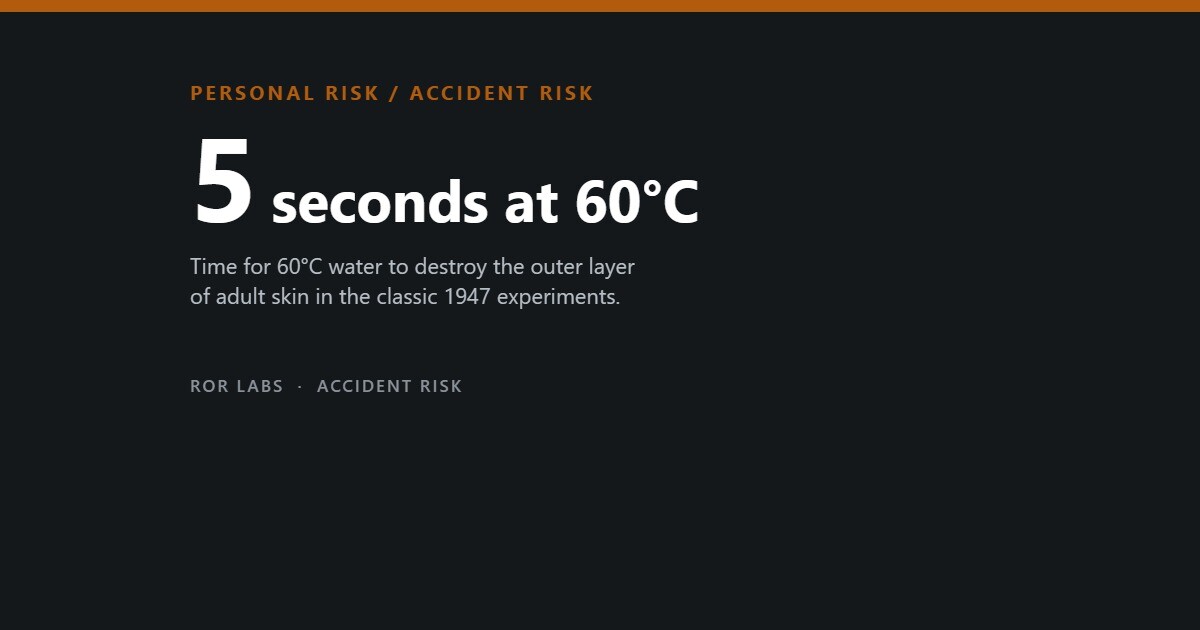
In 1947 Alan Moritz and Frederick Henriques published a set of experiments that still shape the rules on how hot a bath tap may run. They held hot water against skin for set periods and recorded when the outer layer died. At 44°C it took about six hours. At 60°C it took about five seconds. Between those two numbers sits almost everything there is to know about scalds.
Scalds are burns from hot liquid or steam, and they are the most common burn in small children. The World Health Organization estimates that burns of all kinds cause about 180,000 deaths a year, mostly in low- and middle-income countries, and that children and women are usually burned in domestic kitchens.
This article sets out what the research shows about how quickly hot water damages skin, who is most often hurt, why hot drinks matter more than tap water for toddlers, what happened when governments turned water heaters down, why that collides with the need to control Legionella bacteria, and what the evidence says about first aid.
Seconds, not minutes
Moritz and Henriques worked mostly on pigs, with some tests on human volunteers. Below 44°C, injury developed only very slowly. Above it, the time needed to kill the full thickness of the epidermis shrank fast. A 2011 paper summarising their data put the shortest times at nine minutes for 49°C, thirty seconds for 55°C and five seconds for 60°C. A few degrees turn an hour of safety into a few seconds.
How long hot water takes to damage adult skin
Shortest exposure that destroyed the full thickness of the epidermis in the 1947 experiments. Bars are on a logarithmic scale.
Sources: Moritz AR, Henriques FC, American Journal of Pathology 23:695–720 (1947), as summarised by Hartley D et al., Eplasty 11 (2011). Mostly pig skin; adult values.
That chart is the most quoted in scald prevention, so it is worth knowing what it measures. The end point was death of the epidermis, the outer layer, in adult skin. Many leaflets turn the same figures into “third-degree burns”, which go deeper. A 2013 Canadian paper quoted ranges rather than single values: five to ten minutes at 49°C, ten to thirty seconds at 55°C and two to five seconds at 60°C. Children’s skin is thinner, and a 2022 British study noted that even shorter exposures or lower temperatures produce similar burns in children. The thresholds are a gradient, not a cliff, and they shift with age.
Who gets scalded
Hot tap water is a minority of scalds, but it causes some of the worst. A study of US hospital databases for 2016 to 2018 found 52,088 emergency department visits, 7,270 hospital admissions and 110 hospital deaths caused by tap water scalds. The direct cost of the first hospital encounters was about $236 million, and Medicare, the insurer for most Americans over 65, paid $109.54 million of it. More than a third of admitted patients had burns on several parts of the body.
Tap water scalds in the United States, 2016–2018
Hospital-treated injuries over three years, weighted national estimates.
Source: Shields WC et al., Injury Prevention (2023), doi:10.1136/ip-2022-044622, using the National Inpatient Sample and Nationwide Emergency Department Sample.
The pattern repeats elsewhere. When the UK government prepared new building rules, its impact assessment counted about 15 deaths a year in England and Wales from hot tap water, using 2003 to 2005 data, and 767 serious scalds leading to hospital admission in 2006–07. All the deaths and 93% of the severe injuries came from bath taps.
The people hurt are mostly those who cannot move away quickly or cannot feel the heat. A 1981 review of tap water scalds in one Wisconsin county found that 52% of patients were under five, 9% were over 65 and 30% had a disability. A British burns unit that reviewed its admissions from 2016 to 2020 found the balance had shifted: 11 of 23 patients (47.8%) were over 65, 78.3% were hurt by bath immersion and 82.6% of injuries were unwitnessed.
The cup within reach
For toddlers, the bath is not the main danger. The cup is. An Irish paediatric emergency department that reviewed 161 scalds in 2008 found that 65% were caused by hot drinks, 16% by hot water and 10% by hot food; 79% of the children were under five. A Cardiff University campaign in 2019 reported that hot drinks cause 60% of hospital admissions for burns in British children under three. Across 13,460 children admitted with thermal injuries in Germany and Austria between 2006 and 2015, scalds made up 74.4% and almost half the children were between one and three years old.
What caused scalds in children at one emergency department
Share of 161 scalds seen in an urban paediatric emergency department in Ireland, 2008.
Source: Yates J, McKay M, Nicholson AJ, Irish Medical Journal (2011). One hospital; other centres report different splits, but hot drinks lead in most.
The mechanism rarely varies. In a series of 152 children treated for hot drink scalds at an Australian burns centre, the median age was 17.5 months, 70% had pulled the drink down on themselves and 80% of the injuries were witnessed by a parent or carer. A 1994 study that measured how cups cool found that a drink could still cause significant damage up to 11 minutes after it was poured. A mug at the edge of a table holds water far hotter than any regulated tap.
Severity can change even when the numbers do not. When the same Brisbane centre compared 2013 with 1999–2002, hot drinks still caused 18% of its children’s burns, but admissions had fallen from 52% to 11% and skin grafts from 18% to 5%. A 2015 overview found no consistent evidence that home safety programmes changed how families handled hot drinks.
Turning the heater down
The idea of turning the heater down came from a Seattle paediatrician. In 1978 Kenneth Feldman and colleagues reported that hot tap water caused 7% to 17% of the childhood scalds needing hospital care. In 45% of their cases an unsupervised child or a playmate had turned on the tap; in 28% the cause was abuse. When they measured bath water in homes, 80% ran at 54°C or hotter, enough to cause a full-thickness scald in about 30 seconds.
They proposed a passive fix that needed nobody to remember anything: sell new water heaters already set lower. Washington State passed a law in 1983 requiring new heaters to be preset at 49°C. Five years later the same group went back. In 1977, 80% of homes had tap water above 54°C; by 1988, 77% were below it, and the mean temperature had fallen from 61°C to 50°C. Few people turned their heaters back up.
Before and after the Washington State preset law
Home tap water temperatures and child admissions for tap water burns in the study hospitals.
Homes with tap water above 54°C: 80%
Mean tap temperature: 61°C
Child admissions: 5.5 a year
Homes below 54°C: 77%
Mean tap temperature: 50°C
Child admissions: 2.4 a year
Source: Erdmann TC, Feldman KW, Rivara FP et al., Pediatrics 88(3):572 (1991). Before-and-after comparison without a control group; 18 patients in the later period.
Burned children in the later period also had smaller burns, fewer grafts and fewer deaths. But the study rests on 18 patients over nine years, compares two periods rather than two groups, and cannot separate the law from education campaigns running at the same time. One finding cuts the other way. The share of tap water scalds caused by abuse rose to 50%, because a heater setting prevents accidents better than it prevents deliberate harm.
Education alone has a poorer record. In a mass-media campaign that reached two million people, awareness of the danger rose from 72% to 89%, but no more people tested or lowered their water temperature.
Valves, codes and what changed
A thermostatic mixing valve sidesteps part of the problem. Water can be stored hot, and the valve blends in cold water so that what comes out of the tap stays below a set limit. The building rules for England and Wales, revised in 2009, require the hot water supply to a bath in a new dwelling to be limited to no more than 48°C, which in practice means fitting such a valve. The government’s impact assessment estimated that the benefits would outweigh the costs by more than two to one, a net £31.3 million over ten years. Existing homes are not covered.
Ontario took a similar step in 2004, limiting hot water to 49°C in new and renovated homes. Researchers counted 6,952 tap water scalds, including 408 hospital admissions, between 2002 and 2010. Emergency and outpatient cases fell after the rule, but hospital admissions did not change significantly, and neither did length of stay. The authors noted that they had little data from before the rule and that water heaters last about ten years, so most homes had not yet been affected.
Devices fail too: in a 1993 pilot, anti-scald devices on bath taps worked, but all but one were removed within nine months because sediment blocked the flow. A 2015 overview of 39 primary studies found that education with thermometers or mixing valves helped families reach a safe water temperature, but only two studies had measured whether scalds fell.
The Legionella trade-off
Water heaters are not set hot by accident. Legionella bacteria, which cause a severe pneumonia called Legionnaires’ disease, grow in warm water and spread in the spray from taps and showers. Britain’s Health and Safety Executive says hot water should be stored at 60°C or more to kill the bacteria, and that outlets should reach at least 50°C within a minute of running. Those are exactly the temperatures that scald in seconds.
The household evidence comes largely from Quebec. A study of 211 randomly selected homes, published in 1991, found Legionella in 39% of those with electric water heaters and in none of the 33 with oil or gas heaters. In a companion study of 255 heaters, 23% of tap samples were contaminated when the water was below 56°C, against one of 161 samples above it.
Legionella in household tap water, by temperature
Tap water samples from domestic water heaters in Quebec that grew Legionella pneumophila.
Source: Dewailly E, Joly JR (1991), doi:10.1002/tox.2530060213. Contamination of the bacteria in a tank is not the same as disease in a person.
Laboratory work adds nuance. In a pilot-scale rig published in 2015, raising the heater from 39°C to 51°C cut Legionella in recirculating lines by a factor of 28.7, but the bacteria persisted at up to 58°C. In a study published in 2026, Dutch investigators identified 23 cases of Legionnaires’ disease, 21 of them in people who had installed one brand of residential water heater in the previous six months; none of 31 controls had recently installed a heater. The odds ratio was 542, with a confidence interval from 25 to 11,854, which shows how small the numbers are.
This is the real tension. In 2004 Quebec researchers questioned a campaign to turn domestic heaters down to 49°C, noting that those most at risk of Legionnaires’ disease are older people, smokers and people with weak immune systems; older people are also among those most at risk of scalds. The engineering compromise is to store water hot and mix it down near the tap, though the pipe after a mixing valve carries warm water, which is why the HSE says such runs should not exceed two metres. The scald-law evaluations above did not measure Legionnaires’ disease, so the two risks have never been counted in the same homes.
Twenty minutes of cool water
The NHS advises holding a burn or scald under cool running water for 20 minutes, as soon as possible and within three hours, and not using ice, creams, oils or butter. The WHO also advises cool running water but warns against prolonged cooling, which can cause hypothermia.
The best-known evidence for the 20-minute rule is a cohort of 2,495 children treated at a children’s hospital in Queensland, Australia, between 2013 and 2016, published in 2020 in the Annals of Emergency Medicine. It was observational, not a randomised trial. 90.6% of the children had some running water, but only 71.3% had 20 minutes within three hours. 9.5% needed skin grafts. After adjustment, adequate cooling was associated with lower odds of grafting (odds ratio 0.6), full-thickness depth (0.4), hospital admission (0.7) and operations (0.7), but not with a shorter stay.
What the first-aid studies measured
None of these studies was randomised. Cooling is linked to less severe burns; how long to cool is less certain.
| Study | Design | Comparison | Result |
|---|---|---|---|
| Nguyen 2002, Vietnam | 695 children, case series | Immediate cooling vs none | Deep burns 33% vs 49% |
| Griffin 2020, Australia | Cohort, 2,495 children | 20 min within 3 h vs less or none | Odds of grafting 0.6 |
| Djärv 2022 | Review of 4 observational studies | 20 min or more vs under 20 min | No benefit shown; very low certainty |
| Frear 2020, Australia | Cross-sectional, 4,537 children | Care given at the scene | 33.1% adequate; 13.1% used ice |
Sources: Nguyen NL et al., Burns (2002); Griffin BR et al., Ann Emerg Med 75(1):75–85 (2020); Djärv T et al., Burns 48(2):251–262 (2022); Frear CC et al., Emerg Med Australas (2020), doi:10.1111/1742-6723.13686.
A systematic review published in 2022 asked a narrower question: is 20 minutes better than less? Across four observational studies it found no benefit for burn size, depth, healing or grafting, rated the evidence as very low certainty and concluded that the optimal duration is unknown. That does not undercut cooling itself. A Vietnamese series of 695 children found deep burns in 33% of those cooled immediately against 49% of those who were not. The practical gap is elsewhere: in a separate study of 4,537 children at the same centre, only 33.1% got adequate cooling at the scene, and 13.1% of carers reached for ice.
What the evidence suggests
Three points are well supported. Skin damage depends on temperature and time together, and a few degrees above 50°C turn minutes into seconds, faster still for children. Hot drinks, not taps, cause most scalds in toddlers, and the injury usually happens within reach of an adult. And passive measures, such as heaters preset lower or mixing valves on baths, beat education at getting tap water down to safer temperatures, though evidence that they cut the most serious injuries is thinner than the Washington study suggests. Legionella means the answer is not simply “turn it down”; storing hot and limiting what reaches the bath is the usual compromise. For first aid, cool running water helps; 20 minutes is a sensible target, not a proven threshold.
Questions people ask
How hot does water have to be to scald?
Damage starts around 44°C with hours of contact. In the classic experiments adult skin was damaged in about nine minutes at 49°C and five seconds at 60°C. Children burn faster.
What is the most common cause of scalds in young children?
Hot drinks. Studies from Ireland, Britain and Australia find that toddlers pulling a cup of tea or coffee onto themselves is the leading cause.
Is it safe to turn my water heater down?
It reduces scald risk, but water stored below about 60°C can grow Legionella. Many rules now keep storage hot and limit the outlet temperature with a mixing valve. A qualified installer can advise.
How long should I cool a burn?
The NHS advises 20 minutes of cool running water within three hours. Cooling clearly helps; whether 20 minutes beats a shorter time is not proven. Avoid ice.
What temperature is bath water limited to in new homes in England?
No more than 48°C at the bath, under building rules revised in 2009. Older homes are not covered.
The short version
- In the classic 1947 experiments, water at 44°C took about six hours to destroy the outer layer of skin. At 49°C it took about nine minutes, at 55°C thirty seconds and at 60°C five seconds.
- Hot drinks cause most scalds in toddlers. Hot tap water causes fewer but larger ones: 52,088 US emergency visits and 110 hospital deaths in 2016–2018.
- After Washington State made new water heaters ship at 49°C in 1983, mean tap temperature fell from 61°C to 50°C and child admissions for tap water burns in the study hospitals fell from 5.5 to 2.4 a year.
- Lukewarm tanks that prevent scalds can grow Legionella. The usual compromise is to store water at 60°C and mix it down near the tap.
- Twenty minutes of cool running water was linked to fewer skin grafts in 2,495 children, but a review could not confirm that 20 minutes beats a shorter time.
This article summarises published research and public-health guidance for general information. It is not medical advice. If a burn is large or deep, is on the face or genitals, or you are unsure how serious it is, contact a doctor or emergency services.
Further reading: Erdmann et al., Pediatrics 88(3) (1991), for the Washington preset law. Clouatre et al., Journal of Burn Care & Research 34(2) (2013), for an honest look at what a later temperature rule did and did not change. Djärv et al., Burns 48(2) (2022), for the limits of the 20-minute evidence.
- There Are No Accidents, Jessie Singer (2022). A journalist’s argument that injuries called accidents follow predictable patterns set by design, law and money. The best background on why passive fixes such as preset water heaters work better than warnings; it is a polemic, and US-focused.
- The Remarkable Life of the Skin, Monty Lyman (2019). A doctor’s tour of the body’s largest organ, from its layers to how it senses heat. Useful for understanding what a burn actually destroys; burns are only a small part of the book.
- How to Make the World Add Up, Tim Harford (2020). Ten rules for reading statistics without being fooled. Helpful for questions like what a famous threshold really measured; it has nothing specific to say about burns.
Sources
Moritz AR, Henriques FC. American Journal of Pathology 23:695–720 (1947). — Hartley D, McCarthy A, Greenwood JE. Eplasty 11 (2011). — Loo YL et al. International Journal of Medical Science and Clinical Invention (2018). — Clouatre E et al. Journal of Burn Care & Research 34(2):243–248 (2013), doi:10.1097/BCR.0b013e3182789057. — Prokopenko MI et al. European Burn Journal 3(2) (2022), doi:10.3390/ebj3020031. — World Health Organization, Burns fact sheet (13 October 2023). — Shields WC et al. Injury Prevention (2023), doi:10.1136/ip-2022-044622. — Explanatory Memorandum to the Building and Approved Inspectors (Amendment) Regulations 2009, SI 2009/1219. — Katcher ML. JAMA 246:1219–1222 (1981). — Yates J, McKay M, Nicholson AJ. Irish Medical Journal (2011). — Cardiff University, SafeTea campaign release (16 October 2019). — Tegtmeyer LC et al. Burns (2017), doi:10.1016/j.burns.2017.05.013. — Dewar DJ et al. Journal of Burn Care & Rehabilitation (2004), doi:10.1097/01.BCR.0000124821.22553.24. — Ramanathan C, Ekpenyong L, Stevenson JH. Burns (1994). — Burgess J et al. Journal of Burn Care & Research (2016), doi:10.1097/BCR.0000000000000267. — Zou K et al. Burns 41:907–924 (2015). — Feldman KW et al. Pediatrics 62(1):1–7 (1978). — Erdmann TC et al. Pediatrics 88(3):572 (1991). — Katcher ML. American Journal of Public Health 77(9):1195 (1987). — Fallat ME, Rengers SJ. Journal of Trauma (1993), doi:10.1097/00005373-199304000-00013. — Health and Safety Executive, Legionnaires’ disease: hot and cold water systems (accessed October 2026). — Alary M, Joly JR. Applied and Environmental Microbiology 57(8):2360 (1991). — Dewailly E, Joly JR (1991), doi:10.1002/tox.2530060213. — Rhoads WJ et al. Microbiome (2015), doi:10.1186/s40168-015-0134-1. — Reukers DFM et al. Emerging Infectious Diseases 32(7) (2026), doi:10.3201/eid3207.260171. — Lévesque B, Lavoie M, Joly J. Canadian Journal of Infectious Diseases and Medical Microbiology (2004). — NHS, Burns and scalds (reviewed 31 March 2026). — Griffin BR et al. Annals of Emergency Medicine 75(1):75–85 (2020), doi:10.1016/j.annemergmed.2019.06.028. — Djärv T et al. Burns 48(2):251–262 (2022), doi:10.1016/j.burns.2021.10.007. — Nguyen NL et al. Burns (2002), doi:10.1016/S0305-4179(01)00094-8. — Frear CC, Griffin BR, Kimble RM. Emergency Medicine Australasia (2020), doi:10.1111/1742-6723.13686.