Multi-Level Marketing: What the Evidence Shows
Key takeaways · 11 min read
- 47% of US MLM participants lost money and 27% broke even; a quarter made a profit, usually small.
- Participation is higher where women are outside paid work, but losses are larger where inequality is higher.
- Recruitment runs through friends and family, and 39% of those who quit found pitching them awkward.
- Income disclosures lower expectations but barely change interest in joining.
The invitation usually comes from someone you know. A friend from school, a cousin, a neighbour from the playground. They have found something that fits around the children, lets them be their own boss, and pays for itself if you share it with a few people. Would you like to hear more?
This is multi-level marketing, or MLM. Participants buy products from a company, sell some to customers, and earn commission both on their own sales and on the sales of people they recruit, who in turn recruit others. More than 20 million Americans are estimated to have taken part at some point.
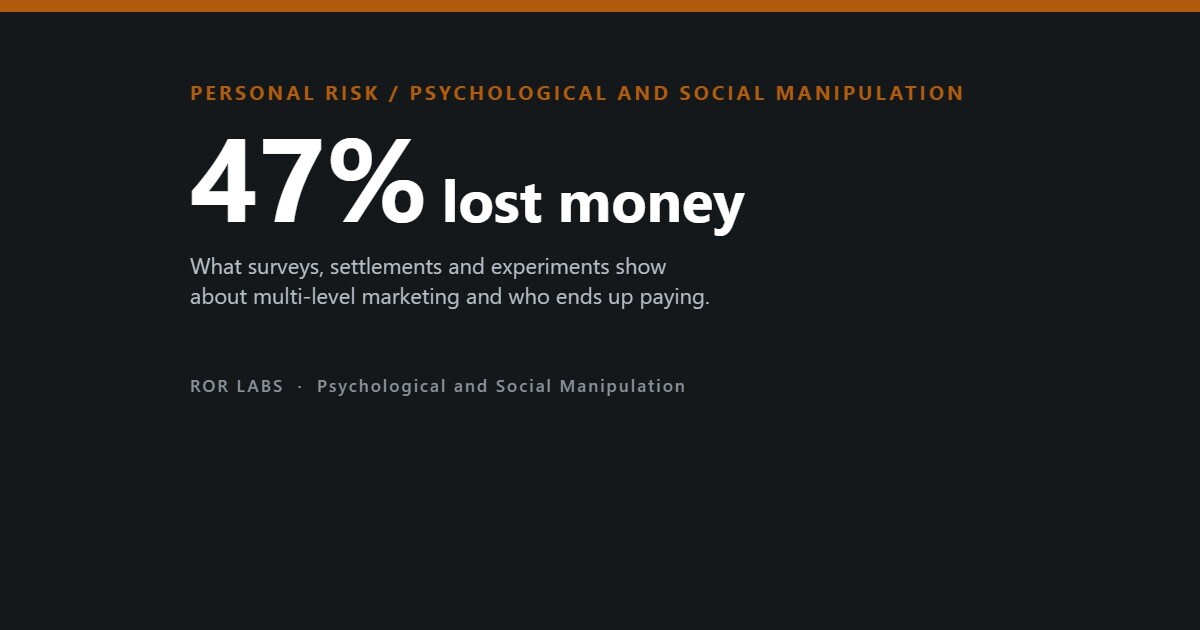
The companies describe it as a flexible small business. Consumer advocates describe it as a system in which almost everyone loses money. The research is clearer than on many consumer finance questions, but it is also thinner than it should be. The figure to hold on to comes from the first nationally representative US survey: 47% of participants lost money, and another 27% made nothing.
What participants actually earn
In 2018 the AARP Foundation commissioned the first nationally representative survey of MLM participation in the United States, led by Marguerite DeLiema, Stephen Bosley and Doug Shadel. It surveyed 1,016 people, 601 of whom were current or former MLM sellers, and ran four focus groups.
Of those who had taken part, 47% said they lost money, 27% said they broke even, and 25% said they made a profit. Of those who made a profit, more than half earned less than $5,000 over the whole time they were involved. Two-thirds said they would not rejoin the same company, and 62% said they would not join any MLM again.
Those figures are self-reported, and people may misremember or be reluctant to admit losses. But they are broadly consistent with the income disclosures that some companies publish themselves, which typically show that most participants earn little or nothing in a given year.
Some critics cite far starker numbers. The consumer advocate Jon Taylor, in a report submitted to the Federal Trade Commission, estimated that about 99% of MLM participants lose money once expenses are counted. That estimate is widely quoted but it is not peer-reviewed, and it depends on assumptions about costs that different analysts would make differently. The AARP survey is the more conservative source.
What MLM participants said they earned
Current and former participants, nationally representative US survey.
AARP Foundation, Study of Multilevel Marketing, 2018 (DeLiema, Bosley and Shadel; fieldwork by GfK). Of those with a profit, more than half made less than $5,000 in total.

Why the structure matters
An MLM is legal in the United States if participants earn their money mainly from selling products to real customers. It becomes an illegal pyramid scheme when the rewards come mainly from recruiting others, who pay to join or must buy products to stay qualified for commission.
The line is harder to draw than it sounds. Many MLMs require participants to buy a minimum amount of product each month to stay ‘active’ and eligible for bonuses. When participants buy mostly for themselves, the company’s sales are real, but the money is coming from the sales force rather than from outside customers.
Economic theory helps explain why the structure attracts concern. Yair Antler, in a 2023 paper in Theoretical Economics, modelled MLM compensation plans and showed that a company can make a profit even when participants understand the odds and the product has no value of its own. To do so, it needs two things: a fee to join and commission paid on at least two levels of recruits below each participant. Companies with a genuinely good product and well-informed participants, the model suggests, have little reason to use either.
Claudia Groß and Dirk Vriens, in a 2025 paper in the Journal of Public Policy and Marketing, studied how MLM companies push their own participants to buy. Their title summarises the finding: participants are pressed repeatedly to purchase products, which can make them a company’s main customers rather than its sales force.
Where the legal line falls
How US regulators distinguish a lawful MLM from a pyramid scheme, in simplified form.
| Feature | Lawful MLM | Pyramid scheme |
|---|---|---|
| Main source of rewards | Sales to real customers | Recruitment and joining fees |
| Who buys the product | Mostly outside customers | Mostly participants themselves |
| Minimum purchases | Not needed to earn | Required to stay eligible |
| Earnings claims | Typical results disclosed | Top earners presented as normal |
Federal Trade Commission, Business Guidance Concerning Multi-Level Marketing. A summary, not a legal test.
How the costs add up
Most MLM losses are not dramatic. They build up from ordinary costs that are easy to underestimate at the start.
A typical path, as consumer advocates describe it, starts with a starter kit, followed by a monthly purchase to stay active and qualify for commission. Then come samples, shipping, events and training, and sometimes a website or app subscription. Each looks small. Together they can easily exceed what a new participant earns from sales.
Consider a hypothetical example, not taken from any particular company. A participant who spends $100 a month on qualifying purchases and another $50 on samples, shipping and events spends $1,800 a year. To break even on a 25% retail margin, they would need to sell $7,200 of product a year to outside customers, about $600 a month, before counting their time.
That arithmetic is why many analysts focus on the monthly purchase requirement rather than the product. If staying active requires buying more than one can realistically sell, the participant becomes the customer.
Who joins, and why
The AARP survey found that people usually join through someone they know. About a third were recruited by a friend and 12% by a family member. Most said they joined to earn money, and about 63% said they wanted to make money selling to others.

Claes Bäckman and Tobin Hanspal used data from a Federal Trade Commission settlement with one of the largest MLMs, covering about 350,000 people who received refunds, and linked it to county-level information. They found that claimants were more common in counties with higher median income and where more women were outside the labour market. That suggests the promise of flexible work around family responsibilities is a real draw. But larger losses were concentrated in counties with more inequality and less social capital, which suggests the costs fall hardest on more vulnerable groups.
Personal beliefs also play a role. Katharine Howie and colleagues, in Acta Psychologica in 2024, used the same FTC data, covering 326,487 people, together with a survey of 515 consumers. They found that people who strongly endorse the Protestant work ethic, the belief that hard work leads to success, were more likely to take part. The finding fits the way MLMs present themselves: as a business where effort, not luck, determines income.
Where MLM refund claimants lived
County-level analysis of about 350,000 claimants in an FTC settlement.
Bäckman C, Hanspal T, Financial Planning Review, 2022.
The social cost of selling to friends
MLMs rely on personal networks. That is part of what makes them effective, and part of why leaving is hard.
In the AARP survey, 39% of people who quit said it was because they felt awkward pitching to friends and family. 41% said the company had misled them about their chances of financial success.
Recruiting through friendship turns a commercial relationship into a social one. A recruit who is struggling may feel that admitting losses would reflect badly on the friend who brought them in, and on themselves. Upline mentors often frame failure as a lack of effort or belief, which fits the work-ethic appeal Howie’s team identified and can keep people buying stock long after the numbers stopped working.
This is one reason MLM appears in this site’s section on manipulation and groups. The risk is not only financial. It is the way the model uses trust, identity and group belonging to sell a business opportunity that most people will lose money on.
Why participants left, and what they would do now
Current and former MLM participants, AARP survey.
AARP Foundation, Study of Multilevel Marketing, 2018.
Does telling people the odds help?
If the problem is unrealistic expectations, the obvious fix is disclosure: make companies publish what their participants actually earn.
The evidence on this is disappointing. In an experiment published in the Journal of Consumer Affairs, Mariah Miller, Stephen Snyder and Stephen Bosley showed participants income disclosure statements of the kind some MLMs publish. The disclosures lowered people’s expectations of what they would earn. But they did little to change people’s interest in joining.
That is a familiar pattern from other areas of consumer protection. People may accept that most participants lose money while believing that they, with enough effort, will be among the minority who succeed.
There is also a question about the research itself. In a 2025 review, Claudia Groß and William Keep compared how MLMs are discussed in law journals and in top marketing journals. They found that marketing research tended to present MLM in a more positive light, underplaying deceptive earnings claims and participant losses, and that authors with industry affiliations had a substantial influence on that literature.
What regulators have done
The largest US enforcement case in recent years involved Herbalife. In July 2016 the company agreed to pay $200 million and restructure its business to settle Federal Trade Commission charges that it had made deceptive earnings claims. In January 2017 the FTC sent refund checks to nearly 350,000 people who had operated Herbalife businesses between 2009 and 2015, invested at least $1,000 and received little in return. Most checks were between $100 and $500.
Since then, the FTC’s ability to win refunds has narrowed. In 2021, in AMG Capital Management v. FTC, the Supreme Court ruled that the agency could not use a key section of its founding statute to obtain monetary relief. That made cases like Herbalife’s harder to repeat.
In January 2025 the FTC proposed a new Earnings Claim Rule for multi-level marketers. It would bar deceptive earnings claims and require companies to hold written evidence for any claim they make about what participants can earn. The agency also asked for comments on whether MLMs should have to disclose typical earnings, observe waiting periods before taking payment, and stop using gag clauses that prevent participants from speaking about their experience. As of this writing, the proposal has not been finalised. Legal commentators noted at the time that its future was uncertain, because the proposal was issued in the final week of one administration and the Commission’s leadership changed shortly afterwards. Whatever happens to it, the proposal is a clear statement of what the regulator sees as the core problem: earnings claims that most participants will never match.
The Herbalife settlement in numbers
Federal Trade Commission, 2016 to 2017.
Federal Trade Commission press release, January 2017. Most checks were between $100 and $500; the largest exceeded $9,000.

What the evidence does not show
It does not show that no one makes money in MLM. About a quarter of AARP respondents reported a profit, though for most of them it was small.
It does not show that every MLM is a pyramid scheme. The legal line depends on where the money comes from, and companies differ.
It does not rest on large independent data sets. The best US evidence is one national survey and data from one FTC settlement, and much of the marketing literature has industry ties.
And it does not show that disclosure alone protects people. Telling people the odds lowers expectations, but in experiments it barely changed interest in joining.
Questions people ask
Do most people lose money in MLM?
In a nationally representative US survey, 47% of participants lost money and 27% broke even. A quarter made a profit, mostly under $5,000 in total.
Is MLM the same as a pyramid scheme?
Not legally. An MLM becomes an illegal pyramid scheme when rewards come mainly from recruitment rather than genuine retail sales, but the line can be hard to draw.
Why do people join MLMs?
Mostly to earn money, often around family responsibilities. Most are recruited by a friend or relative.
Do income disclosure statements help?
They lower earnings expectations, but in one experiment they barely changed people’s interest in joining.
What is the FTC doing about MLMs?
In January 2025 it proposed an Earnings Claim Rule that would require MLMs to back up any earnings claims with written evidence. It has not been finalised.
The short version
- 47% of US MLM participants lost money and 27% broke even; a quarter made a profit, usually small.
- Participation is higher where women are outside paid work, but losses are larger where inequality is higher.
- Recruitment runs through friends and family, and 39% of those who quit found pitching them awkward.
- Income disclosures lower expectations but barely change interest in joining.
- Herbalife paid $200 million in 2016; a proposed FTC Earnings Claim Rule for MLMs is still pending.
This article summarises published research and public records on multi-level marketing. It is not financial or legal advice, and it does not refer to any company beyond those named in public enforcement actions. If you are considering an MLM opportunity, the FTC’s consumer guidance on multi-level marketing is a useful starting point.
Further reading. DeLiema, Bosley and Shadel, AARP Study of Multilevel Marketing, 2018, is short and readable. Groß and Keep, ‘The law and consumer harm in multi-level marketing: a review’, 2025, explains why academic writing on MLM has been so divided.
- Selling the Dream, Jane Marie (2024). A journalist’s history of multi-level marketing in America, from its origins to social media.
- Hey, Hun, Emily Lynn Paulson (2021). A former top-level MLM seller on how the business works from the inside and why she left.
- Cultish, Amanda Montell (2021). A linguist on the language of groups that demand loyalty, with a chapter on MLMs.
Sources
- DeLiema M, Bosley S, Shadel D. AARP Study of Multilevel Marketing: Profiling Participants and Their Experiences in Direct Sales. AARP Foundation, 2018. Press summary: PR Newswire, October 2018.
- Bäckman C, Hanspal T. Participation and losses in multi-level marketing: evidence from a Federal Trade Commission settlement. Financial Planning Review, 2022;5(1):e1137. doi:10.1002/cfp2.1137.
- Howie KM, Mesler RM, Tu K, Chernishenko J. Associations between Protestant work ethic and multilevel marketing participation and financial outcomes. Acta Psychologica, 2024;249:104409. doi:10.1016/j.actpsy.2024.104409.
- Miller M, Snyder S, Bosley S. Income disclosure and consumer judgment in a multilevel marketing experiment. Journal of Consumer Affairs, 2023;57(1):92–120. doi:10.1111/joca.12492.
- Groß C, Vriens D. Buy! Buy! Buy! How multilevel marketing companies pressure their participants to buy their products. Journal of Public Policy and Marketing, 2025;44(4):559–578. doi:10.1177/07439156241301737.
- Groß C, Keep WW. The law and consumer harm in multi-level marketing: a review. 2025. Radboud University repository.
- Antler Y. Multilevel marketing: pyramid-shaped schemes or exploitative scams? Theoretical Economics, 2023;18(2):633–668. doi:10.3982/TE4890.
- Taylor JM. The Case (for and) against Multi-level Marketing. Consumer Awareness Institute, 2011. Submitted to the Federal Trade Commission; not peer-reviewed.
- Federal Trade Commission. Business guidance concerning multi-level marketing.
- Federal Trade Commission. FTC sends checks to nearly 350,000 victims of Herbalife’s multi-level marketing scheme. Press release, January 2017.
- AMG Capital Management, LLC v. Federal Trade Commission, 593 U.S. 67 (2021).
- Federal Trade Commission. FTC proposes rule changes and new rule to deter deceptive earnings claims by multilevel marketers and money-making opportunity sellers. Press release, 13 January 2025.