Folate food sources and the limit set for another vitamin
Key takeaways · 11 min read
- Adults need 400 micrograms DFE a day, 600 in pregnancy. Folic acid counts 1.7 times because it is better absorbed.
- A tablespoon of yeast extract spread holds 882 micrograms DFE, mostly added folic acid; the same kind of jar led to folate’s discovery in 1931.
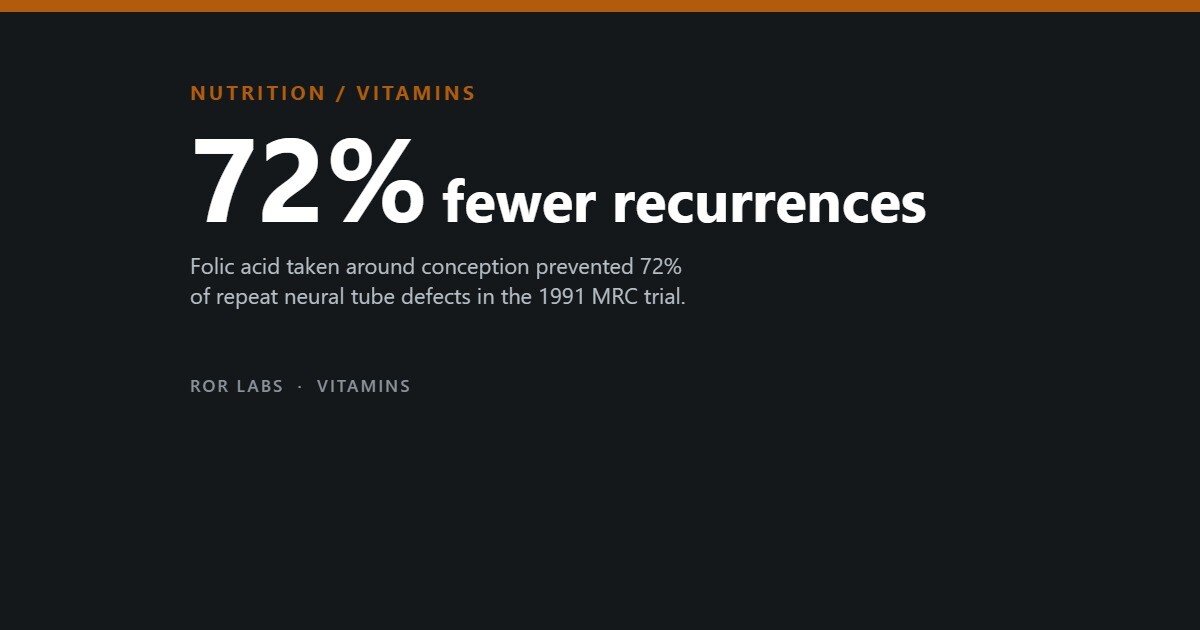
- Folic acid around conception cut repeat neural tube defects by 72% in the MRC trial. Fortification followed; the UK starts in December 2026.
- The 1,000-microgram upper limit exists because folic acid can hide vitamin B12 deficiency, not because it is toxic.
In this article
A tablespoon of yeast extract spread — the dark, salty paste sold as Marmite and under other names — carries 882 micrograms of folate by the standard measure, more than twice the adult daily recommendation. It tops the spoon-by-spoon ranking by a wide margin. Most of that, though, is folic acid the manufacturer added; the yeast itself supplies a small part.
There is a second reason the jar belongs at the top. In 1931 a British doctor, Lucy Wills, found that yeast extract cured a severe anaemia of pregnancy in Bombay. The factor she had found in it turned out to be folate. Sixty years later, a trial showed that folic acid taken around conception prevented most neural tube defects, and flour in dozens of countries has carried it since. The United Kingdom joins them in December 2026.
This article covers what folate does, which foods carry it, the trials that turned a vitamin into public health policy, the unusual reason for its upper limit, and what high doses did in trials.
What folate does, and why it is counted in DFE
Folate is a B vitamin the body needs to make DNA and to divide cells, and it works alongside vitamin B12 to recycle homocysteine into methionine. Rapidly dividing tissue depends on it most, from bone marrow to an embryo in its first weeks. Deficiency causes megaloblastic anaemia — large, immature red cells — along with weakness, fatigue, irritability and a sore tongue, according to the NIH Office of Dietary Supplements.
Folate is the form found naturally in food; folic acid is the synthetic form used in supplements and fortified foods, and the body absorbs them differently. The NIH says only about 50% of food folate is bioavailable, against at least 85% of folic acid taken with food and nearly all of it on an empty stomach. So recommendations are given in dietary folate equivalents, or DFE.
The reference numbers for folate
US recommendations in micrograms of dietary folate equivalents (DFE) per day, with the conversion rules.
Source: NIH Office of Dietary Supplements, folate fact sheet for health professionals.
Average intakes in the United States are above the target — 602 micrograms DFE for men and 455 for women — largely because of fortified grain. About 35% of adults also take a supplement containing folic acid.
Three foods by the spoonful
The series ranks foods by what one level tablespoon, 15 grams, delivers, using USDA per-100-gram values for DFE.
Folate in one level tablespoon (15 g)
USDA FoodData Central, SR Legacy, nutrient 435 (folate, DFE). Percentages are of the 400 µg DFE adult recommendation. FDC identifiers given so the figures can be checked.
Source: USDA FoodData Central. For the spread, 15 g holds 119 µg of food folate and 449 µg of folic acid, which counts 1.7 times.
Yeast extract, baker’s yeast and dry cowpeas are the three, and the familiar pattern returns: nobody eats a tablespoon of baking yeast, and dried beans are weighed before cooking. On its natural folate alone the spread would hold 119 micrograms; its lead comes from added folic acid.
Real servings tell a plainer story. The NIH lists 215 micrograms DFE in three ounces of beef liver, 131 in half a cup of boiled spinach, 105 in half a cup of black-eyed peas, 89 in four spears of asparagus and 78 in half a cup of Brussels sprouts. It also lists 90 in half a cup of cooked white rice — which has almost no folate of its own, and appears because enriched rice in the United States is fortified.
Lucy Wills and the jar
In 1930 and 1931, working at the Haffkine Institute in Bombay, Lucy Wills studied a macrocytic anaemia common among poor pregnant women. It looked like pernicious anaemia under the microscope but had none of its nerve damage. She found that it responded to Marmite and to crude liver extract, and she reasoned that both contained a common factor that the women’s diet lacked.
The key detail: the women did not respond to the purified liver extract then used for pernicious anaemia, which is now known to have been almost pure vitamin B12. So the crude remedies held two separate factors, and Wills had found the second. It was isolated from spinach in 1941 and named folic acid, from the Latin folium, leaf. The story of the first factor is in the vitamin B12 article.
The trials that turned flour into medicine
Neural tube defects — spina bifida, anencephaly and encephalocele — happen in the first four weeks of pregnancy, when the tube that becomes the brain and spinal cord fails to close. Many women do not yet know they are pregnant.
Folic acid and neural tube defects
The trials and the population results. Relative risk below 1.00 means fewer defects.
Source: MRC Vitamin Study Research Group, Lancet (1991); Czeizel and Dudás, NEJM (1992); NIH ODS; Santos et al., Bull World Health Organ (2016).
The Medical Research Council trial settled the question. It randomised 1,817 women in seven countries who had already had an affected pregnancy. Six defects occurred in the folic acid groups and 21 in the others, a 72% protective effect (relative risk 0.28, 95% CI 0.12–0.71). A mix of seven other vitamins did nothing. In Hungary, Andrew Czeizel’s trial of women planning a pregnancy, most for the first time, found no defects among 2,471 offspring in the folic acid multivitamin group and six among 2,391 in the trace-element group.
Because so many pregnancies are unplanned, supplements alone could not reach enough women. The United States required folic acid in enriched grain products from January 1998, at 140 micrograms per 100 grams. The NIH reports a 28% fall in neural tube defects since. In Brazil, after flour fortification became mandatory in 2004, the prevalence among births fell from 0.79 to 0.55 per 1,000.
The newest country is the United Kingdom. Regulations announced in November 2024 require folic acid in non-wholemeal wheat flour at 0.25 milligrams per 100 grams, with a compliance deadline of 13 December 2026. The government estimates about 200 fewer neural tube defects a year and notes that around half of UK pregnancies are unplanned.
Not every analysis agrees on the size of the effect. A 2020 study comparing countries in the Food Fortification Initiative dataset found only a weak link between fortification levels and neural tube defect rates, and a strong one with socioeconomic status. Comparisons between countries cannot separate fortification from everything else that differs. A US case-control study offers the other side: among pregnancies conceived after fortification, supplement use no longer reduced the risk further — which suggests fortified food was already supplying enough.
An upper limit set for another vitamin
Folate has an upper limit of 1,000 micrograms a day, and it applies only to folic acid from supplements and fortified foods, not to folate in food. The reason is not that folic acid is toxic. It is that large amounts can correct the anaemia of vitamin B12 deficiency without stopping the nerve damage. The blood looks better, the warning sign disappears, and the neurological harm continues. A 1954 report already put it plainly: folic acid corrects the blood picture in pernicious anaemia but does not help the neurological complications.
There is a second, less settled concern. The body converts folic acid to active forms slowly, and some circulates unchanged. The NIH notes that single doses of 300 or 400 micrograms produce detectable unmetabolised folic acid in the blood, while 100 or 200 micrograms do not, and that it has been linked to changes in natural killer cells. Whether that matters for health is not known.
What high doses did in the trials
Because folate drives cell division, researchers hoped it might prevent cancer and feared it might feed tumours. The trials found mostly neither.
Folic acid in trials of cancer and stroke
Relative risk or hazard ratio against placebo or control. Below 1.00 favours folic acid.
13 trials, 49,621 people, 5.2 years — all cancers: 1.06 (0.99–1.13)
Three polyp trials pooled — any adenoma: 0.98; advanced: 1.06
Cole 2007, 1 mg/day — advanced lesions: 1.32 (0.90–1.92)
Six trials, prostate cancer: 24% higher
CSPPT 2015, China, 20,702 adults with hypertension, 0.8 mg for a median 4.5 years — first stroke: 0.79 (0.68–0.93)
2.7% against 3.4%
B-vitamin trials pooled: stroke 12% lower, no effect on heart attack
Source: Vollset et al., Lancet 381(9871):1029–1036 (2013); Figueiredo et al., Int J Cancer (2011); Cole et al., JAMA 297(21):2351–2359 (2007); Huo et al., JAMA 313(13):1325–1335 (2015); NIH ODS.
The largest analysis, pooling 13 trials and nearly 50,000 people, found no significant change in overall cancer: 1,904 cancers with folic acid against 1,809 with placebo. A pooled analysis of three large polyp trials found no effect either way. But one of them, the Aspirin/Folate Polyp Prevention Study, reported more advanced lesions with 1 milligram a day — 11.4% against 8.6%, not statistically significant — and, according to the NIH, significantly higher risks of having three or more adenomas and of cancers outside the colon. A meta-analysis of six trials found 24% more prostate cancer in men taking folic acid.
Stroke is the one positive result. In the China Stroke Primary Prevention Trial, adding 0.8 milligrams of folic acid to blood pressure treatment cut first strokes by 21%. China does not require flour fortification and folate levels in the trial population were generally low, so the result may not transfer to countries that fortify.
Keeping folate where it should be
For most adults in countries that fortify, food covers it: leafy greens, beans and peas, asparagus, liver, and fortified grain. The group for whom timing matters is anyone who could become pregnant. The US Preventive Services Task Force recommends a daily supplement with 0.4 to 0.8 milligrams of folic acid, starting at least a month before conception, because the neural tube closes before most people know they are pregnant. Women with a previous affected pregnancy are usually advised a higher dose under supervision.
For everyone else, the limit matters more than the target. Staying under 1,000 micrograms of folic acid a day from supplements and fortified foods, unless a doctor has prescribed more, keeps a B12 deficiency from hiding.
Questions people ask
What is the difference between folate and folic acid?
Folate is the natural form in food; folic acid is the synthetic form in supplements and fortified foods. Folic acid is absorbed better, which is why it counts 1.7 times in dietary folate equivalents.
Which foods are highest in folate?
Per serving, the NIH lists beef liver, boiled spinach, black-eyed peas, fortified cereals and asparagus near the top. Per tablespoon, yeast extract spread leads, mostly because of added folic acid.
Why is there an upper limit for folic acid but not for food folate?
Because the concern is masking vitamin B12 deficiency, and the amounts that do that come from supplements and fortified foods, not from food folate.
Does folic acid cause cancer?
Pooled trials found no significant change in overall cancer, but one polyp trial and a prostate analysis raised concerns about high doses.
When should folic acid be started before pregnancy?
At least a month before conception, which in practice means any time pregnancy is possible. The neural tube closes in the first four weeks.
The short version
- Adults need 400 micrograms DFE a day, 600 in pregnancy. Folic acid counts 1.7 times because it is better absorbed.
- A tablespoon of yeast extract spread holds 882 micrograms DFE, mostly added folic acid; the same kind of jar led to folate’s discovery in 1931.
- Folic acid around conception cut repeat neural tube defects by 72% in the MRC trial. Fortification followed; the UK starts in December 2026.
- The 1,000-microgram upper limit exists because folic acid can hide vitamin B12 deficiency, not because it is toxic.
- High-dose trials found no overall cancer effect, some warnings on polyps and prostate, and fewer strokes where folate was low.
This is a summary of published research, not medical advice. If you could become pregnant, have had a pregnancy affected by a neural tube defect, take a drug that interferes with folate such as methotrexate or certain anti-seizure medicines, or are older or taking metformin and considering high-dose folic acid, talk to your doctor or a registered dietitian first.
Further reading: Hoffbrand and Weir, British Journal of Haematology 113(3):579 (2001), for the history of folic acid from Lucy Wills onward. Vollset et al., Lancet (2013), for the cancer data from the randomised trials. Murphy and Westmark, Nutrients 12(1):247 (2020), for a sceptical reading of fortification’s population effect.
- Extra Life, Steven Johnson (2021). A history of how life expectancy doubled, much of it through unglamorous public health measures of exactly the kind flour fortification is. Broad rather than deep on any single intervention.
- Unwell Women, Elinor Cleghorn (2021). How medicine has understood, and misunderstood, women’s bodies. Relevant to why a defect of early pregnancy took so long to prevent; it is a cultural history, not a clinical guide.
- The Knowledge Machine, Michael Strevens (2020). A philosopher on why science settles questions by insisting on evidence of one kind, the kind the MRC trial supplied. Abstract in places, and rewarding for it.
Sources
NIH Office of Dietary Supplements, folate fact sheet for health professionals: recommended amounts, DFE conversions, bioavailability, the upper limit and its rationale, food-serving values, US fortification level and the 28% fall in neural tube defects, average intakes and supplement use, unmetabolised folic acid, the colorectal adenoma and prostate findings, and the summary of B-vitamin trials on stroke. — USDA FoodData Central, SR Legacy, nutrients 435, 432 and 431; FDC identifiers are printed in the figure. — Wills L. British Medical Journal 1(3676):1059–1064 (1931). — Colman N. Folate deficiency in humans (1977), doi:10.1007/978-1-4613-9928-5_4. — Paul C. BJOG (2016). — MRC Vitamin Study Research Group. Lancet 338(8760):131–137 (1991). — Czeizel AE, Dudás I. New England Journal of Medicine 327(26):1832–1835 (1992). — Santos LMP, Lecca RCR, Cortez-Escalante JJ, et al. Bulletin of the World Health Organization 94(1):22–29 (2016). — UK Department of Health and Social Care, birth defects prevented by fortifying flour with folic acid (14 November 2024); UK Flour Millers, folic acid regulations. — Murphy ME, Westmark CJ. Nutrients 12(1):247 (2020). — Mosley BS, Cleves MA, Siega-Riz AM, et al. American Journal of Epidemiology 169(1):9–17 (2009). — Monto RW. Archives of Internal Medicine (1954), doi:10.1001/archinte.1954.00240260055005. — Vollset SE, Clarke R, Lewington S, et al. Lancet 381(9871):1029–1036 (2013). — Figueiredo JC, Mott LA, Giovannucci E, et al. International Journal of Cancer 129(1):192–203 (2011). — Cole BF, Baron JA, Sandler RS, et al. JAMA 297(21):2351–2359 (2007). — Huo Y, Li J, Qin X, et al. JAMA 313(13):1325–1335 (2015). — US Preventive Services Task Force. JAMA 330(5):454–459 (2023).