Vitamin B12 food sources and the gate that takes two micrograms
Key takeaways · 10 min read
- Adults need 2.4 micrograms a day. There is no upper limit.
- A tablespoon of cooked clams holds 14.8 micrograms, more than six days’ worth; liver is close behind.
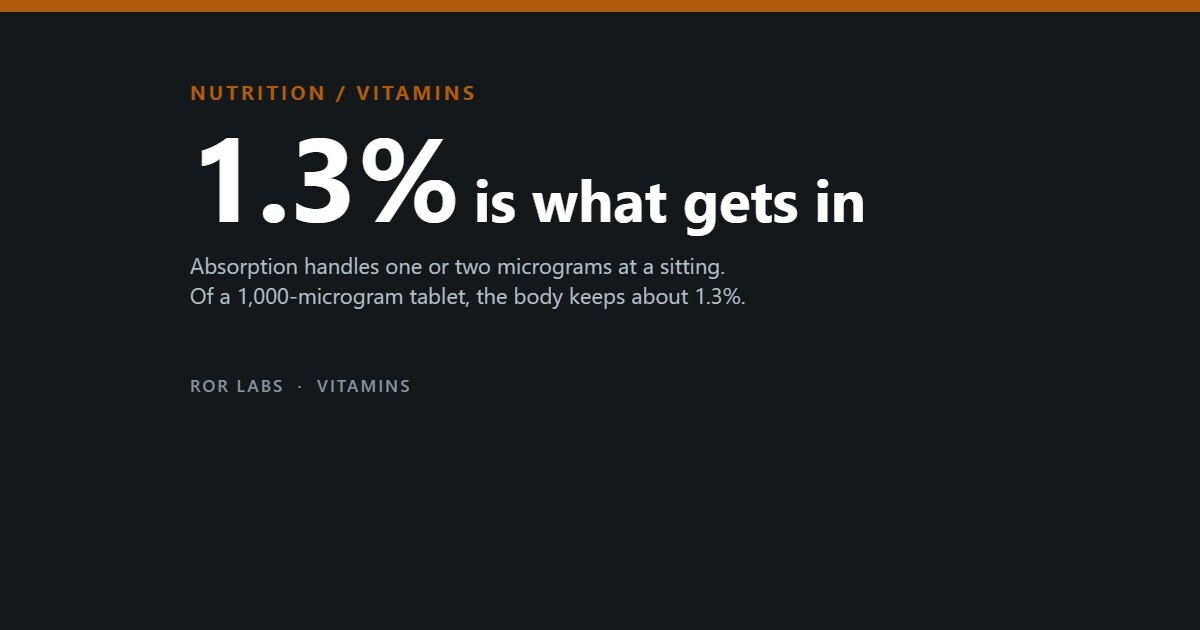
- Absorption runs through intrinsic factor and handles about 1 to 2 micrograms at a time; at 1,000 micrograms only 1.3% is absorbed.
- Deficiency mostly comes from the gut, not the diet: pernicious anaemia, low stomach acid, metformin, acid-suppressing drugs, surgery — and a vegan diet without supplements.
A tablespoon of cooked clams holds 14.8 micrograms of vitamin B12. The recommended amount for an adult is 2.4 micrograms a day, so that one spoonful carries more than six days’ worth. For most nutrients in this series, the tablespoon ranking puts a spice or a baking ingredient at the top. For B12 it puts real food there — clams and liver — and nothing on the list is strange.
The trouble starts after the spoon. The gut takes up B12 through a narrow gate that handles only a microgram or two at a sitting. Push more through and the share absorbed collapses: at a 1,000-microgram tablet dose, the kind sold in every pharmacy, the body keeps about 1.3%. The foods are easy. The absorption is not, and it is the absorption that fails in most people who run short.
This article covers what B12 does, which foods carry it, how the absorption gate works and who loses it, the liver diet that won a Nobel Prize, and what large doses do and do not fix.
What vitamin B12 does, and how much you need
Vitamin B12, or cobalamin, is needed to make red blood cells and DNA and to keep nerves working. The NIH Office of Dietary Supplements lists the results of running short: megaloblastic anaemia, fatigue, a sore tongue, pale skin, numbness and tingling in the hands and feet, and in time memory problems and dementia. It also notes that these symptoms can take several years to appear.
The reference numbers for vitamin B12
US dietary reference intakes and average intakes from food, in micrograms per day.
Source: NIH Office of Dietary Supplements, vitamin B12 fact sheet for health professionals.
There is no upper limit. The Food and Nutrition Board did not set one because of B12’s low potential for toxicity. On paper, most Americans are covered: only 5% of men and 11% of women get less than the estimated average requirement of 2 micrograms from food and drink. The gap between that and the number who end up deficient is a story about the gut, not the plate.
Three foods by the spoonful
The series ranks foods by what one level tablespoon — 15 grams — delivers, using USDA per-100-gram values.
Vitamin B12 in one level tablespoon (15 g)
USDA FoodData Central, SR Legacy, nutrient 418. Percentages are of the 2.4-microgram adult recommendation. FDC identifiers given so the figures can be checked.
Source: USDA FoodData Central. Arithmetic on the per-100 g values: 15 g is 0.15 of the listed figure.
Clams, veal liver and lamb liver are the three, with beef liver close behind. Every one is a food people actually eat. The NIH’s own table lists 70.7 micrograms in three ounces of beef liver, 17 in three ounces of clams, 2.6 in the same weight of salmon, 1.3 in a cup of milk and 0.5 in a large egg.
What the table does not show is what is missing from it. B12 is made by microbes, not plants, and the NIH lists no unfortified plant food as a source. Nutritional yeast appears in its table only because much of it is fortified, at 8.3 to 24 micrograms per quarter cup depending on the brand. Anyone who eats no animal products gets B12 from fortified foods or supplements, or not at all.
The gate: a microgram or two at a time
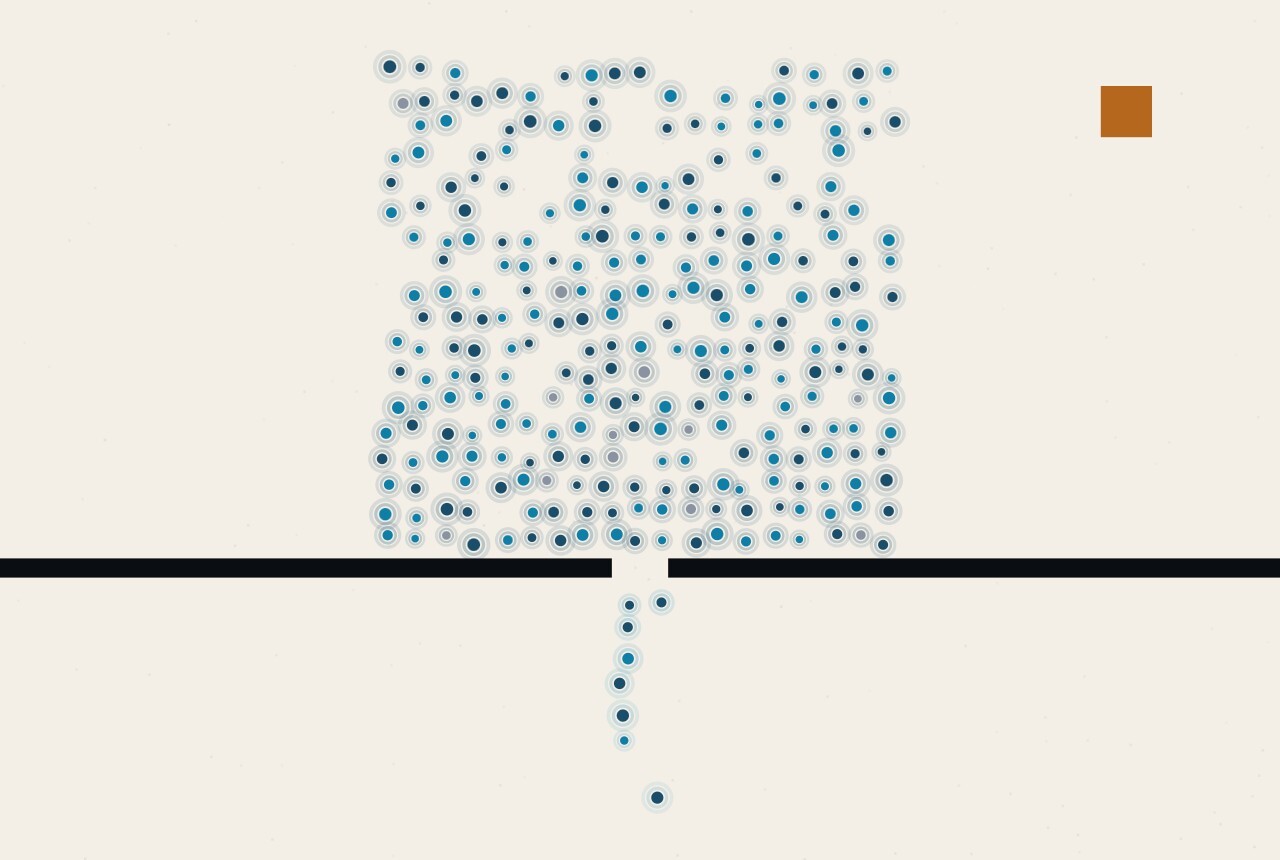
B12 in food is bound to protein. Stomach acid frees it, and it then pairs with intrinsic factor, a protein made in the stomach lining; only that pairing is taken up efficiently, far down the small intestine. The NIH puts absorption at about 50% for doses of 1 to 2 micrograms, the amount intrinsic factor can handle, and much lower above that.
How much of a dose the body absorbs
Share of an oral dose of vitamin B12 absorbed, by size of dose.
Source: NIH Office of Dietary Supplements, vitamin B12 fact sheet for health professionals.
An isotope study from 1954 showed the shape of the curve. George Glass and colleagues fed labelled B12 to twenty healthy people and found absorption peaked at a dose of half a microgram. Raising the dose a hundredfold, to 50 micrograms, added only about one extra microgram to the amount absorbed. By that curve, most of the B12 in a spoonful of clams passes straight through.
It does not matter much, because the body keeps a large reserve. The NIH estimates stores of 1 to 5 milligrams, one to two thousand times a typical day’s intake. That is why deficiency is slow: a person can stop absorbing B12 and feel nothing for years while the store runs down.
Who runs short: the gate breaks
Most B12 deficiency is not a matter of what someone eats. It happens when one of the steps before the gate fails.
Where vitamin B12 deficiency comes from
Selected groups and what the evidence shows.
Source: NIH ODS; Gilsing et al., Eur J Clin Nutr (2010); Aroda et al., J Clin Endocrinol Metab (2016); MHRA Drug Safety Update, June 2022.
Pernicious anaemia, an autoimmune loss of intrinsic factor, is the most common cause of clinically obvious deficiency worldwide, according to the NIH. Atrophic gastritis, which reduces stomach acid, affects 8% to 9% of adults aged 65 and over and stops B12 being freed from food. Acid-suppressing drugs such as omeprazole can do the same, and gastric bypass surgery removes part of the machinery.
Diet matters for one group. In the EPIC-Oxford cohort, 52% of vegan men were classed as deficient, against 7% of vegetarians and a single omnivore. Metformin, the most widely used diabetes drug, is the other large cause. In the Diabetes Prevention Program Outcomes Study, low B12 was more common with metformin at five years (4.3% against 2.3%), and each year of use raised the odds of deficiency by 13%. In June 2022 the UK’s medicines regulator called low B12 a common side effect, affecting up to one in ten users, and advised checking levels in people with symptoms or risk factors.
A newer cause has nothing to do with food. Nitrous oxide, used recreationally from small canisters, inactivates B12 so that it can no longer do its job, and heavy users have presented with nerve damage and spinal cord degeneration. A 2021 clinical review warned that these patients often have normal serum B12 levels. The UK made possession of nitrous oxide for recreational use illegal on 8 November 2023, citing anaemia, nerve damage and paralysis among its harms.
The cure that came from a liver
Before anyone knew B12 existed, pernicious anaemia was usually fatal. In 1926 George Minot and William Murphy reported that a diet heavy in liver reversed it in 45 patients. The work earned them, with George Whipple, the 1934 Nobel Prize in Physiology or Medicine “for their discoveries concerning liver therapy in cases of anaemia”. The active substance was isolated from liver in 1948 and named vitamin B12.
The oddity is that people with pernicious anaemia lack intrinsic factor, the very thing the gate needs. Very large doses still work, because a small fraction of any dose crosses the gut without it — a 1954 report noted that massive oral doses produced an adequate response in these patients. That small fraction is what today’s 1,000-microgram tablets rely on.
Tablets against injections
What the trials found when oral B12 was compared with intramuscular injections.
Source: NIH ODS summary of the 2018 Cochrane review; Sanz-Cuesta et al., BMJ Open 10(8):e033687 (2020); Duyvendak and Veldhuis (2009).
A 2018 Cochrane review of three randomised trials found that 1,000 to 2,000 micrograms by mouth normalised blood levels about as well as injections, and the OB12 trial in Madrid, with 283 people aged 65 and over, found more than 90% normal after eight weeks in both arms. Dose-finding studies in older people put the smallest effective daily dose between 647 and 1,032 micrograms. Injections remain the standard for severe neurological symptoms, where waiting is not an option.
What more B12 does not do
Because deficiency causes fatigue, low mood and memory problems, B12 is widely taken for all three by people who are not deficient. The trials do not support it. A 2021 meta-analysis of 16 randomised trials with 6,276 participants found no effect of B12 alone, or combined with folic acid and B6, on any area of cognitive function or on depression. The NIH summarises the heart evidence the same way: B12 supplements, alone or with other B vitamins, do not prevent heart attacks or reduce death rates in people with or at risk of heart disease.
There is one interaction worth knowing about. High intakes of folic acid can correct the anaemia of B12 deficiency while doing nothing for the nerve damage, so the deficiency carries on unnoticed. That is the reason the upper limit for folic acid exists, and it is the subject of the folate article.
Keeping B12 where it should be
For people who eat fish, meat, eggs or dairy, intake takes care of itself. People who eat no animal products need fortified foods or a supplement. For everyone else the question is absorption: older adults, people with pernicious anaemia or low stomach acid, people after stomach surgery, and long-term users of metformin or acid-suppressing drugs.
Those are the groups for whom testing makes sense, and serum B12 alone can mislead. Specialists increasingly combine it with other markers such as methylmalonic acid and homocysteine, which rise when B12 is not working inside the cell. If a deficiency is found, the treatment is simple and the choice between tablets and injections is one to make with a doctor.
Questions people ask
Which food has the most vitamin B12?
Per tablespoon, cooked clams top the USDA data at 14.8 micrograms, followed by veal, lamb and beef liver. Per typical serving, the NIH lists three ounces of beef liver at 70.7 micrograms.
Why do B12 tablets contain 1,000 micrograms when I need 2.4?
Because absorption drops steeply above a microgram or two. At 1,000 micrograms about 1.3% is absorbed, roughly 13 micrograms, and some of that crosses without intrinsic factor.
Can you take too much vitamin B12?
No upper limit has been set, because B12 has a low potential for toxicity. That is not a reason to take high doses without a deficiency.
Do vegans need a B12 supplement?
Yes, or reliably fortified foods. Unfortified plant foods are not a source, and in one British study half of vegan men were deficient.
Does metformin cause B12 deficiency?
It lowers B12 absorption, and the risk rises with years of use. UK guidance advises checking levels in users with symptoms or other risk factors; keep taking metformin and raise it with your doctor.
The short version
- Adults need 2.4 micrograms a day. There is no upper limit.
- A tablespoon of cooked clams holds 14.8 micrograms, more than six days’ worth; liver is close behind.
- Absorption runs through intrinsic factor and handles about 1 to 2 micrograms at a time; at 1,000 micrograms only 1.3% is absorbed.
- Deficiency mostly comes from the gut, not the diet: pernicious anaemia, low stomach acid, metformin, acid-suppressing drugs, surgery — and a vegan diet without supplements.
- Oral doses of 1,000 to 2,000 micrograms work about as well as injections in trials.
- Extra B12 did not improve cognition, mood or heart outcomes in people who were not deficient.
This is a summary of published research, not medical advice. If you have numbness, tingling, balance problems or unexplained anaemia, take metformin or an acid-suppressing drug long term, have had stomach surgery, or follow a vegan diet, talk to your doctor or a registered dietitian about testing before starting or changing a supplement.
Further reading: Miller, Advances in Nutrition 9(4):511S (2018), on how acid-suppressing drugs and metformin affect B12 and how status is best measured. Markun et al., Nutrients 13(3):923 (2021), for the trials of B12 on cognition, mood and fatigue. Brunt, van den Brink and van Amsterdam, Addiction (2024), on nitrous oxide and B12-related nerve damage.
- The Invisible Kingdom, Meghan O’Rourke (2022). On illnesses that take years to name, told from inside one. B12 deficiency is exactly that kind of problem; the book is a memoir and ranges well beyond nutrition.
- Burn, Herman Pontzer (2021). An evolutionary anthropologist on how the body actually spends and stores what it takes in. Strongest on energy, but a good corrective to thinking of nutrition as simple input and output.
- Outlive, Peter Attia (2023). A physician’s programme for the later decades, when absorption problems become more common. Opinionated and supplement-friendly in places, so read it alongside the trial evidence.
Sources
NIH Office of Dietary Supplements, vitamin B12 fact sheet for health professionals: recommended amounts, the absence of an upper limit, average intakes and the share below the EAR, absorption at 1–2, 500 and 1,000 µg, body stores, food-serving values, pernicious anaemia incidence, atrophic gastritis prevalence, medication effects, deficiency symptoms, and the summaries of the Cochrane review and the cognition and cardiovascular trials. — USDA FoodData Central, SR Legacy, nutrient 418; FDC identifiers are printed in the figure. — Glass GBJ, Boyd LJ, Stephanson L. Proceedings of the Society for Experimental Biology and Medicine 86 (1954), doi:10.3181/00379727-86-21153. — Gilsing AM, Crowe FL, Lloyd-Wright Z, et al. European Journal of Clinical Nutrition 64(9):933–939 (2010). — Aroda VR, Edelstein SL, Goldberg RB, et al. Journal of Clinical Endocrinology and Metabolism 101(4):1754–1761 (2016). — MHRA, Drug Safety Update, metformin and reduced vitamin B12 levels (June 2022). — Evans EB, Evans MRB. Australian Journal of General Practice (2021). — UK Home Office, possession of nitrous oxide is now illegal (8 November 2023). — Nobel Prize in Physiology or Medicine 1934, nobelprize.org. — Monto RW. Archives of Internal Medicine (1954), doi:10.1001/archinte.1954.00240260055005. — Sanz-Cuesta T, Escortell-Mayor E, del Cura-González I, et al. BMJ Open 10(8):e033687 (2020). — Duyvendak M, Veldhuis GJ. Nederlands Tijdschrift voor Geneeskunde (2009). — Markun S, Gravestock I, Jäger L, et al. Nutrients 13(3):923 (2021). — Miller JW. Advances in Nutrition 9(4):511S–518S (2018).