
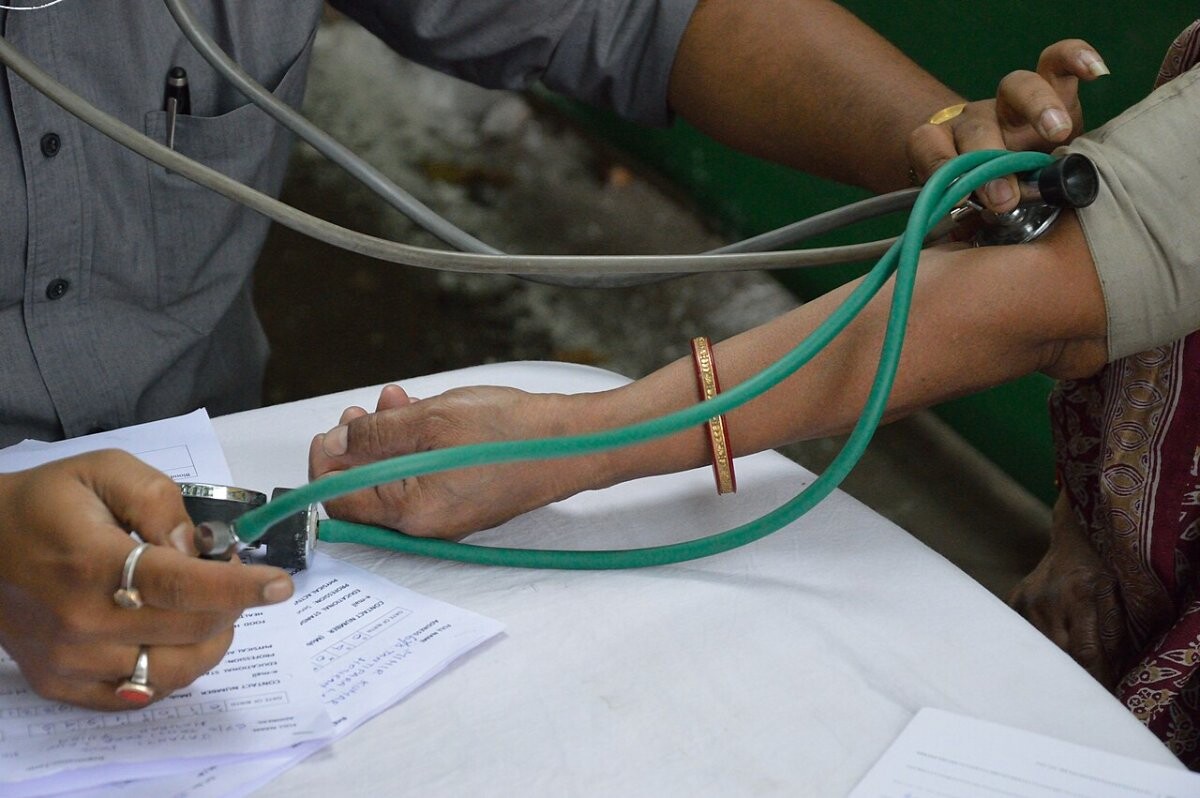
Trend summary
- Non-communicable diseases caused 56.7% of all deaths in India in 2021–23, according to the Sample Registration System. Cardiovascular disease alone accounted for nearly 31%.
- The NCD share of deaths rose from 37.9% in 1990 to 61.8% in 2016, on ICMR’s state-level disease burden estimates. Infections and maternal causes have steadily shrunk as a share.
- The ICMR-INDIAB survey (2023) found 11.4% of adults with diabetes, 15.3% with prediabetes and 35.5% with hypertension. The government puts this at about 101 million people with diabetes.
- Estimated new cancer cases rose from 1.39 million in 2020 to 1.53 million in 2024. The government’s screening programme had checked over 400 million adults for high blood pressure by February 2026.
What the numbers show
India’s causes of death have changed fast. ICMR’s India State-Level Disease Burden Initiative found that non-communicable diseases (NCDs) rose from 37.9% of deaths in 1990 to 61.8% in 2016 (PIB, Feb 2022). Over the same years, their share of total health loss (DALYs) went from 30% to 55%, with ischaemic heart disease the top cause and COPD second (ICMR, Nov 2017). WHO’s 2018 country profile put NCDs at 63% of India’s 9.57 million deaths in 2016: cardiovascular disease 27%, chronic respiratory disease 11%, cancers 9% and diabetes 3%. It gave a 23% risk of dying from one of the four main NCDs between ages 30 and 70, though WHO flags these estimates as highly uncertain (WHO).
The Registrar General’s Sample Registration System, which records deaths in a nationally representative sample of households, gives the current picture. Its cause-of-death report for 2021–23, published in September 2025, attributes 56.7% of deaths to NCDs. Cardiovascular disease caused about 30.9%, cancers 6.4%, chronic respiratory disease 5.7% and diabetes 3.5% (ORGI; The Hitavada). Stroke killed an estimated 699,000 people in 2019, or 7.4% of all deaths (ICMR, 2021).
Cancer is climbing steadily. ICMR’s National Cancer Registry Programme estimated 1,392,179 new cases (13.9 lakh) in 2020 and 1,461,427 in 2022, with estimated deaths rising from 770,230 to 808,558 (PIB, Jul 2023). The estimate for 2024 is 1,533,055 cases (Lok Sabha, Jul 2024), and for 2025 it is 1,569,793. In 2024, lung cancer was the most common cancer in men (79,279 cases) and breast cancer in women (227,152) (Lok Sabha, Mar 2025).
What is driving it
Metabolic risk is the main engine. The ICMR-INDIAB study, which surveyed 113,043 adults in all states between 2008 and 2020, found diabetes in 11.4%, prediabetes in 15.3%, hypertension in 35.5%, generalised obesity in 28.6% and abdominal obesity in 39.5% (Lancet Diabetes & Endocrinology, 2023). The government says over 101 million people live with diabetes and another 136 million have prediabetes (PIB, Dec 2024). People also live longer: life expectancy has risen from about 40 in 1960 to about 70, so more reach the ages when these diseases strike (PIB, 2017).
Tobacco remains a big factor. Tobacco-linked cancers made up 27.1% of the estimated 2020 cancer burden (ICMR, 2020), and the government says tobacco kills over 1.3 million people a year (PIB, Jun 2026). Some of the rise is better counting: more cancer registries and mass screening find cases that once went unrecorded (PIB, Sep 2020). The burden is uneven. Rates of heart disease, stroke, diabetes and COPD differ four- to nine-fold between states (PIB, 2017), and the North East carries a high cancer burden, with male incidence reaching 269.4 per 100,000 in Aizawl (ICMR-NCDIR, 2021).
Recent cases
- 6 June 2026: A government briefing on India’s health record said NCDs such as heart disease, diabetes, cancer and stroke now account for 60% of all deaths. It also said 415 million people (41.5 crore) had been screened for hypertension since 2017 (PIB).
- 23 March 2026: The Health Ministry told Parliament that by February 2026 its NCD programme had screened about 409 million adults for hypertension and found 70.1 million cases, and screened 407 million for diabetes, finding 46.8 million (PIB).
- 3 September 2025: The Registrar General published the Sample Registration System cause-of-death report for 2021–23. It found that NCDs caused 56.7% of deaths and cardiovascular disease nearly 31% (ORGI; The Hitavada).
Press releases and official reports, 2023–2026
Up to five key releases a year for the last four years, newest first. Most come from Government of India ministries through the Press Information Bureau (PIB), national agencies such as NCRB, the Reserve Bank of India and the National Center for Seismology, and state governments; a few news reports and data analyses are included where they are the clearest public record of an event. Releases from 2007–2022 are in the expandable list after 2023.
2026
- 6 Jun 2026Ministry of Health and Family WelfareIndia's Health Transformation
- 21 Apr 2026Ministry of Health and Family WelfareUnion Health Minister Shri JP Nadda chairs session, “Addressing Non-Communicable Diseases in India: From Preventive to Care” during 18th Civil Services Day Celebrations in New Delhi
- 23 Mar 2026Ministry of Health and Family WelfareUpdate on NP-NCD
- 1 Mar 2026Ministry of Health and Family WelfareIndia's Transformation into a Global Health Powerhouse
2025
- 3 Sep 2025Office of the Registrar General & Census Commissioner, IndiaSample Registration System (SRS)-Cause of Death in India 2021-2023
- 5 Aug 2025Ministry of Health and Family WelfareUpdate on progress achieved under NPCDCS
- 21 Mar 2025Lok Sabha (Ministry of Health and Family Welfare reply)Rising Cancer Cases (Unstarred Question No. 3588)
- 11 Mar 2025Ministry of Health and Family WelfareUpdate on "75/25" Initiative
- 20 Feb 2025Ministry of Health and Family WelfareUnion Health Ministry launches Intensified Special NCD Screening Drive to ensure 100% coverage of all individuals aged 30 years and above
2024
- 13 Dec 2024Ministry of Science and TechnologyUnion Minister Jitendra Singh releases landmark RSSDI study 'Indian Prevention of Diabetes Study (IPDS) on Yoga and Diabetes Prevention'
- 14 Nov 2024Press Information BureauWorld Diabetes Day 2024
- 7 Nov 2024Press Information BureauNational Cancer Awareness Day in India: A Call to Action for Cancer Prevention, Treatment, and Innovation
- 20 Oct 2024Ministry of Science and TechnologyDr Jitendra Singh releases first of its kind, largest ICMR-India Diabetes 'INDIAB' Study, all-India survey's Jammu related data on prevalence of Diabetes in Jammu region
- 26 Jul 2024Lok Sabha (Ministry of Health and Family Welfare reply)Cost of Treatment of Cancer (Unstarred Question No. 912)
2023
- 11 Aug 2023Lok Sabha (Ministry of Health and Family Welfare reply)Lancet Report on Diabetes (Unstarred Question No. 3805)
- 4 Aug 2023Ministry of Health and Family WelfareUpdate on Prevention and control of Non-Communicable Diseases (NCDs)
- 1 Aug 2023Ministry of Health and Family WelfareUpdate on treatment of Diabetes
- 28 Jul 2023Ministry of Health and Family WelfareMeasures taken to Address Rising Cases of Cancer
- 7 Feb 2023Office of the Registrar General & Census Commissioner, IndiaSample Registration System (SRS) – Cause of Death in India 2017-2019
View 20 years of major Indian chronic disease press releases (2007–2026)47 more from 2007–2022, up to five a year, newest first
2022
- 21 Sep 2022The WireMore Than Half of Deaths in India Are Due to Cancer, Diabetes, Heart and Respiratory Diseases
- 25 May 2022Office of the Registrar General & Census Commissioner, IndiaAnnual Report on MCCD-2020
- 5 Apr 2022Ministry of Health and Family WelfareUpdate on National Programme for Prevention and Control of Cancer, Diabetes, Cardiovascular Diseases and Stroke
- 8 Feb 2022Ministry of Health and Family WelfareStatus of Non-Communicable Diseases (NCDs) in India
- 2022ICMR-NCDIR and National Health AuthorityPatterns of Stroke Care in ABPM-JAY beneficiaries in empaneled hospitals of PM-JAY Scheme
2021
- 14 Dec 2021Ministry of Health and Family WelfareUpdate on National Programme for Prevention and Control of Cancer, Diabetes, Cardiovascular Diseases and Stroke (NPCDCS)
- 14 Jul 2021Indian Council of Medical ResearchFirst comprehensive estimates of disease burden from neurological disorders and their trends in every state of India
- 4 Feb 2021Indian Council of Medical ResearchNorth Eastern States of India have a high burden of Cancer according to a report released by ICMR-NCDIR
- 2021ICMR National Cancer Registry ProgrammeClinicopathological Profile of Cancers in India: A Report of the Hospital Based Cancer Registries, 2021
- 2021ICMR-NCDIRStroke Incidence and Mortality: A Report of the Population Based Stroke Registries, India
2020
- 28 Sep 2020Indian Council of Medical ResearchICMR's Mobile Stroke Care Unit for North East Region inaugurated
- 18 Sep 2020Ministry of Health and Family WelfareEarly Detection Centres for Cancer
- 18 Aug 2020Indian Council of Medical ResearchICMR-NCDIR National Cancer Registry Programme estimates 12% increase in cancer cases in the country by 2025
- 2020ICMR National Cancer Registry ProgrammeReport of National Cancer Registry Programme 2020
- 20 Mar 2020Ministry of Health and Family WelfareAnti Cancer Drive
2019
- 22 Nov 2019Ministry of Health and Family WelfareWorld Diabetes Day
2018
- 31 Aug 2018World Health OrganizationNoncommunicable diseases India 2018 country profile
- 31 Jul 2018Ministry of Health and Family WelfareLifestyle diseases in India
- 19 Jul 2018Ministry of Women and Child DevelopmentHealth Awareness Programmes to spread awareness of cervical and breast cancer by Ministry of WCD
- 9 Mar 2018Ministry of Health and Family WelfareNational Health Policy
2017
- 18 Dec 2017Ministry of Health and Family WelfareCardiovascular Diseases in India
- 14 Nov 2017Vice President's SecretariatThe Vice President of India releases the findings of 'India State Level Disease Burden' report
- 28 Jul 2017Ministry of Health and Family WelfareLife Style Diseases
- 7 Feb 2017Ministry of Health and Family WelfareSurvey on Diabetic Patients in the Country
- 21 Jan 2017Ministry of Health and Family WelfareHealth Ministry to launch population based prevention, screening and control programme for five non-communicable diseases
2016
- 29 Jul 2016Ministry of Health and Family WelfareCancer Centres with Private Sector Participation
- 10 May 2016Ministry of Health and Family WelfareLaunching of National Programme for prevention and Control of Cancer
- 26 Feb 2016Ministry of Health and Family WelfareCancer Prevalence
- 2016ICMR National Cancer Registry ProgrammeThree Year Report of PBCR 2012-2014
- 2016Indian Council of Medical ResearchICMR- India Diabetes [INDIAB] Study – Phase I (Final Report)
2015
- 1 Jun 2015Office of the Registrar General & Census Commissioner, IndiaAnnual Report on MCCD-2012
- 10 Mar 2015Ministry of Health and Family WelfareProgramme to Combat Obesity
2014
- 28 Aug 2014Office of the Registrar General & Census Commissioner, IndiaCircular-Medical Certification of Cause of Death (MCCD)
- 11 Jul 2014Ministry of Health and Family WelfareCases of Cancer
- 18 Feb 2014Ministry of Health and Family WelfareFree Treatment for Cancer Patients
2013
- 10 Dec 2013Ministry of Health and Family WelfareGovernment not to declare Cancer as a notifiable disease
- 9 Dec 2013Ministry of Health and Family WelfareNational Programme for Prevention and Control of Cancer, Diabetes, Cardiovascular Diseases and Stroke (Npcdcs)
- 24 Aug 2013Ministry of Health and Family WelfareDiabetic Patients
- 2013ICMR National Cancer Registry ProgrammeThree Year Report of PBCR 2009-2011
- 2013ICMR National Cancer Registry ProgrammeTime Trends in Cancer Incidence Rates 1982-2010
2010
- Nov 2010ICMR National Cancer Registry ProgrammeThree-Year Report of Population Based Cancer Registries 2006-2008
- Nov 2010ICMR National Cancer Registry ProgrammeCancer in Bhopal: Comparison of Cancer Patterns in MIC Affected and Unaffected Areas (1988-2007)
2009
- Oct 2009ICMR National Cancer Registry ProgrammeConsolidated Report of Hospital Based Cancer Registries 2004-2006
- Apr 2009ICMR National Cancer Registry ProgrammeTime Trends in Cancer Incidence Rates 1982-2005
2008
- Dec 2008ICMR National Cancer Registry ProgrammeConsolidated Report of Population Based Cancer Registries 2004-2005
- Sep 2008ICMR National Cancer Registry ProgrammeNorth East Population Based Cancer Registries: Second Report 2005-2006
2007
- Apr 2007ICMR National Cancer Registry ProgrammeConsolidated Report of Hospital Based Cancer Registries 2001-2003
Many years list fewer than five items, and some have none yet. Older Government of India releases are hard to find at their original addresses, and we only list items we could open and check. We are still adding to these lists. Where a page shows no date, the date comes from the release address or the publisher’s own index.
Photo list
How this page is built. Figures come from the official statistical releases linked above; where agencies publish provisional numbers we say so, because they are revised. Many Indian statistics are compiled state by state and published a year or two late (NCRB’s accident report for 2024 came out in 2026), so we say which year each figure covers. Large numbers are written in international form, with lakh (100,000) and crore (10 million) in brackets where Indian sources use them. Photos are public-domain or Creative Commons images credited in each caption; file photos are illustrative and are not from the events described unless the caption says so. This page tracks trends and is not personal safety, medical, legal or financial advice.