Sleep Regularity Beat Sleep Duration: What the Mortality Data Shows
In This Series: Healthy Ageing & Everyday Myths
- Two of the 14 Dementia Risk Factors Are Your Ears and Your Eyes
- The Wrong Cuff Turns 125 Into 144. Most People Have Never Had This Measured Properly.
- Every 3 Decibels Halves the Time. That Is the Whole Rule, and Almost Nobody Knows It.
- Sitting Is Not the New Smoking. The Standing Desk Did Not Help Either.
- Falls at Home: The Fixes With Evidence, and the One That Was Withdrawn
- Loneliness Raises the Risk of Dying by Fourteen Per Cent. The Fifteen-Cigarettes Line Came From Somewhere Else.
Disclosure: this article contains affiliate links, marked (paid link). If you buy through one we may earn a commission, at no extra cost to you. As an Amazon Associate I earn from qualifying purchases. It costs you nothing and it does not change what we recommend.
Key takeaways · 11 min read
- Mortality risk by sleep duration is a valley with its floor near seven hours, and the long-sleep end is mostly illness showing up as sleep, not sleep causing illness.
- Regularity beat duration. The most consistent sleepers had roughly 30% lower all-cause mortality, and once regularity was in the model, duration added nothing statistically.
- The practical target is a fixed wake time, weekends included, plus morning daylight.
- Melatonin is not recommended for chronic insomnia by the AASM, and 71% of tested bottles were off-label by more than 10%.
Almost everything written about sleep starts from the same instruction: get eight hours. It is a strange rule to build an industry on, because when researchers actually followed large populations for years and measured what predicted who died, the number of hours turned out to be the less interesting half of the story.
The more useful finding is about when you sleep, not how long. And the second most useful finding is that the product most people reach for when they cannot sleep is the one the sleep-medicine profession specifically recommends against for the problem they actually have.
Here is what the cohort data and the clinical guidelines say, including the parts that are inconvenient for anyone selling sleep.

The duration curve is real, and it bends at both ends
Start with what is solid. In a cohort of 25,481 U.S. adults followed for roughly 146,000 person-years, mortality risk plotted against sleep duration is not a slope. It is a valley, with the floor at about seven hours.
All-cause mortality by nightly sleep duration
Hazard ratios versus a seven-hour reference, adjusted for demographics, behaviour and existing conditions. Above 1.0 means higher risk.
Source: Jin Q, Yang N, Dai J, et al. “Association of Sleep Duration With All-Cause and Cardiovascular Mortality: A Prospective Cohort Study.” Frontiers in Public Health, 2022;10:880276.
The long-sleep end needs a caveat that rarely survives the headline. People who sleep nine or ten hours are disproportionately people who are already unwell — undiagnosed illness, depression, chronic pain, sleep-disordered breathing that fragments the night and stretches it. Long sleep is more plausibly a symptom than a cause. Setting an alarm to cut your sleep to seven hours would be a serious misreading of this chart.
The short end is the one with a clearer causal story: shortened sleep does measurable things to blood pressure, glucose handling and inflammatory markers in controlled experiments. But even there, the effect sizes are moderate, and something else predicted mortality better.
Regularity beat duration
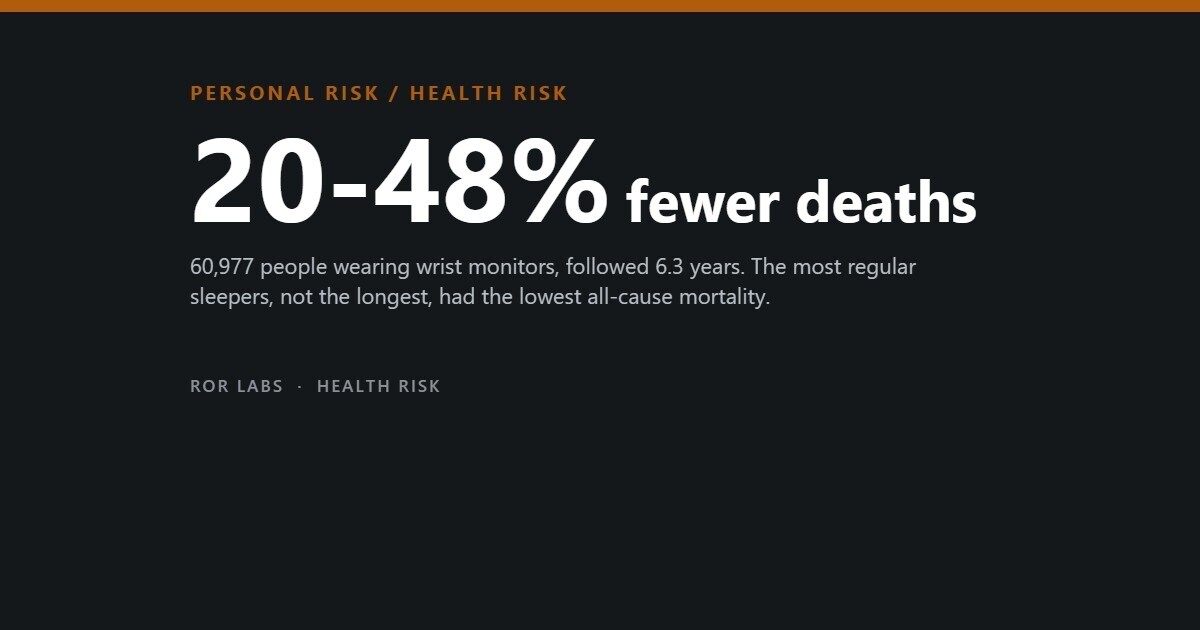
In 2024 a team working with UK Biobank accelerometer data published something that should have changed more minds than it did. They took 60,977 people who had worn a wrist monitor, scored each person on a Sleep Regularity Index — essentially, how likely you are to be asleep at the same clock time on any two days — and followed them for a mean of 6.3 years.
The most regular sleepers had 20–48% lower all-cause mortality
Sleep Regularity Index quintiles, compared with the least regular fifth. 60,977 adults, 1,859 deaths.
Source: Windred DP, et al. “Sleep regularity is a stronger predictor of mortality risk than sleep duration: A prospective cohort study.” Sleep, 2024;47(1):zsad253. doi:10.1093/sleep/zsad253
This is an observational finding and it cannot prove that fixing your schedule extends your life. Irregular sleep travels with shift work, illness, caregiving and poverty, and no statistical adjustment fully removes that. But it reframes the advice in a way that is worth taking seriously.
If you have been trying and failing to add an hour to your night, the evidence suggests the more valuable target is holding your bedtime and wake time steady — including on Saturday. Seven hours from 11pm to 6am every day appears to be a better position than an average of eight hours assembled from a 1am Friday, a 10am Sunday, and a 6am Monday alarm.
The same weekly total, two different weeks
Both people average about seven hours a night. Only one of them has a stable circadian signal.
| Regular week | Irregular week | |
|---|---|---|
| Mon–Thu | 23:00 – 06:00 | 00:30 – 06:00 |
| Friday | 23:15 – 06:15 | 01:30 – 07:00 |
| Saturday | 23:30 – 06:45 | 02:00 – 10:30 |
| Sunday | 23:00 – 06:00 | 23:30 – 06:00 |
| Weekly average | about 7h | about 7h |
| What the body reads | one consistent night, repeated | a time-zone shift every weekend |
Source: schedule illustration built on the Sleep Regularity Index method described in Windred et al., Sleep (2024).
The melatonin problem

Melatonin is the default purchase for people who cannot sleep. The American Academy of Sleep Medicine’s clinical practice guideline says, in plain words, that clinicians should not use melatonin in adults to treat chronic insomnia.
That is not a claim that melatonin does nothing. It is a claim about matching the tool to the job. Melatonin is a timing signal — it tells your body what time it is. It has a reasonable evidence base for problems of timing: jet lag, shift work, delayed sleep phase. It has a poor evidence base for the problem most people are actually having, which is lying awake at a perfectly normal hour.
There is a second issue, which is that you often do not know what you are taking.
What was actually in the bottle
Laboratory analysis of 31 melatonin supplements from 16 brands.
Source: Erland LAE & Saxena PK. “Melatonin natural health products and supplements: presence of serotonin and significant variability of melatonin content.” Journal of Clinical Sleep Medicine, 15 February 2017.
So what does the profession recommend instead? Cognitive behavioural therapy for insomnia (CBT-I) — a short, structured programme of changing sleep timing and the thinking around it. The AASM’s newest guideline, published 13 April 2026, reaffirmed it: as its lead author put it, CBT-I by itself is the most efficacious first-line treatment for insomnia. That guideline looked specifically at combining CBT-I with medication and concluded that combination beats medication alone, but that behavioural treatment on its own already produces meaningful and durable improvement without the added risks of drugs.
Matching the tool to the actual problem
What the guidelines support, and for what.
Sources: AASM Clinical Practice Guideline for the Pharmacologic Treatment of Chronic Insomnia in Adults; AASM combination-treatment guideline, Journal of Clinical Sleep Medicine, 13 April 2026.
The thing no product on this page can fix
If you snore, and you wake unrefreshed after a full night, and you are tired all day, the problem may not be sleep quality in the way the wellness aisle means it. It may be that you stop breathing.
Obstructive sleep apnea in the United States
Estimated adults affected, and where they sit in the diagnostic pipeline.
Source: Watson et al. “Prevalence and Unmet Need of Obstructive Sleep Apnea in the United States.” Sleep, 2025;48(Suppl 1):A278. doi:10.1093/sleep/zsaf090.0637
Four out of five people with this condition do not know they have it. If that description fits you, the useful next step is a conversation with a doctor about a sleep study — not a purchase. We say this here rather than in a footnote because it is the single highest-value action in this article for the people it applies to, and it earns us nothing.
What actually moves the numbers
Ranked by strength of evidence, not by cost
The first four are free.
Sources: Windred et al., Sleep (2024); AASM clinical practice guidelines on chronic insomnia.
Making the room do the work (paid link)
Physical fixes for light, heat and noise — the parts of the problem an object can actually solve.
Browse on Amazon →
Browse on Amazon →
Browse on Amazon →
Browse on Amazon →
Note what is missing: we are not linking melatonin or any other sleep supplement. The guideline above recommends against it for chronic insomnia, and the lab analysis found most bottles do not contain what the label says. We would rather point you at a curtain that works than a capsule that might not.

Questions people ask
Can I catch up at the weekend?
Partly, for acute sleep debt — you will feel better. But the weekend lie-in is exactly what drives a low regularity score, and regularity was the stronger mortality predictor. If you must catch up, going to bed earlier costs you less than waking later, because the wake time is the anchor.
Are sleep trackers worth it?
They are reasonably good at telling you when you were asleep and poor at telling you which stage you were in. That makes them genuinely useful for the one metric this article says matters most — consistency of timing — and unreliable for the “deep sleep score” people fixate on. There is also a documented pattern of people becoming anxious about their sleep data, which is counterproductive for a condition that anxiety worsens.
I am over 50 and wake at 4am. Is that a disorder?
Body clocks tend to shift earlier with age, and sleep becomes lighter and more broken. Waking earlier than you did at 30 is common and not automatically pathological. It becomes worth investigating when it comes with daytime impairment, low mood, or the breathing symptoms described above.
Does a nap ruin the night?
A short early-afternoon nap is fine for most people. A long or late one eats the sleep pressure you need at bedtime. If you are being treated for insomnia, napping is usually restricted deliberately, because building that pressure is part of how CBT-I works.
The short version
- Mortality risk by sleep duration is a valley with its floor near seven hours, and the long-sleep end is mostly illness showing up as sleep, not sleep causing illness.
- Regularity beat duration. The most consistent sleepers had roughly 30% lower all-cause mortality, and once regularity was in the model, duration added nothing statistically.
- The practical target is a fixed wake time, weekends included, plus morning daylight.
- Melatonin is not recommended for chronic insomnia by the AASM, and 71% of tested bottles were off-label by more than 10%.
- CBT-I is first-line, reaffirmed in the April 2026 guideline.
- If you snore and wake unrefreshed, consider sleep apnea — 85.6 million U.S. adults are estimated to have it and about 80% do not know.
- Objects help with light, heat and noise. Nothing on a shelf fixes a schedule or a breathing disorder.
This is an article about published evidence, not medical advice. Persistent sleep problems, loud snoring, or daytime sleepiness that affects your driving are all reasons to talk to a doctor rather than to shop.
On the links above: some are affiliate links, marked (paid link). If you buy through one we may earn a commission at no additional cost to you. As an Amazon Associate I earn from qualifying purchases. We link to product searches rather than specific items so recommendations do not break as models change, and we say plainly when we are choosing not to link something. Full policy: Affiliate Disclosure.
Sources
- Windred DP, Anderson C, Sletten TL, et al. “Sleep regularity is a stronger predictor of mortality risk than sleep duration: A prospective cohort study.” Sleep, 2024;47(1):zsad253. doi:10.1093/sleep/zsad253
- Jin Q, Yang N, Dai J, et al. “Association of Sleep Duration With All-Cause and Cardiovascular Mortality: A Prospective Cohort Study.” Frontiers in Public Health, 2022;10:880276.
- Sateia MJ, Buysse DJ, Krystal AD, et al. “Clinical Practice Guideline for the Pharmacologic Treatment of Chronic Insomnia in Adults: An American Academy of Sleep Medicine Clinical Practice Guideline.” Journal of Clinical Sleep Medicine, 2017. doi:10.5664/jcsm.6470
- American Academy of Sleep Medicine. “Combination treatment for chronic insomnia disorder in adults: an AASM clinical practice guideline.” Journal of Clinical Sleep Medicine, 13 April 2026.
- Erland LAE, Saxena PK. “Melatonin natural health products and supplements: presence of serotonin and significant variability of melatonin content.” Journal of Clinical Sleep Medicine, 15 February 2017.
- Watson NF, et al. “Prevalence and Unmet Need of Obstructive Sleep Apnea in the United States.” Sleep, 2025;48(Suppl 1):A278. doi:10.1093/sleep/zsaf090.0637