Vitamin K food sources and the one dose that matters at birth
Key takeaways · 10 min read
- Adults need 120 micrograms a day (men) or 90 (women), and average US intakes from food already exceed that. No upper limit has been set.
- By the tablespoon, dried basil, sage and thyme tie at 257 micrograms. Natto, the top food on the NIH list, barely registers in the USDA table because its vitamin K2 is not measured there.
- Newborns are the exception. Without a dose at birth, the risk of late bleeding has been estimated at 81 times higher; in Sweden, infants without a record of the injection had about three times the odds of bleeding in the brain.
- The 1990s report linking the injection to childhood cancer was not confirmed by large studies in Sweden and the United States.
In this article
Line up foods by what one level tablespoon delivers and vitamin K produces the oddest table in this series. Dried basil, dried sage and dried thyme tie for first place at exactly the same value, 1,710 micrograms per 100 grams, or 257 micrograms a spoonful — more than twice an adult man’s daily target. Natto, the fermented soybean dish at the top of the US National Institutes of Health (NIH) list, barely registers. The USDA database gives it 23 micrograms per 100 grams, because the form of vitamin K it is rich in is not the one the database counts.
That gap is a fair summary of the vitamin. The amount most adults need is small, food usually covers it, and no upper limit has been set because no harm from food or supplements has been reported. In healthy adults, deficiency is close to impossible. The one group in which it is common, and dangerous, is newborn babies, and there the evidence is about as strong as nutrition science gets.
This article covers what vitamin K does, which foods carry it, why newborns get a dose at birth, what the trials found for bones and arteries, and why people on warfarin are told not “more” but “the same every day”.
What vitamin K does, and why there is no upper limit
Vitamin K finishes the job of making several clotting proteins; without it they are produced but do not work. The same chemical step activates proteins in bone and artery walls, which is why the vitamin has also been tested against fractures and calcified arteries.
Vitamin K1, phylloquinone, comes from green plants and supplies most of what people eat. Vitamin K2 is a family of menaquinones: MK-4 occurs in small amounts in meat, eggs and cheese, and longer forms such as MK-7 are made by bacteria, including during fermentation.
The reference numbers for vitamin K
US Adequate Intakes in micrograms a day. There is not enough evidence for a Recommended Dietary Allowance, and no upper limit has been set.
Source: NIH Office of Dietary Supplements, vitamin K fact sheet for health professionals.
The targets are Adequate Intakes, set from typical intakes of healthy people because the data were too thin for an average requirement, and average US intakes already exceed them. The Food and Nutrition Board set no upper limit, citing a low potential for toxicity and no reported adverse effects from food or supplements. In a healthy person eating a varied diet, the NIH notes, getting intake low enough to change standard clotting tests is almost impossible.
Three foods by the spoonful
The series ranks foods by what one level tablespoon, 15 grams, delivers, using the USDA’s FoodData Central values per 100 grams. For vitamin K the database records phylloquinone, nutrient number 430.
Vitamin K1 in one level tablespoon (15 g)
USDA FoodData Central, SR Legacy, nutrient 430 (phylloquinone). Percentages are of the 120 µg adult male Adequate Intake. FDC identifiers given so the figures can be checked.
Source: USDA FoodData Central. Dried coriander leaf matches dried parsley at 1,360 µg/100 g (FDC 170921).
Three plants sharing a value to the microgram is unusual, so treat the top as a tie, not a ranking — and as a curiosity: nobody eats a tablespoon of dried sage.
Real servings are more useful. The NIH lists half a cup of boiled frozen collards at 530 micrograms, a cup of raw spinach at 145, a cup of raw kale at 113 and half a cup of boiled broccoli at 110. A tablespoon of soybean oil adds 25. Meat, cheese and eggs carry only a few micrograms of MK-4 a portion.
The food the table cannot see
Natto shows the limit of the spoon table. The NIH lists three ounces of natto, about 85 grams, at 850 micrograms of vitamin K — more than seven times the daily value, and almost all of it MK-7 made by the bacteria that ferment the beans. That works out at roughly 1,000 micrograms per 100 grams, or about 150 micrograms in a tablespoon. The USDA table, which records phylloquinone for natto, shows 23.
Neither source is wrong. Food tables were built around phylloquinone, and long-chain menaquinones from fermented foods are measured far less often, so intake estimates undercount K2 for regular natto eaters. Whether that matters is another question: there is no separate target for K2, and the trials below do not show one form protecting bones or arteries better than the other.
Why newborns are the exception
Newborns are short of vitamin K for reasons that have nothing to do with diet. Little crosses the placenta, so a baby is born with low stores, and breast milk contains little. The result can be vitamin K deficiency bleeding, which doctors divide by timing: early, within the first day; classic, in the first week; and late, from two weeks to six months, when bleeding into the brain is common.
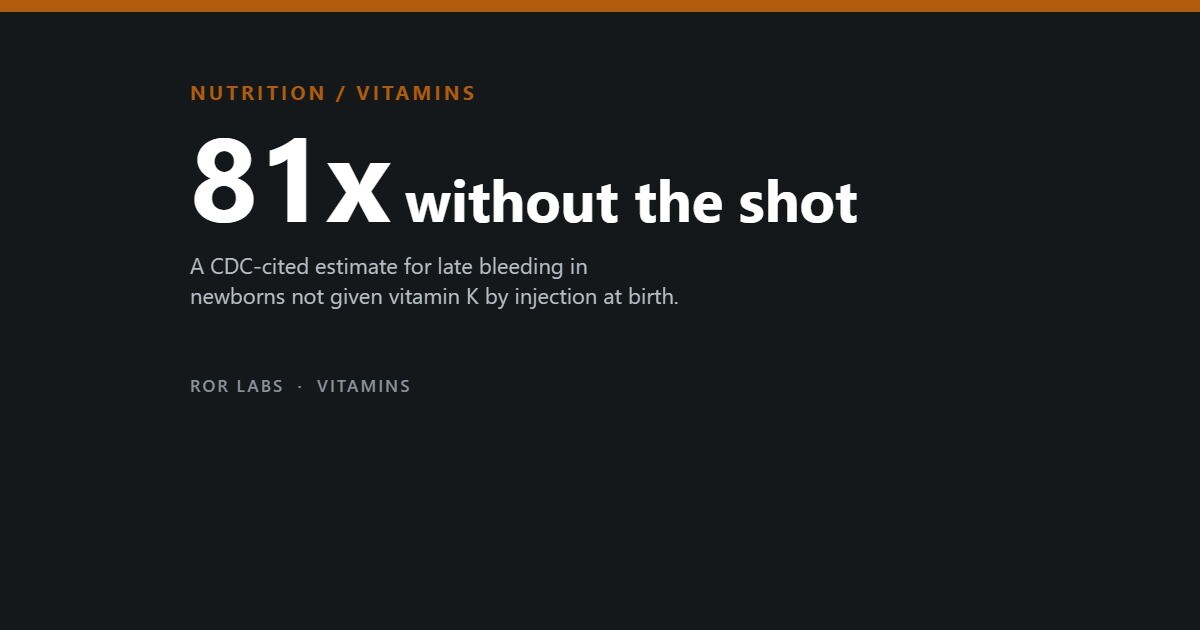
Without prophylaxis, the early and classic forms have been estimated at 0.25% to 1.7% of births. Late bleeding is rarer but more often catastrophic: a median of 35 per 100,000 births in one systematic review. A 2013 report from the Centers for Disease Control and Prevention cited an estimate that infants not given the injection were 81 times more likely to develop it.
Vitamin K deficiency bleeding with and without a dose at birth
Rates per 100,000 live births, and the odds or risk in infants without the injection.
| Measure | Estimate | Source |
|---|---|---|
| Late bleeding, no prophylaxis | 35 per 100,000 (median; 8.8 in high-income countries) | Sankar, 2016 |
| Late bleeding, no prophylaxis | 10.5 to 80 per 100,000 | Loyal and Shapiro, 2020 |
| Late bleeding, Australia, injection recommended | 0.61 per 100,000 | Zurynski, 2020 |
| Late bleeding, no injection vs injection | 81 times the risk (estimate) | CDC MMWR, 2013 |
| Any bleeding by six months, no record of injection | Adjusted odds 1.52 (1.27–1.81) | Simatou, 2026 |
| Bleeding in the brain, no record of injection | Adjusted odds 2.91 (2.13–3.96) | Simatou, 2026 |
Sources: Sankar et al., J Perinatol (2016); Loyal and Shapiro, Hosp Pediatr 10(3) (2020); Zurynski et al., Arch Dis Child 105(5) (2020); CDC, MMWR 62(45) (2013); Simatou et al., JAMA Pediatr (2026).
US paediatricians have recommended a single injection at birth since 1961; the current dose is 0.5 to 1 milligram. Oral doses work too, but must be repeated over the first weeks, and that is where they fail: in Australian surveillance, six of seven bleeding babies given oral vitamin K had not completed the three doses.
The injection had its own scare. In the early 1990s a British team reported about twice the risk of childhood cancer, particularly leukaemia, after injected vitamin K. Much larger studies followed: one of 1.38 million Swedish children found no increase, and a US cohort found no association. None of the later studies found a significant link, though some authors noted a very small risk could not be completely excluded.
The refusals, and what followed
Refusal is rare but rising. A literature review found rates of up to 3.2% in US hospitals, 14.5% in home births and 31% in birthing centres. Parents cited fear of the injection, a wish to be natural and belief in alternatives, and were more likely to decline immunisations too.
Newborns not receiving the vitamin K injection
Share of births without a recorded dose, in two national studies.
Sources: Scott et al., JAMA (8 December 2025), more than 5 million births, via NIH Research Matters; Simatou et al., JAMA Pediatrics (2026), 2,020,302 births.
The consequences show up in case reports. In 2013 Tennessee doctors described a cluster: at one hospital over eight months, seven infants had confirmed deficiency, none had received vitamin K at birth, and four had bleeding inside the skull.
The largest test of what that means comes from Sweden. A nationwide cohort of 2,020,302 births between 2003 and 2021 found that infants without a record of the injection had 1.52 times the adjusted odds of a bleeding diagnosis by six months, and 2.91 times the odds of bleeding in the brain. These are observational numbers, the exposure was a missing record rather than a confirmed refusal, and such families differ in other ways. But the direction matches everything known from before prophylaxis.
Bones and arteries: what the trials found
Adults who eat more vitamin K have fewer fractures in observational studies: a meta-analysis of five cohorts with more than 80,000 participants found a 22% lower risk in the highest intake group. Trials are the test of whether the vitamin is the cause, and they tell a messier story.
Vitamin K supplements in trials of bone and arteries
Ratios below 1.00 favour vitamin K.
ECKO, 440 women, 5 mg K1 a day — spine bone density over 2 years: −1.28% vs −1.22%
Clinical fractures over 4 years, a secondary outcome: 9 women vs 20, HR 0.45 (0.20–0.98)
Updated meta-analysis, postmenopausal or osteoporotic — any fracture: OR 0.72 (0.55–0.95)
Low risk of bias trials only: 0.76 (0.58–1.01)
14 trials, 1,533 people — coronary calcium score progression: mean difference −17.37 (−34.18 to −0.56)
Markers of vitamin K status improved consistently
A 2020 review of controlled trials found no consistent effect on calcification, atherosclerosis or arterial stiffness
Sources: Cheung et al., PLoS Medicine 5(10):e196 (2008); Mott et al., Osteoporosis International (2019); Li et al., Frontiers in Nutrition 10:1115069 (2023); Vlasschaert et al., Nutrients 12(10):2909 (2020).
A 2006 meta-analysis reported large reductions in hip and vertebral fractures, driven mainly by Japanese trials of menatetrenone, a 45-milligram MK-4 drug licensed there for osteoporosis. In 2018 the review’s own authors warned readers that it had included trials whose integrity had been questioned. The 2019 update still found fewer clinical fractures, but the effect lost significance when only trials at low risk of bias were counted, and vertebral fractures did not differ.
ECKO, the largest Western trial, gave 440 Canadian women with thin bones five milligrams of K1 a day — more than 50 times a woman’s Adequate Intake — or placebo. Bone density fell equally in both groups, yet nine women on vitamin K had a fracture against 20 on placebo. With so few events, the authors concluded high-dose K1 should not be recommended until larger trials were done.
Arteries follow the same shape. Supplements reliably improve blood markers, in trials often run in people with kidney disease, but whether calcification slows is unclear: one pooled effect only just reached significance.
Keeping vitamin K where it should be
For most adults food covers vitamin K without planning. The NIH flags people who absorb fat poorly — cystic fibrosis, coeliac disease, ulcerative colitis, short bowel syndrome — and notes that long antibiotic courses, bile acid sequestrants and orlistat can reduce absorption.
People taking warfarin are the important exception, and the advice is often misremembered. Warfarin blocks the recycling of vitamin K, so a sudden change in intake pushes its effect up or down. The NIH guidance is to keep intake consistent, not to avoid greens, and to mention supplements or a big diet change to whoever manages the dose.
For newborns, the evidence supports the single injection at birth. Where parents choose oral vitamin K instead, the protection depends on giving every scheduled dose.
Questions people ask
Which foods are highest in vitamin K?
Per serving, natto, cooked collards and turnip greens, spinach, kale and broccoli. Per tablespoon, dried basil, sage and thyme top the USDA data.
Is there an upper limit for vitamin K?
No; no adverse effects from food or supplements have been reported. For people on warfarin, consistency matters more than amount.
Why do newborns get a vitamin K shot?
They are born with very low stores and breast milk contains little. One injection prevents deficiency bleeding, including the late form that often affects the brain.
Does the vitamin K shot cause leukaemia?
A link reported in the early 1990s was not confirmed by larger studies in Sweden and the United States.
The short version
- Adults need 120 micrograms a day (men) or 90 (women), and average US intakes from food already exceed that. No upper limit has been set.
- By the tablespoon, dried basil, sage and thyme tie at 257 micrograms. Natto, the top food on the NIH list, barely registers in the USDA table because its vitamin K2 is not measured there.
- Newborns are the exception. Without a dose at birth, the risk of late bleeding has been estimated at 81 times higher; in Sweden, infants without a record of the injection had about three times the odds of bleeding in the brain.
- The 1990s report linking the injection to childhood cancer was not confirmed by large studies in Sweden and the United States.
- For bones, high-dose vitamin K did not change bone density in the largest Western trial; fewer fractures were a secondary finding, and the pooled effect weakens in the most reliable trials.
This is a summary of published research, not medical advice. If you take warfarin or another anticoagulant, have a condition that affects fat absorption, or are deciding about vitamin K for a newborn, talk to your doctor, midwife or a registered dietitian.
Further reading: Loyal and Shapiro, Hospital Pediatrics 10(3) (2020), for the evidence on refusal of newborn vitamin K. Cheung et al., PLoS Medicine 5(10):e196 (2008), the ECKO trial, for how a fracture signal can coexist with no change in bone density. Mott et al., Osteoporosis International (2019), for the updated fracture evidence.
- Vaccine Hesitancy, Maya J. Goldenberg (2021). A philosopher of science on why some parents distrust medical advice. Useful on the reasons behind declining the newborn injection; it argues as much about trust as about data.
- The Doctor Who Fooled the World, Brian Deer (2020). The investigation of a fraudulent vaccine study and the damage it did. Relevant to how one flawed paper can shape decisions for decades; it is about vaccines, not vitamins.
- Spoon-Fed, Tim Spector (2020). A geneticist takes apart common nutrition advice and the evidence behind it. Good on why food tables and trials disagree; brisk rather than exhaustive.
Sources
NIH Office of Dietary Supplements, vitamin K fact sheet for health professionals: Adequate Intakes, absence of an upper limit, forms, food-serving values, average intakes, groups at risk, newborn prophylaxis and the AAP dose, and the warfarin interaction. — USDA FoodData Central, SR Legacy, nutrient 430; FDC identifiers are printed in the figure. — Centers for Disease Control and Prevention. Late vitamin K deficiency bleeding in infants whose parents declined vitamin K prophylaxis, Tennessee, 2013. MMWR 62(45) (2013). — Loyal J, Shapiro ED. Hospital Pediatrics 10(3) (2020). — Sankar MJ, Chandrasekaran A, Kumar P, et al. Journal of Perinatology (2016), doi:10.1038/jp.2016.30. — Zurynski YA, Grover CJ, Jalaludin B, Elliott EJ. Archives of Disease in Childhood 105(5) (2020). — Schulte R, Jordan LC, Morad A, et al. Pediatric Neurology (2014), doi:10.1016/j.pediatrneurol.2014.02.013. — Scott K, Miller E, Culhane JF, et al. JAMA (8 December 2025); NIH Research Matters, 13 January 2026. — Simatou E, Tsamantioti E, Hallström A, et al. JAMA Pediatrics (2026), doi:10.1001/jamapediatrics.2026.2606. — Ekelund H, Finnström O, Gunnarskog J, et al. BMJ 307(6896):89 (1993). — Klebanoff MA, Read JS, Mills JL, Shiono PH. New England Journal of Medicine 329(13) (1993). — Hao G, Zhang B, Gu M, et al. Medicine (2017), doi:10.1097/MD.0000000000006725. — Cockayne S, Adamson J, Lanham-New S, et al. Archives of Internal Medicine 166(12):1256 (2006); Torgerson DJ, JAMA Internal Medicine (2018), doi:10.1001/jamainternmed.2018.1127; Grey A, Avenell A, Bolland MJ, JAMA Internal Medicine (2018), doi:10.1001/jamainternmed.2018.2853. — Mott A, Bradley T, Wright K, et al. Osteoporosis International (2019), doi:10.1007/s00198-019-04949-0. — Cheung AM, Tile L, Lee Y, et al. PLoS Medicine 5(10):e196 (2008). — Li T, Wang Y, Tu W. Frontiers in Nutrition 10:1115069 (2023). — Vlasschaert C, Goss CJ, Pilkey NG, et al. Nutrients 12(10):2909 (2020).