Hiking and mountaineering deaths, and why Everest got safer
Key takeaways · 9 min read
- US national parks average about 358 deaths a year, mostly car crashes, drowning, falls and suicide, at about one per million visits.
- Falls cause most traumatic hiking deaths; sudden cardiac death is the main non-traumatic cause in men over 34.
- Heart risk peaks on the first day of unaccustomed exertion and with long gaps without food or drink.
- Slow ascent and acetazolamide prevent altitude illness; ginkgo does not.
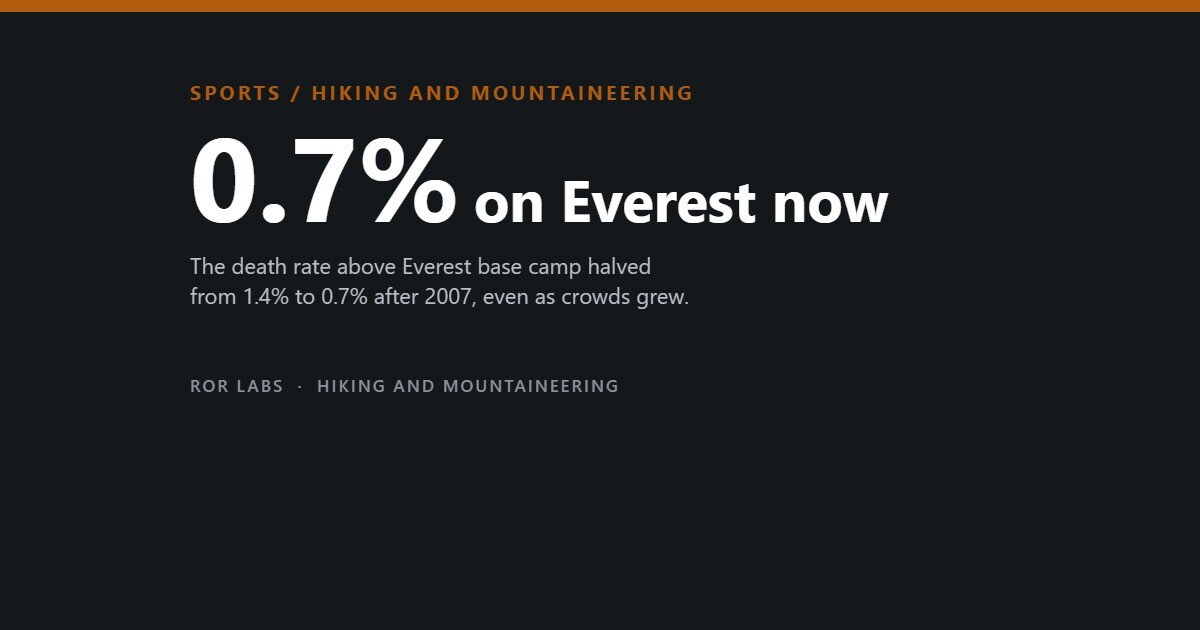
Mount Everest became four times more crowded during summit bids and did not become deadlier. A 2026 analysis of every recorded climber from 1921 to 2024 found the death rate above base camp halved, from 1.4% before 2007 to 0.7% since. The famous photographs of queues on the summit ridge are real; the rise in deaths they seem to imply is not.
On ordinary hills the risk is lower still and looks quite different. Most people who die while hiking fall, and a large share of the rest are middle-aged men whose hearts stop on the first day of an unaccustomed climb. In US national parks, the leading causes of accidental death are not wild animals or cliffs but car crashes and drowning.
This article follows the series format: what actually hurts hikers and mountaineers, where the risk concentrates, what has been measured to reduce it, and why the answer is not to stay at the bottom.
What actually kills and injures
The US National Park Service publishes its own mortality data. From 2014 to 2019 an average of 358 people died in national parks each year, about seven a week, across 177 parks. Half the deaths were unintentional, and the three leading unintentional causes were motor vehicle crashes, drowning and falls. Half of medical deaths happened during physical activity. In 2019 the overall rate was 0.11 deaths per 100,000 recreational visits.
Deaths in US national parks, 2014–2019
Leading recorded causes, from National Park Service data. Categories overlap.
Source: National Park Service mortality data, as reported by National Parks Traveler (May 2024). Total 2,149 deaths; average 358 a year.
On the trail itself, falls dominate the traumatic deaths. In the Swiss canton of Bern, every one of 77 fatal hiking accidents from 2003 to 2018 was a fall, many of them off marked trails. Among non-traumatic deaths, the pattern is just as consistent. Sudden cardiac death is the most common non-traumatic cause of death in men over 34 hiking in the mountains, according to research from the Austrian Alps.
Higher up, the list lengthens. A review of mountain deaths lists trauma, high-altitude illness, cold injury, avalanche burial and sudden cardiac death, and notes that some forms of mountaineering carry death rates comparable to hang gliding or boxing. Trekking, by contrast, is much safer. Among 275,950 trekkers in Nepal from 1987 to 1991, 40 died, about 14 per 100,000: illness caused 14 deaths, trauma 12 and altitude sickness 10.
Deaths among Nepal trekkers, 1987–1991
Causes of 40 deaths among 275,950 trekkers, about 14 per 100,000.
Source: Shlim and Gallie, International Journal of Sports Medicine (1992).
Two things stand out in that breakdown. Ordinary illness killed slightly more trekkers than trauma did, and altitude sickness, the hazard most trekkers prepare for, came third. The mix changes with height and with the kind of trip, which is why advice that fits a day walk in the Alps does not fit a month in the Himalaya.
When the risk concentrates
The heart risk has a precise shape. An Austrian case-control study compared 247 men over 34 who suffered sudden cardiac death while hiking or skiing with 741 matched controls. Risk was highest on the first day at altitude and rose the longer people had gone without food or drink. The men who died were far more likely to have had a previous heart attack, 17% against 0.9%, or known coronary disease, 17% against 4%. Only 14% of the hikers received early resuscitation.
The researchers’ conclusion was that unaccustomed physical activity seems more likely to trigger sudden cardiac death than altitude itself. A sedentary man who drives to a mountain and starts climbing hard, having skipped breakfast, is the profile. The same man after a gentle first day, eating and drinking as he goes, has a much lower risk. Altitude illness concentrates in the same way, on the speed of the climb rather than the height alone. In a classic study at 4,243 metres in Nepal, 53% of trekkers who had not acclimatised developed acute mountain sickness, and the rates were highest in those who flew in, climbed fast or spent fewer nights on the way up. Previous experience at altitude made no difference.
On high peaks, the danger concentrates on the way down. Of 94 deaths above 8,000 metres on Everest from 1921 to 2006, 56% happened while descending from the summit. The newer analysis found 76.5% of climber deaths happened on summit day, while 82% of Sherpa deaths happened during route preparation — a reminder that the workers who fix the ropes carry a different risk from the clients who use them.
Sudden cardiac death on the mountain
Share with each risk factor among men over 34 who died suddenly while hiking or skiing, against matched controls.
Source: Burtscher M, in Hypoxia and the Circulation, Advances in Experimental Medicine and Biology, doi:10.1007/978-0-387-75434-5_1 (2007).
What has been measured to work
Altitude illness has the best trial evidence of any mountain hazard. In a trial on the trek to Everest base camp, acetazolamide at 125 milligrams twice a day halved acute mountain sickness, from 24.7% to 12.2%; about eight people needed to take it to prevent one case. A larger trial of 614 trekkers found 34% developed the illness on placebo and 12% on acetazolamide, while ginkgo did no better than placebo.
Preventing altitude illness
Randomised trials and current guidance.
Everest trek: 24.7% → 12.2% (NNT 8)
614 trekkers: 34% → 12%
Ginkgo: no better than placebo
Above 3,000 m: sleep no more than 500 m higher each day
Rest day every 3 to 4 days
Descent is mandatory for HAPE and HACE
Source: Basnyat et al., High Altitude Medicine and Biology 4(1):45–52 (2003); Gertsch et al., BMJ 328:797 (2004); Luks et al., Wilderness and Environmental Medicine 35(1 suppl):2S–19S (2024).
The Wilderness Medical Society’s 2024 guidelines turn that into rules. Above 3,000 metres, sleeping elevation should rise no more than 500 metres a day, with a rest day every three to four days. Acetazolamide is recommended for moderate and high-risk ascents. High-altitude pulmonary oedema is the leading cause of death from altitude illness, and descent is mandatory for it and for high-altitude cerebral oedema.
For the knees, trekking poles have measurable effects. In a laboratory study on a 25-degree downhill ramp, poles reduced knee joint forces and ground reaction forces by 12% to 25%, and on level ground they reduced the load on the knee extensors by 7% to 10%. The evidence is not all one way: a Nordic walking study found no reduction in knee compression, and in people with knee osteoarthritis poles slightly increased one measure of knee load. Search and rescue data explain where the rest of the effort goes. In US national parks from 2003 to 2006 there were 12,337 search and rescue operations, and day hiking accounted for more than any other activity. In Yosemite during the 1990s, most rescue fatalities occurred while hiking. For the heart risk, the Austrian findings translate directly: an easy first day, food and water on the way, and a medical check for anyone with known heart disease before a strenuous trip.
Heat is the recent case. In June 2026 the National Park Service reported three apparent heat-related deaths on inner-canyon trails at the Grand Canyon within five days — a 72-year-old man on the South Kaibab Trail and a 67-year-old man and 68-year-old woman on the North Kaibab. Temperatures there can exceed 109°F in the shade, and the park asks visitors to stay off inner-canyon trails between 10 a.m. and 4 p.m.
Why the answer is not to stay at the bottom
Walking, which is most of hiking, has some of the most robust health evidence in this series. A meta-analysis of 15 cohorts with 47,471 adults found that people in the highest quarter of daily steps had 40% to 53% lower mortality than those in the lowest. The benefit levelled off at about 6,000 to 8,000 steps a day in adults over 60 and 8,000 to 10,000 in younger adults. An umbrella review of 40 reviews linked green space with lower mortality and better mental health, though most of those studies were cross-sectional and cannot show cause.
Everest became safer
Deaths per climber above base camp, and recent seasons.
Source: Dodge et al., Journal of Physiology, doi:10.1113/jp290840 (2026); Firth et al., BMJ 337:a2654 (2008); Lacrux (2025).
The Everest numbers are the strongest argument that mountain risk is not fixed. Crowds grew, yet the death rate halved. Another analysis found the rate fell from 1.6% in 1990 to 2005 to 1.0% in 2006 to 2019, with risk rising from about age 60. Better forecasting, fixed ropes, bottled oxygen and experienced guides are the likely reasons, though no study can attribute the fall to any one of them. The lesson for ordinary hikers is the same: most deaths come from a few predictable situations — a fall off the path, a first-day heart attack, a midday descent into heat — and each has a known countermeasure.
Against a national park death rate of about one per million visits, the choice for most people is not between safety and hiking. It is between a plan and no plan: stay on the trail, start gently, carry water and food, know the weather and turn back early.
Questions people ask
What is the most common cause of death while hiking?
Falls are the leading traumatic cause. Among non-traumatic causes, sudden cardiac death is the most common in men over 34.
How can I prevent altitude sickness?
Ascend slowly: above 3,000 metres, raise your sleeping altitude by no more than 500 metres a day. Acetazolamide halved the risk in trials; discuss it with a doctor before a high trip.
Is Everest getting more dangerous?
No. Despite crowding, the death rate above base camp halved, from 1.4% before 2007 to 0.7% since.
Do trekking poles protect your knees?
They reduced knee forces by 12% to 25% going downhill in a laboratory study, but not in every study or every group.
Who should see a doctor before a hard hike?
Anyone with known heart disease, a previous heart attack or several cardiovascular risk factors, especially before a strenuous or high-altitude trip.
The short version
- US national parks average about 358 deaths a year, mostly car crashes, drowning, falls and suicide, at about one per million visits.
- Falls cause most traumatic hiking deaths; sudden cardiac death is the main non-traumatic cause in men over 34.
- Heart risk peaks on the first day of unaccustomed exertion and with long gaps without food or drink.
- Slow ascent and acetazolamide prevent altitude illness; ginkgo does not.
- Everest’s death rate halved despite crowding, from 1.4% to 0.7%.
- Walking more is linked to 40% to 53% lower mortality.
This is a summary of published research, not medical or mountaineering advice. It does not replace training, local guidance or a medical check. If you have heart disease or are planning a high-altitude trip, talk to your doctor first. In an emergency, call the local rescue service.
Further reading: Luks et al., Wilderness and Environmental Medicine 35(1 suppl):2S–19S (2024), the current altitude illness guidelines. Huey et al., PLoS One 15(8):e0236919 (2020), on crowding and death on Everest. The National Park Service’s mortality data page.
- In Praise of Walking, Shane O’Mara (2020). A neuroscientist on what walking does for the brain and body. Short and well sourced, though it covers everyday walking more than mountains.
- A Walk in the Park, Kevin Fedarko (2024). Two writers attempt to walk the length of the Grand Canyon and nearly fail. Honest about heat, water and the limits of fitness, which is exactly where the canyon’s deaths come from.
- Rationality, Steven Pinker (2021). On judging risk by rates rather than images — useful when a photograph of a summit queue says one thing and the death rate another.
Sources
National Park Service, Deaths in National Parks, mortality data (nps.gov). — National Parks Traveler, No. 1 cause of death in national parks (May 2024). — Zürcher S, Jackowski C, Schön C. doi:10.7892/boris.142504 (2020). — Burtscher M, Ponchia A. Progress in Cardiovascular Diseases 52(6):507–511 (2010). — Burtscher M. Heart, Lung and Circulation, doi:10.1016/j.hlc.2017.01.010 (2017). — Burtscher M. Risk of cardiovascular events during mountain activities. In: Hypoxia and the Circulation, Springer, doi:10.1007/978-0-387-75434-5_1 (2007). — Windsor JS, Firth PG, Grocott MPW, et al. Postgraduate Medical Journal, doi:10.1136/pgmj.2009.078824 (2009). — Shlim DR, Gallie J. International Journal of Sports Medicine, doi:10.1055/s-2007-1024601 (1992). — Hackett PH, Rennie D, Levine HD. Lancet 2(7996):1149–1155 (1976). — Luks AM, et al. Wilderness and Environmental Medicine 35(1 suppl):2S–19S (2024). — Basnyat B, et al. High Altitude Medicine and Biology 4(1):45–52 (2003). — Gertsch JH, et al. BMJ 328:797 (2004). — Firth PG, Zheng H, Windsor JS, et al. BMJ 337:a2654 (2008). — Dodge RE, Zheng H, Windsor JS, et al. Journal of Physiology, doi:10.1113/jp290840 (2026). — Huey RB, Carroll CL, Salisbury RA, Wang JL. PLoS One 15(8):e0236919 (2020). — Lacrux, Everest season report (2025). — National Park Service, Grand Canyon news release (19 June 2026). — Schwameder H, et al. Journal of Sports Sciences 17(12):969–978 (1999). — Willson J, et al. Medicine and Science in Sports and Exercise 33(1):142–147 (2001). — Hansen L, et al. Scandinavian Journal of Medicine and Science in Sports (2008). — Bechard DJ, et al. Osteoarthritis and Cartilage (2012). — Heggie TW, Heggie TM. Journal of Travel Medicine 16(1):23–27 (2009). — Hung EK, Townes DA. Wilderness and Environmental Medicine 18(2):111–116 (2007). — Paluch AE, Bajpai S, Bassett DR, et al. Lancet Public Health 7(3):e219–e228 (2022). — Yang BY, et al. The Innovation (2021).