Mobile Phones and Brain Cancer: What the Evidence Shows
Key takeaways · 11 min read
- Interphone, the largest case-control study, found lower glioma risk in phone users, a sign of bias rather than protection.
- In 776,156 UK women followed for 14 years, phone users had no higher risk of brain tumours.
- COSMOS, which checked call time against operator records, found no link with glioma or other tumours.
- US malignant brain tumour rates fell by 0.6% a year from 2000 to 2021 as phone use soared.
In this article
- Why the question is hard to answer
- The study that found phones ‘protect’ you
- The 2011 ‘possibly carcinogenic’ label
- Following people forward in time
- What the reviews concluded
- What happened to tumour rates
- Limits, tests and the iPhone 12 case
- What is still uncertain
- Questions people ask
- The short version
- Sources
A mobile phone held to the ear sends radio waves into the side of the head. That simple fact has fuelled one of the longest-running health worries of the digital age: that phones, and the masts that serve them, might cause brain cancer. Each new generation of network, from 3G to 5G, has brought a new wave of concern, and in 2020 it helped inspire arson attacks on mobile masts in the United Kingdom.
The worry is not irrational. The exposure is almost universal, it began only a few decades ago, and brain tumours can take many years to develop. In 2011 the World Health Organization’s cancer agency classified radiofrequency fields as ‘possibly carcinogenic to humans’, a label that is still quoted today.
Since then, the evidence has grown enormously, and it has changed in kind. The early studies asked people with brain tumours to remember how they had used their phones. The newer ones followed hundreds of thousands of people forward in time. This article looks at what each type of study found, why one famous study appeared to show that phones protect against cancer, and what the data say about tumour rates since phones became universal.
Why the question is hard to answer
Brain tumours are rare. In most countries, a few adults in every hundred thousand are diagnosed with a glioma, the most common malignant type, each year. To detect a small increase in risk you need very large numbers of people and long follow-up.
Measuring exposure is just as difficult. How much radiofrequency energy reaches the brain depends on how long someone talks, which ear they use, the network technology, the distance to the nearest mast and whether they use a headset. Most studies have had only a rough measure of any of these.
There is also a question of mechanism. Mobile phone signals are non-ionising: unlike X-rays, they do not carry enough energy to break chemical bonds in DNA directly. Their established effect is slight heating of tissue, which safety limits are designed to keep well below harmful levels. That does not rule out other effects, but it means there is no well-understood route from phone use to cancer.
The study that found phones ‘protect’ you
The largest case-control study, Interphone, was coordinated by the International Agency for Research on Cancer and published in 2010 in the International Journal of Epidemiology. Researchers in 13 countries interviewed 2,708 people with glioma and 2,409 with meningioma, along with matched people without tumours, about their past phone use.
The headline result was strange. People who had ever been regular phone users had a lower risk of glioma than those who had not, with an odds ratio of 0.81. Taken at face value, phones protected the brain. The authors themselves said this was likely to reflect participation bias or other flaws, since there is no plausible way that radio waves could prevent tumours. One explanation is that people without tumours who agreed to take part were more likely to be phone users than those who refused.
The same study also found a raised odds ratio of 1.40 for glioma among the tenth of people who reported the most cumulative call time, 1,640 hours or more. But the authors noted implausible values of reported use in this group and warned that recall bias could not be excluded. People who have a brain tumour, and are looking for a reason, may remember their phone use differently from healthy people.
The Interphone study, 13 countries, 2010
Odds ratios for glioma compared with people who were not regular phone users.
Interphone Study Group, International Journal of Epidemiology, 2010;39(3):675–694. The authors warned that both results were likely affected by bias.

The 2011 ‘possibly carcinogenic’ label
In May 2011, a working group of scientists convened by the International Agency for Research on Cancer classified radiofrequency electromagnetic fields as possibly carcinogenic to humans, Group 2B. Its summary in The Lancet Oncology said the decision rested on limited evidence from Interphone and from a series of Swedish case-control studies led by Lennart Hardell.
Group 2B is often misunderstood. It is a statement about the strength of evidence, not about the size of any risk. It means that a cancer link cannot be ruled out on the evidence available, not that one has been shown. The same category has included aloe vera extract and pickled vegetables as traditionally prepared in Asia.
The Hardell studies reported raised risks, some of them appearing within a short time of first use. Joachim Schüz and colleagues later pointed out that if those associations were real, they would by now have produced a large rise in brain tumours across the population, which has not happened. They suggested major bias in how participants were recruited or how exposure was assessed.
Following people forward in time
The way around recall bias is to record phone use before anyone is diagnosed. Three large prospective studies have done so.
A Danish cohort, updated in the BMJ in 2011 by Patrizia Frei and colleagues, compared Danish adults by whether they had a mobile subscription by 1995, and found no link with any type of brain tumour even after 13 or more years. Its weakness was that a subscription is a crude measure of use.

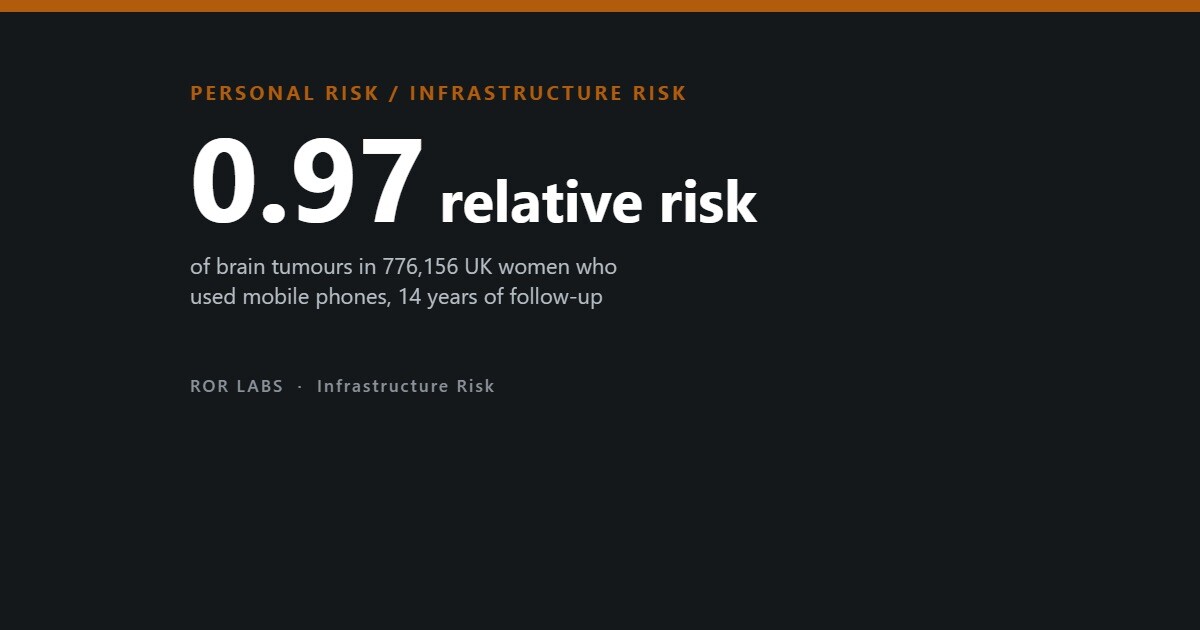
The UK Million Women Study asked women born between 1935 and 1950 about their phone use in about 2001 and again in 2011, then linked them to cancer records. In its 2022 update in the Journal of the National Cancer Institute, 776,156 women were followed for 14 years and 3,268 developed brain tumours. The relative risk for any brain tumour in phone users was 0.97, and there was no increase among daily users, those with ten or more years of use, or for tumours in the temporal and parietal lobes, the parts of the brain closest to the phone. Right and left sides were affected equally, even though most people hold the phone to one ear.
The international COSMOS cohort was designed specifically to fix earlier weaknesses. It recruited adults in Denmark, Finland, the Netherlands, Sweden and the UK between 2007 and 2012, and checked their reported call time against records from the phone operators. Its first results on brain tumours, published in Environment International in 2024, found no association between cumulative call time and the risk of glioma, meningioma or acoustic neuroma.
The UK Million Women Study
Brain tumour risk in phone users compared with never-users, 14 years of follow-up.
Schüz J et al, Journal of the National Cancer Institute, 2022;114(5):704–711. No increase for daily use or ten or more years of use.
What the reviews concluded
In 2024, a systematic review commissioned by the World Health Organization, led by Ken Karipidis in Environment International, brought the human studies together. It concluded with moderate certainty that mobile phone use likely does not increase the risk of glioma, meningioma, acoustic neuroma, pituitary tumours or salivary gland tumours in adults, or of brain tumours in children.
That review has critics. Lennart Hardell and Mona Nilsson argued in 2025 that it overlooked higher risks in the most exposed groups and in the parts of the head closest to the phone. Ronald Melnick and colleagues, in Environmental Health the same year, argued that many of the meta-analyses in the WHO’s series of reviews rested on too few studies or combined studies that were too different. These are real methodological points, and scientists continue to debate them. But the prospective cohorts, which avoid the main weakness of the case-control studies, all point the same way.
The main human studies
Mobile phone use and brain tumours.
| Study | Design | Main finding |
|---|---|---|
| Interphone, 2010 | Case-control, 13 countries | Lower risk in users; raised in heaviest recall |
| Danish cohort | Whole population by subscription | No link after 13+ years |
| Million Women, 2022 | Prospective, 776,156 UK women | No increase, including daily use |
| COSMOS, 2024 | Prospective, five countries | No link with call time |
| WHO-commissioned review, 2024 | Systematic review | Likely no increased risk, moderate certainty |
Interphone Study Group, 2010; Schüz J et al, 2022; Feychting M et al, 2024; Karipidis K et al, Environment International, 2024.
What happened to tumour rates
There is another way to test the idea. Mobile phone use grew from almost nothing in the 1980s to near universal within about 20 years. If phones caused even a modest share of brain tumours, rates should have started to rise, especially among the heaviest early users.
They have not. Peter Inskip and colleagues at the US National Cancer Institute found in 2010 that brain cancer rates in the United States were flat or falling in most age groups between 1992 and 2006. In 2025, Li Zhang and Joshua Muscat extended the analysis to 2021. Rates of malignant brain tumours in adolescents and adults fell by 0.6% a year. There was no significant change in tumours of the temporal lobe, closest to the ear, or in acoustic neuroma, a tumour of the hearing nerve. Only benign tumours rose, which is usually attributed to more brain scans finding small tumours that would once have been missed.
US brain tumour trends, 2000–2021
Average annual change in incidence, adolescents and adults.
| Tumour type | Annual change | Interpretation |
|---|---|---|
| Malignant brain tumours | −0.6% | Falling |
| Temporal lobe tumours | −0.06% | No significant change |
| Acoustic neuroma | +0.09% | No significant change |
| Benign brain tumours | +1.9% | Rising, likely more scanning |
Zhang L, Muscat JE, International Journal of Environmental Research and Public Health, 2025;22(6):933, using SEER data.
Trend data cannot rule out a small effect that takes decades to appear, or an effect limited to a small group of very heavy users. But they make a large effect very unlikely. Glioma rates in the Nordic countries and Australia show the same pattern.

Limits, tests and the iPhone 12 case
Every phone sold in the United States and Europe must meet a limit on the specific absorption rate, the amount of radiofrequency energy absorbed by the body. The US limit is 1.6 watts per kilogram averaged over 1 gram of tissue. The European limit for the head and trunk is 2.0 watts per kilogram averaged over 10 grams, with a higher limit of 4.0 for the limbs. These limits are set well below the level at which tissue heating becomes a concern.
In September 2023, the French frequency agency ANFR ordered Apple to stop selling the iPhone 12 in France after tests found an absorption rate of 5.74 watts per kilogram when the phone was held in the hand or kept in a trouser pocket, above the 4.0 limit for limbs. Apple disputed the result but released a software update, and sales resumed. The case was about compliance with a safety margin, not evidence of harm, but it showed that the limits are checked and enforced.
Safety limits for phones
Specific absorption rate, watts per kilogram.
| Limit | Value |
|---|---|
| United States, averaged over 1 g | 1.6 |
| European Union, head and trunk, 10 g | 2.0 |
| European Union, limbs, 10 g | 4.0 |
| iPhone 12, ANFR limb test, 2023 | 5.74 |
US Federal Communications Commission; EU Council Recommendation 1999/519/EC and harmonised standards; Agence nationale des fréquences, September 2023.
What is still uncertain
Three gaps remain. Most large studies followed adults who began using phones as adults, so the data on people who started in childhood are thinner. Exposure patterns have changed completely, from long calls held to the ear to data use with the phone in the hand, which reduces exposure to the head. And animal studies, including two large bioassays reported around 2018, found some tumours in rodents exposed to whole-body radiation for many hours a day at levels far above what a person receives. The results were inconsistent between species and hard to translate to humans.
If you want to reduce your exposure anyway, it is easy and costs nothing: use the speaker or earphones for long calls, and let the phone sit away from your head when the signal is weak, because phones transmit at higher power when reception is poor. These steps are consistent with the advice given by the Million Women Study authors for very heavy users. Products sold to block radiation are a different matter; a shield that blocked the signal would also stop the phone working.
Questions people ask
Do mobile phones cause brain cancer?
The large prospective studies and a 2024 WHO-commissioned review found no increased risk. A small effect in very heavy users cannot be completely ruled out.
Why did the WHO call phones possibly carcinogenic?
In 2011 its cancer agency placed radiofrequency fields in Group 2B, meaning the evidence was limited, not that a risk had been shown.
Have brain tumour rates gone up since phones became common?
No. US malignant brain tumour rates fell by about 0.6% a year from 2000 to 2021, and tumours near the ear did not rise.
Is 5G more dangerous?
5G uses non-ionising radio waves under the same exposure limits. No evidence shows it causes cancer, and masts give far lower exposure than a phone at the ear.
How can I reduce exposure?
Use the speaker or earphones for long calls and avoid holding the phone to your head when reception is poor.
The short version
- Interphone, the largest case-control study, found lower glioma risk in phone users, a sign of bias rather than protection.
- In 776,156 UK women followed for 14 years, phone users had no higher risk of brain tumours.
- COSMOS, which checked call time against operator records, found no link with glioma or other tumours.
- US malignant brain tumour rates fell by 0.6% a year from 2000 to 2021 as phone use soared.
- Earphones and the speaker cut exposure for free; anti-radiation products are unnecessary.
This article summarises published research on mobile phones and brain tumours. It is not medical advice. If you have symptoms such as persistent headaches, seizures or changes in vision, hearing or behaviour, see a doctor.
Further reading. Schüz and colleagues, ‘Cellular Telephone Use and the Risk of Brain Tumors: Update of the UK Million Women Study’, Journal of the National Cancer Institute, 2022, is open access and clearly written. Swerdlow and colleagues, Environmental Health Perspectives, 2011, explains the problems with Interphone.
- Science Fictions, Stuart Ritchie (2020). A psychologist on how bias, hype and bad methods creep into published research, and how to spot them.
- How to Read Numbers, Tom Chivers and David Chivers (2021). A short guide to the statistical traps behind health scares, from relative risk to sampling bias.
- The Data Detective, Tim Harford (2021). An economist on reading statistics with healthy scepticism rather than cynicism.
Sources
- Interphone Study Group. Brain tumour risk in relation to mobile telephone use: results of the INTERPHONE international case–control study. International Journal of Epidemiology, 2010;39(3):675–694. doi:10.1093/ije/dyq079.
- Baan R, Grosse Y, Lauby-Secretan B, and colleagues. Carcinogenicity of radiofrequency electromagnetic fields. The Lancet Oncology, 2011;12(7):624–626. doi:10.1016/S1470-2045(11)70147-4.
- Swerdlow AJ, Feychting M, Green AC, and colleagues. Mobile phones, brain tumors, and the Interphone study: where are we now? Environmental Health Perspectives, 2011;119(11):1534–1538. doi:10.1289/ehp.1103693.
- Schüz J, Pirie K, Reeves GK, and colleagues. Cellular telephone use and the risk of brain tumors: update of the UK Million Women Study. Journal of the National Cancer Institute, 2022;114(5):704–711. doi:10.1093/jnci/djac042.
- Feychting M, Schüz J, Toledano MB, and colleagues. Mobile phone use and brain tumour risk: COSMOS, a prospective cohort study. Environment International, 2024;185:108552. doi:10.1016/j.envint.2024.108552.
- Karipidis K, Baaken D, Loney T, and colleagues. The effect of exposure to radiofrequency fields on cancer risk in the general and working population: a systematic review of human observational studies, part I. Environment International, 2024;191:108983. doi:10.1016/j.envint.2024.108983.
- Melnick RL, Moskowitz JM, Héroux P, and colleagues. The WHO-commissioned systematic reviews on health effects of radiofrequency radiation provide no assurance of safety. Environmental Health, 2025;24:70. doi:10.1186/s12940-025-01220-4.
- Hardell L, Nilsson M. A critical analysis of the World Health Organization (WHO) systematic review 2024 on radiofrequency radiation exposure and cancer risks. Journal of Cancer Science and Clinical Therapeutics, 2025. doi:10.26502/jcsct.5079261.
- Frei P, Poulsen AH, Johansen C, and colleagues. Use of mobile phones and risk of brain tumours: update of Danish cohort study. BMJ, 2011;343:d6387. doi:10.1136/bmj.d6387.
- Inskip PD, Hoover RN, Devesa SS. Brain cancer incidence trends in relation to cellular telephone use in the United States. Neuro-Oncology, 2010;12(11):1147–1151. doi:10.1093/neuonc/noq077.
- Zhang L, Muscat JE. Trends in malignant and benign brain tumor incidence and mobile phone use in the U.S. (2000–2021): a SEER-based study. International Journal of Environmental Research and Public Health, 2025;22(6):933. doi:10.3390/ijerph22060933.
- Agence nationale des fréquences (ANFR). Decision on the iPhone 12, 12 September 2023.