Emergency Department Boarding: What the Evidence Shows
Key takeaways · 11 min read
- Boarding means staying in the emergency department after the decision to admit, because there is no ward bed.
- In England, 1.7 million people waited 12 hours or more in 2024.
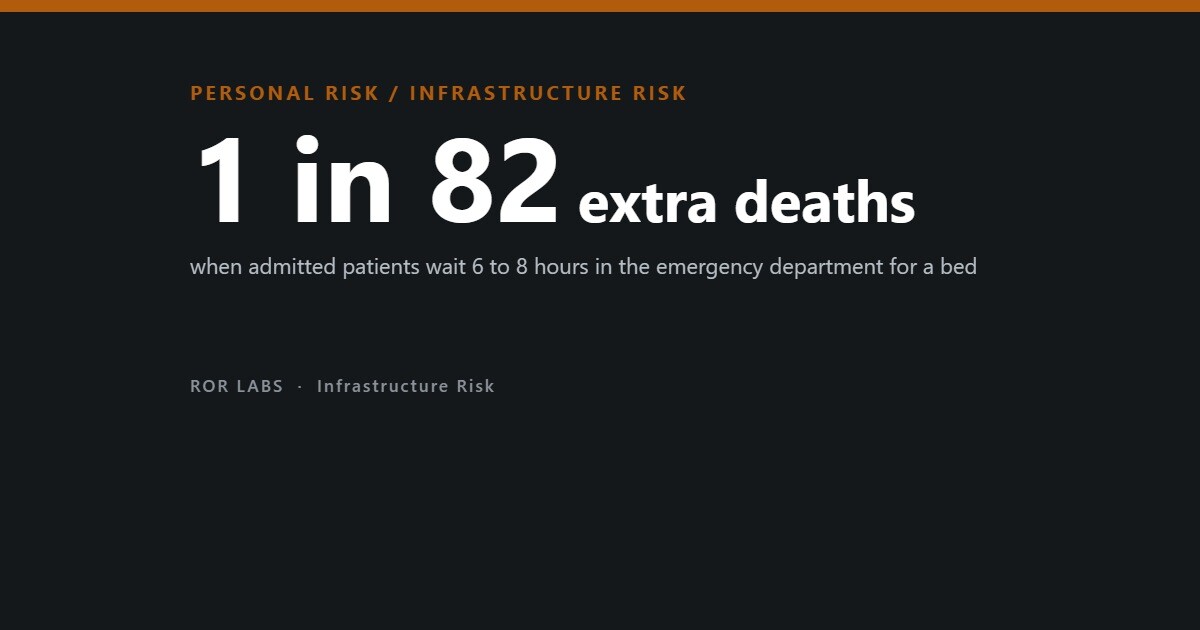
- A study of 5.4 million patients found one extra death for every 82 patients delayed 6 to 8 hours.
- Some large studies find no link after adjustment, and a 2020 review called the evidence suggestive rather than strong.
In this article
- What boarding is, and how common it has become
- The largest study: 5 million admissions
- Studies from other countries
- The studies that found nothing
- How waiting could cause harm
- When the queue reaches the ambulances
- What has been tried
- What the evidence does not show
- Questions people ask
- The short version
- Sources
Most people imagine the risk in an emergency department as the wait to be seen. For many patients the longer and more dangerous wait comes after that. A doctor has decided they need to be admitted, but there is no bed on a ward. So they stay in the emergency department, on a trolley in a corridor or in a cubicle meant for new arrivals, sometimes for a day or more.
Emergency physicians call this boarding. In England it is measured as time from arrival, and the long waits are called trolley waits. It has become one of the most studied problems in hospital care, because it touches everyone in the building: the patient waiting for a bed, the patients arriving behind them, and the ambulances queuing outside.
This article looks at what the research shows about boarding and crowding, how strong the link to mortality is, why some studies find nothing, and what has been tried. The figure most often quoted comes from 7.5 million admissions in England: for every 82 patients whose admission was delayed 6 to 8 hours, there was one extra death within 30 days.
What boarding is, and how common it has become
An emergency department is designed for assessment and early treatment, not for looking after patients over a day or two. When admitted patients stay there, the department runs out of cubicles and staff for new arrivals, ambulances cannot hand over their patients, and the patients waiting for a ward get care that was never designed for them.
The problem is not new. Reports of crowded emergency departments go back to the 1980s. What has changed is its scale. A 2026 systematic review in Health Affairs Scholar, by Marisa Dowling and colleagues, summarised recent US data showing that about 40% of admitted patients boarded for more than 4 hours, and about 6% for more than 24 hours.
In England, the Royal College of Emergency Medicine reported that in 2024, 1.7 million patients waited 12 hours or more in emergency departments, and nearly 479,000 waited more than 24 hours. About 69% of those waiting 12 hours or more were waiting for a ward bed.
Boarding is usually a symptom of problems elsewhere in the hospital. When wards are full, often because patients who are medically ready to leave cannot be discharged to care homes or community services, the queue backs up into the emergency department.
Long waits in English emergency departments, 2024
Patients waiting from arrival to admission, discharge or transfer.
Royal College of Emergency Medicine, analysis of NHS England data, 2025. About 69% of 12-hour waiters were waiting for a ward bed.
The largest study: 5 million admissions
The strongest evidence comes from England, where every emergency attendance is recorded. Simon Jones and colleagues, in the Emergency Medicine Journal in 2022, analysed 26.7 million emergency department attendances from April 2016 to March 2018. Of those, 7.5 million led to admission, involving 5.4 million patients. Within 30 days, 433,962 of them had died, a crude rate of 8.7%.
The researchers compared observed deaths with expected deaths, adjusting for age, sex, deprivation, illness, and other factors. A statistically significant rise in mortality began once patients had spent more than 5 hours in the department between arrival and admission, and it rose steadily with longer waits.
At 6 to 8 hours, the standardised mortality ratio was about 8% higher. The authors translated this into a single number: for every 82 patients whose admission was delayed 6 to 8 hours, there was one extra death. The Royal College of Emergency Medicine, using the same method for waits of 8 to 12 hours, estimates one extra death for every 72 patients.
Applying that ratio to the number of long waits in England, the College estimated that 16,644 deaths in 2024 were associated with waits of 12 hours or more, up from about 13,900 the year before, or roughly 320 a week. That is an estimate built on an observational ratio, not a count of individual deaths, and it depends on assuming that the relationship in 2016 to 2018 still holds.
Delay to admission and 30-day mortality, England
One extra death within 30 days for every N patients delayed.
Jones S and colleagues, Emergency Medicine Journal, 2022; Royal College of Emergency Medicine, 2025.
Studies from other countries
Earlier studies found similar patterns in very different health systems.
Peter Sprivulis and colleagues, in the Medical Journal of Australia in 2006, linked 62,495 emergency admissions at three hospitals in Western Australia to death records. When hospital and emergency department occupancy were high, the hazard of death was about 30% higher at 2 and 7 days, and 20% higher at 30 days.
Adam Singer and colleagues, in Academic Emergency Medicine in 2011, studied 41,256 admissions from one US academic emergency department. Mortality rose from 2.5% among patients who boarded for less than 2 hours to 4.5% among those who boarded for 12 hours or more. Average hospital stays rose from 5.6 days to 8.7 days for those boarding more than 24 hours.
Jane McCusker and colleagues, studying 677,475 patients in 42 emergency departments in Quebec, found that days with higher occupancy were associated with worse 30-day outcomes, including mortality, after adjusting for patient and hospital characteristics.
Mortality by length of boarding
Admissions from one US academic emergency department, 2005 to 2008.
Singer AJ and colleagues, Academic Emergency Medicine, 2011. 41,256 admissions. Bars scaled to 10%.
The studies that found nothing
Not every study agrees, and the disagreements are informative.
Stephen Derose and colleagues, in Medical Care in 2014, analysed 136,740 adults at 13 emergency departments in a large US health system. After adjusting for patient characteristics, severity of illness and diagnosis, no measure of waiting, boarding or crowding predicted higher inpatient mortality. Boarding did predict longer hospital stays.
A 2020 systematic review in PLoS ONE by Jihane Boudi and colleagues found 12 studies of boarding and in-hospital mortality. Six found a positive association, five found none, and one had mixed results. Because the studies used different definitions and cut-offs, the authors could not pool them, and they concluded that there was a tendency towards an association but not strong evidence.
Much of the difficulty is confounding. Sicker patients may wait longer because they need specialist beds, such as intensive care, that are scarcer. Or they may wait less because they are prioritised. Studies adjust for what is recorded, but severity is hard to capture fully. Kevin Gardner and colleagues showed in 2022 that some studies of critically ill boarders had overstated the effect by excluding patients whose condition improved while they waited.
Does boarding raise mortality? What the studies found
Studies of boarding or crowding and death after emergency admission.
| Study | Setting | Finding |
|---|---|---|
| Sprivulis and colleagues, 2006 | Western Australia, 62,495 | About 30% higher 7-day hazard when crowded |
| Singer and colleagues, 2011 | US, 41,256 | 2.5% to 4.5% with longer boarding |
| Derose and colleagues, 2014 | US, 136,740 | No association after adjustment |
| Jones and colleagues, 2022 | England, 5.4 million patients | Rise after 5 hours; 1 in 82 at 6–8 hours |
| Boudi and colleagues, 2020 | Review, 12 studies | 6 positive, 5 null, 1 mixed |
Medical Journal of Australia; Academic Emergency Medicine; Medical Care; Emergency Medicine Journal; PLoS ONE.
How waiting could cause harm
If boarding does cause deaths, the mechanisms are not hard to imagine, and some have been measured.
Patients who board are cared for by staff who are also responsible for new arrivals. The Dowling review found reports of medication errors, including missed doses, among a large share of boarded patients in some studies, and delays to antibiotics for patients with sepsis. Older patients, especially those with dementia, had higher odds of delirium or agitation with each additional hour spent boarding.
The harm also spreads to people who are not boarding. When cubicles are full, new patients wait longer to be assessed, and ambulances wait outside to hand over, leaving fewer available to respond to calls in the community. Several studies have linked high boarding levels to longer ambulance handover times.
And there is the effect on staff. The same review found that many emergency nurses reported being unable to provide safe care during boarding, and that boarding contributed to burnout and to verbal and physical abuse from frustrated patients and relatives.
Boarding in US emergency departments
Recent US data summarised in a 2026 systematic review.
Dowling M and colleagues, Health Affairs Scholar, 2026. Data from 2017 to 2024.
When the queue reaches the ambulances
One of the clearest pieces of evidence that crowding harms patients comes from people who never reached the crowded hospital at all.
When emergency departments are full, US hospitals can go on ambulance diversion, asking ambulances to take patients elsewhere. Yu-Chu Shen and Renee Hsia, in JAMA in 2011, studied 13,860 Medicare patients with heart attacks in four California counties. When a patient’s nearest emergency department had been on diversion for 12 hours or more on the day they were admitted, their death rate was about 3 percentage points higher than when the same department was not on diversion, and the gap persisted at one year.
Because the study compared the same hospitals on different days, it is harder to explain by differences between hospitals. And a later study by the same group, in Health Affairs in 2018, found that diversion hours were driven far more by how full the inpatient wards were than by how many people arrived at the emergency department, a rise in ward volume being associated with about seven times the increase in diversion of a similar rise in emergency visits.
That is the same conclusion reached from a different direction: the pressure in the emergency department is mostly set by what happens upstairs.
What has been tried
The most common policy response has been time targets. England introduced a four-hour target in 2004, requiring most patients to be admitted, transferred or discharged within four hours of arrival. Performance improved for several years, then declined as demand and bed shortages grew.
Researchers generally argue that the solution lies outside the emergency department: enough ward beds, faster discharge from wards, and enough community and social care to allow patients to leave hospital when they are ready. Elaine Rabin and colleagues, in Health Affairs in 2012, argued that proven hospital-wide flow strategies, such as discharging patients earlier in the day and smoothing planned surgery through the week, were underused, and that legislation might be needed.
The same review of recent US studies concluded that boarding had worsened despite extensive evidence of harm. That is partly because the costs of boarding fall on the emergency department and its patients, while the decisions that could relieve it are made elsewhere in the hospital and health system.
What the evidence does not show
It does not show exactly how many people die because of boarding. Estimates such as 16,644 deaths a year in England are built from observational ratios, not from reviewing individual cases.
It does not show that boarding always raises mortality. Some large, well-adjusted studies found no association, and the effect may depend on the patient, the hospital and the country.
It does not separate boarding from the wider pressures that cause it. Hospitals with long boarding times are often short of staff and beds in general.
And it does not tell an individual patient what to do. Leaving an emergency department before being assessed or admitted carries its own risks.
Questions people ask
What is emergency department boarding?
Keeping a patient in the emergency department after the decision to admit them, because no ward bed is available.
Does waiting longer for a bed increase the risk of death?
In the largest study, from England, mortality rose once total time in the department passed 5 hours, with one extra death for every 82 patients delayed 6 to 8 hours.
How long do patients board?
In recent US data, about 40% of admitted patients boarded for more than 4 hours. In England in 2024, 1.7 million people waited 12 hours or more.
Why do some studies find no effect?
Sicker patients may wait longer or shorter for reasons that are hard to measure, and definitions of boarding differ between studies.
What reduces boarding?
Mostly changes outside the emergency department: more ward and community capacity, earlier discharges, and better planning of elective admissions.
The short version
- Boarding means staying in the emergency department after the decision to admit, because there is no ward bed.
- In England, 1.7 million people waited 12 hours or more in 2024.
- A study of 5.4 million patients found one extra death for every 82 patients delayed 6 to 8 hours.
- Some large studies find no link after adjustment, and a 2020 review called the evidence suggestive rather than strong.
- Most proposed solutions lie outside the emergency department, in ward beds, discharge and community care.
This article summarises published research on emergency department crowding and boarding. It is not medical advice. If you or someone you care for needs urgent care, seek it; do not delay or leave treatment because of concerns about waiting times.
Further reading. Jones and colleagues, ‘Association between delays to patient admission from the emergency department and all-cause 30-day mortality’, Emergency Medicine Journal, 2022, is the largest study. Boudi and colleagues, PLoS ONE, 2020, is an open-access review that sets out why the evidence is still debated.
- The Emergency, Thomas Fisher (2022). An emergency physician in Chicago on a year of pandemic shifts and what crowded departments reveal about the health system.
- Every Minute Is a Day, Robert Meyer and Dan Koeppel (2021). An emergency physician in the Bronx on what happens inside an emergency department when demand overwhelms capacity.
- Dear Life, Rachel Clarke (2020). An NHS doctor on caring for patients at the end of life, and on the pressures hospitals place on that care.
Sources
- Jones S, Moulton C, Swift S, and colleagues. Association between delays to patient admission from the emergency department and all-cause 30-day mortality. Emergency Medicine Journal, 2022;39(3):168–173. doi:10.1136/emermed-2021-211572.
- Royal College of Emergency Medicine. Excess deaths linked to long A&E waits increased to over 16,600 last year. May 2025.
- Dowling M and colleagues. Patient and staff safety implications of emergency department boarding: a systematic review. Health Affairs Scholar, 2026. doi:10.1093/haschl/qxag084.
- Sprivulis PC, Da Silva JA, Jacobs IG, Frazer ARL, Jelinek GA. The association between hospital overcrowding and mortality among patients admitted via Western Australian emergency departments. Medical Journal of Australia, 2006;184(5):208–212. doi:10.5694/j.1326-5377.2006.tb00416.x.
- Singer AJ, Thode HC, Viccellio P, Pines JM. The association between length of emergency department boarding and mortality. Academic Emergency Medicine, 2011;18(12):1324–1329. doi:10.1111/j.1553-2712.2011.01236.x.
- McCusker J, Vadeboncoeur A, Lévesque JF, Ciampi A, Belzile E. Increases in emergency department occupancy are associated with adverse 30-day outcomes. Academic Emergency Medicine, 2014;21(10):1092–1100. doi:10.1111/acem.12480.
- Derose SF, Gabayan GZ, Chiu VY, Yiu SC, Sun BC. Emergency department crowding predicts admission length-of-stay but not mortality in a large health system. Medical Care, 2014;52(7):602–611. doi:10.1097/MLR.0000000000000141.
- Boudi Z, Lauque D, Alsabri M, and colleagues. Association between boarding in the emergency department and in-hospital mortality: a systematic review. PLoS ONE, 2020;15(4):e0231253. doi:10.1371/journal.pone.0231253.
- Gardner K, Gordon AJ, Shannon BC, and colleagues. Selection bias in estimating the relationship between prolonged ED boarding and mortality in emergency critical care patients. JACEP Open, 2022;3(1):e12667. doi:10.1002/emp2.12667.
- Shen YC, Hsia RY. Association between ambulance diversion and survival among patients with acute myocardial infarction. JAMA, 2011;305(23):2440–2447. doi:10.1001/jama.2011.811.
- Hsia RY, Sarkar N, Shen YC. Is inpatient or emergency department crowding a greater driver to ambulance diversion? Health Affairs, 2018;37(7):1115–1122. doi:10.1377/hlthaff.2017.1602.
- Rabin E, Kocher K, McClelland M, and colleagues. Solutions to emergency department ‘boarding’ and crowding are underused and may need to be legislated. Health Affairs, 2012;31(8):1757–1766. doi:10.1377/hlthaff.2011.0786.