Measles: What the Evidence Shows About the Risk
Key takeaways · 10 min read
- US measles cases went from 285 in 2024 to 2,289 in 2025 and 3,471 by September 2026. Three people died in 2025.
- Measles is one of the most contagious human infections; coverage around 95% is usually needed to stop it spreading. US kindergarten coverage is now 92.4%.
- Median field effectiveness is 92% for one dose at 12 months or older and about 94% for two doses.
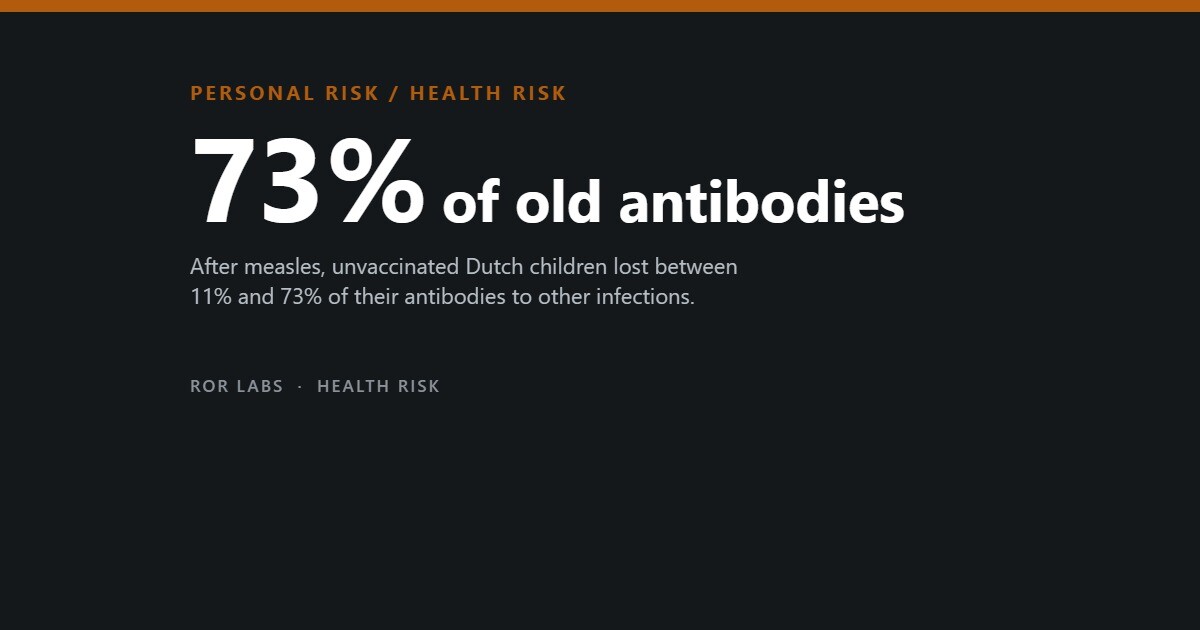
- Measles can wipe out 11% to 73% of existing antibodies to other infections. How many deaths that causes is still debated.
In 2024 the United States recorded 285 measles cases. In 2025 it recorded 2,289. By 17 September 2026 the count for the year had already reached 3,471. Three people died in 2025: two unvaccinated school-age children in Texas and an unvaccinated adult in New Mexico, the first measles deaths in the country in a decade.
Most people who catch measles recover. That is true, and it is the reason the disease is easy to underestimate. What the research of the last ten years has added is a second cost that does not show up in the week of the rash: measles can erase part of the immune memory a child has already built against other infections.
This is what the evidence says about how contagious measles is, how well the vaccine works, what the virus does after the rash fades, and where the famous numbers are firmer or softer than they sound.
US measles cases by year
Confirmed cases reported to CDC.
CDC, Measles Cases and Outbreaks, accessed September 2026; MMWR 2025;74(14). 2026 figures are provisional. In 2025 about 90% of cases were outbreak-associated; in 2026 so far, 95%.
How contagious it is, and who gets it
Measles spreads through the air and lingers in a room after an infected person has left. One case in a fully susceptible population typically infects twelve to eighteen others, one of the highest figures for any human infection, and people are infectious for up to four days before the rash appears. That is why the vaccination coverage needed to stop spread is usually put at about 95%, far higher than for most diseases.
The 2025 outbreak shows what happens below that line. By mid-April 2025, CDC counted 800 cases in 25 jurisdictions, 654 of them in a single outbreak centred on Gaines County, Texas, in close-knit communities with low vaccination coverage. Eleven per cent of patients were hospitalised. Outside Texas, 77% were known to be unvaccinated and a further 14% had unknown status.
Kindergarten MMR coverage in the United States has fallen from 95.2% in the 2019–20 school year to 92.4% in 2025–26, according to CDC. A national average hides the real problem, which is clustering. A 1999–2000 epidemic in the Netherlands started in a school where 7% of pupils were vaccinated, in a country where overall coverage was 96%. Among 255 responding pupils and their households the attack rate was 37%, reaching 88% in the youngest classes. None of the 25 vaccinated pupils developed symptoms.
US kindergarten MMR coverage
Share of kindergarteners with two doses, by school year.
CDC, accessed September 2026. National averages hide local clusters with much lower coverage.
How well the vaccine works
The most complete review of field effectiveness, by Amra Uzicanin and Laura Zimmerman at CDC, pooled 135 estimates from 70 studies published between 1960 and 2010. For one dose given at 12 months or later, the median effectiveness was 92%. For two doses, it was 94.1%. The figure usually quoted by public health bodies, 97% for two doses, comes from studies with laboratory-confirmed cases and verified records.
The same review found that a first dose given at 9 to 11 months, which many countries use because measles is common there early in life, had a median effectiveness of 77%. Age at vaccination matters. In Quebec, among children who had received two doses, those whose first dose came at 12 to 13 months had about five times the risk of measles of those vaccinated first at 15 months or older.
There is also a live question about waning. A systematic review by Stephanie Hughes and colleagues found some evidence that two-dose effectiveness falls with time since vaccination in places where measles has been eliminated, possibly because vaccinated people are no longer boosted by circulating virus. The authors were clear that only three studies from elimination settings met their criteria, so the estimate is weak. Vaccine failure exists; it is far rarer than failure to vaccinate.
Median field effectiveness of measles vaccine
Across 135 estimates from 70 studies, 1960 to 2010.
Uzicanin and Zimmerman, Journal of Infectious Diseases, 2011. Estimates vary by region and study design; restricting to laboratory-confirmed cases raised the one-dose figures slightly.
What the virus does after the rash
Doctors have known since the early twentieth century that children are more vulnerable to other infections for a few weeks after measles. In 2015 Michael Mina, Bryan Grenfell and colleagues argued that the effect lasts much longer. Using mortality records from the United States, England and Wales, and Denmark before and after vaccination, they found that measles incidence predicted deaths from other infectious diseases for two to three years afterwards. When measles was common, they estimated, it may have been involved in as much as half of all childhood deaths from infectious disease in those countries.
The mechanism was shown directly in 2019. Blood taken from unvaccinated Dutch children before and after measles showed that the infection wiped out between 11% and 73% of the antibodies they had built against other pathogens. Measles infects and destroys memory immune cells, so the body loses part of its record of past infections. Researchers call it immune amnesia. Some of that memory comes back with re-exposure; some does not.
Here the evidence needs care. The laboratory findings on immune cells are strong. The population estimate of how many deaths immune amnesia causes is weaker. Mina’s 2015 analysis was challenged in Science by Thakkar and McCarthy, who argued that the regular two-to-three-year cycles of measles epidemics could make a lagged association appear artificially. Mina and colleagues replied that periodicity had a negligible effect on their signal. Both sides agree that the immune damage is real; the dispute is over how precisely it can be counted in mortality data.
An analysis of 46 African countries from 1990 to 2018 found that higher measles prevalence was associated with more deaths from diarrhoea, pneumonia, malaria and other infections, and higher measles vaccination coverage with fewer. That is consistent with immune amnesia, though country-level associations cannot rule out other explanations such as better health systems doing several things at once.
What measles did to existing immunity
Unvaccinated children in the Netherlands, antibodies measured before and after infection.
Mina and colleagues, Science, 2019; described in Haeryfar, PLOS Pathogens, 2020. The mortality consequences were estimated separately (Mina and colleagues, Science, 2015) and remain debated.
The global picture
Before a vaccine was licensed in 1963, measles is estimated to have killed two to three million people a year worldwide. Vaccination is estimated to have prevented about 23 million deaths between 2000 and 2018 alone. The global annual death toll first fell below 100,000 in 2021, according to a 2025 historical review by Heikki Peltola, but outbreaks have since returned in many countries, including in Europe.
The United States has been here before. Between 1989 and 1991 a resurgence produced 55,622 reported cases. Years later, William Bellini and colleagues traced SSPE cases back to that resurgence and concluded that the risk of SSPE after measles was higher than earlier estimates, so vaccination was preventing more of it than had been recognised. The full cost of an outbreak is not known until years after it ends.
Infants too young to be vaccinated depend entirely on the people around them. So do people whose immune systems are suppressed by illness or treatment, who cannot safely receive a live vaccine. When coverage in a community falls, they are the first to lose protection they never had any way to earn for themselves.
The rare complication that arrives years later
Subacute sclerosing panencephalitis, or SSPE, is a progressive brain disease caused by the measles virus persisting in the nervous system. It usually appears seven to ten years after the original infection and is almost always fatal. It is rare overall, but much less rare after measles in infancy.
A German study using two national reporting systems estimated that for children infected before age five, the risk was between 1 in 1,700 and 1 in 3,300, depending on assumptions about how many cases were captured. Of the German children with SSPE and a known history of measles, all had caught it before the age of three. A US analysis from the 1970s put the risk after measles at 5.2 to 9.7 cases per million across all ages, which shows how much the age at infection matters.
That US study also found a smaller number of SSPE cases in children with a history of vaccination and no known measles. A later review by Helen Campbell and colleagues concluded that vaccine virus does not cause SSPE; every brain sample examined with molecular methods has contained wild-type virus. The most likely explanation for the vaccinated cases is unrecognised measles before vaccination. SSPE fell sharply in every country that vaccinated widely.
Estimated SSPE risk after measles
SSPE cases per 100,000 children who had measles before age five, Germany.
Schönberger and colleagues, PLOS ONE, 2013 (capture–recapture from German surveillance, 2003 to 2009). Modlin and colleagues, Pediatrics, 1977, estimated 5.2 to 9.7 per million after measles at all ages in the US.
The vaccine safety question
The claim that MMR causes autism originated in a 1998 paper of twelve children that was later retracted. It has been tested repeatedly since. The largest single study, by Anders Hviid and colleagues, followed 657,461 children born in Denmark between 1999 and 2010. Compared with unvaccinated children, vaccinated children had an adjusted hazard ratio for autism of 0.93, with a confidence interval of 0.85 to 1.01. There was no increased risk in any subgroup, including children with siblings with autism.
MMR does have known side effects. Fever is common, a mild rash occurs in some children, and febrile seizures occur after roughly one in every few thousand doses. Those are real and parents are entitled to be told about them. They are also far rarer than the corresponding complications of measles itself.
What the evidence does not show
It does not give a single, fixed number for how many deaths immune amnesia causes. The immune mechanism is well established; the population mortality estimate depends on modelling that has been challenged.
It does not show that high national coverage protects everyone. The Dutch and Texan outbreaks both happened inside countries with high average coverage. Clusters decide where measles spreads.
It does not show that vaccine immunity is permanent in every person. Waning may occur in elimination settings, though the evidence is thin, and some people do not respond to vaccination at all. Those are reasons for high coverage, not arguments against vaccination.
And the 2026 numbers are provisional. CDC notes that counts are updated as investigations close, so a mid-year figure can change.
Questions people ask
How many measles cases has the US had in 2026?
CDC reported 3,471 confirmed cases as of 17 September 2026, after 2,289 in 2025 and 285 in 2024. About 95% of this year’s cases were part of outbreaks.
How effective is the MMR vaccine?
Across field studies, the median effectiveness was 92% for one dose given at 12 months or older and about 94% for two doses. Public health agencies usually quote 97% for two doses, based on laboratory-confirmed studies.
What is measles immune amnesia?
Measles destroys memory immune cells, so a child can lose part of their existing protection against other infections. One study found between 11% and 73% of prior antibodies lost after infection.
Is measles dangerous for healthy children?
Most recover, but in the 2025 US outbreak 11% of patients were hospitalised and three people died. Infants are at the highest risk of the rare fatal brain complication SSPE, which can appear years later.
Does the MMR vaccine cause autism?
No. A Danish study of 657,461 children found no increased risk, including in children with a family history of autism.
The short version
- US measles cases went from 285 in 2024 to 2,289 in 2025 and 3,471 by September 2026. Three people died in 2025.
- Measles is one of the most contagious human infections; coverage around 95% is usually needed to stop it spreading. US kindergarten coverage is now 92.4%.
- Median field effectiveness is 92% for one dose at 12 months or older and about 94% for two doses.
- Measles can wipe out 11% to 73% of existing antibodies to other infections. How many deaths that causes is still debated.
- SSPE, a fatal brain complication, occurs in roughly 1 in 1,700 to 1 in 3,300 children infected before age five in German data.
This article summarises published research and public health data about measles. It is not medical advice. Questions about vaccination, exposure or symptoms in you or your child should go to your doctor or local public health department, which can also advise on what to do after a known exposure.
Further reading. Mina and colleagues, ‘Measles virus infection diminishes preexisting antibodies that offer protection from other pathogens’, Science, 2019, is the study behind the immune amnesia figures. Uzicanin and Zimmerman, ‘Field effectiveness of live attenuated measles-containing vaccines’, Journal of Infectious Diseases, 2011, is the review of how well the vaccine works outside trials. CDC’s weekly case page gives the current US count.
- The Premonition, Michael Lewis (2021). A narrative of the people inside US public health who saw a pandemic coming. Storytelling rather than epidemiology, and openly partisan about institutions.
- How to Talk to a Science Denier, Lee McIntyre (2021). A philosopher on why arguments about evidence fail, including on vaccines. More about method than about measles.
- The Data Detective, Tim Harford (2020). On reading a statistic with care, which is what separates a national average from the clusters where outbreaks start.
Sources
- Centers for Disease Control and Prevention. Measles cases and outbreaks, accessed September 2026.
- Centers for Disease Control and Prevention. Measles update — United States, January 1–April 17, 2025. MMWR 2025;74(14).
- van den Hof S, Meffre CMA, Conyn-van Spaendonck MAE, and colleagues. Measles outbreak in a community with very low vaccine coverage, the Netherlands. Emerging Infectious Diseases, 2001. doi:10.3201/eid0707.010743.
- Uzicanin A, Zimmerman L. Field effectiveness of live attenuated measles-containing vaccines: a review of published literature. Journal of Infectious Diseases, 2011. doi:10.1093/infdis/jir102.
- Defay F, De Serres G, Skowronski DM, and colleagues. Measles in children vaccinated with 2 doses of MMR. Pediatrics, 2013. doi:10.1542/peds.2012-3975.
- Hughes SL, Bolotin S, Khan S, and colleagues. The effect of time since measles vaccination and age at first dose on measles vaccine effectiveness: a systematic review. Vaccine, 2019 (online).
- Mina MJ, Metcalf CJE, de Swart RL, Osterhaus ADME, Grenfell BT. Long-term measles-induced immunomodulation increases overall childhood infectious disease mortality. Science, 2015. doi:10.1126/science.aaa3662.
- Mina MJ, Kula T, Leng Y, and colleagues. Measles virus infection diminishes preexisting antibodies that offer protection from other pathogens. Science, 2019. doi:10.1126/science.aay6485.
- Mina MJ, Grenfell BT, Metcalf CJE. Response to comment on “Long-term measles-induced immunomodulation increases overall childhood infectious disease mortality”. Science, 2019. doi:10.1126/science.aax6498.
- Haeryfar SMM. On invariant T cells and measles: a theory of “innate immune amnesia”. PLOS Pathogens, 2020.
- Sato R, Haraguchi M. Effect of measles prevalence and vaccination coverage on other disease burden: evidence of measles immune amnesia in 46 African countries. Human Vaccines and Immunotherapeutics, 2021. doi:10.1080/21645515.2021.2013078.
- Schönberger K, Ludwig MS, Wildner M, Weissbrich B. Epidemiology of subacute sclerosing panencephalitis (SSPE) in Germany from 2003 to 2009: a risk estimation. PLOS ONE, 2013. doi:10.1371/journal.pone.0068909.
- Modlin JF, Jabbour JT, Witte JJ, Halsey NA. Epidemiologic studies of measles, measles vaccine, and subacute sclerosing panencephalitis. Pediatrics, 1977. doi:10.1542/peds.59.4.505.
- Campbell H, Andrews N, Brown KE, Miller E. Review of the effect of measles vaccination on the epidemiology of SSPE. International Journal of Epidemiology, 2007. doi:10.1093/ije/dym207.
- Bellini WJ, Rota JS, Lowe LE, and colleagues. Subacute sclerosing panencephalitis: more cases of this fatal disease are prevented by measles immunization than was previously recognized. Journal of Infectious Diseases, 2005. doi:10.1086/497169.
- Hviid A, Hansen JV, Frisch M, Melbye M. Measles, mumps, rubella vaccination and autism: a nationwide cohort study. Annals of Internal Medicine, 2019. doi:10.7326/M18-2101.
- Peltola H. The history of measles and vaccine development. Acta Paediatrica, 2025.