Eighty-Four Per Cent of Eye Injuries From Rubber Bullets Ended in Permanent Blindness. No One Can Tell You the Odds of Being Hit.
Key takeaways · 12 min read
- Of 1,984 people struck by kinetic impact projectiles in a systematic review of 26 studies, 53 died and 300 were permanently disabled.
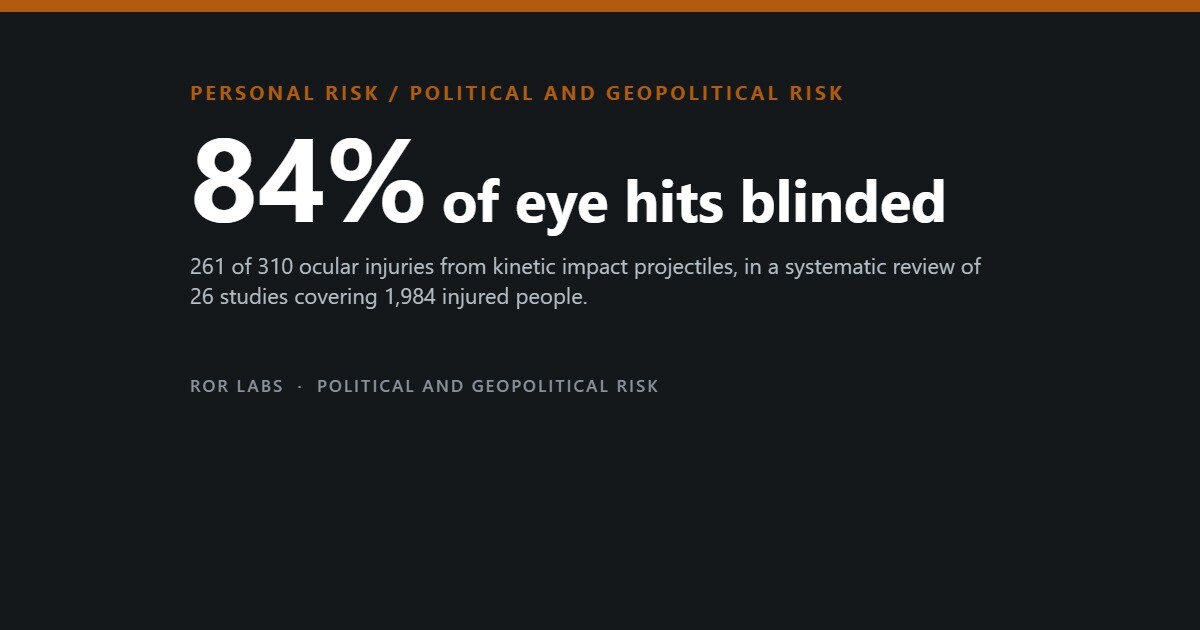
- 261 of 310 eye injuries — 84.2% — ended in permanent blindness. Of 738 limb injuries, 7 caused permanent disability.
- Head and neck strikes accounted for 49.1% of deaths and 82.6% of permanent disabilities.
- The companion review of tear gas and pepper spray found the opposite profile: 74.2% of 9,261 injuries were minor and 98.7% of people recovered fully.
A systematic review published in BMJ Open collected every documented case it could find of a person struck by a rubber bullet, plastic bullet, bean bag round or shot pellet fired for crowd control between 1990 and 2017. It found 1,984 people. Of those, 53 died and 300 were left permanently disabled.
Inside that total sits a number that decides most of the argument. There were 310 recorded injuries to the eye. Of those, 261 — 84.2 per cent — ended in permanent blindness. Of 738 injuries to arms and legs, seven left a permanent disability. Where the projectile lands is not a detail. It is very nearly the whole outcome.
What the same review cannot tell you is your odds of being hit. Nobody counts the rounds fired, and nobody counts the people they are fired at. This article is about what the evidence does support, what it does not, and why two weapons routinely described with the same phrase — “less lethal” — turn out to have almost nothing in common.
Two weapon families, filed under one word
The same research group published two systematic reviews in 2017, using the same methods, a few weeks apart. One covered kinetic impact projectiles: anything solid fired at a person to make them stop. The other covered chemical irritants: CS gas and the various pepper sprays built around oleoresin capsicum, or OC.
Reading them side by side is the most useful thing anyone can do with this literature, because the two sets of findings are not remotely similar. Among the people hit by projectiles, 3 per cent died and 15 per cent were permanently disabled. Among the 5,131 people injured by chemical irritants, two died and 98.7 per cent recovered fully.
Both weapons get called less lethal. Only one of them has a body count that survives contact with the data.
What happened to people struck by kinetic impact projectiles
1,984 people in 26 studies, 1990 to 2017. Rubber and plastic bullets, bean bag rounds and shot pellets.
Source: Haar, R.J. et al., “Death, injury and disability from kinetic impact projectiles in crowd-control settings: a systematic review”, BMJ Open 7:e018154, 2017.
Where it lands is the whole outcome
A kinetic impact projectile is designed around one assumption: that it will strike the large muscles of the lower body from a distance, transfer enough energy to hurt, and not enough to penetrate. Every safety claim made for these weapons depends on that assumption holding.
In the reviewed cases it frequently did not. Head and neck strikes accounted for 49.1 per cent of the deaths and 82.6 per cent of the permanent disabilities. Chest and abdominal trauma accounted for another 27 per cent of deaths. Exactly one death came from a limb injury, and it was indirect: a severe knee wound that threw an air embolism to the lung.
The eye is the specific vulnerability. A projectile that a thigh absorbs without lasting harm destroys an eye, and the review found that most eye strikes did. Anna Fierz, reviewing rubber scattershot in Switzerland, makes the mechanical point plainly: the energy limits set for these weapons were chosen to sit below the threshold for penetrating the eyeball, but a closed globe injury — the eye not perforated, only struck — is quite sufficient to destroy vision permanently.
The same weapon, two body regions
Share of recorded injuries that resulted in permanent disability, by site of impact.
Source: Haar et al., BMJ Open, 2017. Percentages calculated from the counts reported in the review.
Protocols exist. They tell officers to fire from a stated minimum distance and to aim at the soft muscle of the lower limbs. The review found eight studies in which the firing distance was demonstrably shorter than the manufacturer specified, and it notes something more awkward: those safe distances are not well validated in the first place, and they differ by weapon, by country and by manufacturer.
There is a second problem with distance, and it runs the other way. These projectiles are inaccurate at range. Several of the reviewed studies record bystanders and non-participants hit instead of the person aimed at. Close enough to aim reliably is close enough to kill; far enough to be safe is far enough to hit somebody else.
The chemicals are a different weapon
The chemical irritant review looked at 31 studies from 11 countries and found 5,910 people who were exposed and sought medical attention, 5,131 of whom were injured. There were 9,261 separate injuries among them. Three quarters were minor.
Two people died. One was a man in Bahrain who went into respiratory arrest after a CS canister was fired inside his home. The other was in Nepal, and the cause was blunt trauma from the canister rather than the chemical inside it. No death in the review was attributed to pepper spray.
Severity of 9,261 injuries from tear gas and pepper spray
31 studies, 11 countries, 1990 to 2015.
Source: Haar, R.J. et al., “Health impacts of chemical irritants used for crowd control”, BMC Public Health 17:831, 2017.
“Chemical irritant” is itself too broad a category to be useful. Of 7,156 injuries attributed to OC, 6 per cent were severe. Of 1,148 attributed to CS, 27.9 per cent were. That is a fourfold difference between two things people talk about interchangeably, and it is the single most actionable finding in either review.
Delivery matters too, in the same direction. Injuries from spray forms were severe 7.2 per cent of the time; from aerosolised forms, 11.6 per cent. The authors decline to make a formal comparison of agents or delivery mechanisms, on the grounds that the confounding is too heavy, and they are right to. But the gap is large and it points the same way each time it is measured.
Share of injuries classed as severe, by agent
The two chemicals are not interchangeable, though the coverage of them usually is.
Source: Haar et al., BMC Public Health, 2017.
The canister is not the gas
Buried in the chemical review is a set of injuries that belong to the other paper. Tear gas is often delivered by firing a metal canister, and a canister is a kinetic impact projectile with a chemical payload. The review counted 231 injuries caused by the munition itself rather than by the chemical. Sixty-three of them — 27 per cent — were severe.
Among those 231 were 73 traumatic injuries to the head and neck, at least four people who lost the sight of an eye, three amputations, and ten people left with severe functional loss of a limb from neurovascular damage. That severity profile is not the profile of the gas. It is the profile of the projectile.
This matters for how the weapon is described. A crowd-control agent that causes mostly minor, fully recoverable injury is being delivered by a mechanism whose injuries look like rubber bullet injuries, and the two get reported under one heading.
The other exception to the mild picture is the enclosed space. The review flags detention centres and interiors specifically: where people cannot leave, the dose is not self-limiting. Both documented deaths involved that geometry — one in a home, and in a separate study a detention centre where the authors attributed an excess of injuries to a crowded setting with no way out.
Injuries from the delivery munition, inside the chemical irritant review
231 injuries caused by the projectile rather than the chemical.
Source: Haar et al., BMC Public Health, 2017. Counts as reported; the severity share is of the 231 munition injuries.
What no one can tell you
Every number so far is conditional. Given that a person was hit, and given that the case was documented and published, this is what happened. That is not the same as a risk, and both reviews say so in plain terms.
The chemical review states that it has “largely underestimated” the true prevalence, that population estimates could not be calculated, and that the included studies did not contain enough information to estimate the risk of injury to an exposed person. The projectile review concludes that its findings “do not allow for a precise estimate of the prevalence” of specific injuries or deaths.
The reason is structural. To compute a rate you need a denominator: rounds fired, or people exposed. No jurisdiction publishes either as a matter of routine. What exists instead is a pile of hospital case series, which record the people who were hurt badly enough to seek care and reached a facility that later published.
There is exactly one place in this literature where a denominator appears, and it is fifty years old. In Northern Ireland between 1970 and 1975, more than 55,000 rubber bullets were fired, with an estimated one death per 18,000 rounds and one serious injury per 1,100. Those figures are an estimate from one conflict, one weapon and one police force, and they should not be carried across to anywhere else. They are quoted here because they are the only thing of their kind.
Three questions this literature cannot answer
Sources: Haar et al., BMJ Open, 2017; Haar et al., BMC Public Health, 2017, limitations sections.
What the authors themselves flag
Both reviews were written by clinicians associated with human rights organisations, and both reach a critical conclusion. That is a reason to read their limitations sections carefully rather than a reason to discount them, and those sections are unusually candid.
They name three biases working in their own favour. Publication bias: dramatic injuries get written up, ordinary ones do not. Selection bias: particular groups present at particular hospitals. Spectrum bias: documentation and treatment vary by clinical setting. Most of the included work was retrospective, quality varied enough that meta-analysis was not attempted, and the projectile review reports its findings as counts rather than as pooled estimates for exactly that reason.
The chemical review goes further and describes a decision that cuts against its own thesis. The authors excluded published case reports — the single richest source of severe injury descriptions — specifically to avoid biasing the results toward the most dramatic outcomes. They also excluded a large volume of injuries reported by news media and by advocacy organisations, including some with photographic evidence, because causation could not be established to their standard.
The strongest argument on the other side is one neither review is designed to test. These weapons are not deployed instead of nothing; they are deployed instead of a firearm, or instead of a baton, or instead of a physical arrest. A fair evaluation would compare outcomes against those alternatives, and no such comparison exists. The projectile review is explicit that its criticism of one weapon “does not in any way suggest that other weapons are safer”.
Where the authors do push back on that argument, they push on the geometry rather than the ethics. Arresting an individual happens at close range, which is precisely the distance at which projectiles are not recommended and at which the deaths in this review occurred. Dispersing a crowd requires people to be able to leave, and a weapon that causes pain and incapacitation is a strange tool for making a crowd move faster. And most published crowd-management guidance, they note, does not require the use of force at all.

Questions people ask
Is tear gas dangerous or not?
Mostly not, on this evidence, and the exceptions are specific. Of 9,261 injuries, 74.2 per cent were minor and 98.7 per cent of injured people recovered fully. The exceptions are enclosed spaces where a person cannot get away, CS rather than pepper spray, and being struck by the canister. Both deaths in the review involved one of those three.
Are rubber bullets safer than real ones?
Yes, and that is not the useful question. Three per cent of the people in the review died, which is far below what a firearm would produce and far above what “less lethal” suggests to most readers. The review’s own framing is that these weapons are unsuitable for crowd dispersal specifically, because of their inaccuracy at the distances where they would be safe.
What actually protects the eyes?
The literature does not say, and we are not going to guess. The reviews record what happens after impact; none of them tests protective equipment, and no trial of eye protection against kinetic impact projectiles exists. What the mechanical review does establish is that the energy thresholds these weapons were cleared against were set for penetrating injury, and that a non-penetrating strike is enough to end vision.
Why do the injury counts seem low compared with news coverage?
Because the reviews deliberately excluded most of what is in the news coverage. Media reports, advocacy documentation and case reports were all left out, on grounds of causation and of bias. The authors say directly that they have probably understated the totals.
Has any of this changed the rules?
Some. Both papers were written into the argument for the United Nations guidance on less-lethal weapons in law enforcement that followed, and New York and several European jurisdictions have restricted particular munitions since. Whether restriction has changed injury rates is unknown, for the same reason everything else here is unknown: nobody is counting.
The short version
- Of 1,984 people struck by kinetic impact projectiles in a systematic review of 26 studies, 53 died and 300 were permanently disabled.
- 261 of 310 eye injuries — 84.2% — ended in permanent blindness. Of 738 limb injuries, 7 caused permanent disability.
- Head and neck strikes accounted for 49.1% of deaths and 82.6% of permanent disabilities.
- The companion review of tear gas and pepper spray found the opposite profile: 74.2% of 9,261 injuries were minor and 98.7% of people recovered fully.
- CS produced severe injury in 27.9% of cases against 6% for OC pepper spray — the two are not interchangeable.
- 231 injuries in the chemical review came from the canister rather than the gas, and 27% of those were severe.
- Neither review can give a rate. There is no denominator: rounds fired and people exposed are not recorded anywhere.
- The only rounds-fired figures in the literature are a 1970s Northern Ireland estimate of one death per 18,000 rubber bullets and one serious injury per 1,100.
This article summarises published medical research on injuries caused by crowd-control weapons. It is not medical or legal advice, and it describes what happened to people in documented cases rather than any individual’s risk. Where the evidence cannot support a rate, that is said plainly rather than estimated.
Further reading: both 2017 systematic reviews are open access and short, and reading them as a pair is worth more than reading either alone. The 2024 Swiss review by Fierz is the clearest published account of why the energy thresholds these weapons were cleared against do not protect an eye.
- Calling Bullshit, Carl Bergstrom & Jevin West (2020). A field guide to statistical nonsense, still inside the window.
- Doom, Niall Ferguson (2021). On why institutions fail to prevent or respond well to disasters — crowd and crisis events included.
- The Scout Mindset, Julia Galef (2021). On reasoning to see clearly rather than to defend a position.
Sources
- Haar, R.J., Iacopino, V., Ranadive, N., Dandu, M. and Weiser, S.D., “Death, injury and disability from kinetic impact projectiles in crowd-control settings: a systematic review”, BMJ Open 7:e018154, 2017. (26 of 3,228 articles included; 1,984 injured, 53 deaths, 300 permanent disabilities. 2,135 injuries among survivors, 71% severe. Head and neck 49.1% of deaths, 82.6% of permanent disabilities; chest and abdomen 27% of deaths. 261 of 310 ocular injuries caused permanent blindness; 7 of 738 extremity injuries caused permanent disability; 87% of limb musculoskeletal injuries severe; 76.5% of skin injuries minor. Eight studies documented firing distances shorter than specified. Limitations: publication, selection and spectrum bias; retrospective designs; no meta-analysis; no prevalence estimate possible.)
- Haar, R.J., Iacopino, V., Ranadive, N., Weiser, S.D. and Dandu, M., “Health impacts of chemical irritants used for crowd control: a systematic review of the injuries and deaths caused by tear gas and pepper spray”, BMC Public Health 17:831, 2017. (31 studies, 11 countries. 5,910 exposed and seeking care, 5,131 injured, 2 deaths, 58 permanent disabilities, 98.7% full recovery. 9,261 injuries: 74.2% mild, 17% moderate, 8.7% severe. OC 6% of 7,156 injuries severe; CS 27.9% of 1,148. Spray 7.2% severe, aerosolised 11.6%. Munition injuries 231, of which 63 severe, 73 head and neck, 4 losing vision, 3 amputations. Limitations: prevalence largely underestimated; case and media reports excluded; no population estimates possible.)
- Fierz, A., “Risks and regulation of rubber scattershot in Switzerland: a narrative review”, Eye, 2024. (36 known eye injuries from rubber pellets in Switzerland since 1980, with a 2023 incidence exceeding that recorded at the peak of the French protests. Argues that kinetic impact projectiles were cleared at energies assumed to sit below the threshold for ocular penetration, but that closed globe injury alone is sufficient to cause permanent visual loss, and that thresholds for lasting damage from the paintball, airbag and air gun literature are lower than those used.)
- Carenzo, L., Leuci, L., Dünser, M., Granholm, F., Rehn, M. and Hüser, C., “Emergency department medical care during civil unrest: a narrative review”, Scandinavian Journal of Trauma, Resuscitation and Emergency Medicine, 2026. (Mechanisms and emergency management for conducted energy devices, chemical irritants, projectiles, acoustic devices and water cannons. Conducted energy devices injure chiefly through falls; cardiac risk is low and routine monitoring is not supported for alert, asymptomatic patients.)
- Metress, E.K. and Metress, S.P., “The anatomy of plastic bullet damage and crowd control”, International Journal of Health Services, 1987. (Thirteen deaths from plastic bullets in Northern Ireland, seven of them children. Reports that most of those killed were struck from distances well short of the stated safe range and in ways inconsistent with the rules of engagement, and that the plastic bullet caused more skull and brain injury than the rubber bullet it replaced.)
- Holt, L., “Dangers of rubber bullet use in crowd control”, Emergency Nurse, 2002. (Reports that more than 55,000 rubber bullets were fired in Northern Ireland between 1970 and 1975, with an estimated death rate of one per 18,000 rounds and a serious injury rate of one per 1,100 rounds. These are the only rounds-fired denominators located in this literature and are specific to one conflict and one weapon.)
- Bui, A.L., Sleeth, G.A., McDade, J.E., Duber, H.C. and Rivara, F.P., “Protest-related injuries during the Capitol Hill Autonomous Zone protest in Seattle”, Injury Prevention, 2025. (Of 1,938 emergency department visits screened across two hospitals over five weeks, 48 were protest-related: 25 assaults, 11 from crowd-control weapons and 8 ground-level falls. The crowd-control weapon visits were five pepper spray, five tear gas, and smaller numbers from flash-bang grenades, projectiles or a baton.)